
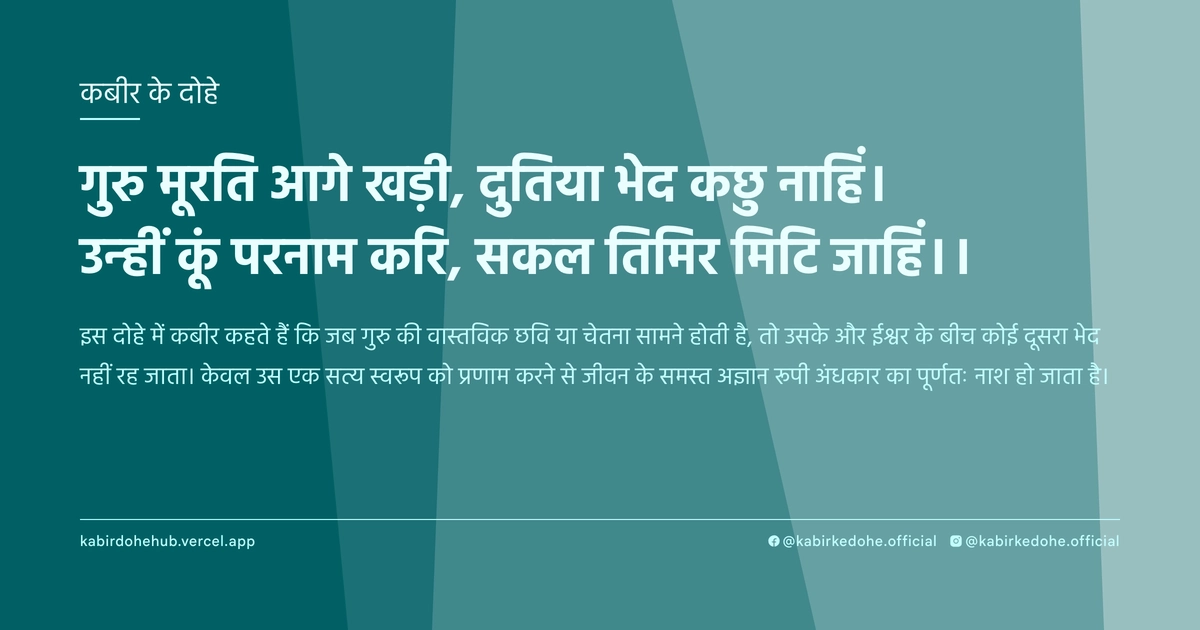
गुरु मूरति आगे खड़ी, दुतिया भेद कछु नाहिं।
उन्हीं कूं परनाम करि, सकल तिमिर मिटि जाहिं।।
Guru moorati aage khadi, dutiya bhed kachu naahin. Unheen kun parnaam kari, sakal timir miti jaahin.
इस पृष्ठ पर इस कबीर दोहे का अर्थ (meaning), हिंदी व्याख्या और अंग्रेज़ी अनुवाद, दार्शनिक विश्लेषण और व्यावहारिक जीवन सीख दी गई है। यह दोहा गुरु महत्व (The Guru's Importance) विषय से जुड़ा है — Kabir doha meaning and explanation in Hindi and English.
अर्थ (Meaning):
इस दोहे में कबीर कहते हैं कि जब गुरु की वास्तविक छवि या चेतना सामने होती है, तो उसके और ईश्वर के बीच कोई दूसरा भेद नहीं रह जाता। केवल उस एक सत्य स्वरूप को प्रणाम करने से जीवन के समस्त अज्ञान रूपी अंधकार का पूर्णतः नाश हो जाता है।
Kabir asserts that when the true form of the Guru stands before the seeker, no duality or distinction remains between the Guru and the Divine. By bowing to this singular essence, all the darkness of ignorance and illusion is utterly extinguished from the soul.
व्याख्या (Interpretation):
शाब्दिक अर्थ यह है कि गुरु के सामने झुकने से अंधकार मिटता है, परंतु गहरा अर्थ 'अद्वैत' में है। यहाँ 'मूरति' केवल भौतिक शरीर नहीं, बल्कि वह दिव्य प्रकाश है जो शिष्य के भीतर जागृत होता है। 'दुतिया भेद' का अर्थ है द्वैत का अंत—जहाँ गुरु, शिष्य और परमात्मा एक हो जाते हैं। यह निर्गुण भक्ति का सार है, जहाँ बाहरी कर्मकांडों के बजाय आंतरिक बोध को प्राथमिकता दी गई है। जब अहंकार मिटता है, तब केवल वह एक ही तत्व शेष रहता है। यह विरोधाभास है कि समर्पण के माध्यम से ही पूर्ण स्वतंत्रता प्राप्त होती है। अंततः, यह दोहा बताता है कि ज्ञान का स्रोत बाहर नहीं, बल्कि उस चेतना में है जिसे गुरु प्रतिबिंबित करता है।
Literally, the verse suggests that bowing to the Guru removes darkness, but the metaphysical layer speaks of 'Advaita' or non-duality. The 'Murti' (image) is not the physical body but the divine consciousness reflecting within the seeker. 'Dutiya bhed' refers to the collapse of duality, where the distinction between the teacher, the taught, and the Ultimate Truth vanishes. This is the essence of Nirgun Bhakti, prioritizing internal realization over external ritualism. As the ego dissolves, only the singular, formless reality remains. It presents the paradox that absolute liberation is achieved only through total surrender. Ultimately, the Doha reveals that the source of knowledge is not an external entity but the consciousness the Guru mirrors.
दार्शनिक विश्लेषण (Philosophical Analysis):
कबीर का यह दृष्टिकोण उनके युग के कट्टरपंथी धार्मिक ढांचों के विरुद्ध एक विद्रोह था। उन्होंने उस समय के पंडितों और मुल्लाओं को चुनौती दी जो ईश्वर को मंदिरों और मस्जिदों में खोजते थे। कबीर के लिए, गुरु वह सेतु है जो जीव को माया के जाल से निकालकर ब्रह्म से मिलाता है। यह विचार सूफी मत के 'पीर' और वेदांत के 'गुरु' के सिद्धांतों का संगम है, जहाँ गुरु केवल एक मार्गदर्शक नहीं, बल्कि सत्य का साक्षात प्रमाण है।
यहाँ 'तिमिर' (अंधकार) केवल ज्ञान की कमी नहीं, बल्कि वह 'अविद्या' है जो हमें यह विश्वास दिलाती है कि हम शरीर हैं। कबीर इस भ्रम को तोड़ने की बात करते हैं। जब शिष्य गुरु के वास्तविक स्वरूप (जो कि शुद्ध चेतना है) को पहचान लेता है, तो वह समझ जाता है कि वह स्वयं भी उसी अनंत का हिस्सा है। यह मनोवैज्ञानिक रूपांतरण है जहाँ 'मैं' का विलोपन होता है।
अद्वैत वेदांत के अनुसार, आत्मा और ब्रह्म एक ही हैं। कबीर इसी सत्य को सरल भाषा में समझाते हैं कि जब भेद मिट जाता है, तो केवल एक ही सत्ता बचती है। यह ritualism (कर्मकांड) का पूर्ण तिरस्कार है; यहाँ माथे पर तिलक लगाने या माला जपने से अधिक महत्व 'बोध' को दिया गया है।
सूफीवाद के 'फना' (अहंकार का विनाश) की अवधारणा यहाँ स्पष्ट है। जब साधक गुरु की उपस्थिति में स्वयं को खो देता है, तभी वह वास्तव में स्वयं को पाता है। यह प्रक्रिया बाहरी नहीं, बल्कि आंतरिक है।
अतः, यह दोहा केवल गुरु की महिमा नहीं गाता, बल्कि उस अवस्था का वर्णन करता है जहाँ ज्ञाता, ज्ञान और ज्ञेय का त्रिकोण समाप्त हो जाता है और केवल एक अखंड प्रकाश शेष रहता है।
Kabir's perspective represents a profound rebellion against the rigid religious structures of his era. He challenged the clergy who sought the Divine within the confines of temples and mosques. For Kabir, the Guru is the bridge that transports the soul from the web of Maya (illusion) to the realization of Brahman. This thought merges the Sufi concept of the 'Pir' with the Vedantic 'Guru', where the teacher is not merely a guide but a living embodiment of Truth.
In this context, 'Timir' (darkness) is not just a lack of information, but 'Avidya'—the primordial ignorance that convinces us we are limited physical bodies. Kabir advocates for the shattering of this delusion. When the disciple recognizes the Guru's true form (pure consciousness), they realize that they themselves are an extension of that same infinite reality. This is a psychological transmutation where the 'I' is annihilated.
According to Advaita Vedanta, Atman and Brahman are one. Kabir simplifies this complex truth by stating that once the distinction vanishes, only one existence remains. This is a total rejection of ritualism; the act of applying tilak or chanting beads is secondary to the 'Bodha' or awakening.
The Sufi concept of 'Fana' (the annihilation of the self) is evident here. When the seeker loses themselves in the presence of the Guru, they paradoxically find their true self. This process is internal, not external.
Therefore, this Doha does not merely praise a teacher; it describes the state where the triad of the knower, the known, and the knowledge collapses, leaving only an unbroken, singular light.
मूल संदेश (Core Message):
- बाहरी गुरु केवल एक द्वार है, वास्तविक गंतव्य आंतरिक बोध है।
- अहंकार का विसर्जन ही सत्य के साक्षात्कार की एकमात्र शर्त है।
- जब द्वैत समाप्त होता है, तब केवल अखंड प्रकाश शेष रहता है।
- श्रद्धा केवल व्यक्ति में नहीं, बल्कि उस तत्व में हो जो व्यक्ति के पार है।
- अज्ञान का अंधकार केवल आत्म-साक्षात्कार के सूर्य से मिट सकता है।
- The external Guru is but a gateway; the true destination is internal awakening.
- The dissolution of ego is the sole prerequisite for realizing the Truth.
- When duality ceases, only the unbroken light of consciousness remains.
- Faith should not lie in the person, but in the Essence that transcends the person.
- The darkness of ignorance can only be dispelled by the sun of self-realization.
व्यावहारिक उदाहरण (Practical Example):
वाराणसी के घाटों पर रहने वाले एक वृद्ध बुनकर, माधव, का जीवन केवल धागों के जाल में उलझा था। वह अपनी कला में निपुण था, लेकिन उसके मन में हमेशा यह शिकायत रहती थी कि उसका जीवन व्यर्थ है और वह ईश्वर से बहुत दूर है। वह घंटों मंदिर के बाहर खड़ा रहता, इस उम्मीद में कि कोई चमत्कार उसे मोक्ष दिलाएगा।
एक दिन उसकी मुलाकात एक फकीर से हुई, जो बिना किसी बाहरी आडंबर के शांत बैठा था। माधव ने उनसे पूछा, 'मैं ईश्वर को कैसे पाऊं? मैं कौन से कठिन व्रत करूँ?' फकीर ने मुस्कुराकर माधव की ओर देखा और कहा, 'तुम जिस धागे को बुन रहे हो, उसी में वह छिपा है। बस अपनी नजर बदलो।'
माधव पहले तो उलझन में पड़ा, लेकिन उसने फकीर की आँखों में एक ऐसी शांति देखी जो उसने कभी किसी मंदिर की मूर्ति में नहीं देखी थी। उसे महसूस हुआ कि वह फकीर कोई साधारण मनुष्य नहीं, बल्कि एक दर्पण है जिसमें उसे अपनी ही आत्मा की झलक दिख रही है।
उस क्षण माधव का अहंकार, कि वह एक 'पापी' या 'अधूरा' व्यक्ति है, टूट गया। उसने महसूस किया कि फकीर और वह स्वयं अलग नहीं हैं; दोनों एक ही चेतना के दो रूप हैं। उसने फकीर के चरणों में सिर झुकाया, लेकिन यह समर्पण किसी व्यक्ति के प्रति नहीं, बल्कि उस सत्य के प्रति था जो फकीर के माध्यम से प्रकट हुआ था।
अचानक, माधव के लिए बुनना केवल जीविका नहीं, बल्कि एक साधना बन गया। वह अब धागों में केवल कपड़ा नहीं, बल्कि ईश्वर की निरंतरता देखने लगा। उसके मन का वह अंधकार, जो उसे अलग-थलग महसूस कराता था, पूरी तरह मिट गया।
उसने पाया कि जब उसने फकीर को 'गुरु' के रूप में स्वीकार किया, तो उसने वास्तव में अपने भीतर के अंधकार को विदा किया। अब वह मंदिर के बाहर खड़ा होकर भी भीतर से पूर्ण था।
उसकी कला में अब एक नई चमक थी, क्योंकि वह अब अहंकार से नहीं, बल्कि प्रेम से बुन रहा था। उसके जीवन का संघर्ष समाप्त हो गया क्योंकि उसने 'भेद' को मिटा दिया था।
माधव की कहानी यह सिखाती है कि गुरु वह नहीं जो आपको कहीं ले जाए, बल्कि वह है जो आपको यह दिखाए कि आप पहले से ही वहीं हैं जहाँ आपको होना चाहिए।
Madhav, an elderly weaver living on the ghats of Varanasi, spent his life entangled in the web of threads. While masterful in his craft, he lived with a constant grievance that his life was futile and he was far removed from God. He would stand for hours outside temples, hoping for a miracle to grant him salvation.
One day, he encountered a Fakir who sat in profound silence, devoid of any external religious ornamentation. Madhav asked him, 'How may I find God? Which rigorous fasts must I observe?' The Fakir smiled and said, 'He is hidden in the very thread you are weaving. Simply change your gaze.'
Madhav was initially confused, but he noticed a stillness in the Fakir's eyes that he had never seen in any temple idol. He felt that this Fakir was not a mere human, but a mirror reflecting his own soul's essence.
In that moment, Madhav's ego—the belief that he was a 'sinner' or 'incomplete'—shattered. He realized that the Fakir and he were not separate; they were two forms of the same consciousness. He bowed at the Fakir's feet, but this surrender was not to a person, but to the Truth manifesting through the person.
Suddenly, weaving ceased to be a mere livelihood and became a spiritual practice. He began to see not just fabric in the threads, but the continuity of the Divine. The darkness of isolation that had haunted him vanished completely.
He discovered that by accepting the Fakir as the 'Guru', he had actually evicted the darkness from within himself. Now, even while standing outside the temple, he felt internally complete.
His art acquired a new radiance, for he no longer wove from ego, but from love. The struggle of his life ended because he had erased the 'distinction'.
Madhav's story teaches that the Guru is not one who takes you somewhere, but one who shows you that you are already where you need to be.
अभ्यास मार्गदर्शन (Practice Guidance):
- प्रतिदिन 20 मिनट मौन साधना करें, जहाँ आप किसी बाहरी आकृति के बजाय अपने भीतर के 'साक्षी' (Witness) को गुरु मानकर ध्यान लगाएं।
- एक डायरी लिखें जिसमें आप उन क्षणों को दर्ज करें जब आपका अहंकार (Ego) आपको दूसरों से अलग महसूस कराता है, और फिर विचार करें कि वह 'भेद' वास्तव में कहाँ है।
- व्यवहार परिवर्तन: दिन में कम से कम एक बार किसी ऐसे व्यक्ति में 'दिव्यता' देखने का प्रयास करें जिसे आप नापसंद करते हैं, यह मानकर कि वह भी उसी एक चेतना का हिस्सा है।
- नैदानिक चेकलिस्ट: क्या मैं अभी भी सत्य को बाहरी अनुष्ठानों में खोज रहा हूँ? क्या मैं गुरु को केवल एक शरीर मान रहा हूँ या एक ऊर्जा? क्या मेरे भीतर का द्वैत (मैं बनाम अन्य) कम हो रहा है?
- Practice 20 minutes of daily silent meditation, treating the 'Witness' within you as the Guru rather than focusing on any external form.
- Maintain a journal to record moments when your ego makes you feel separate from others, then analyze where that 'distinction' actually resides.
- Behavioral Shift: At least once a day, attempt to see the 'divinity' in someone you dislike, acknowledging that they are a manifestation of the same universal consciousness.
- Diagnostic Checklist: Am I still seeking truth in external rituals? Do I perceive the Guru as a mere physical body or as a spiritual energy? Is the duality of 'I vs. Other' diminishing in my daily interactions?
चिंतन प्रश्न (Reflection Questions):
- क्या मेरा 'गुरु' के प्रति सम्मान वास्तव में उनके ज्ञान के लिए है, या मैं केवल एक मानसिक सहारे की तलाश में हूँ?
- मेरे जीवन में वह कौन सा 'भेद' है जिसे मैं सबसे अधिक पकड़ कर बैठा हूँ—जाति, धर्म, या सामाजिक स्तर?
- यदि मेरा बाहरी व्यक्तित्व (डिजिटल या सामाजिक पहचान) पूरी तरह मिट जाए, तो मेरे भीतर क्या शेष बचेगा?
- मैं अपनी कमियों को सुधारने की कोशिश करता हूँ या मैं यह समझने की कोशिश करता हूँ कि ये कमियाँ केवल माया का भ्रम हैं?
- क्या मैं सत्य को सुनने के लिए तैयार हूँ, या मैं केवल वही सुनना चाहता हूँ जो मेरे मौजूदा विश्वासों की पुष्टि करे?
- Is my reverence for the 'Guru' truly for their wisdom, or am I merely seeking a psychological crutch?
- What is the primary 'distinction' I cling to in my life—caste, religion, or social status?
- If my external persona (digital or social identity) were completely erased, what would remain within me?
- Do I strive to 'fix' my flaws, or do I seek to understand that these flaws are merely illusions of Maya?
- Am I truly open to the Truth, or do I only seek that which confirms my existing biases?