
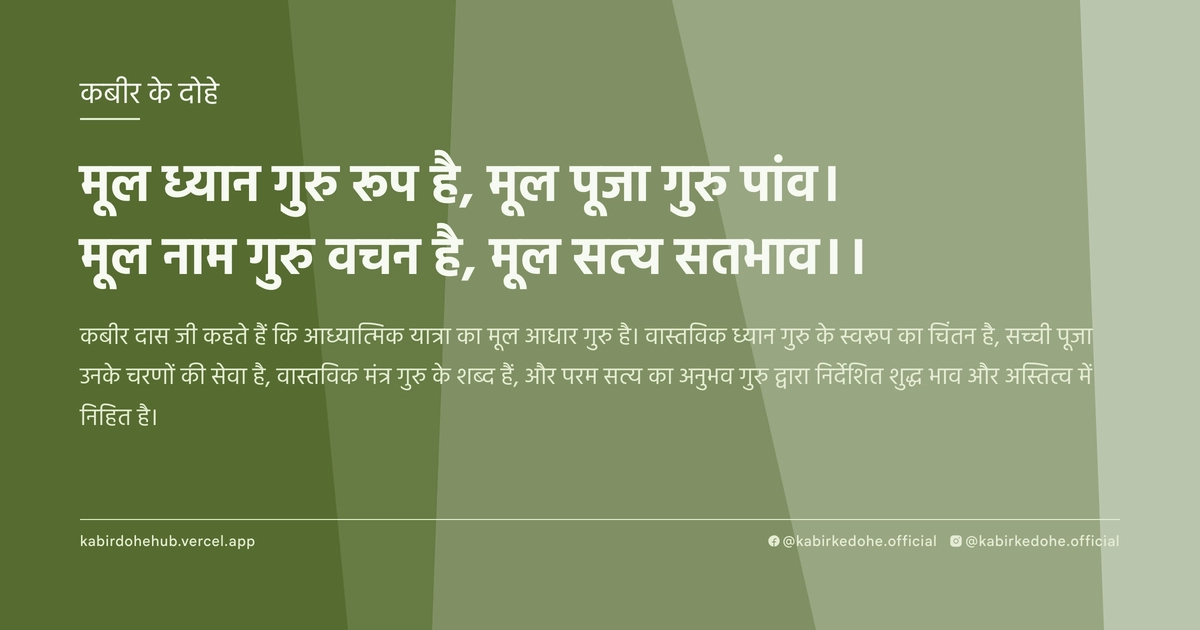
मूल ध्यान गुरु रूप है, मूल पूजा गुरु पांव।
मूल नाम गुरु वचन है, मूल सत्य सतभाव।।
Mool dhyan guru roop hai, mool pooja guru paon. Mool naam guru vachan hai, mool satya satbhav.
इस पृष्ठ पर इस कबीर दोहे का अर्थ (meaning), हिंदी व्याख्या और अंग्रेज़ी अनुवाद, दार्शनिक विश्लेषण और व्यावहारिक जीवन सीख दी गई है। यह दोहा गुरु महत्व (The Guru's Importance) विषय से जुड़ा है — Kabir doha meaning and explanation in Hindi and English.
अर्थ (Meaning):
कबीर दास जी कहते हैं कि आध्यात्मिक यात्रा का मूल आधार गुरु है। वास्तविक ध्यान गुरु के स्वरूप का चिंतन है, सच्ची पूजा उनके चरणों की सेवा है, वास्तविक मंत्र गुरु के शब्द हैं, और परम सत्य का अनुभव गुरु द्वारा निर्देशित शुद्ध भाव और अस्तित्व में निहित है।
Kabir asserts that the foundation of the spiritual journey is the Guru. True meditation is the contemplation of the Guru's essence, genuine worship is the service of the Guru's feet, the ultimate mantra resides in the Guru's words, and the absolute truth is found in the state of pure being as guided by the teacher.
व्याख्या (Interpretation):
यह दोहा गुरु को केवल एक व्यक्ति नहीं, बल्कि एक आध्यात्मिक द्वार के रूप में प्रस्तुत करता है। 'मूल ध्यान गुरु रूप है' का अर्थ है कि गुरु का बाहरी रूप वास्तव में उस निराकार ब्रह्म का प्रतिबिंब है। जब साधक गुरु के चरणों की पूजा करता है, तो वह वास्तव में अपने अहंकार का विसर्जन कर रहा होता है। 'मूल नाम' यहाँ किसी विशिष्ट शब्द का नहीं, बल्कि उस ज्ञान का संकेत है जो अज्ञान के पर्दे को हटाता है। यह निर्गुण भक्ति का सार है जहाँ गुरु एक माध्यम है जो आत्मा को परमात्मा (अद्वैत) से जोड़ता है। अंततः, 'सतभाव' वह स्थिति है जहाँ साधक और सत्य के बीच का द्वैत समाप्त हो जाता है। यह यात्रा बाहरी कर्मकांडों से आंतरिक रूपांतरण की ओर ले जाती है।
This couplet presents the Guru not merely as a person, but as a spiritual portal. 'Mool dhyan guru roop hai' implies that the Guru's form is a reflection of the formless Brahman. When the seeker worships the Guru's feet, they are effectively dissolving their own ego. The 'Mool Naam' (root name) refers not to a specific word, but to the wisdom that lifts the veil of ignorance. This is the essence of Nirgun Bhakti, where the Guru acts as the catalyst connecting the Atman to the Brahman (non-duality). Ultimately, 'Satbhav' is the state where the duality between the seeker and the Truth vanishes. The journey transitions from external ritualism to internal transmutation.
दार्शनिक विश्लेषण (Philosophical Analysis):
कबीर का यह दृष्टिकोण उस समय के कट्टरपंथी धार्मिक ढांचे के विरुद्ध एक सशक्त प्रहार था। उन्होंने मंदिर, मस्जिद और मूर्ति पूजा के स्थान पर 'जीवंत गुरु' और 'आंतरिक अनुभव' को प्राथमिकता दी। यह दर्शन अद्वैत वेदांत से मेल खाता है, जहाँ यह माना जाता है कि आत्मा और परमात्मा एक ही हैं, लेकिन माया के कारण हम अलग महसूस करते हैं। गुरु यहाँ उस दर्पण की तरह है जो साधक को उसका अपना वास्तविक स्वरूप दिखाता है।
सूफीवाद के 'मुर्शिद' (मार्गदर्शक) की अवधारणा के समान, कबीर गुरु को वह सेतु मानते हैं जो शून्य (Void) और अस्तित्व के बीच की दूरी को पाटता है। उनके लिए गुरु की पूजा चरणों से शुरू होती है, जो पूर्ण समर्पण का प्रतीक है, लेकिन इसका लक्ष्य गुरु के 'वचनों' यानी ज्ञान को आत्मसात करना है।
यहाँ 'मूल नाम' का अर्थ है वह आदि-ध्वनि या सत्य जो शब्दों से परे है। कबीर यह स्पष्ट करते हैं कि बिना गुरु के मार्गदर्शन के, साधक माया के जाल में उलझकर रह जाएगा। वे ritualism (कर्मकांड) को केवल एक बाहरी आवरण मानते हैं, जबकि वास्तविक पूजा मन की शुद्धि है।
मनोवैज्ञानिक स्तर पर, गुरु के प्रति समर्पण वास्तव में 'अहंकार' (Ego) की मृत्यु है। जब तक 'मैं' जीवित है, तब तक 'सत्य' का अनुभव असंभव है। गुरु का रूप केवल एक माध्यम है ताकि साधक धीरे-धीरे भौतिकता से सूक्ष्मता की ओर बढ़ सके।
अंततः, 'सतभाव' का अर्थ है वह शाश्वत स्थिति जहाँ कोई द्वंद्व नहीं रहता। यह केवल ज्ञान का संचय नहीं, बल्कि ज्ञान का जीवंत अनुभव है। कबीर हमें सिखाते हैं कि सत्य कहीं बाहर नहीं, बल्कि गुरु द्वारा जगाई गई आंतरिक चेतना में है।
Kabir's perspective was a powerful critique of the rigid religious structures of his era. He prioritized the 'living Guru' and 'internal experience' over temples, mosques, and idol worship. This philosophy aligns with Advaita Vedanta, which posits that the Atman and Brahman are one, though separated by the illusion of Maya. The Guru serves as the mirror reflecting the seeker's true nature.
Similar to the Sufi concept of the 'Murshid' (guide), Kabir views the Guru as the bridge spanning the gap between the Void and Existence. For him, worship begins at the feet—symbolizing total surrender—but the ultimate goal is to internalize the Guru's 'vachan' or wisdom.
'Mool Naam' here refers to the primordial sound or truth that transcends language. Kabir clarifies that without a guide, the seeker remains entangled in the web of Maya. He dismisses ritualism as a mere external shell, asserting that true worship is the purification of the mind.
Psychologically, surrender to the Guru represents the death of the Ego. As long as the 'I' persists, the experience of Truth remains impossible. The Guru's form is a pedagogical tool to move the seeker from the gross material plane to the subtle spiritual plane.
Ultimately, 'Satbhav' denotes the eternal state where all duality ceases. This is not the accumulation of knowledge, but the living embodiment of Truth. Kabir teaches that Truth is not external but resides in the inner consciousness awakened by the Guru.
मूल संदेश (Core Message):
- बाहरी पूजा केवल एक शुरुआत है, आंतरिक रूपांतरण ही लक्ष्य है।
- गुरु वह दर्पण है जो आपके भीतर के ईश्वर को दिखाता है।
- अहंकार का विसर्जन ही वास्तविक समर्पण और मोक्ष का मार्ग है।
- सत्य शब्दों में नहीं, बल्कि शुद्ध अस्तित्व और भाव में निहित है।
- जब शिष्य और गुरु एक हो जाते हैं, तब केवल सत्य शेष रहता है।
- External worship is merely a beginning; internal transformation is the goal.
- The Guru is the mirror reflecting the Divinity within you.
- The dissolution of ego is the only path to true surrender and liberation.
- Truth resides not in words, but in pure existence and consciousness.
- When the disciple and Guru merge, only the Truth remains.
व्यावहारिक उदाहरण (Practical Example):
वाराणसी के घाटों पर रहने वाला एक वृद्ध विधवा, जिसे समाज ने हाशिए पर धकेल दिया था, प्रतिदिन घंटों मंदिर की सीढ़ियों पर बैठकर मंत्र पढ़ती थी। वह मानती थी कि केवल कठिन तप और लंबी मालाओं से ही मोक्ष मिलेगा। उसका जीवन दुख और अकेलेपन से भरा था, और वह अपनी स्थिति को भाग्य का खेल मानकर स्वीकार कर चुकी थी।
एक दिन उसकी मुलाकात एक फकीर से हुई, जो किसी मंदिर का पुजारी नहीं था, बल्कि एक साधारण सा व्यक्ति था जिसकी आँखों में असीम शांति थी। उसने विधवा से पूछा, 'तुम इन पत्थरों को पुकार रही हो, लेकिन क्या तुमने कभी अपने भीतर की उस आवाज़ को सुना है जो तुम्हें बता रही है कि तुम पहले से ही पूर्ण हो?'
विधवा ने पहले तो उसे अनदेखा किया, लेकिन फकीर की बातों में एक अजीब सा खिंचाव था। उसने फकीर को अपना गुरु मान लिया। उसने बाहरी दिखावे और घंटों के रटने वाले मंत्रों को छोड़कर, फकीर के शब्दों पर ध्यान देना शुरू किया। फकीर ने उसे सिखाया कि सेवा केवल मंदिर में नहीं, बल्कि हर जीवित प्राणी के प्रति करुणा में है।
उसने देखा कि जब वह दूसरों की मदद करती है, तो उसका अपना दुख कम होने लगता है। उसने महसूस किया कि गुरु का 'रूप' केवल वह शरीर नहीं था, बल्कि वह करुणा थी जो फकीर ने उसे सिखाई थी। उसने अपने अहंकार को—कि वह एक 'दुखी विधवा' है—त्याग दिया।
धीरे-धीरे, उसकी पूजा केवल चरणों की सेवा तक सीमित नहीं रही, बल्कि वह फकीर के वचनों को अपने जीवन में उतारने लगी। उसने पाया कि शांति किसी तीर्थयात्रा में नहीं, बल्कि वर्तमान क्षण की जागरूकता में है।
एक दिन, जब वह घाट पर बैठी थी, उसे महसूस हुआ कि वह और वह फकीर, और वह बहती गंगा, सब एक ही चेतना के हिस्से हैं। यह उसका 'सतभाव' था।
उसका जीवन बदल गया। अब वह केवल मोक्ष की प्रतीक्षा नहीं कर रही थी, बल्कि वह स्वयं मोक्ष बन गई थी। उसने अपने घर के छोटे से आंगन को अन्य बेसहारा महिलाओं के लिए एक आश्रय स्थल बना दिया।
उसकी कहानी यह साबित करती है कि जब गुरु का मार्गदर्शन बाहरी कर्मकांडों से हटाकर आंतरिक सत्य की ओर ले जाता है, तब जीवन का वास्तविक रूपांतरण होता है।
An elderly widow living on the ghats of Varanasi, pushed to the margins of society, spent hours daily chanting mantras on temple steps. She believed that only rigorous penance and long prayer beads would grant her salvation. Her life was steeped in sorrow and loneliness, which she accepted as an inevitable act of fate.
One day, she encountered a Fakir—not a temple priest, but a simple man with infinite peace in his eyes. He asked her, 'You call out to these stones, but have you ever heard the voice within telling you that you are already complete?'
Initially, she ignored him, but there was an irresistible pull in the Fakir's words. She eventually accepted him as her Guru. She abandoned the external displays and the rote chanting of mantras, focusing instead on the Fakir's living words.
The Fakir taught her that service is not found in temples, but in compassion toward every living being. She noticed that as she helped others, her own sorrow began to diminish. She realized the Guru's 'form' was not just a physical body, but the compassion he embodied.
She surrendered her identity as a 'suffering widow'—the ego of her victimhood. Gradually, her worship evolved from mere service at the feet to the embodiment of the Guru's teachings in her daily life.
She discovered that peace was not found in a pilgrimage, but in the awareness of the present moment. One day, sitting by the river, she felt that she, the Fakir, and the flowing Ganges were all parts of a single consciousness. This was her 'Satbhav'.
Her life was transformed. She no longer waited for salvation; she became salvation. She turned her small courtyard into a sanctuary for other homeless women.
Her story proves that when a Guru's guidance shifts focus from external rituals to internal truth, a genuine transformation of life occurs.
अभ्यास मार्गदर्शन (Practice Guidance):
- प्रतिदिन 20 मिनट मौन बैठें और विचार करें कि आपके जीवन में 'गुरु' कौन है—चाहे वह कोई व्यक्ति हो, प्रकृति हो या आपकी अपनी अंतरात्मा।
- एक डायरी लिखें जिसमें आप उन क्षणों को दर्ज करें जब आपका अहंकार (Ego) आपको सत्य देखने से रोकता है। पूछें: 'मैं कौन हूँ जो यह निर्णय ले रहा हूँ?'
- व्यवहार परिवर्तन: किसी ऐसे व्यक्ति की निस्वार्थ सेवा करें जिससे आपका कोई स्वार्थ न हो, इसे 'गुरु के चरणों की सेवा' के रूप में देखें।
- निदान चेकलिस्ट: क्या आप अभी भी बाहरी प्रतीकों (कपड़े, माला, मंदिर) में शांति खोज रहे हैं? यदि हाँ, तो आप अभी भी 'माया' के प्रभाव में हैं। क्या आप गुरु के शब्दों को केवल सुनते हैं या उन्हें जीवन में उतारते हैं?
- Sit in silence for 20 minutes daily, contemplating who the 'Guru' is in your life—be it a person, nature, or your own inner intuition.
- Maintain a journal recording moments where your ego prevents you from seeing the truth. Ask: 'Who is the "I" that is making this judgment?'
- Behavioral Shift: Perform selfless service for someone from whom you expect nothing, viewing this as 'service at the Guru's feet'.
- Diagnostic Checklist: Are you still seeking peace in external symbols (clothes, beads, temples)? If so, you are still under the influence of Maya. Do you merely hear the Guru's words, or do you embody them?
चिंतन प्रश्न (Reflection Questions):
- क्या मैं वास्तव में गुरु का सम्मान करता हूँ, या मैं केवल अपनी आध्यात्मिक श्रेष्ठता सिद्ध करने के लिए उनके नाम का उपयोग करता हूँ?
- मेरे जीवन में वह कौन सा 'अहंकार' है जो मुझे दूसरों को समान समझने से रोकता है?
- यदि मेरे जीवन से सभी धार्मिक प्रतीक हटा दिए जाएँ, तो क्या मेरे भीतर कोई सत्य शेष रहेगा?
- मैं अपनी डिजिटल पहचान (Social Media Ego) को सत्य के मार्ग में बाधा के रूप में कैसे देखता हूँ?
- क्या मेरी भक्ति मुझे विनम्र बना रही है या मुझे दूसरों से अलग और श्रेष्ठ महसूस करा रही है?
- Do I truly honor the Guru, or do I use their name merely to validate my own spiritual superiority?
- What specific 'ego' in my life prevents me from seeing others as equals?
- If all religious symbols were removed from my life, would any Truth remain within me?
- How do I perceive my digital identity (Social Media Ego) as an obstacle on the path to Truth?
- Is my devotion making me humble, or is it making me feel separate and superior to others?