
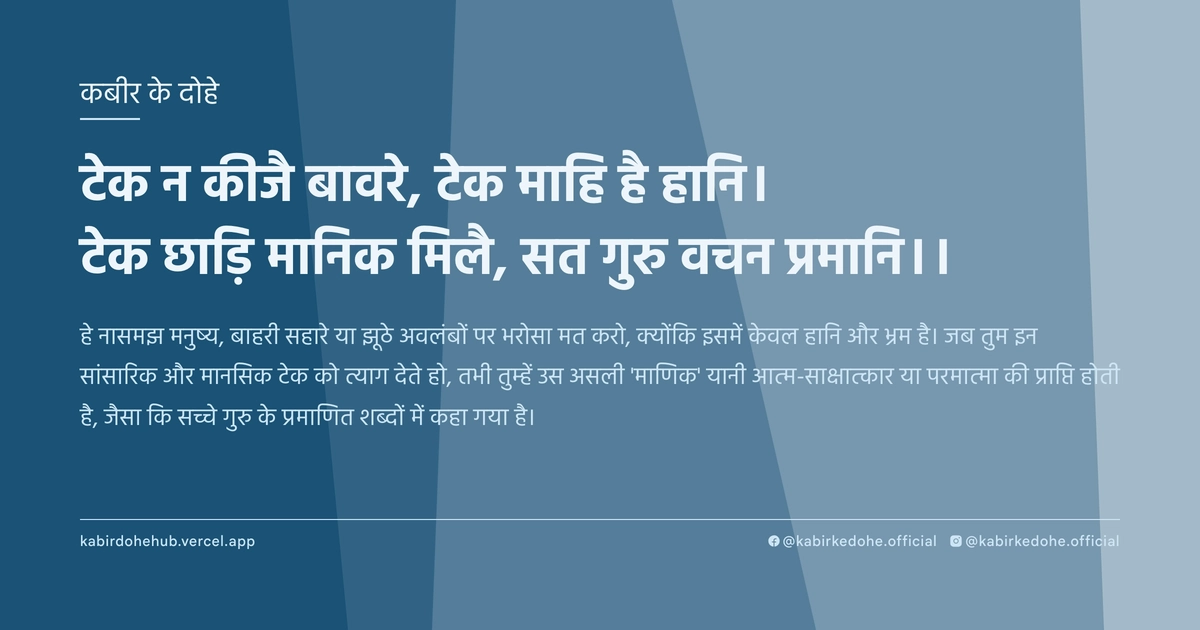
टेक न कीजै बावरे, टेक माहि है हानि।
टेक छाड़ि मानिक मिलै, सत गुरु वचन प्रमानि।।
Tek na keeje bawre, tek mahi hai haani. Tek chhad manik milai, sat guru vachan pramaani.
इस पृष्ठ पर इस कबीर दोहे का अर्थ (meaning), हिंदी व्याख्या और अंग्रेज़ी अनुवाद, दार्शनिक विश्लेषण और व्यावहारिक जीवन सीख दी गई है। यह दोहा गुरु महत्व (The Guru's Importance) विषय से जुड़ा है — Kabir doha meaning and explanation in Hindi and English.
अर्थ (Meaning):
हे नासमझ मनुष्य, बाहरी सहारे या झूठे अवलंबों पर भरोसा मत करो, क्योंकि इसमें केवल हानि और भ्रम है। जब तुम इन सांसारिक और मानसिक टेक को त्याग देते हो, तभी तुम्हें उस असली 'माणिक' यानी आत्म-साक्षात्कार या परमात्मा की प्राप्ति होती है, जैसा कि सच्चे गुरु के प्रमाणित शब्दों में कहा गया है।
O foolish soul, do not lean upon external supports or false crutches, for there is only loss and delusion in such reliance. Only when you abandon these worldly and mental dependencies do you find the true 'ruby'—the realization of the Self or the Divine—as attested by the proven words of the True Guru.
व्याख्या (Interpretation):
इस दोहे में 'टेक' का अर्थ है वह मानसिक या भौतिक सहारा जिसे हम अपनी असुरक्षा को ढंकने के लिए पकड़ते हैं, जैसे कि जाति, धर्म, पद या अन्य मनुष्यों का समर्थन। कबीर कहते हैं कि यह सहारा वास्तव में एक बंधन है जो हमें हमारी अपनी आंतरिक शक्ति से दूर रखता है। जब साधक इस बाहरी अवलंबन को छोड़ता है, तो वह 'शून्य' की स्थिति में आता है जहाँ अहंकार का विसर्जन होता है। यही वह बिंदु है जहाँ 'माणिक' (परम सत्य) प्रकट होता है। यह निर्गुण भक्ति का सार है: जब तक 'मैं' और 'मेरा सहारा' है, तब तक ईश्वर नहीं है। अद्वैत वेदांत के अनुसार, जब द्वैत (सहारा लेने वाला और सहारा देने वाला) समाप्त होता है, तब केवल ब्रह्म शेष रहता है।
In this couplet, 'Tek' refers to the mental or physical crutches we cling to out of insecurity, such as caste, religion, status, or the validation of others. Kabir asserts that this support is actually a shackle that distances us from our inherent inner strength. When the seeker relinquishes this external dependency, they enter a state of 'emptiness' where the ego is dissolved. It is precisely at this juncture that the 'Maanik' (the supreme ruby of truth) reveals itself. This is the essence of Nirgun Bhakti: as long as there is an 'I' and 'my support,' the Divine remains hidden. According to Advaita Vedanta, when duality—the distinction between the seeker and the support—vanishes, only Brahman remains.
दार्शनिक विश्लेषण (Philosophical Analysis):
कबीर का यह संदेश उस युग की प्रतिक्रिया है जहाँ लोग धर्म के नाम पर कर्मकांडों और बाहरी गुरुओं के पाखंडी सहारे पर निर्भर थे। उन्होंने स्पष्ट किया कि मोक्ष किसी बाहरी संस्था या व्यक्ति के सहारे से नहीं, बल्कि स्वयं के भीतर की यात्रा से मिलता है। यह दृष्टिकोण सूफीवाद के 'फना' (अहंकार का विनाश) के करीब है, जहाँ साधक को अपनी पहचान को मिटाना पड़ता है ताकि वह ईश्वर में विलीन हो सके।
यहाँ 'टेक' का मनोवैज्ञानिक विश्लेषण यह है कि मनुष्य अपनी आंतरिक शून्यता को भरने के लिए बाहरी पहचानों का सहारा लेता है। यह 'माया' का एक सूक्ष्म जाल है जो हमें यह विश्वास दिलाता है कि हम किसी बाहरी वस्तु या व्यक्ति के बिना अधूरे हैं। कबीर इस भ्रम को तोड़कर व्यक्ति को 'स्व-निर्भर' या 'आत्म-साक्षात्कारी' बनाने पर जोर देते हैं।
अद्वैत वेदांत के परिप्रेक्ष्य में, यह दोहा 'नेति नेति' (यह नहीं, वह नहीं) की प्रक्रिया है। जब हम हर उस चीज़ को नकार देते हैं जो नश्वर है और जिसे हम सहारा मानते हैं, तब जो बचता है वही शाश्वत सत्य है। यह केवल भौतिक त्याग नहीं, बल्कि मानसिक विरक्ति है।
कबीर जाति और वर्ग के भेदों को 'टेक' मानते थे। एक व्यक्ति जब अपनी जाति के गर्व को सहारा बनाकर चलता है, तो वह सत्य की खोज में सबसे बड़ा अवरोध पैदा करता है। उनके लिए सत्य सार्वभौमिक है और इसे पाने के लिए किसी विशेष सामाजिक पहचान की आवश्यकता नहीं है।
अंततः, यह दोहा हमें सिखाता है कि आध्यात्मिक प्रगति का मार्ग 'जोड़ने' में नहीं बल्कि 'छोड़ने' में है। जब हम अपनी मानसिक बैसाखियों को फेंक देते हैं, तब हम पाते हैं कि हम पहले से ही पूर्ण थे। यह पूर्णता ही वह 'माणिक' है जिसे हम बाहर खोज रहे थे।
Kabir's message is a reaction to an era where people relied on ritualistic formalities and the fraudulent support of external religious authorities. He clarifies that liberation is not achieved through the crutch of an external institution or person, but through an internal journey. This perspective aligns closely with the Sufi concept of 'Fana' (annihilation of the self), where the seeker must erase their identity to merge with the Divine.
Psychologically, 'Tek' represents the external identities humans cling to in order to fill an inner void. This is a subtle web of 'Maya' (illusion) that convinces us we are incomplete without external validation or possessions. Kabir emphasizes breaking this delusion to make the individual 'Swa-nirbhar' or self-realized.
From the lens of Advaita Vedanta, this doha embodies the process of 'Neti Neti' (not this, not that). When we negate everything that is transient and everything we mistake for a support, what remains is the Eternal Truth. This is not merely physical renunciation, but a profound mental detachment.
Kabir viewed caste and class distinctions as 'Tek.' When a person leans on the pride of their lineage, they create the greatest obstacle to the truth. For him, truth is universal and requires no specific social identity to be accessed.
Ultimately, this doha teaches that spiritual progress lies not in 'adding' but in 'subtracting.' When we cast away our mental crutches, we discover that we were already complete. This inherent wholeness is the 'Maanik' (ruby) we spent our lives searching for externally.
मूल संदेश (Core Message):
- बाहरी सहारे वास्तव में आंतरिक कमजोरी के लक्षण हैं।
- अहंकार का त्याग ही सत्य के द्वार की एकमात्र कुंजी है।
- जब आप पूरी तरह अकेले होते हैं, तभी आप वास्तव में पूर्ण होते हैं।
- सच्चा गुरु केवल दिशा दिखाता है, चलना आपको स्वयं पड़ता है।
- परमात्मा कोई बाहरी वस्तु नहीं, बल्कि स्वयं की शुद्ध चेतना है।
- External supports are actually symptoms of internal weakness.
- The surrender of ego is the only key to the gateway of truth.
- When you are completely alone, you are truly complete.
- The True Guru only shows the direction; you must walk the path yourself.
- The Divine is not an external object, but your own pure consciousness.
व्यावहारिक उदाहरण (Practical Example):
वाराणसी के घाटों पर रहने वाला एक वृद्ध विधवा, जिसे लोग 'माई' कहते थे, अपना पूरा जीवन मंदिर के पुजारियों और दानदाताओं के भरोसे बिता चुकी थी। वह मानती थी कि उसकी मुक्ति केवल उन पुजारियों द्वारा बताए गए कठिन व्रतों और बाहरी अनुष्ठानों के सहारे ही संभव है। वह अपनी हर छोटी जरूरत और मानसिक शांति के लिए दूसरों की दया पर निर्भर थी।
एक दिन उसने कबीर के इस दोहे को सुना। उसे एहसास हुआ कि वह जिस 'टेक' (पुजारियों के सहारे) को पकड़कर बैठी थी, वह वास्तव में उसे उसके अपने भीतर के ईश्वर से दूर कर रहा था। उसने महसूस किया कि वह डर और निर्भरता के कारण अपनी आंतरिक शक्ति को भूल गई थी।
माई ने धीरे-धीरे बाहरी अनुष्ठानों पर निर्भरता कम की। उसने पुजारियों से यह पूछना बंद कर दिया कि 'क्या मैं सही कर रही हूँ?' और अपने भीतर मौन का अभ्यास शुरू किया। उसने पाया कि जब वह दूसरों के सहारे की उम्मीद छोड़कर अकेले बैठती है, तो उसे एक असीम शांति का अनुभव होता है।
शुरुआत में उसे बहुत डर लगा, जैसे कोई बिना सहारे के गहरी खाई में कूद रहा हो। उसे लगा कि बिना किसी मार्गदर्शक या सहारे के वह भटक जाएगी। लेकिन यही वह 'हानि' थी जिसे कबीर ने बताया था—वह डर जो बाहरी सहारे की वजह से पैदा होता है।
जैसे-जैसे उसने इस डर को स्वीकार किया और उसे छोड़ा, उसे अपने भीतर एक ऐसी चमक महसूस हुई जिसे उसने कभी नहीं जाना था। वह अब किसी के दान या आशीर्वाद की मोहताज नहीं रही।
उसने पाया कि उसकी असली ताकत उसकी अपनी सांसों और मौन में थी। वह अब मंदिर की सीढ़ियों पर बैठकर केवल मुस्कुराती थी, क्योंकि उसने अपना 'माणिक' पा लिया था।
गाँव के लोग हैरान थे कि जो महिला कभी दूसरों के सामने गिड़गिड़ाती थी, वह अब इतनी शांत और आत्मविश्वासी कैसे हो गई। उसने किसी बाहरी चमत्कार का सहारा नहीं लिया, बल्कि अपने भीतर के सहारे को खोज लिया।
यह 'कबीर ट्विस्ट' था: जब उसने बाहरी सहारे (टेक) को पूरी तरह त्याग दिया, तभी उसे वह आंतरिक रत्न (माणिक) मिला जो हमेशा से उसके पास था, लेकिन निर्भरता के पर्दे के पीछे छिपा था।
In the ghats of Varanasi lived an elderly widow known as 'Mai,' who had spent her entire life relying on the temple priests and donors. She believed her salvation was only possible through the rigorous fasts and external rituals prescribed by these priests. Every small need and her very sense of peace depended on the mercy of others.
One day, she heard this doha of Kabir. She realized that the 'Tek' (the support of the priests) she had clung to was actually distancing her from the Divine within. She understood that her fear and dependency had blinded her to her own inner strength.
Mai gradually reduced her reliance on external rituals. She stopped asking the priests, 'Am I doing this correctly?' and began practicing silence within herself. She discovered that when she stopped expecting support from others and sat in solitude, she experienced a boundless peace.
Initially, she felt terrified, as if jumping into a deep abyss without a safety net. She feared she would lose her way without a guide or a crutch. But this was exactly the 'loss' Kabir spoke of—the fear generated by the very act of relying on external supports.
As she accepted and released this fear, she felt a radiance within her that she had never known. She was no longer dependent on anyone's charity or blessing for her spiritual well-being.
She found that her true strength resided in her own breath and silence. She would now sit on the temple steps and simply smile, for she had found her 'Maanik' (ruby).
The villagers were astonished that the woman who once pleaded with others had become so serene and self-assured. She didn't rely on any external miracle; she discovered the internal support.
This was the 'Kabir Twist': only when she completely abandoned the external crutch (Tek) did she find the internal gem (Maanik) that had always been hers, hidden behind the veil of dependency.
अभ्यास मार्गदर्शन (Practice Guidance):
- प्रतिदिन 20 मिनट 'शून्य ध्यान' का अभ्यास करें, जहाँ आप किसी भी विचार, मंत्र या बाहरी छवि का सहारा न लें।
- एक 'निर्भरता सूची' बनाएँ: उन सभी लोगों, पदों या वस्तुओं को लिखें जिनके बिना आपको लगता है कि आप अधूरे हैं, और फिर विचार करें कि यदि वे कल गायब हो जाएँ, तो आपकी आत्मा पर क्या प्रभाव पड़ेगा।
- व्यवहार परिवर्तन: दिन में कम से कम एक बार ऐसी स्थिति में खुद को डालें जहाँ आपको किसी की मदद या प्रशंसा की आवश्यकता हो, लेकिन सचेत रूप से उस सहारे की इच्छा को त्याग कर स्वयं समाधान खोजें।
- डायग्नोस्टिक चेकलिस्ट: क्या मैं निर्णय लेने के लिए दूसरों की पुष्टि (Validation) खोजता हूँ? क्या मेरी शांति बाहरी परिस्थितियों पर निर्भर है? यदि हाँ, तो आप अभी भी 'टेक' में हैं।
- Practice 20 minutes of 'Shunya Meditation' daily, where you rely on no thoughts, mantras, or external images.
- Create a 'Dependency List': Write down all people, titles, or objects without which you feel incomplete, then contemplate how your soul would be affected if they vanished tomorrow.
- Behavioral Change: Once a day, consciously place yourself in a situation where you feel the need for help or praise, but deliberately renounce that desire and find the solution within yourself.
- Diagnostic Checklist: Do I seek external validation before making decisions? Is my peace dependent on external circumstances? If yes, you are still clinging to 'Tek'.
चिंतन प्रश्न (Reflection Questions):
- वह कौन सी 'मानसिक बैसाखी' है जिसे मैं अपनी पहचान बनाए रखने के लिए सबसे मजबूती से पकड़े हुए हूँ?
- यदि मेरी सामाजिक प्रतिष्ठा और उपलब्धियाँ मुझसे छीन ली जाएँ, तो क्या मेरे पास कुछ बचेगा जिसे मैं 'मैं' कह सकूँ?
- क्या मेरा धर्म या आध्यात्मिकता वास्तव में मुझे मुक्त कर रहा है, या यह केवल एक नया सहारा (टेक) बन गया है?
- मैं अपनी असुरक्षाओं को ढंकने के लिए किन बाहरी मुखौटों का उपयोग करता हूँ?
- क्या मैं सत्य को खोजने के लिए तैयार हूँ, या मैं केवल उस सत्य की पुष्टि करने वाले किसी 'सहारे' की तलाश में हूँ?
- What is the 'mental crutch' I cling to most tightly to maintain my identity?
- If my social status and achievements were stripped away, would there be anything left that I could call 'I'?
- Is my religion or spirituality actually liberating me, or has it simply become a new form of 'Tek' (support)?
- Which external masks do I use to cover my insecurities?
- Am I truly ready to find the truth, or am I merely searching for a 'support' that confirms the truth for me?