
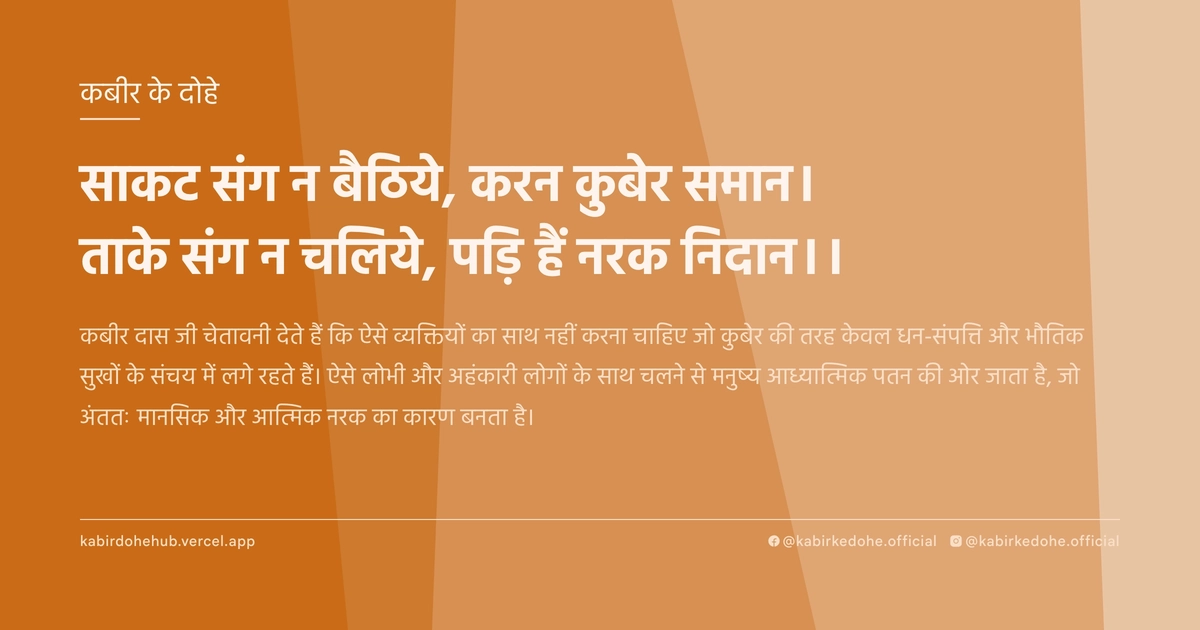
साकट संग न बैठिये, करन कुबेर समान।
ताके संग न चलिये, पड़ि हैं नरक निदान।।
Saakat sang na baithiye, karan kuber samaan. Taake sang na chaliye, padi hain narak nidaan.
इस पृष्ठ पर इस कबीर दोहे का अर्थ (meaning), हिंदी व्याख्या और अंग्रेज़ी अनुवाद, दार्शनिक विश्लेषण और व्यावहारिक जीवन सीख दी गई है। यह दोहा सत्संग (Satsang) विषय से जुड़ा है — Kabir doha meaning and explanation in Hindi and English.
अर्थ (Meaning):
कबीर दास जी चेतावनी देते हैं कि ऐसे व्यक्तियों का साथ नहीं करना चाहिए जो कुबेर की तरह केवल धन-संपत्ति और भौतिक सुखों के संचय में लगे रहते हैं। ऐसे लोभी और अहंकारी लोगों के साथ चलने से मनुष्य आध्यात्मिक पतन की ओर जाता है, जो अंततः मानसिक और आत्मिक नरक का कारण बनता है।
Kabir warns against the company of those who, like Kuber (the treasurer of gods), are obsessively consumed by the accumulation of wealth and material luxury. To walk the path of such ego-driven individuals is to invite spiritual decay, leading the soul into a living hell of greed and detachment from the Divine.
व्याख्या (Interpretation):
शाब्दिक अर्थ में यह दोहा धनवानों से दूर रहने की बात करता है, परंतु आध्यात्मिक स्तर पर यह 'माया' के प्रति आसक्ति का विरोध है। कुबेर यहाँ केवल एक व्यक्ति नहीं, बल्कि उस मानसिक अवस्था का प्रतीक है जहाँ व्यक्ति अपनी पहचान अपनी संपत्ति से जोड़ लेता है। यह निरगुण भक्ति का मार्ग है, जहाँ आत्मा को यह समझना होता है कि बाहरी समृद्धि अक्सर आंतरिक शून्यता को छिपाने का मुखौटा होती है। जब हम ऐसे लोगों के प्रभाव में आते हैं, तो हमारा ध्यान 'अहं' (Ego) की तुष्टि में लग जाता है, जिससे ब्रह्म के साथ अद्वैत संबंध टूट जाता है। यह 'नरक' कोई भौगोलिक स्थान नहीं, बल्कि वह मानसिक अवस्था है जहाँ शांति का अभाव है और केवल अंतहीन इच्छाएं शेष हैं।
Literally, the verse cautions against associating with the wealthy, but metaphorically, it is a critique of attachment to 'Maya' (illusion). Kuber represents the psychological state where identity is fused with possession. In the context of Nirgun Bhakti, the soul must realize that material abundance often masks a profound internal void. By aligning oneself with those driven by greed, the seeker reinforces the 'Ahamkara' (ego), severing the non-dual connection between Atman and Brahman. The 'hell' mentioned here is not a subterranean pit of fire, but a state of consciousness characterized by restlessness, spiritual blindness, and the agony of perpetual desire.
दार्शनिक विश्लेषण (Philosophical Analysis):
कबीर का यह दृष्टिकोण उनके युग के सामाजिक और धार्मिक पाखंड के विरुद्ध एक विद्रोह था। उन्होंने देखा कि कैसे धर्म के नाम पर लोग केवल बाहरी आडंबरों और भौतिक शक्ति को ही ईश्वर की कृपा मान लेते थे। यह दोहा अद्वैत वेदांत के उस सिद्धांत से जुड़ा है जहाँ 'माया' को सत्य के मार्ग में सबसे बड़ी बाधा माना गया है। कबीर का तर्क है कि जब तक मनुष्य स्वयं को भौतिक वस्तुओं का स्वामी मानता है, वह वास्तव में उन वस्तुओं का दास बन जाता है।
सूफी मत के 'फना' (अहंकार का विनाश) के सिद्धांत की तरह, कबीर यहाँ उस मानसिक कचरे को साफ करने की बात कर रहे हैं जो हमें परमात्मा से अलग करता है। वे जाति और वर्ग से ऊपर उठकर केवल 'चेतना' की शुद्धता पर जोर देते हैं। उनके लिए, कुबेर जैसी मानसिकता वाला व्यक्ति वह है जिसने अपनी आत्मा को बाजार की वस्तु बना लिया है।
यहाँ 'संग' (संगति) का महत्व है। भारतीय दर्शन में 'सत्संग' को मोक्ष का साधन माना गया है, और इसके विपरीत 'कुसंग' को पतन का। कबीर यह स्पष्ट करते हैं कि भौतिक समृद्धि बुरी नहीं है, लेकिन समृद्धि के प्रति 'मोह' और उससे उत्पन्न 'अहंकार' विनाशकारी है।
मनोवैज्ञानिक स्तर पर, यह दोहा संज्ञानात्मक विसंगति (cognitive dissonance) की बात करता है। जब हम ऐसे लोगों के साथ रहते हैं जो केवल भौतिकता को पूजते हैं, तो हमारा अवचेतन मन भी उन्हीं मूल्यों को आत्मसात करने लगता है, जिससे हमारी आध्यात्मिक संवेदनशीलता समाप्त हो जाती है।
अंततः, कबीर हमें यह सिखाते हैं कि वास्तविक संपदा 'संतोष' है। जो व्यक्ति कुबेर की तरह संचय करता है, वह वास्तव में भयभीत होता है—खोने का भय। जबकि एक साधक वह है जो शून्य होकर पूर्णता को प्राप्त करता है।
Kabir's perspective is a visceral rebellion against the social and religious hypocrisies of his era. He observed how people conflated material power and external rituals with divine grace. This verse aligns with the Advaita Vedanta principle that 'Maya' (illusion) is the primary veil obscuring the realization of Truth. Kabir argues that the moment a human claims ownership over material objects, they cease to be the master and instead become a slave to those possessions.
Mirroring the Sufi concept of 'Fana' (the annihilation of the ego), Kabir advocates for the purging of mental debris that separates the individual from the Universal Consciousness. He transcends caste and class, focusing solely on the purity of consciousness. To him, a 'Kuber-like' mindset is one where the soul has been commodified and traded for transient pleasures.
Central to this is the concept of 'Sangat' (association). In Indian philosophy, 'Satsang' (holy company) is a vehicle for liberation, while 'Kusang' (bad company) is a catalyst for spiritual decay. Kabir clarifies that wealth itself is not the enemy; rather, the 'Moha' (attachment) and the resulting arrogance are the poisons.
Psychologically, this verse addresses the danger of social mirroring. When we surround ourselves with those who worship materialism, our subconscious begins to adopt those values, eroding our spiritual sensitivity and capacity for empathy.
Ultimately, Kabir teaches that true wealth is 'Santosha' (contentment). The one who accumulates like Kuber lives in a state of perpetual fear—the fear of loss. In contrast, the seeker is one who embraces emptiness to discover the fullness of the Divine.
मूल संदेश (Core Message):
- भौतिक संचय आत्मा की गहराई को कम करता है।
- अहंकार से प्रेरित संगति आध्यात्मिक पतन का द्वार है।
- असली नरक बाहरी आग नहीं, बल्कि आंतरिक अतृप्ति है।
- संतोष ही एकमात्र ऐसी संपत्ति है जो कभी समाप्त नहीं होती।
- माया के मोह को त्यागकर ही शून्य की पूर्णता मिलती है।
- Material accumulation shallows the depth of the soul.
- Company driven by ego is a gateway to spiritual decay.
- True hell is not external fire, but internal insatiability.
- Contentment is the only wealth that never diminishes.
- Only by shedding the veil of Maya can one find the fullness of Emptiness.
व्यावहारिक उदाहरण (Practical Example):
वाराणसी के एक पुराने घाट पर रामदीन नाम का एक वृद्ध नाविक रहता था। वह बहुत गरीब था, लेकिन उसका मन शांत था। उसी घाट पर एक बड़ा व्यापारी आता था, जिसने शहर में कई आलीशान हवेलियां बना रखी थीं। वह व्यापारी अक्सर रामदीन को अपने साथ चलने और उसके व्यापार में मदद करने का लालच देता था। वह कहता, 'रामदीन, तुम इस टूटी नाव में जीवन बर्बाद कर रहे हो। मेरे साथ आओ, मैं तुम्हें रेशमी कपड़े और सोने के गहने दूंगा।'
रामदीन शुरू में प्रभावित हुआ। उसने कुछ समय उस व्यापारी के साथ बिताना शुरू किया। धीरे-धीरे, रामदीन के मन में अपनी छोटी सी नाव और सादगी के प्रति घृणा पैदा होने लगी। वह अब घाट पर आने वाले श्रद्धालुओं की सेवा करने के बजाय, व्यापारी के हिसाब-किताब में उलझ गया। वह अब यह सोचने लगा कि उसके पास पर्याप्त पैसा क्यों नहीं है। उसकी रातों की नींद उड़ गई और वह हर समय चिड़चिड़ा रहने लगा।
एक दिन, रामदीन ने देखा कि वह व्यापारी, जिसके पास सब कुछ था, एक छोटी सी जमीन की लड़ाई को लेकर अपने ही बेटे से लड़ रहा था। दोनों के बीच इतनी नफरत थी कि वे एक-दूसरे को देखना भी नहीं चाहते थे। व्यापारी की आँखों में वह शांति नहीं थी जो रामदीन की आँखों में हुआ करती थी।
रामदीन को अचानक कबीर का वह दोहा याद आया कि कुबेर जैसे लोगों का साथ नरक के समान है। उसने महसूस किया कि वह व्यापारी धन तो दे सकता था, लेकिन वह उसे वह मानसिक शांति नहीं दे सकता था जो उसे अपनी नाव चलाने और ईश्वर के सुमिरन में मिलती थी।
उसने महसूस किया कि 'नरक' कोई आग की जगह नहीं है, बल्कि वह लालच और ईर्ष्या है जिसने उस व्यापारी के घर को जला रखा था। रामदीन ने तुरंत उस व्यापारी का साथ छोड़ा और वापस अपनी नाव की ओर लौट आया।
उसने अपनी नाव को फिर से साफ किया और घाट की सेवा में लग गया। अब वह धन के बारे में नहीं सोचता था, बल्कि इस बात पर ध्यान देता था कि वह कितने लोगों को शांतिपूर्वक नदी पार करा सकता है।
उसकी जीवनशैली फिर से सरल हो गई, लेकिन उसका हृदय अब पहले से अधिक विस्तृत था। उसने सीखा कि बाहरी चमक-धमक अक्सर आंतरिक अंधकार को ढकने का तरीका होती है।
रामदीन अब घाट पर आने वाले युवाओं को समझाता था कि असली अमीरी वह नहीं जो तिजोरी में हो, बल्कि वह है जो आत्मा के संतोष में हो।
On an ancient ghat in Varanasi lived Ramdeen, an elderly boatman. He possessed very little, yet his mind was a lake of stillness. To the same ghat came a wealthy merchant who owned sprawling mansions across the city. The merchant often tempted Ramdeen, saying, 'Ramdeen, you are wasting your life in this rotting boat. Come with me; I will clothe you in silk and adorn you with gold.'
Initially, Ramdeen was swayed. He began spending time in the merchant's circle. Slowly, a seed of contempt grew within him toward his simple life and his weathered boat. He stopped focusing on the spiritual service of the pilgrims and became entangled in the merchant's ledgers. He began to obsess over why he lacked the riches others possessed.
His nights became restless, and he grew irritable. The peace that once defined him vanished, replaced by a constant, gnawing hunger for more.
One day, Ramdeen witnessed the merchant—a man who seemingly had everything—engaged in a vicious legal battle over a small piece of land with his own son. The hatred between them was so profound that they could not bear to look at each other. Ramdeen noticed that the merchant's eyes lacked the serenity that Ramdeen once possessed.
In that moment, Kabir's words flashed through his mind: associating with those like Kuber is a path to hell. He realized that while the merchant could offer him gold, he could never offer the spiritual liberation and peace found in simplicity and devotion.
He understood that 'hell' was not a pit of fire, but the greed and resentment that had incinerated the merchant's home and heart.
Ramdeen immediately severed his ties with the merchant's influence and returned to his boat. He scrubbed the wood, cleaned his oars, and returned to the service of the pilgrims.
He stopped calculating his losses and started measuring his life by the number of souls he could help cross the river in peace.
His lifestyle returned to its humble roots, but his heart expanded. He learned that external glitter is often a veil for internal darkness.
Ramdeen spent the rest of his days teaching young seekers on the ghat that true wealth is not what is locked in a vault, but what is unlocked in the soul through contentment.
अभ्यास मार्गदर्शन (Practice Guidance):
- प्रतिदिन 20 मिनट मौन ध्यान करें, जहाँ आप अपने भीतर के 'संग्रहकर्ता' (Collector) को पहचानें और उसे विदा करें।
- एक 'इच्छा-डायरी' लिखें: हर उस चीज़ को लिखें जिसे आप पाना चाहते हैं, और फिर खुद से पूछें, 'क्या यह मेरी आत्मा की ज़रूरत है या मेरे अहंकार की मांग?'
- सचेत संगति का अभ्यास करें: ऐसे लोगों के साथ समय बिताएं जो भौतिकता से ऊपर उठकर करुणा और ज्ञान की बात करते हों।
- निदान चेकलिस्ट: यदि आप दूसरों की सफलता देखकर ईर्ष्या महसूस करते हैं या अपनी उपलब्धियों से अपनी पहचान जोड़ रहे हैं, तो समझ लें कि आप 'कुबेर मार्ग' पर हैं।
- Practice 20 minutes of silent meditation daily, observing the 'Collector' within you and consciously letting go of the need to possess.
- Maintain a 'Desire Journal': List everything you crave, then ask yourself, 'Is this a necessity for my soul, or a demand of my ego?'
- Practice Conscious Association: Intentionally spend time with those who prioritize compassion and wisdom over material accumulation.
- Diagnostic Checklist: If you feel envy at another's success or derive your self-worth from your possessions, recognize that you are drifting toward the 'Kuber path'.
चिंतन प्रश्न (Reflection Questions):
- यदि आज आपकी सारी संपत्ति और पद छीन लिए जाएं, तो आपके व्यक्तित्व में क्या बचेगा?
- आपकी सामाजिक छवि (Social Image) को बनाए रखने के लिए आप अपनी आंतरिक शांति का कितना बलिदान दे रहे हैं?
- क्या आप उन लोगों के साथ हैं जो आपको बेहतर इंसान बनाते हैं, या उन लोगों के साथ जो आपकी लालसाओं को बढ़ाते हैं?
- आपके जीवन में 'सफलता' की परिभाषा क्या है—अधिक पाना या कम की आवश्यकता होना?
- क्या आपका डिजिटल व्यक्तित्व (Social Media Ego) आपके वास्तविक आत्म से अलग हो चुका है?
- If all your possessions and titles were stripped away today, what would remain of your identity?
- How much of your inner peace are you sacrificing to maintain a curated social image?
- Are you surrounded by people who elevate your consciousness, or those who amplify your cravings?
- What is your definition of 'success'—the act of acquiring more, or the state of needing less?
- Has your digital persona become a separate ego that masks your authentic self?