
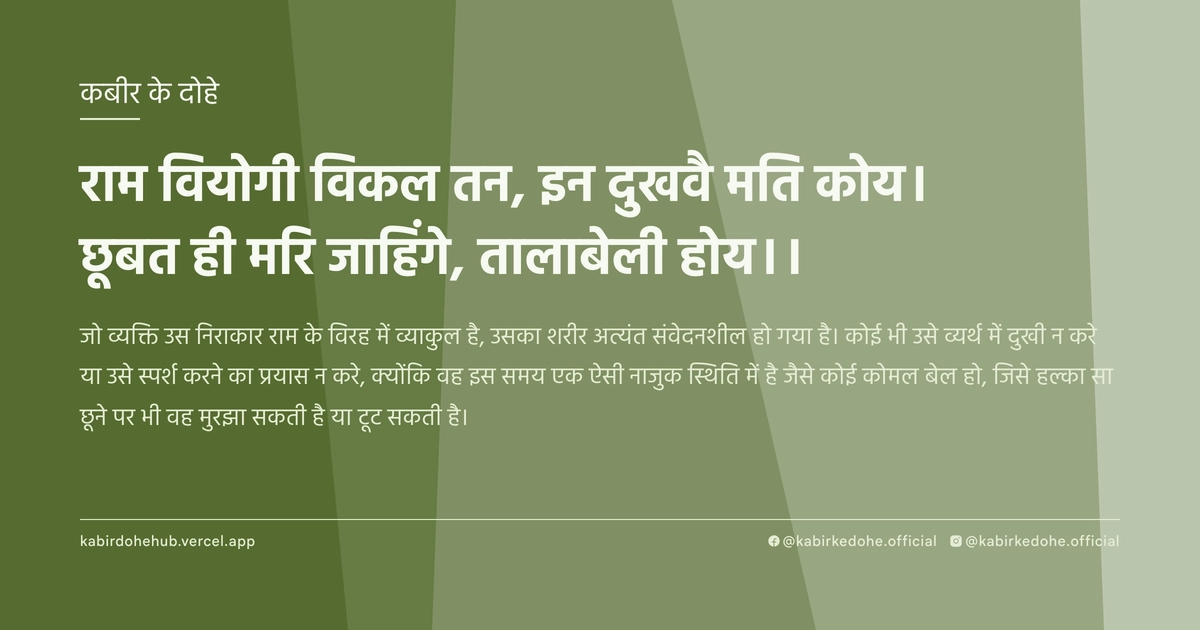
राम वियोगी विकल तन, इन दुखवै मति कोय।
छूबत ही मरि जाहिंगे, तालाबेली होय।।
Ram viyogi vikal tan, in dukhvai mati koy. Chhubat hi mari jaahinge, taalabeli hoye.
इस पृष्ठ पर इस कबीर दोहे का अर्थ (meaning), हिंदी व्याख्या और अंग्रेज़ी अनुवाद, दार्शनिक विश्लेषण और व्यावहारिक जीवन सीख दी गई है। यह दोहा भक्ति (Bhakti) विषय से जुड़ा है — Kabir doha meaning and explanation in Hindi and English.
अर्थ (Meaning):
जो व्यक्ति उस निराकार राम के विरह में व्याकुल है, उसका शरीर अत्यंत संवेदनशील हो गया है। कोई भी उसे व्यर्थ में दुखी न करे या उसे स्पर्श करने का प्रयास न करे, क्योंकि वह इस समय एक ऐसी नाजुक स्थिति में है जैसे कोई कोमल बेल हो, जिसे हल्का सा छूने पर भी वह मुरझा सकती है या टूट सकती है।
The one who is consumed by the agony of separation from the Formless Ram possesses a body rendered hypersensitive by longing. Let no one cause them further distress or touch them harshly, for they have become as fragile as a tender vine; even a slight touch could lead to their spiritual or physical collapse in the intensity of their devotion.
व्याख्या (Interpretation):
यहाँ 'राम' शब्द किसी व्यक्ति विशेष के लिए नहीं, बल्कि उस सर्वव्यापी चेतना (Nirgun Brahman) के लिए है। विरह की अवस्था वह बिंदु है जहाँ साधक का अहंकार पूरी तरह पिघल चुका होता है। यह 'विकल तन' केवल शारीरिक कमजोरी नहीं, बल्कि माया के पर्दों का हटना है। जब आत्मा अपने मूल स्रोत से मिलने के लिए तड़पती है, तो वह संसार की कठोरता को सहन नहीं कर पाती। यह स्थिति अद्वैत वेदांत के उस क्षण को दर्शाती है जहाँ द्वैत समाप्त होने लगता है और साधक केवल प्रेम के धागे से बंधा होता है। 'तालाबेली' का रूपक यह बताता है कि भक्ति की पराकाष्ठा में मनुष्य अपनी सामाजिक पहचान खोकर केवल एक संवेदनशील ऊर्जा बन जाता है।
In this verse, 'Ram' does not refer to a mythological figure but to the Formless Absolute (Nirgun Brahman). The state of 'separation' (Viraha) represents the critical juncture where the seeker's ego has completely dissolved. This 'restless body' is not mere physical frailty but the thinning of the veils of Maya. When the Atman yearns for its source, it can no longer tolerate the coarseness of worldly existence. This mirrors the Advaita Vedanta transition where duality vanishes, leaving the seeker bound only by the thread of divine love. The metaphor of the 'tender vine' (talabeli) signifies that at the peak of devotion, a human sheds their social identity to become a conduit of pure, hypersensitive spiritual energy.
दार्शनिक विश्लेषण (Philosophical Analysis):
कबीर का यह दोहा भक्ति मार्ग की उस चरम अवस्था का वर्णन करता है जिसे सूफी परंपरा में 'फना' और योग में 'समाधि' के करीब माना जाता है। कबीर ने यहाँ ritualism (कर्मकांड) को पूरी तरह नकार दिया है; उनके लिए ईश्वर मंदिर या मस्जिद में नहीं, बल्कि विरह की उस तड़प में है जो हृदय को शुद्ध करती है। यह विरह वास्तव में एक मनोवैज्ञानिक प्रक्रिया है जहाँ साधक अपनी झूठी पहचान (अहंकार) को मिटाकर सत्य की खोज करता है।
ऐतिहासिक रूप से, कबीर ने उस समय के समाज को चुनौती दी जहाँ धर्म केवल बाहरी दिखावा था। वे समझाते हैं कि वास्तविक आध्यात्मिकता आंतरिक रूपांतरण है, न कि तीर्थयात्रा। जब कोई व्यक्ति 'राम वियोगी' बनता है, तो वह जाति, वर्ण और वर्ग के भेदों से ऊपर उठ जाता है क्योंकि विरह की अग्नि सब कुछ जला देती है।
अद्वैत वेदांत के परिप्रेक्ष्य में, यह विरह एक भ्रम है क्योंकि आत्मा और परमात्मा वास्तव में एक ही हैं। लेकिन यह 'भ्रमित विरह' ही वह ईंधन है जो साधक को अज्ञानता से ज्ञान की ओर ले जाता है। जब तक साधक खुद को अलग महसूस नहीं करेगा, वह मिलन की तड़प महसूस नहीं करेगा।
सूफीवाद के साथ इसका गहरा संबंध है, जहाँ 'इश्क-ए-हकीकी' (ईश्वरीय प्रेम) में प्रेमी अपनी सुध-बुध खो देता है। कबीर यहाँ चेतावनी दे रहे हैं कि ऐसे संवेदनशील साधकों के साथ कठोर व्यवहार न करें, क्योंकि वे संसार के शोर से दूर एक सूक्ष्म धरातल पर जी रहे होते हैं।
अंततः, यह दोहा अहंकार के पूर्ण विसर्जन की बात करता है। जब 'मैं' मर जाता है, तब केवल 'वह' बचता है। यह संवेदनशीलता इस बात का प्रमाण है कि साधक अब बाहरी दुनिया के बजाय आंतरिक शून्यता और पूर्णता के बीच संतुलन बना रहा है।
This couplet describes the zenith of the devotional path, akin to 'Fana' in Sufism or the threshold of 'Samadhi' in Yoga. Kabir completely rejects ritualism; for him, the Divine is not found in temples or mosques but in the searing agony of separation that purifies the heart. This longing is a psychological alchemy where the seeker incinerates the false identity of the ego to uncover the Absolute Truth.
Historically, Kabir challenged a society where religion had become a mere performance. He posits that true spirituality is an internal transmutation, not a pilgrimage. When one becomes a 'Ram Viyogi,' they transcend the boundaries of caste, creed, and class, as the fire of longing consumes all superficial distinctions.
From the lens of Advaita Vedanta, this separation is paradoxically an illusion, for the Atman and Brahman are non-dual. However, this 'illusory longing' serves as the essential fuel that propels the seeker from ignorance to enlightenment. Without the perceived gap, there would be no impetus for the journey toward union.
There is a profound resonance here with Sufi 'Ishq-e-Haqiqi' (Divine Love), where the lover loses all self-awareness. Kabir warns against treating such sensitive souls with harshness, as they exist on a subtle plane, far removed from the cacophony of worldly existence.
Ultimately, the verse speaks to the total annihilation of the ego. When the 'I' dies, only the 'He/It' remains. This hypersensitivity is evidence that the seeker is now balancing between the void of the world and the fullness of the Divine.
मूल संदेश (Core Message):
- बाहरी कठोरता अक्सर आंतरिक रिक्तता का मुखौटा होती है।
- ईश्वर की प्राप्ति ज्ञान से नहीं, बल्कि तीव्र विरह से होती है।
- अहंकार का विसर्जन ही वास्तविक संवेदनशीलता का जन्म देता है।
- सत्य वह है जो हमें कोमल और करुणामयी बनाता है।
- आत्मा का मिलन तभी संभव है जब 'मैं' पूरी तरह मिट जाए।
- External hardness is often a mask for internal emptiness.
- Divine union is achieved not through intellect, but through intense longing.
- The dissolution of ego gives birth to true spiritual sensitivity.
- Truth is that which renders us tender and compassionate.
- Union with the Absolute is possible only when the 'I' is completely erased.
व्यावहारिक उदाहरण (Practical Example):
एक समय की बात है, वाराणसी के घाटों पर एक वृद्ध बुनकर रहता था जिसका नाम माधव था। माधव ने अपना पूरा जीवन कपड़ों की बुनाई में बिताया था, लेकिन जीवन के अंतिम पड़ाव पर उसने सब कुछ त्याग कर केवल उस निराकार राम की खोज में समय बिताना शुरू किया।
वह अब घंटों मौन रहता और उसकी आँखों में एक अजीब सी गहराई और नमी रहती थी। वह इतना संवेदनशील हो गया था कि किसी की चीख या किसी का कठोर शब्द उसे भीतर तक झकझोर देता था।
गाँव के कुछ लोग उसे 'पागल' समझने लगे थे। एक दिन एक अहंकारी व्यापारी माधव के पास आया और उसका मज़ाक उड़ाते हुए बोला, "तुम इस तरह खाली बैठे रहकर क्या पा लोगे? उठो और काम करो, यह विरह-व्याकुलता केवल कमजोरी है।"
व्यापारी ने माधव के कंधे पर जोर से हाथ रखा और उसे झकझोर दिया। माधव उस स्पर्श से ऐसे कांप गया जैसे कोई नाजुक पत्ता तेज हवा में हिलता है। उसकी आँखों से आँसू बह निकले, लेकिन उनमें क्रोध नहीं, बल्कि एक असीम करुणा थी।
माधव ने धीरे से कहा, "भाई, तुम जिस शरीर को छू रहे हो, वह तो अब केवल एक खोल है। मेरा असली अस्तित्व उस प्रेम में विलीन हो रहा है जिसे तुम देख नहीं सकते।"
व्यापारी ने देखा कि माधव की शांति उसके अपने शोर से कहीं अधिक शक्तिशाली थी। उसे महसूस हुआ कि उसकी अपनी भौतिक समृद्धि उसके भीतर के खालीपन को नहीं भर पा रही है।
उस क्षण व्यापारी का अहंकार टूट गया। उसने महसूस किया कि जिसे वह 'कमजोरी' समझ रहा था, वह वास्तव में एक ऐसी मानसिक शक्ति थी जहाँ व्यक्ति दुनिया के प्रति पूरी तरह खुला और संवेदनशील हो जाता है।
व्यापारी ने माधव के चरणों में गिरकर क्षमा मांगी और उसी दिन से उसने अपने धन का उपयोग गरीबों की सेवा के लिए करना शुरू किया, यह समझकर कि असली संपत्ति हृदय की कोमलता है।
माधव की वह 'विकल' अवस्था वास्तव में एक दर्पण बन गई थी जिसने व्यापारी को उसके अपने कठोर व्यक्तित्व का अहसास कराया।
इस प्रकार, एक साधारण बुनकर की आध्यात्मिक संवेदनशीलता ने एक कठोर हृदय वाले व्यक्ति का रूपांतरण कर दिया, यह सिद्ध करते हुए कि प्रेम और विरह की शक्ति तर्क से कहीं अधिक गहरी होती है।
Once, on the ghats of Varanasi, lived an elderly weaver named Madhav. Madhav had spent his entire life weaving fabrics, but in the twilight of his years, he renounced everything to seek the Formless Ram.
He would spend hours in silence, his eyes reflecting a strange depth and a perpetual moistness. He became so sensitive that a distant scream or a harsh word would shake him to his core.
Some villagers began to label him as 'mad.' One day, an arrogant merchant approached Madhav and mocked him, saying, "What will you achieve by sitting idle? Get up and work; this longing is nothing but weakness."
The merchant placed a heavy, rough hand on Madhav's shoulder and shook him. Madhav trembled at that touch, like a fragile leaf in a storm. Tears streamed down his face, but they held no anger, only an infinite compassion.
Madhav whispered, "Brother, the body you touch is now merely a shell. My true existence is dissolving into a Love that you cannot see."
The merchant realized that Madhav's silence was far more powerful than his own noise. He felt that his material wealth could not fill the void within his own heart.
In that moment, the merchant's ego shattered. He understood that what he perceived as 'weakness' was actually a profound spiritual strength where a person becomes completely open and vulnerable to the universe.
The merchant fell at Madhav's feet, seeking forgiveness, and from that day, he dedicated his wealth to the service of the poor, realizing that true riches lie in the tenderness of the heart.
Madhav's 'restless' state became a mirror that forced the merchant to confront his own emotional rigidity.
Thus, the spiritual sensitivity of a simple weaver transformed a hardened heart, proving that the power of divine longing is deeper than any worldly logic.
अभ्यास मार्गदर्शन (Practice Guidance):
- दैनिक अभ्यास: प्रतिदिन 20 मिनट पूर्ण मौन में बैठें। बाहरी शोर को सुनने के बजाय, अपने भीतर उठने वाले विरह या तड़प को महसूस करें।
- आत्म-पूछताछ: एक डायरी लिखें जिसमें यह दर्ज करें कि दिन भर में किन बातों ने आपको भावनात्मक रूप से विचलित किया। पूछें—क्या यह अहंकार की चोट थी या आत्मा की पुकार?
- व्यवहार परिवर्तन: दूसरों के प्रति अत्यधिक कठोरता का त्याग करें। यह याद रखें कि हर व्यक्ति अपने भीतर किसी न किसी अदृश्य दर्द या खोज से जूझ रहा है।
- निदान चेकलिस्ट: यदि आप छोटी बातों पर क्रोधित होते हैं, तो आप अभी भी अहंकार में हैं। यदि आप दूसरों के दुख को देखकर भीतर से पिघलते हैं, तो आप इस 'विकल' अवस्था की ओर बढ़ रहे हैं।
- Daily Practice: Sit in absolute silence for 20 minutes daily. Instead of focusing on external noise, feel the subtle longing or yearning arising within your own heart.
- Self-Inquiry: Keep a journal recording the moments you felt emotionally triggered. Ask yourself—was this a wound to the ego or a call from the soul?
- Behavioral Shift: Abandon all forms of harshness toward others. Remind yourself that every individual is battling an invisible pain or searching for an unseen truth.
- Diagnostic Checklist: If you react with anger to small inconveniences, the ego still dominates. If you find yourself melting in the presence of another's suffering, you are moving toward this state of 'divine sensitivity'.
चिंतन प्रश्न (Reflection Questions):
- क्या मेरी संवेदनशीलता वास्तव में आध्यात्मिक है, या यह केवल मेरी भावनात्मक अस्थिरता है?
- मैं अपनी सार्वजनिक छवि को बनाए रखने के लिए अपने भीतर के किस 'कोमल' हिस्से को दबा रहा हूँ?
- क्या मैं दूसरों के दर्द को महसूस करता हूँ, या मैं केवल उनके दर्द पर अपनी राय देता हूँ?
- मेरे जीवन में वह कौन सा 'विरह' है जो मुझे वास्तव में बदलने की क्षमता रखता है?
- यदि मेरा सामाजिक पद और पहचान छीन ली जाए, तो मेरे भीतर क्या बचेगा?
- Is my sensitivity truly spiritual, or is it merely emotional instability?
- Which 'tender' part of my inner self am I suppressing to maintain my public persona?
- Do I actually feel the pain of others, or do I merely offer opinions on their suffering?
- What is the specific 'longing' in my life that has the power to truly transform me?
- If my social status and identity were stripped away, what would remain of me?