
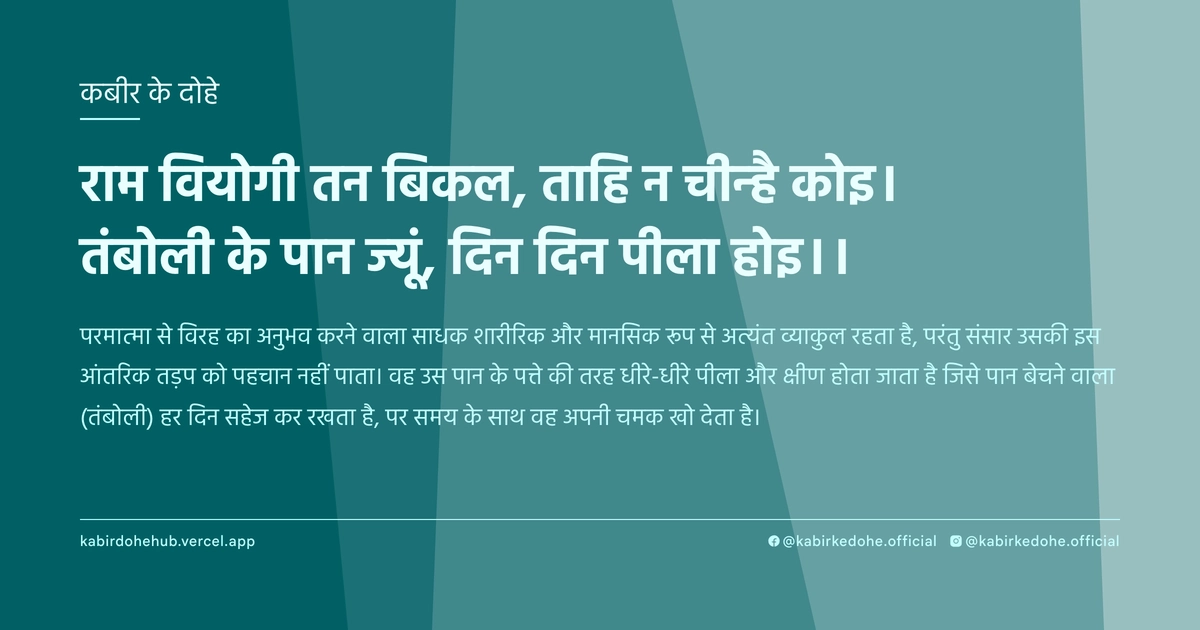
राम वियोगी तन बिकल, ताहि न चीन्है कोइ।
तंबोली के पान ज्यूं, दिन दिन पीला होइ।।
Ram viyogi tan bikal, taahi na chinnhai koi. Tamboli ke paan jyoon, din din peela hoye.
इस पृष्ठ पर इस कबीर दोहे का अर्थ (meaning), हिंदी व्याख्या और अंग्रेज़ी अनुवाद, दार्शनिक विश्लेषण और व्यावहारिक जीवन सीख दी गई है। यह दोहा भक्ति (Bhakti) विषय से जुड़ा है — Kabir doha meaning and explanation in Hindi and English.
अर्थ (Meaning):
परमात्मा से विरह का अनुभव करने वाला साधक शारीरिक और मानसिक रूप से अत्यंत व्याकुल रहता है, परंतु संसार उसकी इस आंतरिक तड़प को पहचान नहीं पाता। वह उस पान के पत्ते की तरह धीरे-धीरे पीला और क्षीण होता जाता है जिसे पान बेचने वाला (तंबोली) हर दिन सहेज कर रखता है, पर समय के साथ वह अपनी चमक खो देता है।
The seeker who suffers the agony of separation from the Divine (Ram) becomes physically and mentally exhausted, yet the world remains oblivious to this internal turmoil. Like a betel leaf in the possession of a vendor, which gradually loses its freshness and turns pale day by day, the longing soul fades away in the intensity of its spiritual yearning.
व्याख्या (Interpretation):
यहाँ 'राम' किसी व्यक्ति विशेष नहीं, बल्कि निर्गुण ब्रह्म या उस सार्वभौमिक चेतना का प्रतीक है जिससे आत्मा अलग हो गई है। 'वियोग' वह आध्यात्मिक प्यास है जो साधक को सांसारिक सुखों से विरक्त कर देती है। शारीरिक क्षीणता (पीलापन) केवल रोग नहीं, बल्कि अहंकार के विसर्जन की प्रक्रिया है। जब बाहरी पहचान मिटती है, तब आंतरिक सत्य उभरता है। यह दोहा दर्शाता है कि वास्तविक भक्ति बाहरी आडंबरों में नहीं, बल्कि उस गहन विरह में है जहाँ 'मैं' पूरी तरह मिट जाता है। यह अद्वैत वेदांत की उस स्थिति को दर्शाता है जहाँ जीव अपनी पृथकता के दुख से गुजरकर अंततः ब्रह्म में विलीन होता है।
In this verse, 'Ram' does not refer to a mythological deity but to the Nirgun Brahman—the formless, universal consciousness from which the soul has drifted. 'Separation' (Viyog) represents the spiritual thirst that renders worldly pleasures tasteless. The physical wasting away, symbolized by the 'yellowing leaf,' is not a biological illness but the process of ego-dissolution. As the external identity fades, the internal truth emerges. Kabir suggests that true devotion is not found in rituals but in the profound longing where the 'I' is completely erased. This aligns with Advaita Vedanta, where the soul undergoes the agony of perceived duality before realizing its non-dual identity with the Absolute.
दार्शनिक विश्लेषण (Philosophical Analysis):
कबीर का यह दोहा भक्ति आंदोलन के उस दौर का है जहाँ बाहरी कर्मकांडों और जातिगत श्रेष्ठता का बोलबाला था। कबीर ने 'विरह' को एक साधना के रूप में प्रस्तुत किया है, जो सूफी मत के 'इश्क-ए-हकीकी' (ईश्वरीय प्रेम) के अत्यंत निकट है। सूफीवाद में भी प्रेमी (साधक) का अपने महबूब (ईश्वर) के लिए तड़पना ही उसे पवित्र करता है। यहाँ कबीर यह स्पष्ट करते हैं कि आध्यात्मिक प्रगति का प्रमाण बाहरी माला या तिलक नहीं, बल्कि हृदय की वह तड़प है जो साधक को दुनिया की नजरों में 'अजीब' या 'बीमार' बना देती है।
यह विश्लेषण हमें अद्वैत वेदांत की ओर ले जाता है, जहाँ माया के कारण आत्मा स्वयं को शरीर मान लेती है और परमात्मा से अलग महसूस करती है। यह अलगाव ही दुख का मूल कारण है। जब साधक इस अलगाव को गहराई से महसूस करता है, तो वह 'वियोगी' बन जाता है। यह वियोग वास्तव में मिलन की पहली सीढ़ी है। जब तक व्यक्ति यह महसूस नहीं करता कि वह अधूरा है, वह पूर्णता की खोज नहीं करेगा।
कबीर यहाँ सामाजिक धारणाओं पर प्रहार करते हैं। समाज केवल बाहरी स्वास्थ्य और समृद्धि को देखता है, जबकि आध्यात्मिक स्वास्थ्य अक्सर बाहरी कमजोरी के रूप में प्रकट होता है। तंबोली के पान का उदाहरण एक सटीक रूपक है—जैसे पान का पत्ता अपनी हरियाली खोकर रस देता है, वैसे ही साधक अपने अहंकार और शारीरिक मोह को त्यागकर आत्म-साक्षात्कार की ओर बढ़ता है।
मनोवैज्ञानिक स्तर पर, यह 'अहंकार का विलोपन' (Annihilation of Ego) है। जब तक व्यक्ति अपनी सामाजिक पहचान (नाम, पद, जाति) से चिपका रहता है, वह ईश्वर से नहीं मिल सकता। विरह की अग्नि उस पहचान को जला देती है। यह एक ऐसी प्रक्रिया है जहाँ साधक अपनी पूरी सत्ता को शून्य कर देता है ताकि परमात्मा उसमें समा सके।
अंततः, यह दोहा हमें सिखाता है कि आध्यात्मिक मार्ग एकाकी है। दुनिया उसे नहीं पहचान पाएगी जो सत्य की खोज में अपनी सुख-सुविधाओं का त्याग कर रहा है। यह 'पीलापन' वास्तव में उस आंतरिक प्रकाश की तैयारी है जो अंधकार के पूर्ण विनाश के बाद प्रकट होता है।
This couplet emerges from an era of rigid ritualism and caste hierarchies, where Kabir positioned 'longing' (Viraha) as a primary spiritual discipline. This concept closely mirrors the Sufi tradition of 'Ishq-e-Haqiqi' (Divine Love), where the lover's agony is the very catalyst for purification. Kabir asserts that the evidence of spiritual progress is not found in prayer beads or forehead marks, but in a heart-wrenching yearning that often makes the seeker appear 'strange' or 'ailing' to the mundane world.
Philosophically, this connects to Advaita Vedanta, where Maya (illusion) creates the false perception that the Atman (soul) is separate from Brahman (the Absolute). This perceived separation is the root of all suffering. When a seeker deeply experiences this void, they become a 'Viyogi.' This separation is, paradoxically, the first step toward union; without the realization of incompleteness, the quest for wholeness never begins.
Kabir critiques social perceptions of success and health. Society values external vigor and material prosperity, whereas spiritual vitality often manifests as external frailty. The metaphor of the betel leaf is precise: just as the leaf loses its greenness to release its essence, the seeker sheds their ego and bodily attachments to reveal the inner spirit.
On a psychological level, this describes the 'annihilation of the ego.' As long as one clings to social identities—name, status, or caste—the Divine cannot enter. The fire of separation burns away these constructs. It is a process of becoming 'zero' so that the Infinite may occupy the space.
Ultimately, the verse highlights the solitude of the spiritual path. The world cannot recognize the one who is sacrificing comfort for Truth. This 'paleness' is not a sign of decay, but a preparation for the inner light that dawns only after the total destruction of the illusory self.
मूल संदेश (Core Message):
- बाहरी चमक अक्सर आंतरिक अंधकार को छुपाती है।
- सच्ची भक्ति विरह की अग्नि में तपकर ही निखरती है।
- अहंकार का मिटना ही परमात्मा से मिलन की पहली शर्त है।
- दुनिया की नासमझी को अपनी साधना का कवच बनाएँ।
- शारीरिक क्षय आध्यात्मिक उत्थान का संकेत हो सकता है।
- External luster often masks internal darkness.
- True devotion is refined only in the fire of separation.
- The dissolution of ego is the primary condition for Divine union.
- Use the world's misunderstanding as a shield for your practice.
- Physical frailty can be a sign of spiritual ascension.
व्यावहारिक उदाहरण (Practical Example):
एक समय की बात है, बनारस की तंग गलियों में एक वृद्ध विधवा रहती थी, जिनका नाम जानकी था। जानकी का जीवन केवल मंदिर की सीढ़ियों और दूसरों की सेवा में बीत रहा था। लोग उन्हें 'पागल' कहते थे क्योंकि वे अक्सर अकेले बैठकर शून्य में ताकती रहती थीं और कभी-कभी बिना किसी कारण के रोने लगती थीं। उनके चेहरे की चमक जा चुकी थी, त्वचा पीली पड़ गई थी और शरीर कमजोर हो गया था।
पड़ोस के लोग उनकी इस स्थिति का मजाक उड़ाते थे। कोई कहता कि उन्हें मानसिक रोग है, तो कोई कहता कि वे केवल ध्यान आकर्षित करना चाहती हैं। उनके लिए जानकी केवल एक 'बीमार' औरत थीं, जिनका कोई सहारा नहीं था। लेकिन जानकी के भीतर एक अलग ही दुनिया थी। वे उस परमात्मा के विरह में जल रही थीं, जिसे उन्होंने अपनी आत्मा के भीतर महसूस करना शुरू किया था।
एक दिन शहर का एक बड़ा विद्वान पंडित उनके पास आया। उसने देखा कि जानकी की आँखों में एक ऐसी गहराई है जो उसने बड़े-बड़े ग्रंथों में नहीं पढ़ी थी। पंडित ने पूछा, "माता, आप इतनी दुखी क्यों दिखती हैं? आपके पास तो शांति होनी चाहिए।"
जानकी ने मंद मुस्कान के साथ उत्तर दिया, "बेटा, जिसे तुम दुख कह रहे हो, वह मेरी सबसे बड़ी संपत्ति है। यह वह प्यास है जो मुझे बताती है कि मेरा घर कहीं और है। जब तक यह तड़प है, तब तक मेरी खोज जारी है। जिस दिन यह प्यास बुझ गई, उस दिन मैं फिर से इस दुनिया की भीड़ का हिस्सा बन जाऊँगी।"
पंडित हैरान रह गया। उसने महसूस किया कि वह स्वयं को 'ज्ञानी' मानता था क्योंकि उसने किताबें पढ़ी थीं, लेकिन जानकी 'ज्ञानी' थी क्योंकि उसने उस विरह को जिया था। जानकी का पीला शरीर वास्तव में उनके भीतर जल रही प्रेम की अग्नि का परिणाम था।
उस दिन पंडित ने सीखा कि जिसे दुनिया कमजोरी समझती है, वह वास्तव में एक गहन आंतरिक शक्ति हो सकती है। उसने जानकी के चरणों में सिर झुकाया और समझा कि वास्तविक भक्ति वह नहीं जो दुनिया को दिखाई दे, बल्कि वह है जो आत्मा को बदल दे।
जानकी की स्थिति उस तंबोली के पान जैसी थी—बाहर से रंग उतरा हुआ, लेकिन भीतर से रस से भरा हुआ। उन्होंने अपनी सामाजिक पहचान और शारीरिक सौंदर्य को खो दिया था, लेकिन उन्होंने उस 'राम' को पा लिया था जिसे लोग केवल मूर्तियों में खोजते थे।
यह कहानी हमें सिखाती है कि आध्यात्मिक यात्रा में अक्सर हम अपनी बाहरी चमक खो देते हैं ताकि हम आंतरिक प्रकाश को देख सकें। जिसे दुनिया 'बीमारी' कहती है, वह वास्तव में आत्मा का शुद्धिकरण होता है।
In the narrow lanes of Varanasi lived an elderly widow named Janaki. Her life revolved around the temple steps and serving others. People called her 'mad' because she would often sit in silence, staring into the void, sometimes weeping without any apparent cause. The glow of her youth had vanished; her skin had turned pale, and her body had grown frail.
Neighbors mocked her condition. Some claimed she was mentally ill, while others thought she was merely seeking attention. To them, Janaki was simply a 'sick' woman with no support. However, inside Janaki, a different world existed. She was burning in the agony of separation from the Divine, whom she had begun to feel within her own soul.
One day, a renowned scholar-priest from the city visited her. He noticed a depth in Janaki's eyes that he had never encountered in the greatest scriptures. The priest asked, "Mother, why do you look so sorrowful? You should be at peace."
Janaki replied with a faint smile, "Son, what you call sorrow is my greatest treasure. It is the thirst that reminds me my true home is elsewhere. As long as this longing exists, my search continues. The day this thirst vanishes, I will once again become just another face in the crowd of this world."
The priest was stunned. He realized that while he considered himself 'learned' because he had read books, Janaki was 'enlightened' because she had lived the longing. Janaki's pale physique was the result of the fire of love burning within her.
That day, the scholar learned that what the world perceives as weakness can actually be a profound inner strength. He bowed at Janaki's feet, understanding that true devotion is not what is visible to the world, but what transforms the soul.
Janaki's state was like the betel leaf of the vendor—colorless on the outside, but saturated with essence on the inside. She had lost her social identity and physical beauty, but she had found the 'Ram' whom others sought only in stone idols.
This story teaches us that on the spiritual journey, we often lose our external luster so that we may perceive the internal light. What the world labels as 'illness' is often the purification of the soul.
अभ्यास मार्गदर्शन (Practice Guidance):
- प्रतिदिन 20 मिनट मौन रहकर इस विचार पर चिंतन करें: "मेरे भीतर वह कौन सा खालीपन है जिसे मैं सांसारिक चीजों से भरने की कोशिश कर रहा हूँ?"
- एक 'विरह जर्नल' बनाएँ जहाँ आप अपनी उन भावनाओं को लिखें जो आपको अधूरा महसूस कराती हैं, और उन्हें ईश्वर के प्रति प्रेम में बदलें।
- व्यवहार परिवर्तन: जब भी आप किसी की बाहरी स्थिति (गरीबी, बीमारी या कमजोरी) को देखकर निर्णय लें, तो रुकें और सोचें कि क्या उनके भीतर कोई ऐसा सत्य है जिसे आप नहीं देख पा रहे।
- निदान चेकलिस्ट: क्या आप अभी भी अपनी पहचान केवल अपने पद, रूप या संपत्ति से जोड़ते हैं? यदि हाँ, तो आप अभी भी 'माया' के प्रभाव में हैं। क्या आप अकेलेपन में भी एक सुखद तड़प महसूस करते हैं? यदि हाँ, तो आपकी आध्यात्मिक यात्रा शुरू हो चुकी है।
- Spend 20 minutes daily in silence contemplating: "What is the void within me that I am trying to fill with worldly possessions?"
- Maintain a 'Longing Journal' where you record the feelings of incompleteness and consciously transmute them into love for the Divine.
- Behavioral Shift: Whenever you judge someone based on their external state (poverty, illness, or frailty), pause and ask if there is an inner truth within them that you are failing to perceive.
- Diagnostic Checklist: Do you still define your identity solely by your status, appearance, or wealth? If so, you are still under the grip of Maya. Do you feel a blissful yearning even in solitude? If yes, your spiritual journey has truly begun.
चिंतन प्रश्न (Reflection Questions):
- क्या मेरी 'सफलता' की छवि मेरे भीतर के वास्तविक खालीपन को ढक रही है?
- मैं अपनी सामाजिक पहचान (डिजिटल ईगो) को बनाए रखने के लिए कितना मानसिक तनाव झेलता हूँ?
- क्या मैं वास्तव में ईश्वर को चाहता हूँ, या मैं केवल उस शांति को चाहता हूँ जो मुझे समाज में 'सम्मानित' दिखाए?
- मेरे जीवन का वह कौन सा 'पीलापन' या दुख है जिसे मैं स्वीकार करने से डरता हूँ, जबकि वह मुझे सत्य की ओर ले जा सकता है?
- यदि कल मेरी सारी बाहरी पहचान छीन ली जाए, तो मेरे पास ऐसा क्या बचेगा जिसे मैं 'मैं' कह सकूँ?
- Is my image of 'success' merely masking a profound inner void?
- How much mental stress do I endure to maintain my social identity (digital ego)?
- Do I truly desire the Divine, or do I only desire the peace that makes me look 'respected' in society?
- What is the 'paleness' or sorrow in my life that I fear accepting, even though it might lead me to the Truth?
- If all my external identities were stripped away tomorrow, what would remain that I could call 'I'?