
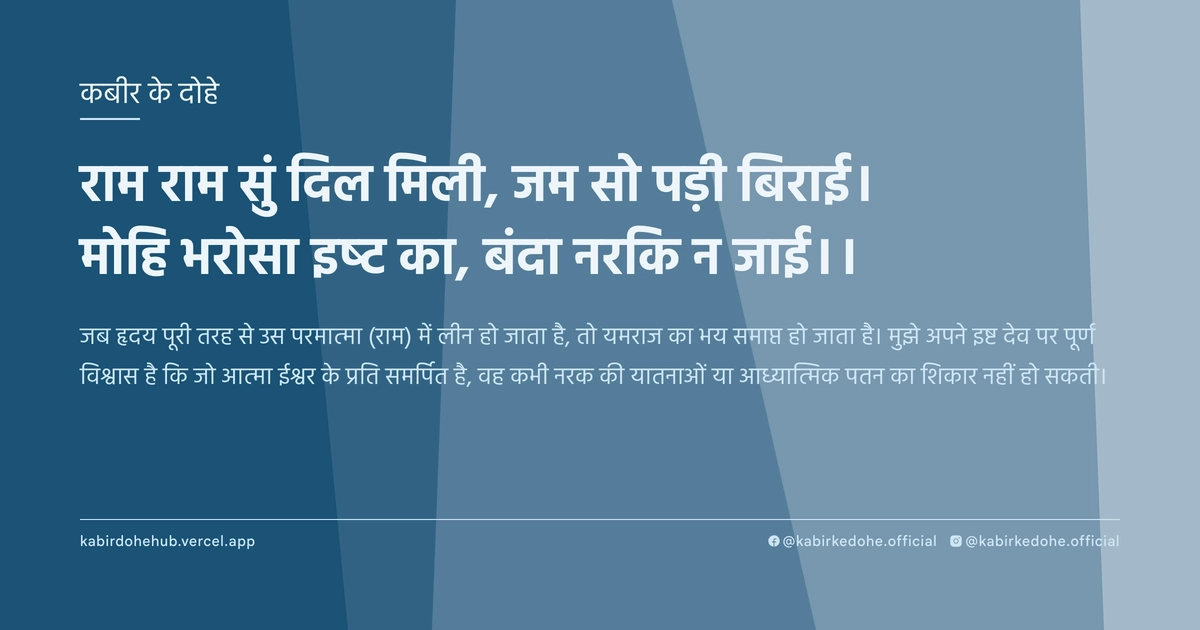
राम राम सुं दिल मिली, जम सो पड़ी बिराई।
मोहि भरोसा इष्ट का, बंदा नरकि न जाई।।
Ram ram sun dil mili, jam so padi birai. Mohi bharosa isht ka, banda narki na jaai.
इस पृष्ठ पर इस कबीर दोहे का अर्थ (meaning), हिंदी व्याख्या और अंग्रेज़ी अनुवाद, दार्शनिक विश्लेषण और व्यावहारिक जीवन सीख दी गई है। यह दोहा भक्ति (Bhakti) विषय से जुड़ा है — Kabir doha meaning and explanation in Hindi and English.
अर्थ (Meaning):
जब हृदय पूरी तरह से उस परमात्मा (राम) में लीन हो जाता है, तो यमराज का भय समाप्त हो जाता है। मुझे अपने इष्ट देव पर पूर्ण विश्वास है कि जो आत्मा ईश्वर के प्रति समर्पित है, वह कभी नरक की यातनाओं या आध्यात्मिक पतन का शिकार नहीं हो सकती।
When the heart becomes completely merged with the Divine (Ram), the fear of the Lord of Death (Yama) vanishes. I have absolute faith in my Beloved Lord that a soul surrendered to the Divine can never fall into the depths of hell or spiritual oblivion.
व्याख्या (Interpretation):
यहाँ 'राम' किसी व्यक्ति या मूर्ति नहीं, बल्कि उस निर्गुण, निराकार चेतना का प्रतीक है जो कण-कण में व्याप्त है। जब साधक का हृदय इस सार्वभौमिक सत्य से मिल जाता है, तो वह द्वैत से अद्वैत की ओर बढ़ता है। यमराज यहाँ केवल मृत्यु के देवता नहीं, बल्कि उस 'अहंकार' और 'भय' का प्रतीक हैं जो हमें जन्म-मृत्यु के चक्र में बांधे रखते हैं। यह दोहा स्पष्ट करता है कि वास्तविक मुक्ति बाहरी कर्मकांडों से नहीं, बल्कि आंतरिक समर्पण से आती है। जब आत्मा और परमात्मा का मिलन होता है, तो माया का पर्दा हट जाता है और नरक—जो वास्तव में अज्ञानता की अवस्था है—पूरी तरह समाप्त हो जाता है। यह निर्गुण भक्ति की पराकाष्ठा है जहाँ भक्त और भगवान एक हो जाते हैं।
Here, 'Ram' does not refer to a historical figure or an idol, but to the Nirgun, formless consciousness that permeates every atom of existence. When the seeker's heart merges with this universal truth, they transition from duality to non-duality (Advaita). Yama here represents not just the deity of death, but the 'ego' and 'fear' that bind us to the cycle of birth and death. The couplet clarifies that true liberation comes not from external rituals, but from internal surrender. When the Atman and Brahman unite, the veil of Maya is lifted, and 'hell'—which is essentially a state of profound ignorance—ceases to exist. This is the pinnacle of Nirgun Bhakti, where the devotee and the Divine become one.
दार्शनिक विश्लेषण (Philosophical Analysis):
कबीर का यह दोहा उस कालखंड की उपज है जब धर्म केवल बाहरी आडंबरों, तीर्थों और जातिगत श्रेष्ठता में सिमट गया था। कबीर ने इस व्यवस्था को चुनौती देते हुए 'सहज मार्ग' का प्रतिपादन किया। उनका दर्शन अद्वैत वेदांत और सूफी मत का एक अनूठा संगम है, जहाँ 'इश्क' (प्रेम) और 'ज्ञान' एक ही बिंदु पर मिलते हैं। वे कहते हैं कि ईश्वर मंदिर या मस्जिद में नहीं, बल्कि हृदय की गहराई में है।
यहाँ 'नरक' का विचार भौतिक नहीं, बल्कि मनोवैज्ञानिक है। कबीर के अनुसार, ईश्वर से विलग होना ही सबसे बड़ा नरक है। जब मनुष्य अपने अहंकार (I-ness) को मिटाकर उस अनंत में विलीन हो जाता है, तो वह भयमुक्त हो जाता है। यह 'अहं ब्रह्मास्मि' की अनुभूति है, जहाँ व्यक्ति यह जान लेता है कि वह स्वयं वही परमात्मा है जिसे वह बाहर खोज रहा था।
सूफीवाद के 'फना' (अहंकार का विनाश) की अवधारणा यहाँ स्पष्ट दिखती है। जब तक 'मैं' जीवित है, तब तक भय है; जब 'मैं' मर जाता है, तब केवल 'वह' बचता है। यह आध्यात्मिक रूपांतरण व्यक्ति को सामाजिक बंधनों और धार्मिक कट्टरता से ऊपर उठा देता है।
कबीर ritualism (कर्मकांड) का खंडन करते हुए यह समझाते हैं कि मोक्ष किसी बाहरी शक्ति द्वारा दिया गया पुरस्कार नहीं है, बल्कि यह अपनी वास्तविक प्रकृति को पहचानने का परिणाम है। जो व्यक्ति अपने भीतर के राम को पा लेता है, उसके लिए संसार के सारे भय निरर्थक हो जाते हैं।
अंततः, यह विश्लेषण हमें बताता है कि भक्ति का अर्थ केवल प्रार्थना करना नहीं, बल्कि पूर्ण समर्पण है। यह समर्पण ही वह सेतु है जो जीव को शिव में बदल देता है, जिससे जन्म-मरण के चक्र का अंत होता है और शाश्वत शांति की प्राप्ति होती है।
This couplet is a product of an era when religion had shrunk into external ostentations, pilgrimages, and caste superiority. Kabir challenged this system by propounding the 'Sahaj Marg' (the Natural Path). His philosophy is a unique confluence of Advaita Vedanta and Sufism, where 'Ishq' (Divine Love) and 'Gyan' (Knowledge) meet at a single point. He asserts that God resides not in temples or mosques, but in the depths of the heart.
Here, the concept of 'Hell' is psychological rather than physical. According to Kabir, separation from the Divine is the greatest hell. When a human annihilates their ego (I-ness) and merges into the Infinite, they become fearless. This is the realization of 'Aham Brahmasmi'—the understanding that one is the very Divinity they were searching for externally.
The Sufi concept of 'Fana' (the annihilation of the self) is evident here. As long as the 'I' exists, fear persists; when the 'I' dies, only 'He' remains. This spiritual transformation elevates the individual above social constraints and religious bigotry.
Rejecting ritualism, Kabir explains that liberation is not a reward granted by an external power, but the result of recognizing one's true nature. One who finds the 'Ram' within finds all worldly fears redundant.
Ultimately, this analysis reveals that Bhakti is not merely the act of praying, but total surrender. This surrender is the bridge that transforms the Jiva (individual soul) into Shiva (universal consciousness), ending the cycle of birth and death and attaining eternal peace.
मूल संदेश (Core Message):
- भय अज्ञानता की उपज है, जबकि प्रेम सत्य की पहचान है।
- ईश्वर कोई बाहरी सत्ता नहीं, बल्कि हृदय की गहनतम चेतना है।
- अहंकार का विसर्जन ही वास्तविक मोक्ष और शांति का एकमात्र मार्ग है।
- कर्मकांड केवल बाहरी आवरण हैं; वास्तविक पूजा आंतरिक समर्पण है।
- जब आत्मा परमात्मा में लीन होती है, तो मृत्यु एक उत्सव बन जाती है।
- Fear is the product of ignorance, while love is the recognition of truth.
- God is not an external entity, but the deepest consciousness of the heart.
- The dissolution of ego is the only path to true liberation and peace.
- Rituals are mere external shells; true worship is internal surrender.
- When the soul merges with the Divine, death becomes a celebration.
व्यावहारिक उदाहरण (Practical Example):
वाराणसी के घाटों पर रहने वाले एक वृद्ध विधवा, जानकी, का जीवन केवल शोक और कठोर नियमों के इर्द-गिर्द घूमता था। वह प्रतिदिन घंटों मंत्र जाप करती और यह डर सताता रहता कि यदि उसने कोई छोटी सी गलती की, तो उसे मृत्यु के बाद नरक की भयानक यातनाएं सहनी पड़ेंगी। उसका पूरा अस्तित्व भय और पाप-पुण्य के हिसाब-किताब में उलझा था।
एक दिन उसकी मुलाकात एक घुमंतू फकीर से हुई, जिसने उसे कबीर का यह दोहा सुनाया। फकीर ने उससे पूछा, "माँ, क्या तुम्हारा राम इतना क्रूर है कि वह एक छोटी सी चूक पर तुम्हें नरक में झोंक दे? या क्या तुम्हारा राम वह प्रेम है जो पूरे ब्रह्मांड को थामे हुए है?"
जानकी को यह बात चुभी। उसने महसूस किया कि उसका अब तक का धर्म केवल 'डर' पर आधारित था, 'प्रेम' पर नहीं। उसने बाहरी अनुष्ठानों की कठोरता को छोड़कर अपने भीतर के उस मौन को सुनना शुरू किया जिसे कबीर 'राम' कहते थे।
धीरे-धीरे, जानकी का व्यवहार बदलने लगा। वह अब केवल अपने लिए प्रार्थना नहीं करती थी, बल्कि घाट पर आने वाले भूखे पशुओं और असहाय लोगों की सेवा में जुट गई। उसने पाया कि जब वह दूसरों के दुख में डूबती है, तो उसका अपना दुख और मृत्यु का भय गायब हो जाता है।
एक समय ऐसा आया जब वह अपनी मृत्यु के करीब थी। उसके परिवार वाले चिंतित थे, लेकिन जानकी के चेहरे पर एक अलौकिक शांति थी। उसे अब यमराज का डर नहीं था, क्योंकि उसने अपने हृदय को उस अनंत प्रेम से भर लिया था।
उसने महसूस किया कि नरक कोई जगह नहीं, बल्कि वह मानसिक स्थिति है जहाँ केवल भय और अलगाव होता है। और स्वर्ग वह है जहाँ आत्मा परमात्मा के साथ एकाकार हो जाती है।
उसकी यह आंतरिक यात्रा उसे एक ऐसी स्थिति में ले गई जहाँ वह जान गई कि वह कभी अकेली नहीं थी। वह स्वयं उस राम का हिस्सा थी।
जानकी की कहानी यह दिखाती है कि कैसे एक व्यक्ति डर-आधारित धर्म से निकलकर प्रेम-आधारित आध्यात्मिकता की ओर बढ़ सकता है, जिससे जीवन का अंतिम सत्य सहज हो जाता है।
Janaki, an elderly widow living on the ghats of Varanasi, lived a life revolving around grief and rigid rules. She spent hours chanting mantras, haunted by the fear that a single mistake would cast her into the horrific tortures of hell after death. Her entire existence was entangled in the accounting of sin and merit.
One day, she met a wandering fakir who recited this couplet of Kabir to her. The fakir asked, "Mother, is your Ram so cruel that He would throw you into hell for a minor slip? Or is your Ram the Love that sustains the entire universe?"
This question pierced Janaki's heart. She realized that her religion until then was based on 'fear,' not 'love.' She stopped the rigidity of external rituals and began listening to the silence within, which Kabir calls 'Ram.'
Gradually, Janaki's behavior changed. She no longer prayed only for herself but dedicated her time to serving hungry animals and helpless people on the ghats. She discovered that when she immersed herself in the suffering of others, her own grief and fear of death vanished.
Eventually, as she approached the end of her life, her family was anxious, but Janaki's face radiated a transcendental peace. She no longer feared Yama, for she had filled her heart with that infinite love.
She realized that hell is not a place, but a mental state of fear and separation. And heaven is where the soul merges with the Divine.
Her inner journey led her to the realization that she was never alone; she was herself a part of that Ram.
Janaki's story demonstrates how an individual can move from a fear-based religion to a love-based spirituality, making the ultimate truth of life effortless.
अभ्यास मार्गदर्शन (Practice Guidance):
- प्रतिदिन 20 मिनट मौन ध्यान करें, जहाँ आप किसी बाहरी देवता की छवि के बजाय अपने भीतर की गूँज (अनहद नाद) को सुनने का प्रयास करें।
- एक डायरी लिखें जिसमें आप उन सभी 'भयों' की सूची बनाएं जो आपको रोकते हैं, और फिर विश्लेषण करें कि क्या ये भय आपके अहंकार (Ego) से उपजे हैं या वास्तविक सत्य से।
- व्यवहार परिवर्तन: दिन भर में कम से कम एक ऐसा कार्य करें जो पूरी तरह निस्वार्थ हो, जिससे यह अनुभव हो कि आप और दूसरा व्यक्ति अलग नहीं हैं।
- निदान चेकलिस्ट: क्या आप अभी भी पाप-पुण्य के डर से कार्य कर रहे हैं? क्या आप ईश्वर को एक न्यायाधीश के रूप में देखते हैं या एक प्रेमी के रूप में? यदि उत्तर 'न्यायाधीश' है, तो आप अभी भी माया के प्रभाव में हैं।
- Practice 20 minutes of silent meditation daily, attempting to hear the inner resonance (Anhad Naad) rather than focusing on an external image of a deity.
- Maintain a journal listing all the 'fears' that constrain you, then analyze whether these fears stem from your ego or from actual truth.
- Behavioral Change: Perform at least one completely selfless act daily to experience the realization that you and the other are not separate.
- Diagnostic Checklist: Are you still acting out of a fear of sin and merit? Do you perceive God as a Judge or as a Beloved? If the answer is 'Judge,' you are still under the influence of Maya.
चिंतन प्रश्न (Reflection Questions):
- क्या मेरा धर्म प्रेम पर आधारित है या केवल सामाजिक दबाव और नरक के डर पर?
- यदि मैं अपनी सभी धार्मिक पहचान (जाति, संप्रदाय) खो दूँ, तो मेरे भीतर क्या बचेगा?
- मैं अपनी डिजिटल छवि (Social Media Ego) को बनाए रखने के लिए कितना मानसिक तनाव झेलता हूँ, और क्या यह मेरा आधुनिक 'नरक' है?
- क्या मैं वास्तव में दूसरों की मदद करता हूँ, या मैं अपनी 'अच्छे इंसान' होने की छवि को पुष्ट कर रहा हूँ?
- मेरे जीवन का वह कौन सा हिस्सा है जहाँ मैं अभी भी द्वैत (मैं बनाम तुम) में जी रहा हूँ?
- Is my faith based on love, or merely on social pressure and the fear of hell?
- If I were to lose all my religious identities (caste, sect), what would remain within me?
- How much mental stress do I endure to maintain my digital persona (Social Media Ego), and is this my modern 'hell'?
- Do I truly help others, or am I merely reinforcing my image of being a 'good person'?
- In which part of my life am I still living in duality (I versus You)?