
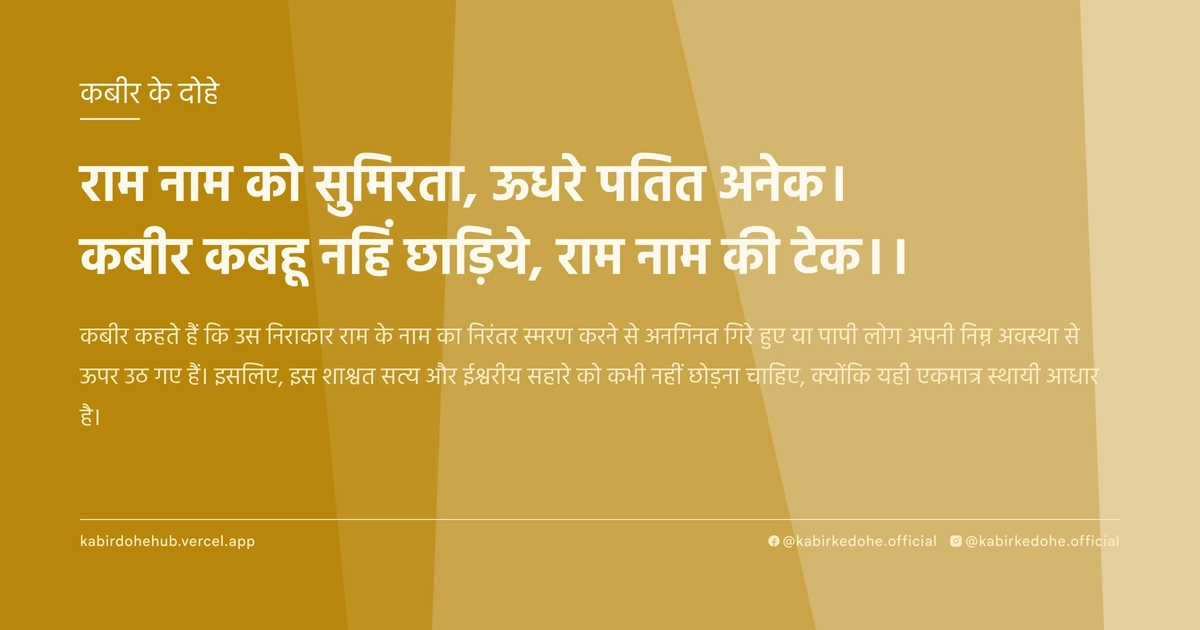
राम नाम को सुमिरता, ऊधरे पतित अनेक।
कबीर कबहू नहिं छाड़िये, राम नाम की टेक।।
Ram naam ko sumirta, udhare patit anek. Kabir kabahu nahi chhadye, Ram naam ki tek.
इस पृष्ठ पर इस कबीर दोहे का अर्थ (meaning), हिंदी व्याख्या और अंग्रेज़ी अनुवाद, दार्शनिक विश्लेषण और व्यावहारिक जीवन सीख दी गई है। यह दोहा भक्ति (Bhakti) विषय से जुड़ा है — Kabir doha meaning and explanation in Hindi and English.
अर्थ (Meaning):
कबीर कहते हैं कि उस निराकार राम के नाम का निरंतर स्मरण करने से अनगिनत गिरे हुए या पापी लोग अपनी निम्न अवस्था से ऊपर उठ गए हैं। इसलिए, इस शाश्वत सत्य और ईश्वरीय सहारे को कभी नहीं छोड़ना चाहिए, क्योंकि यही एकमात्र स्थायी आधार है।
Kabir asserts that by remembering the name of the Formless Ram, countless fallen souls have been liberated from their degradation. He urges that one must never abandon this divine support, for it is the only enduring anchor in the turbulent sea of existence.
व्याख्या (Interpretation):
यहाँ 'राम' दशरथ पुत्र नहीं, बल्कि वह 'रहीम' या 'अविनाशी' तत्व है जो कण-कण में व्याप्त है। शाब्दिक अर्थ है नाम जप, लेकिन आध्यात्मिक अर्थ है अपनी चेतना को उस परम सत्य के साथ जोड़ना। यह निर्गुण भक्ति का मार्ग है जहाँ बाहरी कर्मकांडों के बजाय आंतरिक स्मृति को प्रधानता दी गई है। जब साधक 'राम' का स्मरण करता है, तो वह वास्तव में अपनी सीमित अहंकार-युक्त पहचान को मिटाकर अनंत ब्रह्म में विलीन होने का प्रयास करता है। यह प्रक्रिया माया के पर्दे को हटाती है और आत्मा को यह बोध कराती है कि वह स्वयं उस परमात्मा का अंश है। इस प्रकार, 'पतित' होने का अर्थ नैतिक पतन नहीं, बल्कि अज्ञानता के कारण स्वयं को ईश्वर से अलग मानना है।
Here, 'Ram' does not refer to the historical prince of Ayodhya, but to the 'Rahiim' or the Eternal Element that permeates every atom. While the literal meaning suggests chanting, the spiritual essence is the alignment of consciousness with the Absolute Truth. This is the path of Nirgun Bhakti, prioritizing internal remembrance over external rituals. When the seeker remembers 'Ram', they are actually attempting to dissolve the limited, ego-driven identity into the infinite Brahman. This process lifts the veil of Maya, allowing the Atman to realize its non-duality with the Divine. Thus, being 'fallen' (patit) does not merely imply moral sin, but the spiritual ignorance of perceiving oneself as separate from the Whole.
दार्शनिक विश्लेषण (Philosophical Analysis):
कबीर का यह दोहा उस युग की उपज है जब धर्म केवल बाहरी प्रतीकों, जातिगत भेदभाव और जटिल अनुष्ठानों में सिमट गया था। कबीर ने इन सबको नकारते हुए 'नाम' की महिमा गाई, जो किसी विशेष धर्म या संप्रदाय की बपौती नहीं है। उनका दृष्टिकोण अद्वैत वेदांत के करीब है, जहाँ जीव और ब्रह्म की एकता पर बल दिया गया है। वे बताते हैं कि मुक्ति किसी तीर्थयात्रा या कठिन तपस्या से नहीं, बल्कि निरंतर जागरूकता (स्मरण) से आती है।
सूफी मत के 'ज़िक्र' (Zikr) की तरह, कबीर का 'सुमिरन' हृदय की वह अवस्था है जहाँ विचार शांत हो जाते हैं और केवल अस्तित्व का अनुभव शेष रहता है। यह मनोवैज्ञानिक रूपांतरण की प्रक्रिया है; जब मन एक ही बिंदु (राम) पर केंद्रित होता है, तो बिखरी हुई ऊर्जा एकत्रित होकर आत्म-साक्षात्कार का मार्ग प्रशस्त करती है।
कबीर का 'राम' एक मेटाफर है उस सार्वभौमिक चेतना के लिए जिसे हर भाषा में अलग नाम दिया गया। वे जाति व्यवस्था पर प्रहार करते हुए यह स्पष्ट करते हैं कि ईश्वरीय कृपा किसी विशेष कुल के लिए आरक्षित नहीं है; एक 'पतित' व्यक्ति भी केवल सच्चे समर्पण से मुक्त हो सकता है।
यहाँ 'टेक' शब्द का अर्थ है सहारा या आधार। संसार की हर वस्तु नश्वर है—रिश्ते, पद, और शरीर। केवल वह निराकार तत्व ही स्थायी है। कबीर चेतावनी देते हैं कि सांसारिक मोह-माया का सहारा लेना वैसा ही है जैसे रेत पर महल बनाना।
अंततः, यह दोहा अहंकार के विसर्जन की बात करता है। जब 'मैं' मिटता है, तब 'राम' प्रकट होते हैं। यह विरोधाभास है कि नाम का सहारा लेकर ही नाम से परे की स्थिति (शून्यता) प्राप्त की जा सकती है।
This couplet emerges from an era where religion had dwindled into external symbols, caste hierarchies, and complex rituals. Kabir rejected these, championing the glory of the 'Name'—a truth that belongs to no specific sect or religion. His perspective aligns closely with Advaita Vedanta, emphasizing the essential oneness of the individual soul (Jiva) and the Absolute (Brahman). He posits that liberation is achieved not through pilgrimages or rigorous penance, but through constant awareness (remembrance).
Similar to the Sufi practice of 'Zikr', Kabir's 'Sumiran' is a state of the heart where discursive thoughts cease, leaving only the experience of pure existence. This is a process of psychological transformation; when the mind converges on a single point (Ram), fragmented energy is gathered, paving the way for self-realization.
Kabir's 'Ram' serves as a metaphor for the universal consciousness known by different names across languages. By attacking the caste system, he clarifies that divine grace is not reserved for a specific lineage; even a 'fallen' soul can be liberated through sincere surrender.
The word 'Tek' signifies a support or anchor. Every worldly object is transient—relationships, status, and the physical body. Only the Formless Element is permanent. Kabir warns that relying on worldly attachments is akin to building a castle on sand.
Ultimately, this verse speaks of the dissolution of the ego. When the 'I' vanishes, 'Ram' manifests. It is a spiritual paradox: by clinging to the Name, one eventually transcends the Name to reach the state of Void (Shunya).
मूल संदेश (Core Message):
- बाहरी कर्मकांडों के बजाय आंतरिक स्मृति ही वास्तविक मुक्ति का मार्ग है।
- अहंकार का विसर्जन ही परमात्मा के साथ एकाकार होने की पहली शर्त है।
- संसार की नश्वरता को पहचानकर केवल शाश्वत सत्य का सहारा लें।
- कोई भी व्यक्ति इतना 'पतित' नहीं है कि वह ईश्वरीय प्रेम से ऊपर न उठ सके।
- निरंतर जागरूकता ही अज्ञानता के अंधेरे को मिटाने वाला एकमात्र दीपक है।
- Internal remembrance, rather than external ritual, is the true path to liberation.
- The dissolution of the ego is the primary condition for union with the Divine.
- Recognize the transience of the world and anchor yourself only in the Eternal Truth.
- No soul is so 'fallen' that it cannot be uplifted by Divine Love.
- Constant awareness is the only lamp capable of dispelling the darkness of ignorance.
व्यावहारिक उदाहरण (Practical Example):
वाराणसी के एक पुराने घाट पर रहने वाले माधव नाम के एक वृद्ध नाविक की कहानी है। माधव का जीवन संघर्षों से भरा था; उसने गरीबी देखी और कई बार जीवन की कड़वाहट के कारण वह क्रोध और ईर्ष्या के अंधेरे में डूबा रहा। वह खुद को एक 'पतित' व्यक्ति मानता था, जिसने जीवन में केवल गलतियाँ की थीं।
वह अक्सर देखता था कि लोग गंगा में डुबकी लगाकर अपने पाप धोने का दावा करते हैं, लेकिन उनके व्यवहार में कोई बदलाव नहीं आता था। माधव को यह सब ढोंग लगता था। वह चुपचाप अपनी नाव चलाता, लेकिन उसके मन में एक गहरी तड़प थी कि क्या उसके जैसा साधारण और 'गंदा' इंसान कभी शांति पा सकता है?
एक दिन उसकी मुलाकात एक घुमक्कड़ फकीर से हुई, जिसने उसे कबीर का यह दोहा सुनाया। फकीर ने कहा, 'माधव, राम कोई मूर्ति नहीं जिसे तुम मंदिर में ढूंढो, बल्कि वह लय है जो तुम्हारी नाव की लहरों में है, तुम्हारी सांसों में है। बस उसे याद रखो, चाहे तुम नाव चला रहे हो या सो रहे हो।'
माधव ने इसे एक प्रयोग की तरह लिया। उसने किसी मंदिर जाना शुरू नहीं किया, न ही कोई कठिन व्रत रखा। उसने बस अपनी हर सांस के साथ उस 'अविनाशी' तत्व का स्मरण करना शुरू किया। जब वह नाव खेता, तो वह लहरों की आवाज़ को राम की ध्वनि मानने लगा। जब कोई यात्री उसे गाली देता, तो वह उस क्रोध को राम के चरणों में समर्पित कर देता।
धीरे-धीरे, माधव के भीतर एक अद्भुत बदलाव आया। उसकी ईर्ष्या शांत होने लगी। वह अब खुद को 'पापी' नहीं, बल्कि उस अनंत चेतना का एक छोटा सा हिस्सा महसूस करने लगा। उसकी नाव चलाने की लय बदल गई; वह अब केवल पैसे के लिए नहीं, बल्कि सेवा के भाव से नाव चलाने लगा।
एक बार एक बहुत अमीर व्यापारी उसकी नाव पर सवार हुआ और अपनी धन-संपत्ति का अहंकार दिखाने लगा। माधव ने मुस्कुराते हुए बस एक बात कही, 'साहब, यह नाव और यह पानी तो राम का है, हम तो बस मुसाफिर हैं।' व्यापारी उसकी शांति देखकर दंग रह गया।
माधव ने महसूस किया कि जिस 'टेक' (सहारे) की तलाश वह बाहर कर रहा था, वह उसके भीतर ही था। उसने अपनी पूरी जिंदगी की कड़वाहट को उस एक नाम के सुमिरन में विलीन कर दिया।
अंत में, माधव की मृत्यु बहुत शांत हुई। उसके चेहरे पर एक ऐसी मुस्कान थी जो केवल उन्हें मिलती है जिन्होंने जीवन के अंतिम सत्य को पा लिया हो। वह नाविक, जिसे दुनिया 'पतित' समझती थी, वास्तव में सबसे अधिक 'ऊधरे' (उद्धारित) हुआ था।
Consider the story of Madhav, an elderly boatman living on the ancient ghats of Varanasi. Madhav's life was fraught with struggle; he had endured extreme poverty and, driven by the bitterness of life, had often sunk into the darkness of anger and envy. He viewed himself as a 'fallen' man, believing his life was merely a series of mistakes.
He often observed people claiming to wash away their sins by dipping into the Ganges, yet their behavior remained unchanged. To Madhav, this seemed like a facade. He rowed his boat in silence, but within him burned a deep longing: could a simple, 'tainted' man like him ever find peace?
One day, he met a wandering fakir who recited this couplet of Kabir. The fakir told him, 'Madhav, Ram is not an idol to be sought in a temple, but the rhythm within the waves of your boat, the breath in your lungs. Just remember Him, whether you are rowing or sleeping.'
Madhav took this as an experiment. He didn't start visiting temples or observing rigorous fasts. He simply began to remember that 'Indestructible Element' with every breath. As he rowed, he began to perceive the sound of the waves as the sound of Ram. When a passenger insulted him, he surrendered that anger to the Divine.
Gradually, a profound transformation occurred. His envy subsided. He no longer saw himself as a 'sinner' but as a tiny fragment of that infinite consciousness. The rhythm of his rowing changed; he no longer worked merely for money, but with a spirit of service.
Once, a wealthy merchant boarded his boat and began boasting of his riches. Madhav smiled and simply said, 'Sir, this boat and this water belong to Ram; we are all just travelers.' The merchant was stunned by his serenity.
Madhav realized that the 'Tek' (support) he had been searching for externally was already within him. He dissolved the bitterness of his entire life into the remembrance of that one Name.
In the end, Madhav passed away in profound peace. A smile graced his face—the kind of smile reserved for those who have realized the ultimate truth. The boatman, whom the world deemed 'fallen', was in truth the most liberated of all.
अभ्यास मार्गदर्शन (Practice Guidance):
- दैनिक सुमिरन: दिन में तीन बार (सुबह, दोपहर, शाम) 10 मिनट के लिए मौन बैठें और अपनी सांसों के साथ 'राम' (या अपने इष्ट के निराकार रूप) के विचार को जोड़ें।
- जागरूकता अभ्यास: काम करते समय (जैसे चलना, खाना बनाना, सफाई करना) मन में यह भाव रखें कि यह कार्य आप नहीं, बल्कि वह सार्वभौमिक चेतना कर रही है।
- आत्म-पूछताछ जर्नल: प्रतिदिन लिखें कि आज किस क्षण में आपका अहंकार (I-ness) हावी हुआ और कैसे उस क्षण में 'नाम' का स्मरण आपको वापस केंद्र में ला सकता था।
- डायग्नोस्टिक चेकलिस्ट: क्या मैं संकट के समय घबराता हूँ? क्या मैं दूसरों को उनकी गलतियों के लिए जज करता हूँ? यदि हाँ, तो इसका अर्थ है कि मेरी 'टेक' अभी भी सांसारिक है, ईश्वरीय नहीं।
- Daily Sumiran: Three times a day (morning, noon, evening), sit in silence for 10 minutes and synchronize the thought of 'Ram' (or your concept of the Formless Divine) with your breath.
- Mindfulness Practice: While performing mundane tasks (walking, cooking, cleaning), maintain the awareness that it is the Universal Consciousness acting through you, not the limited ego.
- Self-Inquiry Journal: Daily record the moments where your ego (I-ness) dominated and reflect on how remembering the 'Name' could have brought you back to center.
- Diagnostic Checklist: Do I panic during crises? Do I judge others for their flaws? If yes, it indicates that my 'Tek' (support) is still anchored in the worldly, not the Divine.
चिंतन प्रश्न (Reflection Questions):
- मैं किन सांसारिक 'टेक' (सहारों) पर निर्भर हूँ, और यदि वे आज छिन जाएं, तो मेरी पहचान क्या रह जाएगी?
- क्या मेरा 'ईश्वर' केवल एक डर या पुरस्कार की उम्मीद है, या वह मेरी हर सांस का हिस्सा है?
- मेरे भीतर का वह कौन सा हिस्सा है जिसे मैं 'पतित' मानता हूँ, और क्या मैं उसे स्वीकार करने का साहस रखता हूँ?
- क्या मेरी भक्ति दूसरों को छोटा दिखाने का एक साधन है, या यह वास्तव में मेरे अहंकार को मिटा रही है?
- डिजिटल युग के शोर में, मैं अपनी आंतरिक शांति और 'सुमिरन' के लिए कितना समय निकाल पाता हूँ?
- Upon which worldly 'Tek' (supports) do I rely, and if they were stripped away today, what would remain of my identity?
- Is my 'God' merely a source of fear or a hope for reward, or is the Divine an integral part of my every breath?
- Which part of myself do I consider 'fallen', and do I have the courage to fully accept and integrate it?
- Is my spirituality a tool to feel superior to others, or is it genuinely dissolving my ego?
- In the noise of the digital age, how much space do I truly carve out for internal silence and 'Sumiran'?