
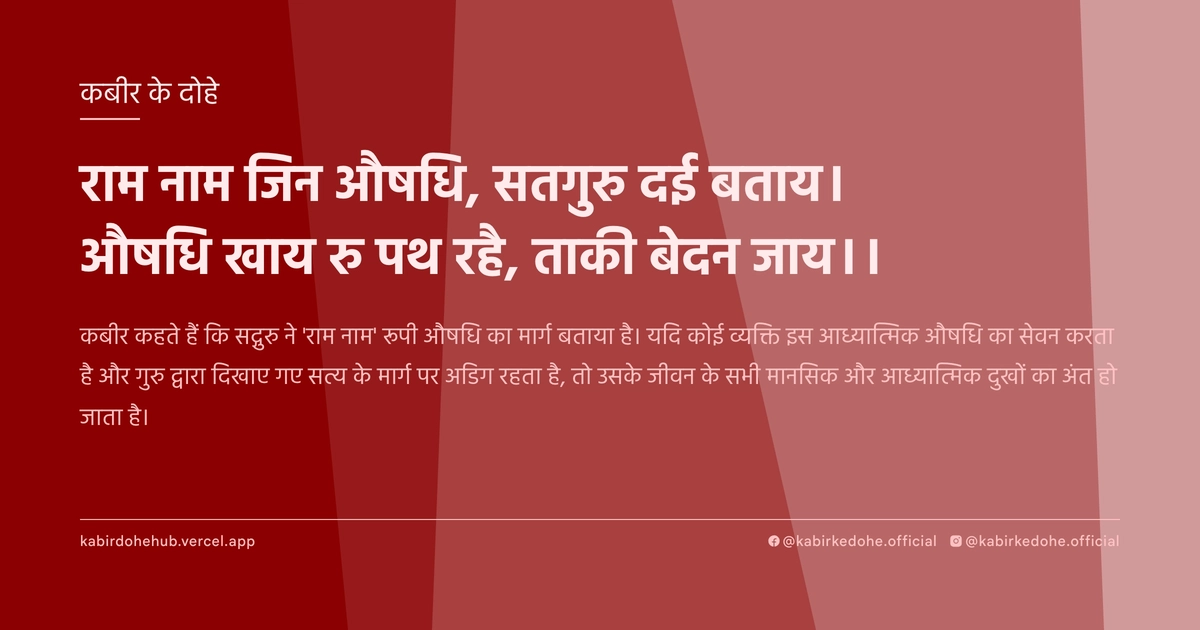
राम नाम जिन औषधि, सतगुरु दई बताय।
औषधि खाय रु पथ रहै, ताकी बेदन जाय।।
Ram naam jin aushadhi, satguru dai batay. Aushadhi khay ru path rahaye, taki bedan jaaye.
इस पृष्ठ पर इस कबीर दोहे का अर्थ (meaning), हिंदी व्याख्या और अंग्रेज़ी अनुवाद, दार्शनिक विश्लेषण और व्यावहारिक जीवन सीख दी गई है। यह दोहा गुरु महत्व (The Guru's Importance) विषय से जुड़ा है — Kabir doha meaning and explanation in Hindi and English.
अर्थ (Meaning):
कबीर कहते हैं कि सद्गुरु ने 'राम नाम' रूपी औषधि का मार्ग बताया है। यदि कोई व्यक्ति इस आध्यात्मिक औषधि का सेवन करता है और गुरु द्वारा दिखाए गए सत्य के मार्ग पर अडिग रहता है, तो उसके जीवन के सभी मानसिक और आध्यात्मिक दुखों का अंत हो जाता है।
Kabir asserts that the True Guru has revealed the 'Name of Ram' as a potent spiritual medicine. He explains that if a seeker consumes this divine remedy and remains steadfast on the path prescribed by the Guru, all their existential suffering and mental agonies will vanish.
व्याख्या (Interpretation):
यहाँ 'राम' किसी व्यक्ति विशेष नहीं, बल्कि उस निर्गुण निराकार तत्व का प्रतीक है जो कण-कण में व्याप्त है। 'औषधि' का अर्थ केवल मंत्र जाप नहीं, बल्कि उस चेतना का बोध है जो अहंकार को मिटाती है। कबीर संकेत देते हैं कि रोग बाहरी नहीं, बल्कि आंतरिक है—अज्ञान और माया का रोग। जब साधक गुरु के मार्गदर्शन में इस नाम-स्मरण को आत्मसात करता है, तो वह द्वैत से अद्वैत की ओर बढ़ता है। यह प्रक्रिया आत्मा और परमात्मा के मिलन की है, जहाँ 'मैं' का विसर्जन होता है। अंततः, यह दोहा इस विरोधाभास को दर्शाता है कि मुक्ति बाहर नहीं, बल्कि भीतर की औषधि में छिपी है।
In this context, 'Ram' does not refer to a mythological deity but to the Nirgun (formless) Absolute that permeates every atom of existence. The 'medicine' is not merely the repetition of a word, but the awakening of a consciousness that dissolves the ego. Kabir suggests that the true ailment is not physical, but the spiritual sickness of ignorance (Avidya) and the illusion of Maya. As the seeker internalizes this divine vibration under the Guru's guidance, they transition from duality to non-duality (Advaita). This process is the merging of the Atman with Brahman, where the 'I' is surrendered. Ultimately, the doha highlights the paradox that liberation is not found in external rituals, but in the internal alchemy of the soul.
दार्शनिक विश्लेषण (Philosophical Analysis):
कबीर का यह दोहा उस युग की प्रतिक्रिया है जहाँ धर्म केवल कर्मकांडों और बाहरी दिखावे तक सीमित था। उन्होंने स्पष्ट किया कि मोक्ष किसी तीर्थ या मंदिर में नहीं, बल्कि आंतरिक शुद्धि में है। यह विचार अद्वैत वेदांत के करीब है, जहाँ माना जाता है कि आत्मा और ब्रह्म एक ही हैं, बस अज्ञान की परत ने उन्हें अलग कर रखा है।
सूफी मत के 'ज़िक्र' (स्मरण) की तरह, कबीर 'नाम' पर जोर देते हैं। उनके लिए नाम एक यंत्र है जो मन की चंचलता को शांत करता है। यह मनोवैज्ञानिक रूपांतरण की प्रक्रिया है, जहाँ व्यक्ति अपनी पहचान को सामाजिक पद और जाति से हटाकर सार्वभौमिक चेतना से जोड़ता है।
कबीर ने जाति और धर्म के भेदभाव को पूरी तरह नकार दिया। उनके अनुसार, 'राम नाम' की औषधि सबके लिए उपलब्ध है, चाहे वह किसी भी कुल का हो। यह सामाजिक समानता का एक आध्यात्मिक घोषणापत्र है, जो मनुष्य को उसकी बाहरी पहचान से मुक्त कर उसे शुद्ध आत्मा के रूप में देखता है।
यहाँ 'सद्गुरु' की भूमिका अनिवार्य है क्योंकि बिना मार्गदर्शक के साधक अक्सर माया के जाल में फंसकर गलत रास्ते पर निकल जाता है। गुरु वह दर्पण है जो साधक को उसके अपने असली स्वरूप का दर्शन कराता है। यह केवल ज्ञान का हस्तांतरण नहीं, बल्कि एक जीवंत अनुभव का संचार है।
अंततः, यह विश्लेषण बताता है कि 'बेदन' या दर्द वास्तव में हमारी इच्छाओं और आसक्तियों का परिणाम है। जब नाम-औषधि अहंकार को नष्ट करती है, तो वह दर्द स्वतः समाप्त हो जाता है। यह एक ऐसी चिकित्सा है जो शरीर को नहीं, बल्कि अस्तित्व के मूल कारण को ठीक करती है।
Kabir's doha is a profound reaction to an era where religion had devolved into mere ritualism and outward displays of piety. He clarifies that liberation is not found in pilgrimages or temples, but in internal purification. This aligns closely with Advaita Vedanta, which posits that the Atman and Brahman are identical, separated only by the veil of ignorance.
Similar to the Sufi practice of 'Zikr' (remembrance), Kabir emphasizes the 'Naam'. For him, the Name is a spiritual tool that stills the restlessness of the mind. This is a process of psychological transformation, where the individual shifts their identity from social status and caste to a universal consciousness.
Kabir vehemently rejected the hierarchies of caste and creed. He asserts that the medicine of 'Ram Naam' is accessible to all, regardless of their birth. This serves as a spiritual manifesto for social equality, viewing the human being as a pure soul stripped of external labels.
The role of the 'Satguru' is indispensable here, as without a guide, the seeker often falls prey to the illusions of Maya. The Guru acts as a mirror, reflecting the seeker's true essence. This is not a mere transfer of information, but the transmission of a living experience.
Ultimately, this analysis reveals that 'Bedan' or suffering is the byproduct of our desires and attachments. When the medicine of the Name annihilates the ego, the suffering ceases naturally. It is a cure that targets the root cause of existential angst rather than the symptoms.
मूल संदेश (Core Message):
- बाहरी अनुष्ठान केवल आवरण हैं; वास्तविक उपचार भीतर है।
- अहंकार वह रोग है जिसे केवल आत्म-बोध की औषधि मिटा सकती है।
- सद्गुरु केवल रास्ता दिखाते हैं, चलना साधक को स्वयं पड़ता है।
- नाम का जाप केवल शब्द नहीं, बल्कि चेतना का विस्तार है।
- जब 'मैं' मिटता है, तब समस्त दुखों का अंत होता है।
- शांति किसी गंतव्य का नाम नहीं, बल्कि चलने का तरीका है।
- External rituals are mere veils; the true healing lies within.
- Ego is the disease that only the medicine of self-realization can cure.
- The Guru shows the path, but the walking must be done by the seeker.
- The repetition of the Name is not a word, but an expansion of consciousness.
- When the 'I' dissolves, all suffering comes to an end.
- Peace is not a destination, but a manner of walking through life.
व्यावहारिक उदाहरण (Practical Example):
वाराणसी के एक पुराने घाट पर रहने वाले माधव नाम के एक वृद्ध बुनकर थे। माधव का जीवन केवल धागों को जोड़ने और कपड़े बुनने में बीत गया, लेकिन उनके मन में एक गहरी बेचैनी थी। उन्हें लगता था कि जीवन का कोई उद्देश्य नहीं है और वे अपने अकेलेपन और पुराने दुखों से बहुत परेशान थे।
वे हर साल बड़े-बड़े मेलों में जाते, दान करते और पंडितों से उपाय पूछते, लेकिन शांति नहीं मिली। एक दिन उनकी मुलाकात एक फकीर से हुई, जिसने उन्हें कोई मंत्र नहीं दिया, बल्कि केवल यह कहा कि 'अपने भीतर के शोर को सुनो और उस शोर के पीछे छिपे मौन को राम कहो'।
माधव ने पहले तो इसे मजाक समझा, लेकिन फिर उन्होंने प्रयास किया। जब भी वे करघे पर काम करते, वे बाहरी दुनिया की बातों के बजाय अपने भीतर उठने वाले क्रोध और दुख को देखना शुरू करते। उन्होंने उस 'नाम' को एक औषधि की तरह इस्तेमाल करना शुरू किया।
शुरुआत में यह कठिन था। जब भी कोई ग्राहक उनसे बहस करता, माधव को पुराना गुस्सा आता। लेकिन वे तुरंत याद करते कि यह गुस्सा ही वह 'रोग' है जिसे उन्हें ठीक करना है। वे चुपचाप उस आंतरिक मौन (राम) की शरण में चले जाते।
धीरे-धीरे, माधव का व्यवहार बदलने लगा। जो व्यक्ति पहले चिड़चिड़ा रहता था, अब वह घाट पर सबसे शांत व्यक्ति बन गया था। उनके चेहरे पर एक ऐसी चमक थी जो किसी महंगी औषधि से नहीं, बल्कि आंतरिक शांति से आई थी।
एक दिन उनके बेटे ने पूछा, 'पिताजी, आपने कौन सी दवा ली कि आप इतने खुश रहने लगे?' माधव मुस्कुराए और बोले, 'बेटा, मैंने वह दवा ली जो मुफ्त है, लेकिन जिसे पाने के लिए अहंकार की कीमत चुकानी पड़ती है।'
उन्होंने महसूस किया कि उनका दुख बाहरी परिस्थितियों के कारण नहीं, बल्कि उनके मन के जुड़ाव के कारण था। जब उन्होंने 'नाम' के माध्यम से स्वयं को उस विराट सत्ता से जोड़ लिया, तो व्यक्तिगत दुख छोटे पड़ गए।
माधव अब केवल कपड़े नहीं बुन रहे थे, बल्कि वे प्रेम और शांति का एक जीवंत उदाहरण बन गए थे। उनकी कहानी यह सिखाती है कि आध्यात्मिक औषधि बाहरी दुनिया में नहीं, बल्कि जागरूकता के अभ्यास में है।
अंत में, माधव ने जाना कि सद्गुरु का मार्ग कोई कठिन तपस्या नहीं, बल्कि वर्तमान क्षण में पूरी तरह उपस्थित होना है। यही वह 'पथ' था जिस पर चलकर उनके जीवन के सारे 'बेदन' समाप्त हो गए।
In the ancient ghats of Varanasi lived an elderly weaver named Madhav. Madhav's life had been spent weaving threads and fabrics, yet a deep restlessness lingered in his heart. He felt his life lacked purpose and was plagued by loneliness and old grievances.
Every year, he visited grand fairs, gave donations, and sought remedies from priests, but peace remained elusive. One day, he encountered a wandering fakir who gave him no complex mantra, but simply said, 'Listen to the noise within you, and call the silence hidden behind that noise Ram.'
Madhav initially dismissed this as a joke, but eventually, he tried. While working at his loom, instead of focusing on the external chatter of the market, he began to observe the anger and sorrow rising within him. He started using this 'Name' as a spiritual medicine.
It was difficult at first. Whenever a customer argued with him, Madhav's old temper would flare. But he would immediately remind himself that this anger was the 'disease' he needed to cure. He would silently retreat into that inner silence (Ram).
Gradually, Madhav's behavior shifted. The man who was once irritable became the most serene person on the ghat. A radiance appeared on his face—not from any physical medicine, but from an internal stillness.
One day, his son asked, 'Father, what medicine did you take that made you so happy?' Madhav smiled and replied, 'Son, I took a medicine that is free, but to obtain it, one must pay the price of their ego.'
He realized that his suffering was not caused by external circumstances, but by his internal attachments. Once he connected himself to the universal consciousness through the 'Name', his personal sorrows became insignificant.
Madhav was no longer just weaving cloth; he had become a living example of love and peace. His story teaches that the spiritual remedy is not found in the external world, but in the practice of awareness.
Finally, Madhav understood that the path of the Satguru is not a grueling penance, but the act of being fully present in the current moment. This was the 'path' that finally extinguished all the 'bedan' of his life.
अभ्यास मार्गदर्शन (Practice Guidance):
- दैनिक अभ्यास: प्रतिदिन 20 मिनट मौन बैठें। जब भी मन में कोई विचार या दुख आए, उसे एक 'रोग' की तरह देखें और 'राम' (शुद्ध चेतना) के विचार से उसे संतुलित करें।
- आत्म-पूछताछ जर्नल: प्रतिदिन लिखें—'आज मेरा कौन सा अहंकार मुझे दुखी कर रहा था?' और 'क्या मैं इस दुख को साक्षी भाव से देख पाया?'
- व्यवहारिक परिवर्तन: जब भी किसी के प्रति क्रोध आए, तुरंत प्रतिक्रिया देने के बजाय तीन गहरी सांसें लें और याद करें कि सामने वाला भी उसी एक चेतना का हिस्सा है।
- निदान चेकलिस्ट: यदि आप अभी भी छोटी बातों पर विचलित होते हैं या दूसरों में दोष ढूंढते हैं, तो इसका अर्थ है कि 'औषधि' का प्रभाव अभी गहरा नहीं हुआ है। शांति और तटस्थता ही आपकी प्रगति के संकेतक हैं।
- Daily Practice: Sit in silence for 20 minutes daily. Whenever a distressing thought arises, view it as a 'disease' and balance it with the vibration of 'Ram' (Pure Consciousness).
- Self-Inquiry Journal: Write daily—'Which part of my ego caused me suffering today?' and 'Was I able to observe this pain from a witness perspective?'
- Behavioral Shift: When anger arises toward someone, instead of reacting immediately, take three deep breaths and remind yourself that the other person is also a manifestation of the same universal consciousness.
- Diagnostic Checklist: If you are still easily agitated by trivialities or find faults in others, the 'medicine' has not yet penetrated deeply. Equanimity and neutrality are the only true indicators of progress.
चिंतन प्रश्न (Reflection Questions):
- मेरा वह कौन सा 'मानसिक रोग' है जिसे मैं दवाइयों या बाहरी बदलावों से ठीक करने की कोशिश कर रहा हूँ, जबकि वह केवल जागरूकता से ठीक हो सकता है?
- क्या मैं 'राम नाम' को एक धार्मिक लेबल की तरह उपयोग कर रहा हूँ या एक आध्यात्मिक उपकरण की तरह?
- मेरे जीवन में 'सद्गुरु' कौन है—कोई व्यक्ति, या मेरी अपनी अंतरात्मा की वह आवाज जो मुझे सत्य की ओर ले जाती है?
- यदि आज मेरा सामाजिक पद, मेरी संपत्ति और मेरी पहचान छीन ली जाए, तो मेरे भीतर क्या बचेगा?
- क्या मैं वास्तव में दुखी हूँ, या मैं अपने दुख की कहानी को दोहराने का आदी हो गया हूँ?
- मेरे भीतर का कौन सा हिस्सा अभी भी यह मानता है कि मुक्ति किसी बाहरी स्थान या समय में मिलेगी?
- What is that 'mental ailment' I am trying to cure with external changes, when it can only be healed through awareness?
- Am I using 'Ram Naam' as a religious label or as a spiritual tool for transformation?
- Who is the 'Satguru' in my life—a person, or the inner voice of my own conscience leading me toward truth?
- If my social status, wealth, and identity were stripped away today, what would remain within me?
- Am I truly suffering, or have I simply become addicted to the narrative of my own pain?
- Which part of me still believes that liberation will be found in an external place or a future time?