
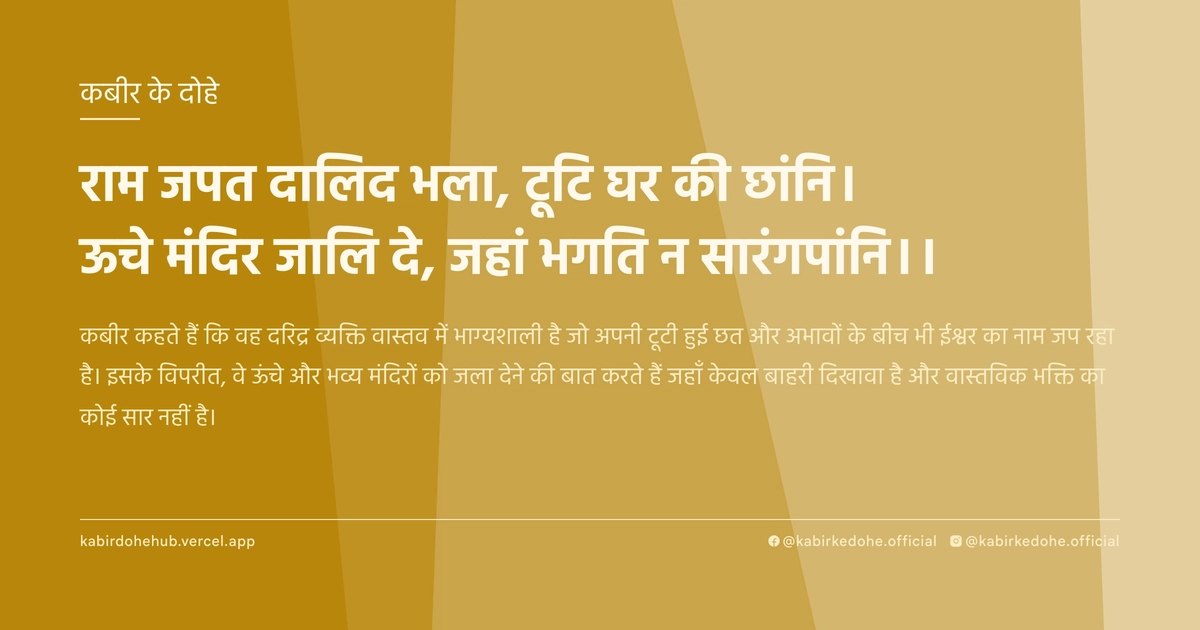
राम जपत दालिद भला, टूटि घर की छांनि।
ऊचे मंदिर जालि दे, जहां भगति न सारंगपांनि।।
Ram japat daalid bhala, tuti ghar ki chaani. Uche mandir jaali de, jahan bhagati na saarangpaani.
इस पृष्ठ पर इस कबीर दोहे का अर्थ (meaning), हिंदी व्याख्या और अंग्रेज़ी अनुवाद, दार्शनिक विश्लेषण और व्यावहारिक जीवन सीख दी गई है। यह दोहा धार्मिक पाखंड (Religious Hypocrisy) विषय से जुड़ा है — Kabir doha meaning and explanation in Hindi and English.
अर्थ (Meaning):
कबीर कहते हैं कि वह दरिद्र व्यक्ति वास्तव में भाग्यशाली है जो अपनी टूटी हुई छत और अभावों के बीच भी ईश्वर का नाम जप रहा है। इसके विपरीत, वे ऊंचे और भव्य मंदिरों को जला देने की बात करते हैं जहाँ केवल बाहरी दिखावा है और वास्तविक भक्ति का कोई सार नहीं है।
Kabir asserts that the impoverished soul who chants the name of the Divine despite a leaking roof and crushing poverty is truly blessed. In stark contrast, he suggests that grand, opulent temples should be razed if they are devoid of genuine devotion and spiritual essence, serving only as monuments to ego.
व्याख्या (Interpretation):
इस दोहे का शाब्दिक अर्थ है कि भौतिक अभाव भक्ति में बाधक नहीं हैं, बल्कि विलासिता अक्सर आध्यात्मिक पतन का कारण बनती है। रूपक के स्तर पर, 'टूटी छत' मानवीय दुखों और संसार की नश्वरता का प्रतीक है, जबकि 'ऊंचा मंदिर' अहंकार और संस्थागत धर्म के पाखंड को दर्शाता है। यह निर्गुण भक्ति का प्रमाण है, जहाँ ईश्वर किसी भवन में नहीं बल्कि हृदय की शुद्धता में बसता है। यहाँ 'राम' शब्द किसी विशिष्ट देवता के बजाय उस सार्वभौमिक चेतना (ब्रह्म) का संकेत है जो हर जीव में व्याप्त है। कबीर माया के भ्रम को तोड़कर यह समझाते हैं कि सच्ची आध्यात्मिक उपलब्धि बाहरी आडंबरों से नहीं, बल्कि आंतरिक समर्पण से आती है। यह अद्वैत वेदांत के उस सत्य को पुष्ट करता है कि आत्मा और परमात्मा एक हैं, और उनके बीच की दूरी केवल अहंकार की दीवार है।
Literally, the verse posits that material lack does not hinder devotion; rather, luxury often precipitates spiritual decay. Metaphorically, the "leaking roof" symbolizes human suffering and the transience of the physical world, while the "grand temple" represents the ego and the hypocrisy of institutionalized religion. This is a quintessential expression of Nirgun Bhakti, where the Divine resides not in a structure, but in the purity of the heart. The term "Ram" here transcends a specific deity, signaling the universal consciousness (Brahman) permeating every being. Kabir dismantles the illusion of Maya, arguing that true spiritual attainment arises from inner surrender rather than outward ostentation. It reinforces the Advaita Vedanta truth that the Atman and Brahman are non-dual, and the perceived separation is merely a wall built by the ego.
दार्शनिक विश्लेषण (Philosophical Analysis):
कबीर का यह दोहा उनके युग के सामाजिक और धार्मिक पाखंड पर एक तीखा प्रहार है। 15वीं शताब्दी में, धर्म अक्सर बाहरी अनुष्ठानों, जातिगत श्रेष्ठता और भव्य मंदिरों के निर्माण तक सीमित हो गया था। कबीर ने इस व्यवस्था को चुनौती देते हुए यह तर्क दिया कि ईश्वर की प्राप्ति के लिए किसी मध्यस्थ या भव्य संरचना की आवश्यकता नहीं है। उनका दृष्टिकोण सूफी मत के 'फना' (अहंकार का विनाश) और अद्वैत वेदांत के 'अहं ब्रह्मास्मि' के करीब है, जहाँ साधक को यह समझना होता है कि वह स्वयं ही वह सत्य है जिसे वह बाहर खोज रहा है।
यहाँ 'मंदिर जलाने' का आह्वान भौतिक विनाश नहीं, बल्कि मानसिक वैचारिक परिवर्तन का आह्वान है। यह उस मानसिक ढांचे को नष्ट करने की बात है जो धर्म को कर्मकांडों में बदल देता है। कबीर का दर्शन यह सिखाता है कि गरीबी अक्सर एक वरदान बन जाती है क्योंकि यह मनुष्य को भौतिक मोह से मुक्त कर देती है, जिससे वह ईश्वर के करीब पहुँच पाता है। इसके विपरीत, समृद्धि अक्सर 'माया' के जाल को मजबूत करती है, जिससे मनुष्य अपनी वास्तविक प्रकृति को भूल जाता है।
यह विश्लेषण यह स्पष्ट करता है कि कबीर केवल एक कवि नहीं, बल्कि एक मनोवैज्ञानिक क्रांतिकारी थे। वे जानते थे कि जब तक मनुष्य अपनी पहचान को बाहरी प्रतीकों (जैसे मंदिर, जाति, या पद) से जोड़ता रहेगा, वह कभी भी आंतरिक शांति प्राप्त नहीं कर पाएगा। उनके लिए भक्ति का अर्थ है—अपने भीतर के अंधकार को मिटाकर उस ज्योति को पहचानना जो सबके भीतर समान रूप से जल रही है।
कबीर का यह संदेश आज के युग में भी प्रासंगिक है, जहाँ धर्म अक्सर प्रदर्शन की वस्तु बन गया है। वे हमें याद दिलाते हैं कि आध्यात्मिकता का मार्ग 'होने' (Being) का है, न कि 'पाने' (Having) का। जब हम बाहरी दिखावे को त्याग कर आंतरिक सत्य की ओर मुड़ते हैं, तभी हम उस 'सारंगपांनि' या दिव्य ऊर्जा का अनुभव कर सकते हैं।
अंततः, यह दोहा हमें सिखाता है कि पवित्रता किसी स्थान की नहीं, बल्कि भाव की होती है। एक टूटी झोपड़ी में बैठा व्यक्ति यदि पूर्ण समर्पण में है, तो वह उस पाखंडी पुजारी से कहीं अधिक पवित्र है जो स्वर्ण मंडित मंदिरों में बैठकर अहंकार का पोषण करता है। यह अहंकार का पूर्ण विलोपन ही मोक्ष का एकमात्र मार्ग है।
This couplet is a piercing critique of the social and religious hypocrisy of Kabir's era. In the 15th century, religion had largely devolved into external rituals, caste superiority, and the construction of opulent temples. Kabir challenged this establishment, arguing that the realization of the Divine requires neither a mediator nor a grand structure. His perspective aligns closely with the Sufi concept of 'Fana' (the annihilation of the ego) and the Advaita Vedanta realization of 'Aham Brahmasmi,' where the seeker understands that they are the very Truth they seek externally.
The call to "burn the temples" is not an incitement to physical arson, but a demand for a mental and conceptual paradigm shift. It is a call to destroy the psychological framework that reduces spirituality to mere ritualism. Kabir's philosophy suggests that poverty can often become a blessing, as it strips away material attachments, thereby accelerating the soul's proximity to the Divine. Conversely, prosperity often strengthens the veil of 'Maya,' causing the individual to forget their true nature.
This analysis reveals Kabir not merely as a poet, but as a psychological revolutionary. He recognized that as long as a human ties their identity to external symbols—such as temples, caste, or status—they will never attain inner peace. For him, Bhakti is the process of extinguishing the darkness within to recognize the light that burns equally in every soul.
Kabir's message remains profoundly relevant today, where religion is often treated as a performative commodity. He reminds us that the spiritual path is about 'Being,' not 'Having.' Only when we pivot from external display to internal truth can we experience the 'Sarangpaani' or the divine energy.
Ultimately, the verse teaches that sanctity resides not in a location, but in an intention. A person in a dilapidated hut, existing in total surrender, is far holier than a hypocritical priest in a gold-plated temple who nurtures his own ego. The complete dissolution of this ego is the only gateway to liberation.
मूल संदेश (Core Message):
- बाहरी भव्यता अक्सर आंतरिक शून्यता का मुखौटा होती है।
- सच्ची भक्ति अभावों में अधिक प्रखर और शुद्ध होती है।
- ईश्वर पत्थरों के ढांचों में नहीं, प्रेमपूर्ण हृदय में बसता है।
- अहंकार का विनाश ही वास्तविक आध्यात्मिक मंदिर का निर्माण है।
- भौतिक दरिद्रता आध्यात्मिक समृद्धि का मार्ग प्रशस्त कर सकती है।
- External grandeur is often a mask for internal emptiness.
- True devotion becomes more vivid and pure amidst deprivation.
- The Divine dwells in a loving heart, not in stone structures.
- The annihilation of ego is the construction of the real spiritual temple.
- Material poverty can pave the way for spiritual abundance.
व्यावहारिक उदाहरण (Practical Example):
एक समय की बात है, वाराणसी के एक पुराने मोहल्ले में माधव नाम का एक वृद्ध बुनकर रहता था। माधव की आर्थिक स्थिति अत्यंत दयनीय थी। उसकी झोपड़ी की छत घास-फूस की थी, जो हर मानसून में टपकती थी। उसके पास पहनने के लिए केवल एक फटी हुई धोती थी और खाने के लिए कभी-कभी एक सूखी रोटी। लेकिन माधव के चेहरे पर एक ऐसी शांति थी जो राजमहलों में नहीं मिलती थी। वह दिन भर करघे पर सूत कातता और निरंतर 'राम-राम' का जाप करता रहता। उसके लिए वह जाप केवल शब्द नहीं, बल्कि एक गहरा अनुभव था।
उसी शहर में एक बहुत बड़ा और भव्य मंदिर था, जहाँ के मुख्य पुजारी, पंडित दीनानाथ, अपनी विद्वत्ता और मंदिर की भव्यता के लिए प्रसिद्ध थे। दीनानाथ के पास सोने के पात्र, रेशमी वस्त्र और हजारों भक्तों का सम्मान था। लेकिन उनके मन में हमेशा एक बेचैनी रहती थी। वे इस बात से चिंतित रहते थे कि मंदिर की प्रतिष्ठा कैसे बढ़ाई जाए और अन्य मंदिरों से अपनी श्रेष्ठता कैसे सिद्ध की जाए। उनका पूरा जीवन बाहरी दिखावे और अनुष्ठानों के प्रबंधन में बीत रहा था।
एक दिन, भारी बारिश हो रही थी। माधव की छत पूरी तरह टूट गई और उसका घर पानी से भर गया। वह अपनी फटी चटाई समेटकर मंदिर के बरामदे में शरण लेने पहुँचा। पंडित दीनानाथ ने उसे देखा और घृणा से कहा, "तुम जैसे दरिद्र और गंदे लोग मेरे पवित्र मंदिर की शुद्धि को नष्ट कर देते हैं। जाओ यहाँ से!"
माधव ने बड़ी विनम्रता से उत्तर दिया, "महाराज, मेरा घर तो टूट गया, पर मेरा राम तो मेरे साथ है। आपकी छत तो सोने की है, पर क्या आपका राम आपके साथ है?"
दीनानाथ को यह बात चुभी। उन्होंने माधव का उपहास उड़ाते हुए कहा, "राम को पाने के लिए शुद्धता, विधि-विधान और भव्यता चाहिए होती है, जो तुम्हारे पास नहीं है।"
माधव मुस्कुराया और बोला, "पंडित जी, मैंने देखा है कि आप मंदिर की दीवारों को तो सोने से सजाते हैं, लेकिन अपने भीतर के अहंकार की धूल नहीं झाड़ते। जिस मंदिर में प्रेम और करुणा नहीं, वह केवल पत्थरों का ढेर है। मेरी टूटी छत ने मुझे सिखाया कि सब कुछ नश्वर है, केवल वह नाम ही सत्य है।"
उस रात, मंदिर में एक भीषण आग लगी, जिससे उसका आधा हिस्सा जलकर राख हो गया। दीनानाथ अपनी कीमती मूर्तियों और सोने के बर्तनों को बचाने के लिए पागलों की तरह चिल्ला रहे थे। वे अपनी संपत्ति खोने के दुख में टूट चुके थे। वहीं माधव, जो सब कुछ खो चुका था, शांत खड़ा था। उसने देखा कि दीनानाथ का अहंकार उस आग में जल रहा था।
माधव ने आगे बढ़कर दीनानाथ का हाथ पकड़ा और कहा, "अब आपका मंदिर जल गया है, अब शायद आपके भीतर का राम जाग सके।"
दीनानाथ को पहली बार महसूस हुआ कि जिस भव्यता पर उन्हें गर्व था, वह कितनी खोखली थी। उन्होंने देखा कि जिस दरिद्र को वे तुच्छ समझते थे, उसके पास वह मानसिक संपदा थी जिसे वे करोड़ों खर्च करके भी नहीं पा सके। उस दिन दीनानाथ ने अपनी पोथियाँ छोड़कर माधव के चरणों में बैठकर वास्तविक भक्ति का अर्थ सीखा। उन्होंने समझा कि ईश्वर सोने की दीवारों में नहीं, बल्कि एक टूटे हुए हृदय की सच्ची पुकार में बसता है।
Once, in an old neighborhood of Varanasi, lived an elderly weaver named Madhav. Madhav's financial condition was dire. His hut had a thatched roof that leaked during every monsoon. He possessed only one torn dhoti and occasionally a single dry roti for sustenance. Yet, Madhav's face radiated a peace unseen in royal palaces. As he worked his loom all day, he constantly chanted 'Ram-Ram.' For him, this chant was not mere words, but a profound experience.
In the same city stood a magnificent temple, where the chief priest, Pandit Dinanath, was renowned for his scholarship and the temple's opulence. Dinanath possessed golden vessels, silk robes, and the reverence of thousands. However, a constant restlessness plagued his mind. He was obsessed with increasing the temple's prestige and proving its superiority over others. His entire life was consumed by managing external displays and rituals.
One day, during a torrential downpour, Madhav's roof completely collapsed, flooding his home. He gathered his torn mat and sought shelter in the temple's veranda. Pandit Dinanath saw him and said with disdain, "Wretches like you destroy the purity of my sacred temple. Get out!"
Madhav replied with great humility, "Maharaj, my house has collapsed, but my Ram is with me. Your roof is made of gold, but is your Ram with you?"
Dinanath was stung by this. He mocked Madhav, saying, "To attain Ram, one needs purity, ritual, and grandeur, none of which you possess."
Madhav smiled and said, "Pandit ji, I have seen you adorn the temple walls with gold, but you do not brush away the dust of ego within. A temple without love and compassion is merely a pile of stones. My broken roof taught me that everything is transient; only the Name is Truth."
That night, a fierce fire broke out, reducing half the temple to ashes. Dinanath screamed frantically, trying to save his precious idols and golden vessels. He was devastated by the loss of his wealth. Meanwhile, Madhav, who had already lost everything, stood calmly. He observed that Dinanath's ego was burning in that fire.
Madhav stepped forward, took Dinanath's hand, and said, "Now that your temple has burned, perhaps the Ram within you can finally awaken."
For the first time, Dinanath realized how hollow the grandeur he prized truly was. He saw that the pauper he had deemed insignificant possessed a spiritual wealth that he could not buy with millions. That day, Dinanath set aside his scriptures and sat at Madhav's feet to learn the meaning of true devotion. He understood that God does not dwell in golden walls, but in the sincere cry of a broken heart.
अभ्यास मार्गदर्शन (Practice Guidance):
- दैनिक चिंतन: प्रतिदिन 15 मिनट मौन बैठें और विचार करें कि आपकी कौन सी बाहरी उपलब्धियां या वस्तुएं आपके अहंकार को बढ़ा रही हैं।
- आत्म-पूछताछ जर्नल: लिखें कि जब आप किसी 'अधम' या गरीब व्यक्ति से मिलते हैं, तो आपके मन में पहला विचार क्या आता है? क्या वह निर्णय आपकी आंतरिक श्रेष्ठता की भावना से प्रेरित है?
- व्यवहार परिवर्तन: सप्ताह में एक बार किसी ऐसे व्यक्ति की निस्वार्थ सेवा करें जिससे आप सामाजिक या आर्थिक कारणों से दूर रहते हैं, और उसमें उस 'दिव्य राम' को देखने का प्रयास करें।
- डायग्नोस्टिक चेकलिस्ट: यदि आप मंदिर/पूजा स्थल की भव्यता से अधिक प्रभावित होते हैं बजाय कि वहां की शांति के, या यदि आप अपनी भौतिक संपत्ति को अपनी आध्यात्मिक योग्यता मानते हैं, तो समझें कि आप 'माया' के प्रभाव में हैं।
- Daily Contemplation: Sit in silence for 15 minutes daily and reflect on which external achievements or possessions are inflating your ego.
- Self-Inquiry Journal: Record your first thought when encountering someone 'lowly' or impoverished. Is that judgment driven by a subconscious sense of superiority?
- Behavioral Shift: Once a week, selflessly serve someone you typically avoid due to social or economic barriers, and consciously attempt to perceive the 'Divine Ram' within them.
- Diagnostic Checklist: If you are more impressed by the grandeur of a shrine than its stillness, or if you equate material wealth with spiritual merit, recognize that you are under the influence of 'Maya'.
चिंतन प्रश्न (Reflection Questions):
- क्या मेरी धार्मिकता केवल सामाजिक स्वीकृति पाने का एक साधन है?
- यदि आज मेरी सारी संपत्ति और पद छीन लिए जाएं, तो क्या मेरे पास ईश्वर के साथ मेरा संबंध बचेगा?
- मैं किन 'मानसिक मंदिरों' (पूर्वाग्रहों) में कैद हूँ जो मुझे दूसरों की मानवता देखने से रोकते हैं?
- क्या मैं अपनी प्रार्थनाओं में ईश्वर को खोज रहा हूँ, या केवल अपनी इच्छाओं की पुष्टि?
- मेरे जीवन की 'टूटी छत' (मेरे दुख) मुझे ईश्वर के करीब ले जा रहे हैं या उनसे दूर?
- Is my religiosity merely a tool for gaining social acceptance?
- If all my wealth and status were stripped away today, would my relationship with the Divine remain?
- In which 'mental temples' (prejudices) am I imprisoned, preventing me from seeing the humanity in others?
- In my prayers, am I seeking the Divine, or merely seeking confirmation of my own desires?
- Is the 'leaking roof' of my life (my suffering) drawing me closer to the Truth or pushing me away?