
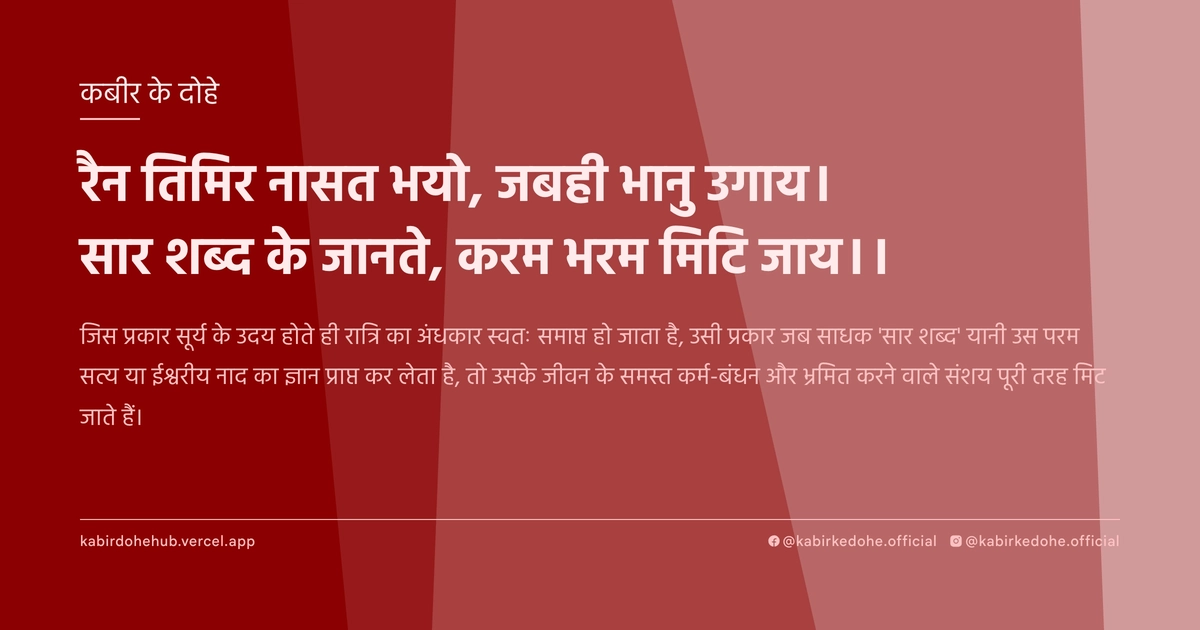
रैन तिमिर नासत भयो, जबही भानु उगाय।
सार शब्द के जानते, करम भरम मिटि जाय।।
Rain timir naasat bhayo, jabhee bhanu ugay. Saar shabd ke jaante, karam bharam miti jaaye.
इस पृष्ठ पर इस कबीर दोहे का अर्थ (meaning), हिंदी व्याख्या और अंग्रेज़ी अनुवाद, दार्शनिक विश्लेषण और व्यावहारिक जीवन सीख दी गई है। यह दोहा जागृति (The Wake-up Call) विषय से जुड़ा है — Kabir doha meaning and explanation in Hindi and English.
अर्थ (Meaning):
जिस प्रकार सूर्य के उदय होते ही रात्रि का अंधकार स्वतः समाप्त हो जाता है, उसी प्रकार जब साधक 'सार शब्द' यानी उस परम सत्य या ईश्वरीय नाद का ज्ञान प्राप्त कर लेता है, तो उसके जीवन के समस्त कर्म-बंधन और भ्रमित करने वाले संशय पूरी तरह मिट जाते हैं।
Just as the darkness of the night is instantly dissolved upon the rising of the sun, the realization of the 'Saar Shabd'—the Essential Word or the primordial vibration of Truth—eradicates all karmic burdens and the illusions of worldly existence from the seeker's consciousness.
व्याख्या (Interpretation):
कबीर यहाँ अंधकार को अज्ञान (माया) और सूर्य को ज्ञान (आत्म-साक्षात्कार) का प्रतीक मानते हैं। 'रैन तिमिर' केवल बाहरी रात नहीं, बल्कि वह मानसिक धुंध है जो आत्मा को परमात्मा से अलग दिखाती है। 'सार शब्द' वह अलौकिक ध्वनि या सत्य है जो निर्गुण भक्ति का केंद्र है, जहाँ शब्द केवल अक्षर नहीं बल्कि ब्रह्मांडीय चेतना है। जब यह ज्ञान जागता है, तो 'करम भरम' यानी कर्मों का चक्र और द्वैत का भ्रम समाप्त हो जाता है। यह अद्वैत वेदांत की उस स्थिति को दर्शाता है जहाँ ज्ञाता, ज्ञान और ज्ञेय एक हो जाते हैं। यहाँ विरोधाभास यह है कि जिसे हम अपना 'भाग्य' या 'कर्म' मानकर डरते हैं, वह वास्तव में केवल अज्ञानता का एक पर्दा है जिसे सत्य का एक क्षणिक प्रकाश मिटा सकता है।
Kabir employs the metaphor of darkness to represent ignorance (Maya) and the sun to symbolize the awakening of spiritual knowledge (Atma-Gyan). 'Rain Timir' is not a physical night but the psychological veil that obscures the unity of the soul and the Divine. The 'Saar Shabd' refers to the Essential Word or the primordial sound, a cornerstone of Nirgun Bhakti, where the Word is not mere language but the cosmic vibration of existence. Upon realizing this Truth, 'Karam Bharam'—the cycle of karmic bondage and the illusion of duality—is dissolved. This aligns with Advaita Vedanta, where the distinction between the knower, the known, and the knowledge vanishes. The central paradox presented is that the 'destiny' we fear is merely a shadow cast by ignorance, which evaporates instantly upon the arrival of the light of Truth.
दार्शनिक विश्लेषण (Philosophical Analysis):
कबीर का यह दोहा उनके युग के धार्मिक पाखंड और कर्मकांडीय जटिलताओं पर एक गहरा प्रहार है। उस समय समाज जाति और बाहरी अनुष्ठानों में उलझा हुआ था, जिसे कबीर 'भ्रम' कहते हैं। वे तर्क देते हैं कि मोक्ष किसी बाहरी तीर्थ या कठिन तपस्या से नहीं, बल्कि आंतरिक 'शब्द' के साक्षात्कार से मिलता है। यह दृष्टिकोण सूफी मत के 'कलमा' और योग परंपरा के 'नाद' के करीब है, जहाँ ध्वनि को ईश्वर तक पहुँचने का सेतु माना गया है।
दार्शनिक स्तर पर, यह अद्वैत वेदांत के उस सिद्धांत का समर्थन करता है कि ब्रह्म ही एकमात्र सत्य है और जगत मिथ्या है। जब साधक यह जान लेता है कि वह स्वयं उस अनंत चेतना का हिस्सा है, तो 'कर्ता' का अहंकार समाप्त हो जाता है। अहंकार का यह विलोपन ही कर्मों के बंधन से मुक्ति का एकमात्र मार्ग है। कबीर यहाँ यह स्पष्ट करते हैं कि कर्म केवल तब तक प्रभावी हैं जब तक हम स्वयं को शरीर और अहंकार के साथ जोड़कर देखते हैं।
सूफीवाद के प्रभाव में, कबीर 'शब्द' को उस नूर (प्रकाश) के रूप में देखते हैं जो हृदय के अंधेरे को मिटा देता है। यह केवल बौद्धिक ज्ञान नहीं है, बल्कि एक अनुभवात्मक सत्य है। वे चेतावनी देते हैं कि शास्त्रों को रटने से भ्रम बढ़ता है, जबकि अनुभवजन्य ज्ञान (Siddha-Gyan) भ्रम को काटता है।
मनोवैज्ञानिक रूप से, यह दोहा संज्ञानात्मक पुनर्गठन की बात करता है। जब हम अपनी पहचान को सीमित 'मैं' से हटाकर सार्वभौमिक 'सत्य' पर केंद्रित करते हैं, तो भय और चिंता का अंत होता है। यह 'अहं' से 'सोऽहम्' (वह मैं हूँ) की यात्रा है।
अंततः, कबीर का संदेश यह है कि सत्य सरल है, लेकिन हमारी जटिलताएं उसे कठिन बना देती हैं। जैसे सूर्य को उगने के लिए किसी प्रार्थना की आवश्यकता नहीं होती, वैसे ही सत्य उपलब्ध है; बस उसे पहचानने वाली दृष्टि की आवश्यकता है।
This couplet is a profound critique of the ritualistic complexities and religious hypocrisy prevalent during Kabir's era. Society was entangled in caste hierarchies and external ceremonies, which Kabir dismisses as 'Bharam' or illusion. He argues that liberation is not achieved through external pilgrimages or rigorous asceticism, but through the internal realization of the 'Shabd' (The Word). This perspective converges with the Sufi concept of the 'Kalima' and the Yogic tradition of 'Nada', where sound is viewed as the bridge to the Divine.
Philosophically, this supports the Advaita Vedanta tenet that Brahman is the only reality and the world is an illusion (Maya). When the seeker realizes they are an extension of this infinite consciousness, the ego of the 'doer' vanishes. This annihilation of the ego is the only path to liberation from karmic bondage. Kabir clarifies that karma only holds power as long as we identify ourselves with the physical body and the limited ego.
Influenced by Sufism, Kabir views the 'Shabd' as the 'Noor' (Divine Light) that dispels the darkness of the heart. This is not intellectual knowledge but an experiential truth. He warns that rote learning of scriptures often increases illusion, whereas empirical spiritual experience (Siddha-Gyan) severs it.
Psychologically, the verse speaks to a cognitive restructuring. By shifting identity from the limited 'I' to the universal 'Truth', fear and anxiety are extinguished. It is the journey from 'Aham' (ego) to 'So-ham' (I am That).
Ultimately, Kabir suggests that Truth is simple, but our complexities make it seem difficult. Just as the sun requires no prayer to rise, the Truth is always present; it only requires the eyes of awareness to perceive it.
मूल संदेश (Core Message):
- अज्ञानता एक अंधेरी रात है जिसे केवल सत्य का प्रकाश मिटा सकता है।
- बाहरी कर्मकांडों के बजाय आंतरिक 'शब्द' या चेतना की खोज करें।
- हम कर्मों के बंधन में नहीं, बल्कि अपनी पहचान के भ्रम में बंधे हैं।
- सत्य का अनुभव बौद्धिक नहीं, बल्कि अनुभवात्मक और जीवंत होता है।
- जब 'मैं' मिटता है, तब केवल अनंत और शुद्ध अस्तित्व शेष रहता है।
- Ignorance is a dark night that only the light of Truth can dissolve.
- Seek the internal 'Word' or consciousness rather than external rituals.
- We are bound not by karma, but by the illusion of our separate identity.
- The experience of Truth is not intellectual, but experiential and vivid.
- When the 'I' vanishes, only the infinite and pure existence remains.
व्यावहारिक उदाहरण (Practical Example):
वाराणसी के घाटों पर रहने वाले एक वृद्ध बुनकर, माधव, का जीवन केवल धागों और रंगों के बीच सिमटा था। वह अपनी गरीबी और असफलताओं को अपने 'पिछले जन्मों के कर्मों' का दंड मानता था। वह हर दिन मंदिर जाता, घंटों प्रार्थना करता और अपनी नियति को कोसता, यह सोचकर कि उसका जीवन एक अंधेरी रात है जिससे वह कभी नहीं जाग पाएगा।
एक दिन उसकी मुलाकात एक घुमक्कड़ फकीर से हुई, जिसने माधव से पूछा, 'क्या तुम धागे को देखते हो या उस कपड़े को जो उससे बनेगा?' माधव ने कहा, 'मैं केवल धागे की उलझन देखता हूँ।' फकीर ने मुस्कुराकर कहा, 'यही तुम्हारा भ्रम है। तुम स्वयं को उलझा हुआ धागा मान रहे हो, जबकि तुम वह बुनकर हो जिसने इस पूरे संसार को बुना है।'
माधव को यह बात समझ नहीं आई, लेकिन फकीर ने उसे 'शून्य' में बैठने और अपनी सांसों की ध्वनि सुनने का अभ्यास कराया। फकीर ने समझाया कि जैसे सूर्य के आने पर रात का अंधेरा गायब हो जाता है, वैसे ही जब तुम यह जान लोगे कि तुम केवल एक शरीर नहीं बल्कि अनंत चेतना हो, तो तुम्हारी गरीबी और दुख का बोझ हल्का हो जाएगा।
शुरुआत में माधव को यह केवल शब्दों का खेल लगा। लेकिन धीरे-धीरे, मौन के अभ्यास से उसे अपने भीतर एक गूंज सुनाई देने लगी। उसने महसूस किया कि उसका दुख उसकी परिस्थितियों में नहीं, बल्कि इस विश्वास में था कि वह 'अधूरा' और 'असफल' है।
एक शाम, जब वह अपने करघे पर काम कर रहा था, अचानक उसे एक तीव्र बोध हुआ। उसने महसूस किया कि वह और उसका करघा, उसके धागे और उसके सामने बैठा ग्राहक—सब एक ही ऊर्जा के विभिन्न रूप हैं। यह 'सार शब्द' का अनुभव था।
उस क्षण, उसके मन से यह बोझ उतर गया कि वह 'कर्मों का मारा' है। उसने अपनी गरीबी को अभिशाप मानना बंद कर दिया और उसे एक अवसर के रूप में देखना शुरू किया। उसका काम अब बोझ नहीं, बल्कि एक साधना बन गया।
उसकी मानसिक शांति उसके काम की गुणवत्ता में झलकने लगी। उसके द्वारा बुने गए कपड़ों में एक ऐसी चमक और सुकून था कि लोग दूर-दूर से आने लगे। उसकी आर्थिक स्थिति सुधरी, लेकिन अब वह धन के पीछे नहीं भाग रहा था।
माधव अब घाटों पर बैठकर दूसरों को यह नहीं बताता था कि क्या करना है, बल्कि उसकी शांत आँखों और मुस्कुराहट से लोग समझ जाते थे कि उसने उस 'सूर्य' को पा लिया है जो अज्ञान की रात को मिटा देता है।
Madhav, an elderly weaver living on the ghats of Varanasi, spent his life confined between threads and dyes. He viewed his poverty and failures as the punishment for 'karmas' from previous births. Every day he visited the temple, prayed for hours, and cursed his destiny, believing his life was a dark night from which he would never wake.
One day, he met a wandering fakir who asked him, 'Do you see the thread, or the cloth that will be made from it?' Madhav replied, 'I only see the tangle of the threads.' The fakir smiled and said, 'That is your illusion. You consider yourself the tangled thread, whereas you are the Weaver who has woven this entire universe.'
Madhav didn't understand at first, but the fakir guided him to sit in silence and listen to the sound of his own breath. The fakir explained that just as the sun dissolves the night, once he realized he was not just a body but infinite consciousness, the burden of his poverty and sorrow would lighten.
Initially, Madhav thought this was mere wordplay. However, through the practice of silence, he began to hear a resonance within himself. He realized that his suffering lay not in his circumstances, but in the belief that he was 'incomplete' and 'a failure'.
One evening, while working at his loom, he had a sudden, piercing realization. He felt that he, the loom, the threads, and the customer sitting before him were all different forms of the same energy. This was the experience of the 'Saar Shabd'.
In that moment, the burden of being 'cursed by karma' lifted. He stopped viewing his poverty as a blight and began to see it as a backdrop for his awakening. His work ceased to be a chore and became a meditation.
This inner peace reflected in the quality of his craft. The fabrics he wove acquired a radiance and serenity that attracted people from afar. His financial situation improved, but he no longer chased wealth.
Madhav no longer told people on the ghats what to do; instead, his calm eyes and gentle smile revealed that he had found the 'Sun' that erases the night of ignorance.
अभ्यास मार्गदर्शन (Practice Guidance):
- प्रतिदिन 20 मिनट 'नाद योग' का अभ्यास करें: पूर्ण मौन में बैठें और अपने भीतर उठने वाली सूक्ष्म ध्वनियों पर ध्यान केंद्रित करें।
- आत्म-पूछताछ जर्नल: प्रतिदिन एक ऐसी घटना लिखें जहाँ आपने स्वयं को 'पीड़ित' या 'कर्मों का मारा' महसूस किया, और फिर विश्लेषण करें कि उस स्थिति में आपका 'अहंकार' कैसे काम कर रहा था।
- व्यवहारिक परिवर्तन: जब भी क्रोध या भय महसूस हो, तो तुरंत रुकें और स्वयं से कहें, 'यह अंधेरा है, और मैं वह प्रकाश हूँ जो इसे मिटा सकता है'।
- निदान चेकलिस्ट: क्या आप अभी भी अपनी असफलताओं के लिए बाहरी कारणों या भाग्य को दोष दे रहे हैं? क्या आप शांति के लिए बाहरी अनुष्ठानों पर निर्भर हैं? यदि हाँ, तो आप अभी भी 'तिमिर' (अंधकार) में हैं।
- Practice 'Nada Yoga' for 20 minutes daily: Sit in absolute silence and focus on the subtle internal sounds vibrating within your consciousness.
- Self-Inquiry Journaling: Daily, record an instance where you felt like a 'victim' or 'cursed by fate,' then analyze how your ego was operating in that specific situation.
- Behavioral Shift: Whenever anger or fear arises, pause immediately and affirm, 'This is the darkness, and I am the Light that can dissolve it.'
- Diagnostic Checklist: Are you still blaming external factors or destiny for your failures? Are you relying solely on external rituals for peace? If yes, you are still residing in the 'Timir' (darkness).
चिंतन प्रश्न (Reflection Questions):
- मेरे जीवन का वह कौन सा 'अंधेरा' है जिसे मैं स्वीकार करने से डरता हूँ?
- मैं अपनी पहचान को अपनी उपलब्धियों और असफलताओं से कितना जोड़ता हूँ?
- क्या मेरा आध्यात्मिक प्रयास वास्तव में मुक्ति के लिए है, या केवल मानसिक शांति का एक साधन है?
- यदि मेरा 'अहंकार' पूरी तरह मिट जाए, तो मेरे व्यक्तित्व का क्या बचेगा?
- मैं किन सामाजिक या धार्मिक मुखौटों के पीछे अपनी वास्तविक शून्यता को छिपा रहा हूँ?
- What is the 'darkness' in my life that I am most afraid to acknowledge?
- To what extent do I tether my identity to my achievements and failures?
- Is my spiritual pursuit truly for liberation, or is it merely a tool for psychological comfort?
- If my 'ego' were to vanish completely, what would remain of my personality?
- Behind which social or religious masks am I hiding my actual inner void?