
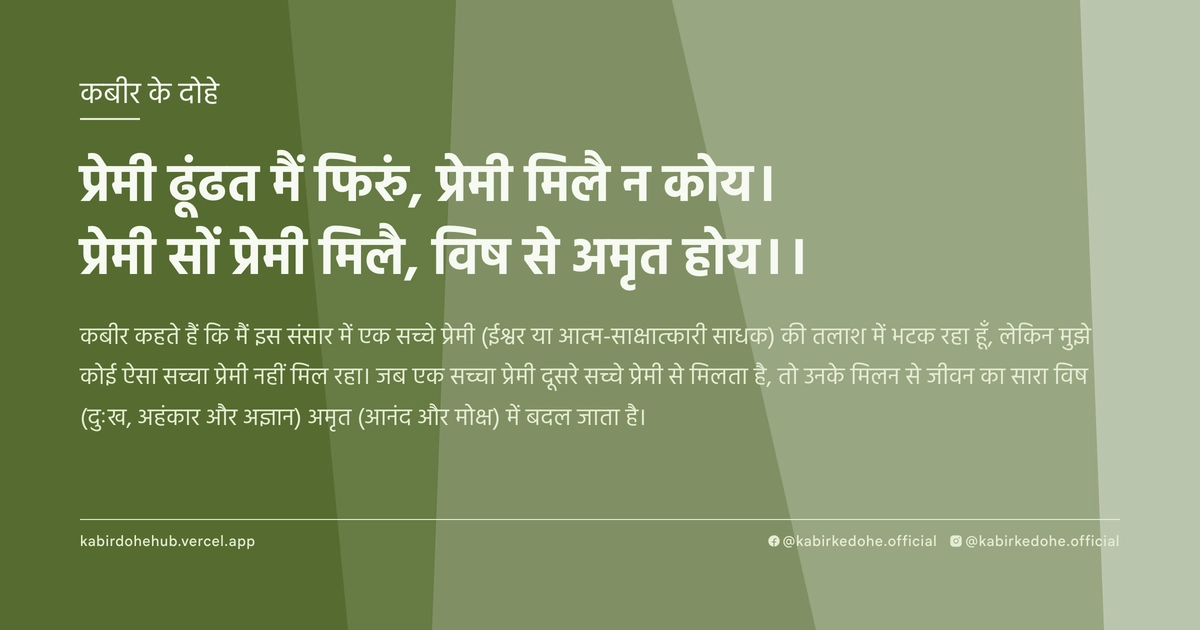
प्रेमी ढूंढत मैं फिरुं, प्रेमी मिलै न कोय।
प्रेमी सों प्रेमी मिलै, विष से अमृत होय।।
Premi dhoondhat main phirun, premi milai na koy. Premi son premi milai, vish se amrit hoye.
इस पृष्ठ पर इस कबीर दोहे का अर्थ (meaning), हिंदी व्याख्या और अंग्रेज़ी अनुवाद, दार्शनिक विश्लेषण और व्यावहारिक जीवन सीख दी गई है। यह दोहा भक्ति (Bhakti) विषय से जुड़ा है — Kabir doha meaning and explanation in Hindi and English.
अर्थ (Meaning):
कबीर कहते हैं कि मैं इस संसार में एक सच्चे प्रेमी (ईश्वर या आत्म-साक्षात्कारी साधक) की तलाश में भटक रहा हूँ, लेकिन मुझे कोई ऐसा सच्चा प्रेमी नहीं मिल रहा। जब एक सच्चा प्रेमी दूसरे सच्चे प्रेमी से मिलता है, तो उनके मिलन से जीवन का सारा विष (दुःख, अहंकार और अज्ञान) अमृत (आनंद और मोक्ष) में बदल जाता है।
Kabir expresses a profound longing, stating that he wanders the earth searching for a true lover—one who loves the Divine unconditionally—yet finds none. He asserts that when two such genuine lovers meet, the alchemy of their shared devotion transforms the poison of worldly existence, ego, and suffering into the nectar of eternal bliss and spiritual liberation.
व्याख्या (Interpretation):
यहाँ 'प्रेमी' शब्द केवल सांसारिक प्रेम के लिए नहीं, बल्कि उस आत्मा के लिए है जिसने परमात्मा को अपना सर्वस्व मान लिया है। कबीर पहले चरण में विरह की वेदना और अकेलेपन को दर्शाते हैं, जो साधक की प्रारंभिक अवस्था है। दूसरा चरण मिलन की पराकाष्ठा है, जहाँ दो आत्माएँ अपने अहंकार को विलीन कर देती हैं। यह मिलन 'अद्वैत' की स्थिति है, जहाँ द्वैत समाप्त हो जाता है। 'विष' यहाँ माया और वासनाओं का प्रतीक है, जबकि 'अमृत' आत्म-साक्षात्कार का। यह विरोधाभास दर्शाता है कि उच्चतम आनंद केवल पूर्ण समर्पण और प्रेम के माध्यम से ही प्राप्त किया जा सकता है, न कि शुष्क ज्ञान या कर्मकांडों से।
The term 'Premi' (Lover) here transcends romantic love, referring to the soul that has surrendered entirely to the Formless Divine. In the first line, Kabir depicts the agony of separation and the spiritual loneliness of the seeker, a prerequisite for deep longing. The second line describes the pinnacle of union, where two souls dissolve their individual egos. This union represents the state of 'Advaita' or non-duality, where the distinction between the seeker and the sought vanishes. 'Poison' symbolizes the toxins of Maya, attachment, and ignorance, while 'Nectar' signifies the realization of the Atman. The central paradox is that the most profound joy is found not through intellectual pursuit, but through the vulnerability of absolute love.
दार्शनिक विश्लेषण (Philosophical Analysis):
कबीर का यह दोहा निर्गुण भक्ति परंपरा का सार है, जहाँ ईश्वर किसी मूर्ति या मंदिर में नहीं, बल्कि हृदय के प्रेम में निवास करता है। यह सूफी मत के 'इश्क-ए-हकीकी' (दिव्य प्रेम) के अत्यंत निकट है, जहाँ प्रेमी और प्रियतम का भेद मिट जाता है। कबीर ने अपने समय के उन पाखंडियों पर प्रहार किया जो केवल बाहरी दिखावे और शास्त्रार्थ में विश्वास रखते थे, जबकि वास्तविक धर्म हृदय की पवित्रता और प्रेम में निहित है।
अद्वैत वेदांत के दृष्टिकोण से, यह 'विष से अमृत' बनने की प्रक्रिया अज्ञान (Avidya) के विनाश और ज्ञान (Vidya) के उदय की प्रक्रिया है। जब अहंकार (I-ness) समाप्त होता है, तो केवल शुद्ध चेतना बचती है। कबीर यह समझाते हैं कि जब तक मनुष्य स्वयं को अलग मानता है, वह विषमय संसार में तड़पता रहता है, लेकिन जैसे ही वह अपनी एकता को पहचानता है, वह अमृतमय हो जाता है।
ऐतिहासिक रूप से, कबीर ने जाति और धर्म की दीवारों को तोड़कर प्रेम को एकमात्र सेतु बनाया। उनके लिए प्रेम कोई भावना नहीं, बल्कि एक आध्यात्मिक अनुशासन था। यह विश्लेषण स्पष्ट करता है कि कबीर का 'प्रेम' कामुकता से मुक्त और आत्मा की गहराई से उपजा हुआ है।
मनोवैज्ञानिक स्तर पर, यह दोहा अकेलेपन के रूपांतरण की बात करता है। जब एक व्यक्ति अपनी आंतरिक रिक्तता को स्वीकार करता है और उसे परमात्मा की खोज में बदल देता है, तो वह रिक्तता ही उसे दूसरे सच्चे साधकों से जोड़ती है। यह सामाजिक अलगाव से वैश्विक एकता की ओर संक्रमण है।
अंततः, यह शिक्षण हमें बताता है कि आध्यात्मिक प्रगति अकेले संभव नहीं है; हमें ऐसे 'सह-यात्रियों' की आवश्यकता होती है जो हमारे दर्पण बन सकें। यह मिलन ही वह अग्नि है जो हमारे भीतर के विकारों को जलाकर भस्म कर देती है और हमें शुद्ध चैतन्य में बदल देती है।
This couplet encapsulates the essence of the Nirgun Bhakti tradition, where the Divine is not found in idols or temples but resides within the love of the heart. It closely aligns with the Sufi concept of 'Ishq-e-Haqiqi' (Divine Love), where the boundary between the lover and the Beloved dissolves. Kabir critiques the hypocrites of his era who relied on external rituals and scholarly debates, asserting that true religion lies in purity of heart and unconditional love.
From the perspective of Advaita Vedanta, the transformation of 'poison into nectar' is the process of annihilating ignorance (Avidya) and awakening to higher knowledge (Vidya). When the ego (Ahamkara) is dissolved, only pure consciousness remains. Kabir suggests that as long as a human perceives themselves as separate from the Whole, they suffer in the poisonous world of duality; however, upon realizing their oneness, they attain the nectar of liberation.
Historically, Kabir utilized love as the sole bridge to dismantle the rigid walls of caste and organized religion. For him, love was not a mere emotion but a rigorous spiritual discipline. This analysis clarifies that Kabir's 'love' is devoid of lust and is an eruption of the soul's deepest longing for its source.
Psychologically, the verse addresses the transformation of loneliness. When an individual accepts their internal void and converts it into a quest for the Divine, that very void becomes the magnet that attracts other genuine seekers. It is a transition from social isolation to universal kinship.
Ultimately, this teaching posits that spiritual evolution is not a solitary journey; it requires 'fellow travelers' who act as mirrors to our own soul. This meeting is the alchemical fire that burns away the impurities of the psyche, refining the human experience into pure consciousness.
मूल संदेश (Core Message):
- अकेलापन आध्यात्मिक खोज की पहली सीढ़ी है।
- सच्चा प्रेम अहंकार का पूर्ण विसर्जन है।
- जब हृदय खुलता है, तब विष अमृत बन जाता है।
- बाहरी खोज अंततः आंतरिक मिलन में बदलती है।
- प्रेम ही एकमात्र मार्ग है जो द्वैत को मिटाता है।
- Loneliness is the first step of the spiritual quest.
- True love is the total dissolution of the ego.
- When the heart opens, poison transforms into nectar.
- External searching eventually leads to internal union.
- Love is the only path that erases all duality.
व्यावहारिक उदाहरण (Practical Example):
वाराणसी के एक पुराने घाट पर रामदीन नाम का एक वृद्ध नाविक रहता था। वह जीवन भर नाव चलाता रहा, लेकिन उसका मन हमेशा अशांत रहता था। वह लोगों को पार तो कराता, लेकिन स्वयं जीवन के पार नहीं जा पाया था। वह धार्मिक था, लेकिन उसके भीतर क्रोध और कड़वाहट का विष भरा था, क्योंकि उसे लगता था कि दुनिया ने उसे कभी समझा नहीं।
एक दिन उसकी नाव पर एक फकीर सवार हुआ, जिसकी आँखों में एक अजीब सी शांति और करुणा थी। फकीर ने रामदीन की व्याकुलता को पहचान लिया। उसने कोई उपदेश नहीं दिया, बस रामदीन के हाथ को पकड़ा और उसकी आँखों में देखा। उस एक क्षण के मौन संपर्क में, रामदीन को महसूस हुआ कि कोई है जो उसके दर्द को बिना शब्दों के समझ रहा है।
रामदीन ने पहली बार अपनी पूरी व्यथा उस फकीर के सामने उड़ेल दी। उसने अपने जीवन के सारे दुख, अपनी असफलताओं और अपनी नफरत को शब्दों में पिरोया। फकीर बस सुनता रहा, बिना किसी निर्णय के, केवल प्रेम और स्वीकृति के साथ।
जैसे-जैसे रामदीन बोलता गया, उसे महसूस हुआ कि उसके भीतर का वह भारीपन, वह 'विष' धीरे-धीरे कम हो रहा है। उसे लगा जैसे वह फकीर उसके भीतर के अंधेरे को सोख रहा है और उसकी जगह एक शीतल शांति भर रहा है।
उस दिन के बाद रामदीन बदल गया। उसने पाया कि जब उसने अपना हृदय खोला, तो उसे दुनिया में अन्य दुखी लोग भी 'प्रेमी' की तरह दिखने लगे। वह अब केवल नाव नहीं चलाता था, बल्कि हर यात्री के साथ प्रेम और सहानुभूति से बात करता था।
उसने महसूस किया कि उसका क्रोध वास्तव में प्रेम की ही एक विकृत इच्छा थी। जब उसे वह 'सच्चा प्रेमी' (फकीर) मिला, तो उसकी सारी कड़वाहट अमृत में बदल गई।
अब वह घाट पर बैठने वाले अन्य नाविकों की मदद करता, उनके झगड़े सुलझाता और उन्हें प्रेम का मार्ग दिखाता। वह अब अकेला नहीं था; वह हर उस व्यक्ति में उस फकीर को ढूंढता जो प्रेम की तलाश में था।
रामदीन की कहानी यह सिखाती है कि जब दो आत्माएँ बिना किसी मुखौटे के, पूर्ण ईमानदारी और प्रेम के साथ मिलती हैं, तो जीवन का सबसे गहरा दुख भी सबसे बड़े आनंद में बदल सकता है।
On an ancient ghat in Varanasi lived an elderly boatman named Ramdeen. He had spent his entire life ferrying passengers across the river, yet his own mind remained turbulent. While he helped others cross the water, he felt he had failed to cross the river of existence. He was religious, but his heart was filled with the 'poison' of bitterness and anger, believing the world had never truly understood him.
One day, a wandering dervish boarded his boat. The dervish possessed a gaze of extraordinary peace and compassion. He immediately recognized the restlessness in Ramdeen's spirit. Without offering a single sermon, the dervish simply took Ramdeen's hand and looked into his eyes.
In that moment of silent connection, Ramdeen felt a profound sense of being seen. For the first time, he poured out his entire life's grief, his failures, and his hatred before the dervish. The dervish simply listened, without judgment, offering only absolute love and acceptance.
As Ramdeen spoke, he felt the heaviness—the 'poison'—within him slowly evaporating. It was as if the dervish was absorbing his darkness and replacing it with a cool, soothing serenity.
After that day, Ramdeen was transformed. He realized that once he opened his heart, other suffering people began to appear to him as 'lovers' of the truth. He no longer just rowed a boat; he engaged every passenger with genuine empathy and love.
He understood that his anger was merely a distorted desire for love. Upon meeting a 'true lover' (the dervish), his bitterness turned into nectar.
He began helping other boatmen on the ghat, resolving their disputes and guiding them toward a path of kindness. He was no longer alone; he saw the reflection of that dervish in every soul searching for love.
Ramdeen's story illustrates that when two souls meet without masks, in total honesty and love, the deepest sorrow of life can be transmuted into the highest bliss.
अभ्यास मार्गदर्शन (Practice Guidance):
- प्रतिदिन 20 मिनट मौन ध्यान करें, जहाँ आप स्वयं को एक 'प्रेमी' के रूप में देखें जो केवल प्रेम देना चाहता है, बिना किसी अपेक्षा के।
- एक 'प्रेम-डायरी' लिखें: प्रतिदिन एक ऐसी घटना दर्ज करें जहाँ आपने अपने क्रोध (विष) को करुणा (अमृत) में बदला हो।
- सचेत श्रवण (Deep Listening) का अभ्यास करें: किसी व्यक्ति की बात को बिना उसे जज किए या सलाह दिए सुनें, केवल उसकी आत्मा से जुड़ने का प्रयास करें।
- निदान चेकलिस्ट: क्या मैं दूसरों में कमियाँ ढूंढ रहा हूँ? (विष) या मैं उनमें छिपे दिव्य प्रेम को देख पा रहा हूँ? (अमृत)। यदि क्रोध हावी है, तो रुकें और सांस लें।
- Practice 20 minutes of silent meditation daily, visualizing yourself as a 'Lover' who wishes only to give love, without any expectation of return.
- Maintain a 'Love Journal': Record one daily instance where you consciously transmuted an emotion of anger (poison) into compassion (nectar).
- Practice Deep Listening: Listen to another person without judging or offering unsolicited advice; strive only to connect with their essence.
- Diagnostic Checklist: Am I searching for flaws in others? (Poison) Or am I perceiving the hidden divine love within them? (Nectar). If anger dominates, pause and breathe.
चिंतन प्रश्न (Reflection Questions):
- मेरे जीवन में 'विष' के रूप में कौन सी भावनाएँ हैं जिन्हें मैं अमृत में बदलना चाहता हूँ?
- क्या मैं वास्तव में किसी से प्रेम करता हूँ, या मैं केवल अपनी जरूरतों के लिए दूसरों का उपयोग करता हूँ?
- मेरा 'डिजिटल अहंकार' मुझे सच्चे मानवीय संबंधों और प्रेम से कैसे दूर कर रहा है?
- यदि मैं अपना सारा सामाजिक मुखौटा उतार दूँ, तो क्या मैं किसी दूसरे के सामने अपनी कमजोरी दिखाने का साहस रखता हूँ?
- क्या मेरा प्रेम केवल उन लोगों के लिए है जो मुझसे सहमत हैं, या मैं अपने विरोधियों में भी उस 'प्रेमी' को देख सकता हूँ?
- Which emotions in my life currently act as 'poison' that I long to transmute into nectar?
- Do I truly love others, or do I merely use people to satisfy my own emotional needs?
- How is my 'digital ego' distancing me from authentic human connection and selfless love?
- If I stripped away all my social masks, would I have the courage to be vulnerable before another?
- Is my love reserved only for those who agree with me, or can I perceive the 'Lover' even in my adversaries?