
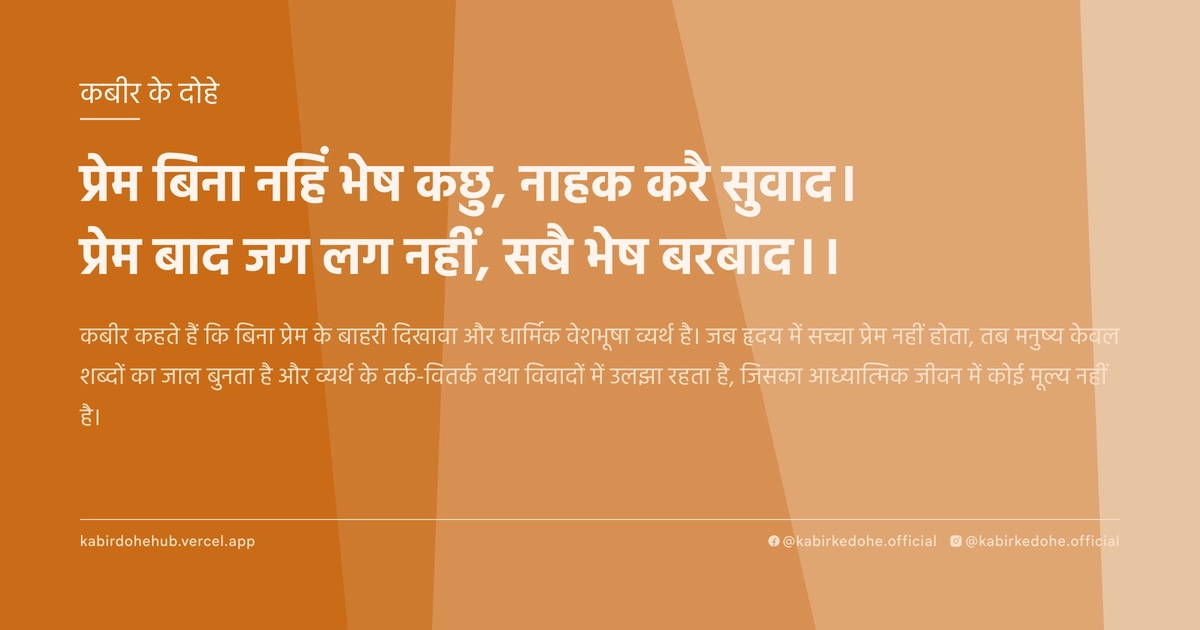
प्रेम बिना नहिं भेष कछु, नाहक करै सुवाद।
प्रेम बाद जग लग नहीं, सबै भेष बरबाद।।
Prem bina nahin bhesh kachhu, nahak karai suvaad. Prem baad jag lag nahin, sabai bhesh barbaad.
इस पृष्ठ पर इस कबीर दोहे का अर्थ (meaning), हिंदी व्याख्या और अंग्रेज़ी अनुवाद, दार्शनिक विश्लेषण और व्यावहारिक जीवन सीख दी गई है। यह दोहा भक्ति (Bhakti) विषय से जुड़ा है — Kabir doha meaning and explanation in Hindi and English.
अर्थ (Meaning):
कबीर कहते हैं कि बिना प्रेम के बाहरी दिखावा और धार्मिक वेशभूषा व्यर्थ है। जब हृदय में सच्चा प्रेम नहीं होता, तब मनुष्य केवल शब्दों का जाल बुनता है और व्यर्थ के तर्क-वितर्क तथा विवादों में उलझा रहता है, जिसका आध्यात्मिक जीवन में कोई मूल्य नहीं है।
Kabir asserts that without love, all external appearances and religious attire are meaningless. When the essence of love is absent from the heart, human interaction descends into empty rhetoric and endless disputes, which hold no value in the pursuit of spiritual liberation.
व्याख्या (Interpretation):
इस दोहे का शाब्दिक अर्थ है कि प्रेम के बिना कोई भी बाहरी रूप या पोशाक सार्थक नहीं है। आध्यात्मिक स्तर पर, 'भेष' केवल कपड़ों को नहीं, बल्कि उस अहंकार को दर्शाता है जिसे हम धर्म या ज्ञान के नाम पर ओढ़ते हैं। कबीर यहाँ निरगुण भक्ति का समर्थन करते हैं, जहाँ ईश्वर किसी मूर्ति या मंदिर में नहीं, बल्कि प्रेम की शुद्धता में बसता है। जब साधक माया के प्रभाव में होता है, तो वह सत्य को तर्क (वाद-विवाद) से खोजने की कोशिश करता है, जबकि सत्य केवल अनुभव और प्रेम से प्राप्त होता है। यह द्वैतवाद (Duality) की स्थिति है जहाँ 'मैं' और 'तुम' के बीच विवाद है; अद्वैत (Non-duality) की स्थिति में केवल प्रेम शेष रहता है।
Literally, the verse suggests that no outward garment holds meaning without love. Spiritually, 'bhesh' refers not just to clothing, but to the egoic identity we drape over ourselves in the guise of religion or scholarship. Kabir champions Nirgun Bhakti, where the Divine resides not in idols or temples, but in the purity of love. When a seeker is clouded by Maya, they attempt to reach Truth through intellectual gymnastics and debate, whereas Truth is accessible only through experiential love. This represents the state of duality where the 'I' and 'Other' clash in conflict; in the state of Advaita, only love remains, dissolving the boundary between the seeker and the sought.
दार्शनिक विश्लेषण (Philosophical Analysis):
कबीर का यह विचार उनके युग के कट्टरपंथ और कर्मकांडीय आडंबरों पर एक तीखा प्रहार है। उन्होंने देखा कि लोग केवल तिलक, माला या विशेष वस्त्र पहनकर स्वयं को धार्मिक सिद्ध करने का प्रयास करते थे, जबकि उनके भीतर करुणा और प्रेम का अभाव था। यह विश्लेषण सूफी मत के 'इश्क-ए-हकीकी' (ईश्वरीय प्रेम) से मेल खाता है, जहाँ तर्क को प्रेम के सामने नगण्य माना गया है।
अद्वैत वेदांत के परिप्रेक्ष्य में, विवाद और तर्क 'अहंकार' की उपज हैं। जब तक व्यक्ति स्वयं को शरीर या सामाजिक पहचान से जोड़ता है, वह दूसरों से अलग महसूस करता है और यही अलगाव विवाद को जन्म देता है। प्रेम वह सेतु है जो इस पृथकता को समाप्त करता है और आत्मा को ब्रह्म के साथ एकाकार करता है।
कबीर यहाँ 'ज्ञान' और 'प्रेम' के बीच के द्वंद्व को स्पष्ट करते हैं। उनके अनुसार, वह ज्ञान जो प्रेम में परिवर्तित नहीं हुआ, वह केवल एक मानसिक बोझ है। बौद्धिक श्रेष्ठता का अहंकार अक्सर सत्य के मार्ग में सबसे बड़ी बाधा बनता है।
सामाजिक स्तर पर, यह दोहा जाति और धर्म के नाम पर होने वाले संघर्षों की जड़ को उजागर करता है। जब प्रेम का भाव लुप्त हो जाता है, तब केवल पहचान (Identity) बचती है, और पहचान हमेशा टकराव पैदा करती है।
अंततः, कबीर यह संदेश देते हैं कि आध्यात्मिक रूपांतरण केवल बाहरी बदलाव से नहीं, बल्कि आंतरिक हृदय परिवर्तन से आता है। अहंकार का विसर्जन ही वास्तविक 'भेष' है, जहाँ मनुष्य स्वयं को शून्य कर प्रेम के अनंत सागर में विलीन हो जाता है।
Kabir's insight is a sharp critique of the bigotry and ritualistic ostentation of his era. He observed people attempting to establish their piety through tilaks, beads, or specific attire, while their hearts remained devoid of compassion and love. This analysis aligns with the Sufi concept of 'Ishq-e-Haqiqi' (Divine Love), where intellectual logic is considered insignificant compared to the transformative power of love.
From the perspective of Advaita Vedanta, disputes and arguments are offspring of the 'Ahamkara' (ego). As long as an individual identifies with the body or a social persona, they perceive a separation from others, and this perceived separation breeds conflict. Love is the bridge that annihilates this duality, merging the Atman with Brahman.
Kabir clarifies the tension between 'Jnana' (knowledge) and 'Prem' (love). According to him, knowledge that has not been transmuted into love is merely a mental burden. The ego of intellectual superiority often becomes the greatest obstacle on the path to Truth.
On a social level, this verse exposes the root of conflicts fought in the name of caste and religion. When the essence of love vanishes, only 'identity' remains, and identity invariably leads to friction.
Ultimately, Kabir suggests that spiritual transformation occurs not through external modification, but through internal alchemy. The dissolution of the ego is the only true 'attire,' where the human becomes a void, allowing the infinite ocean of love to flow through them.
मूल संदेश (Core Message):
- बाहरी दिखावा आध्यात्मिक रिक्तता को नहीं भर सकता।
- तर्क सत्य का मार्ग नहीं, बल्कि अहंकार का विस्तार है।
- प्रेम ही वह एकमात्र भाषा है जिसे आत्मा समझती है।
- विवाद वहाँ जन्म लेता है जहाँ करुणा का अभाव होता है।
- सच्ची भक्ति शब्दों में नहीं, बल्कि भावों की शुद्धता में है।
- अहंकार का विसर्जन ही वास्तविक ज्ञान की प्राप्ति है।
- External appearances cannot fill a spiritual void.
- Logic is not the path to Truth, but an extension of the ego.
- Love is the only language the soul truly understands.
- Conflict is born where compassion is absent.
- True devotion lies not in words, but in the purity of emotion.
- The dissolution of ego is the actual attainment of knowledge.
व्यावहारिक उदाहरण (Practical Example):
वाराणसी के एक पुराने घाट पर रामदीन नाम का एक वृद्ध नाविक रहता था। वह अपनी नाव चलाने के साथ-साथ शास्त्रों का गहरा अध्ययन करता था और अक्सर घाट पर आने वाले तीर्थयात्रियों के साथ धर्म और मोक्ष पर लंबी बहसें करता था। वह अपनी विद्वत्ता का प्रदर्शन करता और जो उसकी बात नहीं मानता, उसे अज्ञानी कहकर उपहास करता। उसकी पहचान एक 'विद्वान नाविक' की थी, लेकिन उसके व्यवहार में कड़वाहट थी।
एक दिन, एक साधारण सा फकीर उसकी नाव में बैठा। रामदीन ने उसे देखते ही अपनी श्रेष्ठता सिद्ध करने के लिए कठिन दार्शनिक प्रश्न पूछने शुरू कर दिए। फकीर चुप रहा और बस मुस्कुराता रहा। जब रामदीन ने देखा कि फकीर कोई प्रतिक्रिया नहीं दे रहा, तो वह और अधिक उग्र हो गया और चिल्लाकर बोला, "क्या आप इतने मूर्ख हैं कि मेरे प्रश्नों का उत्तर नहीं दे सकते?"
फकीर ने शांति से कहा, "भाई, तुम्हारी नाव तो बहुत सुंदर है, लेकिन क्या तुमने कभी इस नदी के पानी को प्रेम से छुआ है? तुम लहरों के विज्ञान पर बहस कर रहे हो, लेकिन तुमने कभी लहरों के संगीत को सुना ही नहीं।"
रामदीन को लगा कि यह कोई साधारण बात नहीं है। उसने गौर किया कि वह वर्षों से किताबों में 'प्रेम' पढ़ रहा था, लेकिन उसने कभी किसी के दुख को बिना तर्क के महसूस नहीं किया था। उसने महसूस किया कि उसकी विद्वत्ता उसके और ईश्वर के बीच एक दीवार बन गई थी।
उस रात, रामदीन ने अपनी सभी पुस्तकों को एक कोने में रख दिया। उसने तय किया कि वह अब बहस नहीं करेगा। अगले दिन, जब एक गरीब विधवा उसकी नाव में चढ़ी जिसके पास पैसे कम थे, रामदीन ने उसे बिना किसी तर्क या विवाद के मुफ्त में पार कराया।
उस विधवा की आँखों में जो कृतज्ञता और प्रेम था, उसने रामदीन को वह शांति दी जो उसे हज़ारों शास्त्रों की बहस से नहीं मिली थी। उसने महसूस किया कि प्रेम का एक छोटा सा कार्य हज़ारों शब्दों के संवाद से अधिक शक्तिशाली है।
रामदीन का व्यवहार बदल गया। अब वह घाट पर बहस करने के बजाय, लोगों की मदद करने लगा। उसकी नाव अब केवल शरीर को पार कराने का साधन नहीं, बल्कि प्रेम बांटने का माध्यम बन गई।
उसने सीखा कि जब तक हृदय में प्रेम नहीं होता, तब तक ज्ञान केवल अहंकार की तुष्टि का साधन है। उसका 'विद्वान' होने का भेष उतर गया और वह एक सच्चा इंसान बन गया।
इस प्रकार, रामदीन ने अनुभव किया कि प्रेम के बिना सारा संवाद व्यर्थ है और विवाद केवल अहंकार की पुकार है।
On an ancient ghat in Varanasi lived an elderly boatman named Ramdeen. Alongside rowing his boat, he studied scriptures deeply and often engaged in long debates about religion and salvation with the pilgrims who visited the ghats. He flaunted his erudition and mocked those who disagreed with him, labeling them ignorant. His identity was that of a 'learned boatman,' but his behavior was laced with bitterness.
One day, a simple dervish boarded his boat. Seeing him, Ramdeen immediately began asking complex philosophical questions to prove his superiority. The dervish remained silent, merely smiling. When Ramdeen noticed the lack of reaction, he grew agitated and shouted, "Are you so foolish that you cannot answer my questions?"
The dervish calmly replied, "Brother, your boat is beautiful, but have you ever touched the water of this river with love? You are debating the science of the waves, but you have never listened to the music of the waves."
Ramdeen felt that this was no ordinary remark. He realized that for years he had been reading about 'love' in books, but he had never felt someone's pain without analyzing it logically. He understood that his scholarship had become a wall between him and the Divine.
That night, Ramdeen set aside all his books in a corner. He decided he would no longer engage in debates. The next day, when a poor widow boarded his boat with insufficient money, Ramdeen ferried her across for free, without any argument or hesitation.
The gratitude and love in that widow's eyes gave Ramdeen a peace that thousands of scriptural debates had never provided. He realized that one small act of love is more powerful than a thousand words of dialogue.
Ramdeen's behavior transformed. Instead of debating on the ghats, he began helping people. His boat was no longer just a means of transporting bodies, but a medium for distributing love.
He learned that without love in the heart, knowledge is merely a tool for feeding the ego. His 'mask' of being a scholar fell away, and he became a true human being.
Thus, Ramdeen experienced that without love, all dialogue is futile, and dispute is merely the cry of the ego.
अभ्यास मार्गदर्शन (Practice Guidance):
- प्रतिदिन 20 मिनट मौन साधना करें, जहाँ आप शब्दों और तर्कों को छोड़कर केवल हृदय की धड़कन और प्रेम के भाव पर ध्यान केंद्रित करें।
- एक 'अहंकार पत्रिका' (Ego Journal) बनाएँ। जब भी आप किसी से विवाद करें, लिखें कि उस समय आप सत्य खोजना चाहते थे या अपनी श्रेष्ठता सिद्ध करना चाहते थे।
- सचेत व्यवहार परिवर्तन: दिन भर में कम से कम तीन ऐसे कार्य करें जिनमें कोई व्यक्तिगत लाभ न हो और जो पूरी तरह से निस्वार्थ प्रेम से प्रेरित हों।
- निदान चेकलिस्ट: क्या मैं बातचीत के दौरान सामने वाले को चुप कराने की कोशिश करता हूँ? क्या मेरी धार्मिक पहचान मुझे दूसरों से श्रेष्ठ महसूस कराती है? यदि हाँ, तो आप अभी भी 'वाद-विवाद' के स्तर पर हैं।
- Practice 20 minutes of silent meditation daily, letting go of words and logic to focus solely on the heartbeat and the feeling of love.
- Maintain an 'Ego Journal.' Whenever you engage in a dispute, record whether you were seeking Truth or merely trying to prove your superiority.
- Conscious Behavioral Shift: Perform at least three acts daily that offer no personal gain and are driven entirely by selfless love.
- Diagnostic Checklist: Do I try to silence others during conversations? Does my religious identity make me feel superior to others? If yes, you are still operating at the level of 'dispute'.
चिंतन प्रश्न (Reflection Questions):
- मेरे जीवन में ऐसे कौन से 'भेष' (पहचान) हैं जिन्हें मैं अपनी असलियत से ज्यादा महत्व देता हूँ?
- जब मैं किसी से असहमत होता हूँ, तो क्या मेरा उद्देश्य सत्य तक पहुँचना होता है या अपनी जीत दर्ज करना?
- क्या मेरा धर्म या मेरी विचारधारा मुझे दूसरों से जोड़ने का माध्यम है या उन्हें छोटा दिखाने का हथियार?
- मेरे भीतर का वह कौन सा हिस्सा है जो प्रेम करने से डरता है और तर्क का सहारा लेता है?
- यदि मेरी सारी उपाधियाँ और सामाजिक प्रतिष्ठा छीन ली जाए, तो क्या मेरे पास देने के लिए केवल प्रेम बचेगा?
- मैं अपनी डिजिटल पहचान (Social Media Ego) के माध्यम से कितनी बार केवल 'दिखावे' का संवाद करता हूँ?
- What 'masks' (identities) in my life do I value more than my authentic self?
- When I disagree with someone, is my goal to reach the Truth or to record a victory?
- Is my religion or ideology a bridge to connect with others, or a weapon to belittle them?
- Which part of me is afraid to love and instead relies on the safety of logic?
- If all my titles and social prestige were stripped away, would I have nothing left to give but love?
- How often do I engage in 'performative' dialogue through my digital identity (Social Media Ego)?