
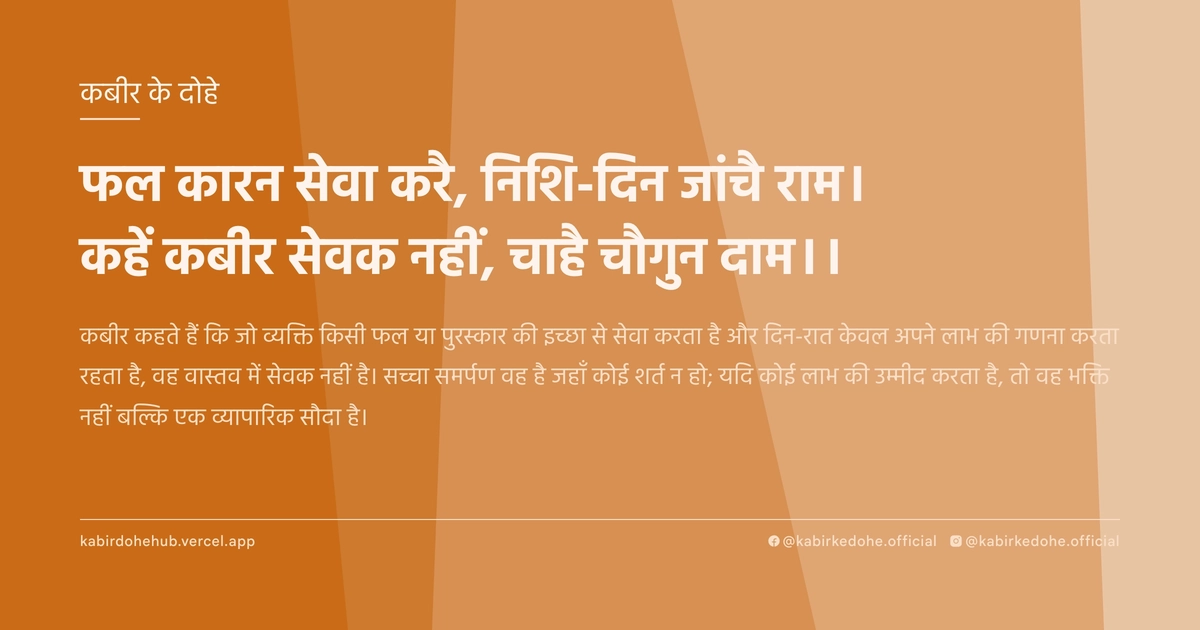
फल कारन सेवा करै, निशि-दिन जांचै राम।
कहें कबीर सेवक नहीं, चाहै चौगुन दाम।।
Phal karan seva karai, nishi-din janchai Ram. Kahein Kabir sevak nahi, chahai chougun daam.
इस पृष्ठ पर इस कबीर दोहे का अर्थ (meaning), हिंदी व्याख्या और अंग्रेज़ी अनुवाद, दार्शनिक विश्लेषण और व्यावहारिक जीवन सीख दी गई है। यह दोहा निष्कामता (Pure Intent) विषय से जुड़ा है — Kabir doha meaning and explanation in Hindi and English.
अर्थ (Meaning):
कबीर कहते हैं कि जो व्यक्ति किसी फल या पुरस्कार की इच्छा से सेवा करता है और दिन-रात केवल अपने लाभ की गणना करता रहता है, वह वास्तव में सेवक नहीं है। सच्चा समर्पण वह है जहाँ कोई शर्त न हो; यदि कोई लाभ की उम्मीद करता है, तो वह भक्ति नहीं बल्कि एक व्यापारिक सौदा है।
Kabir asserts that one who serves with the expectation of a reward, constantly calculating their gains day and night, is not a true devotee. Genuine service is unconditional; if there is a desire for profit or a specific return, it is not spiritual devotion but a mere commercial transaction.
व्याख्या (Interpretation):
यह दोहा निस्वार्थता और अहंकार के बीच के सूक्ष्म अंतर को स्पष्ट करता है। शाब्दिक अर्थ में, यह फल की इच्छा रखने वाले सेवक की आलोचना है, लेकिन आध्यात्मिक स्तर पर यह 'साकाम भक्ति' (इच्छा-युक्त भक्ति) और 'निष्कॉम भक्ति' (फल-रहित भक्ति) के बीच के संघर्ष को दर्शाता है। यहाँ 'राम' केवल एक देवता नहीं, बल्कि उस परम चेतना का प्रतीक हैं जिसे केवल पूर्ण समर्पण से पाया जा सकता है। जब हम सेवा के बदले कुछ माँगते हैं, तो हम वास्तव में अपने अहंकार (Maya) को पोषित कर रहे होते हैं, न कि आत्मा को। यह विरोधाभास है कि हम ईश्वर को पाने का दावा करते हैं, लेकिन वास्तव में हम केवल अपनी इच्छाओं की पूर्ति चाहते हैं। जब तक 'मैं' और 'मेरा लाभ' मौजूद है, तब तक 'अद्वैत' या गैर-द्वैत की स्थिति प्राप्त नहीं हो सकती।
This couplet elucidates the subtle distinction between selflessness and the ego. Literally, it critiques a servant seeking rewards, but spiritually, it highlights the conflict between 'Sakam Bhakti' (desire-driven devotion) and 'Nishkam Bhakti' (selfless devotion). Here, 'Ram' is not merely a deity but a symbol of the Supreme Consciousness attainable only through absolute surrender. When we seek something in return for service, we are nourishing the ego (Maya) rather than the soul. The paradox lies in claiming to seek God while actually seeking the fulfillment of personal desires. As long as 'I' and 'my profit' exist, the state of 'Advaita' or non-duality cannot be realized, as the duality of giver and receiver persists.
दार्शनिक विश्लेषण (Philosophical Analysis):
कबीर का यह दृष्टिकोण उनके युग के कर्मकांडीय और औपचारिक धर्म के विरुद्ध एक सशक्त प्रहार था। उस समय, लोग मंदिर और मस्जिदों में दान केवल इसलिए देते थे ताकि उन्हें स्वर्ग मिले या सामाजिक प्रतिष्ठा प्राप्त हो। कबीर इसे 'व्यापार' कहते हैं। उनका दर्शन निर्गुण भक्ति पर आधारित है, जहाँ ईश्वर किसी बाहरी मूर्ति में नहीं, बल्कि हृदय की शुद्धता में बसता है।
अद्वैत वेदांत के परिप्रेक्ष्य में, जब तक साधक 'फल' की इच्छा रखता है, वह स्वयं को ब्रह्मांड से अलग मानता है। यह अलगाव ही अज्ञानता है। यदि मैं फल चाहता हूँ, तो मैं यह मान रहा हूँ कि मैं और वह फल देने वाला दो अलग सत्ताएँ हैं। सच्चा सेवक वह है जो यह जान ले कि सेवा करने वाला, सेवा पाने वाला और सेवा स्वयं—तीनों एक ही ब्रह्म हैं।
सूफीवाद के 'फना' (अहंकार का विनाश) के सिद्धांत से यह मेल खाता है। जब तक 'मैं' जीवित है, प्रेम अधूरा है। कबीर सिखाते हैं कि प्रेम और सेवा का अर्थ है स्वयं का विसर्जन। यदि सेवा में 'चौगुन दाम' (चार गुना लाभ) की लालसा है, तो वह प्रेम नहीं, बल्कि एक अनुबंध (contract) है।
मनोवैज्ञानिक स्तर पर, यह दोहा हमें हमारी 'लेन-देन' की मानसिकता से मुक्त करता है। आधुनिक मनुष्य हर रिश्ते को उपयोगितावाद (utilitarianism) की दृष्टि से देखता है। कबीर इस मानसिक जकड़न को तोड़कर हमें उस स्थिति में ले जाना चाहते हैं जहाँ कर्म स्वयं में ही पुरस्कार बन जाए।
अंततः, यह दोहा यह स्पष्ट करता है कि आध्यात्मिक प्रगति बाहरी क्रियाओं से नहीं, बल्कि उन क्रियाओं के पीछे छिपे इरादों (intentions) से होती है। बिना निस्वार्थ भाव के की गई हज़ारों पूजाएँ भी शून्य हैं, जबकि एक छोटा सा निस्वार्थ कार्य आत्मा को परमात्मा से जोड़ देता है।
Kabir's perspective is a powerful strike against the ritualistic and formal religion of his era. At that time, people donated to temples and mosques primarily to secure heaven or social prestige. Kabir labels this as 'trade.' His philosophy is rooted in Nirgun Bhakti, where the Divine resides not in external idols but in the purity of the heart.
From the lens of Advaita Vedanta, as long as the seeker desires a 'fruit,' they perceive themselves as separate from the universe. This separation is the root of ignorance. If I desire a reward, I am assuming that I and the giver of the reward are two distinct entities. A true servant is one who realizes that the server, the served, and the service itself are all one Brahman.
This aligns with the Sufi concept of 'Fana' (the annihilation of the ego). As long as the 'I' survives, love remains incomplete. Kabir teaches that love and service mean the dissolution of the self. If there is a longing for 'fourfold profit' (chaugun daam), it is not love, but a commercial contract.
Psychologically, this couplet liberates us from a 'transactional' mindset. The modern human views every relationship through the lens of utilitarianism. Kabir seeks to break this mental shackle, guiding us toward a state where the action itself becomes the reward.
Ultimately, this couplet clarifies that spiritual progress is not achieved through external rituals, but through the intentions behind those actions. Thousands of prayers performed with expectation are void, whereas a single selfless act can unite the soul with the Divine.
मूल संदेश (Core Message):
- इच्छा ही बंधन है, निस्वार्थता ही मुक्ति है।
- सेवा जब सौदा बनती है, तो वह भक्ति नहीं रहती।
- अहंकार का विसर्जन ही परमात्मा से मिलन का एकमात्र मार्ग है।
- फल की चिंता करना आत्मा की चेतना को सीमित करना है।
- सच्ची भक्ति वह है जहाँ केवल देने का आनंद हो, पाने की लालसा नहीं।
- Desire is the bond; selflessness is the liberation.
- When service becomes a deal, it ceases to be devotion.
- The dissolution of ego is the only path to union with the Divine.
- Worrying about the fruit limits the consciousness of the soul.
- True devotion is where there is only the joy of giving, not the longing for receiving.
व्यावहारिक उदाहरण (Practical Example):
एक समय की बात है, वाराणसी के घाटों पर माधव नाम का एक वृद्ध नाविक रहता था। माधव का जीवन अत्यंत कठिन था, लेकिन वह अपनी नाव पर आने वाले हर यात्री की सेवा पूरी निष्ठा से करता था।
शहर में एक धनी व्यापारी आया, जिसने माधव को अपनी नाव पर विशेष सेवा के लिए नियुक्त किया। व्यापारी ने माधव से कहा, 'यदि तुम मेरी हर आज्ञा मानोगे और मुझे खुश रखोगे, तो मैं तुम्हें तुम्हारी उम्मीद से चार गुना अधिक धन दूँगा।'
माधव ने काम शुरू किया। वह व्यापारी के पैर दबाता, उसके सामान का ध्यान रखता और उसकी हर छोटी ज़रूरत पूरी करता। लेकिन धीरे-धीरे माधव का मन बदलने लगा। वह अब सेवा इसलिए नहीं करता था कि उसे यात्री की मदद करनी है, बल्कि इसलिए कि उसे उस 'चार गुना धन' की चिंता थी।
वह हर रात हिसाब लगाता कि उसने आज कितनी सेवा की और उसे कितना बोनस मिलना चाहिए। उसकी सेवा में अब वह सहजता और प्रेम नहीं रहा, बल्कि एक तनाव आ गया। वह व्यापारी के चेहरे को देखकर यह अंदाज़ा लगाने लगा कि वह खुश है या नहीं, ताकि उसका पैसा न कट जाए।
एक दिन, व्यापारी बीमार पड़ गया और उसकी हालत गंभीर हो गई। उसने माधव से कहा, 'मुझे इस समय केवल शांति और सच्चे प्रेम की आवश्यकता है, धन की नहीं।'
माधव ने महसूस किया कि वह पिछले कई महीनों से केवल एक 'सौदागर' बना हुआ था, सेवक नहीं। उसे याद आया कि जब वह अनजान यात्रियों को नाव पर ले जाता था, तो वह बिना किसी लालच के उनकी मदद करता था और उसे आंतरिक शांति मिलती थी।
उस क्षण माधव को कबीर की वाणी याद आई कि जो फल की इच्छा करता है, वह सेवक नहीं होता। उसने तुरंत उस लालच को त्याग दिया और व्यापारी की सेवा केवल मानवता के नाते शुरू की।
जैसे ही माधव के मन से 'चार गुना दाम' का विचार निकला, उसके चेहरे पर एक अद्भुत चमक आ गई। उसकी सेवा में अब एक ऐसी निश्छलता थी जिसने बीमार व्यापारी के मन को भी शांति प्रदान की।
व्यापारी ठीक होने के बाद माधव की इस निस्वार्थ भावना से इतना प्रभावित हुआ कि उसने उसे धन तो दिया ही, साथ ही उसे अपना सच्चा मित्र मान लिया।
माधव ने सीखा कि जब हम लाभ की गणना छोड़ देते हैं, तब हम वास्तव में उस परमात्मा (राम) की सेवा कर रहे होते हैं, जो हर जीव में व्याप्त है।
Once, on the ghats of Varanasi, lived an elderly boatman named Madhav. Madhav's life was arduous, yet he served every passenger on his boat with utmost sincerity.
A wealthy merchant arrived in the city and hired Madhav for specialized service. The merchant told him, 'If you obey my every command and keep me pleased, I will give you four times more wealth than you expect.'
Madhav began his work. He massaged the merchant's feet, tended to his luggage, and fulfilled every minor need. However, gradually, Madhav's mindset shifted. He no longer served because he wanted to help the passenger, but because he was preoccupied with that 'fourfold wealth.'
Every night, he calculated how much service he had provided and how much bonus he deserved. The natural ease and love in his service vanished, replaced by a palpable tension. He began reading the merchant's facial expressions to gauge his satisfaction, fearing a reduction in pay.
One day, the merchant fell gravely ill. He told Madhav, 'At this moment, I need only peace and genuine love, not wealth.'
Madhav realized that for the past several months, he had been a 'trader,' not a servant. He remembered how, when he took unknown passengers across the river, he helped them without greed and felt an inner peace.
In that moment, Kabir's words resonated within him: he who desires the fruit is not a true servant. He immediately discarded the greed and began serving the merchant purely for the sake of humanity.
As soon as the thought of 'fourfold profit' left Madhav's mind, a divine radiance appeared on his face. His service now possessed a purity that brought peace even to the ailing merchant.
Upon recovery, the merchant was so moved by Madhav's selfless devotion that he not only paid him but also accepted him as a true friend.
Madhav learned that when we stop calculating profit, we are actually serving the Divine (Ram) who resides within every living being.
अभ्यास मार्गदर्शन (Practice Guidance):
- प्रतिदिन 15 मिनट 'साक्षी भाव' का अभ्यास करें: अपने भीतर उठने वाली इच्छाओं को देखें और पूछें, 'क्या मैं यह कार्य फल की इच्छा से कर रहा हूँ?'
- एक 'निस्वार्थ कर्म' डायरी बनाएँ: रोज़ाना एक ऐसा काम करें जिसके बदले आप किसी से कोई आभार, धन्यवाद या लाभ की उम्मीद न करें।
- आत्म-पूछताछ (Self-Inquiry): जब भी आप किसी की मदद करें, तो मन में यह विचार लाएँ कि आप स्वयं की ही सेवा कर रहे हैं (अद्वैत भाव)।
- डायग्नोस्टिक चेकलिस्ट: यदि आप सेवा के बाद उपेक्षित महसूस करते हैं या क्रोधित होते हैं कि सामने वाले ने आभार नहीं जताया, तो समझ लें कि आपकी सेवा 'व्यापार' थी, 'भक्ति' नहीं।
- Practice 'Witness Consciousness' for 15 minutes daily: Observe the desires arising within and ask, 'Am I doing this act with an expectation of a reward?'
- Maintain a 'Selfless Action' journal: Perform one act daily for which you expect no gratitude, thanks, or benefit in return.
- Self-Inquiry: While helping someone, cultivate the thought that you are serving yourself (the state of non-duality/Advaita).
- Diagnostic Checklist: If you feel neglected or angry after serving because the other person didn't express gratitude, recognize that your service was a 'transaction,' not 'devotion.'
चिंतन प्रश्न (Reflection Questions):
- मेरे जीवन के कौन से 'पवित्र' कार्य वास्तव में सामाजिक प्रशंसा पाने के गुप्त सौदे हैं?
- यदि मुझे पता चले कि मेरी सबसे बड़ी सेवा का श्रेय कभी किसी को नहीं मिलेगा, तो क्या मैं उसे फिर भी करूँगा?
- मेरा 'डिजिटल ईगो' (सोशल मीडिया पर परोपकार दिखाना) मेरी वास्तविक सेवा को कैसे प्रभावित कर रहा है?
- मैं अपने रिश्तों में 'लेन-देन' की मानसिकता को कहाँ-कहाँ लागू कर रहा हूँ और यह मुझे अकेला कैसे बना रहा है?
- क्या मेरी भक्ति ईश्वर के प्रति है, या उस ईश्वर के माध्यम से मेरी अपनी इच्छाओं की पूर्ति के प्रति?
- Which of my 'sacred' acts are actually secret deals to gain social validation?
- If I knew that my greatest act of service would never be credited to me, would I still perform it?
- How is my 'digital ego' (displaying philanthropy on social media) affecting my authentic service?
- Where am I applying a 'transactional' mindset in my relationships, and how is this isolating me?
- Is my devotion directed toward the Divine, or toward the fulfillment of my own desires through the Divine?