
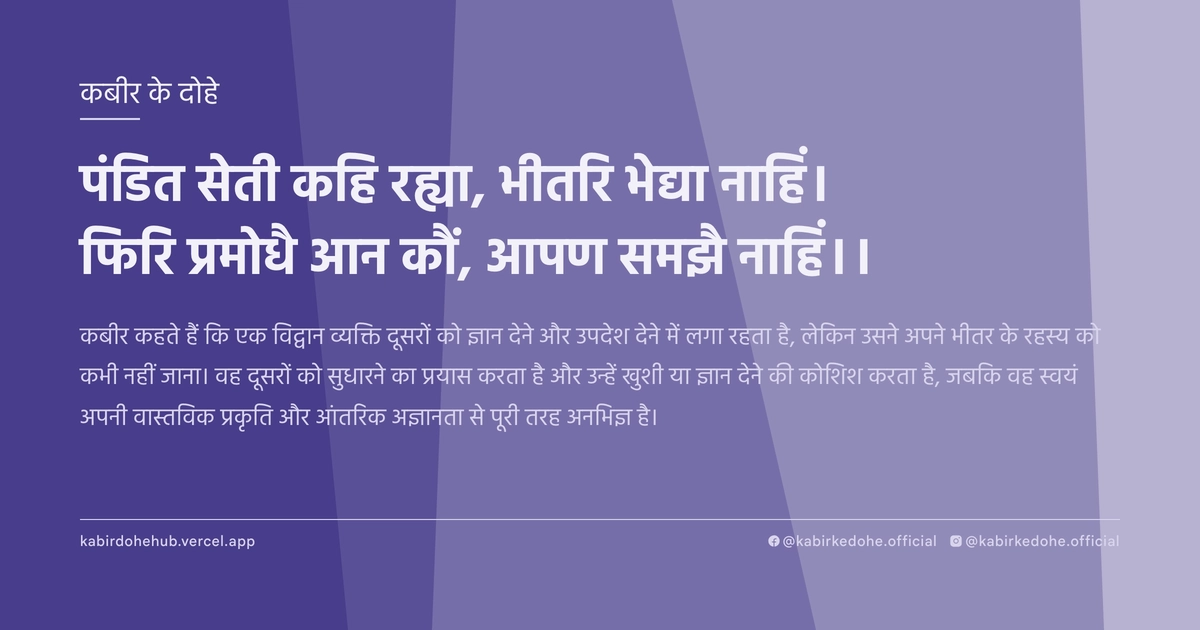
पंडित सेती कहि रह्या, भीतरि भेद्या नाहिं।
फिरि प्रमोधै आन कौं, आपण समझै नाहिं।।
Pandit seti kahi rahya, bhitari bhedya nahin. Phiri pramodhai aan kaun, aapan samjhai nahin.
इस पृष्ठ पर इस कबीर दोहे का अर्थ (meaning), हिंदी व्याख्या और अंग्रेज़ी अनुवाद, दार्शनिक विश्लेषण और व्यावहारिक जीवन सीख दी गई है। यह दोहा आत्मनिरीक्षण (Self-introspection) विषय से जुड़ा है — Kabir doha meaning and explanation in Hindi and English.
अर्थ (Meaning):
कबीर कहते हैं कि एक विद्वान व्यक्ति दूसरों को ज्ञान देने और उपदेश देने में लगा रहता है, लेकिन उसने अपने भीतर के रहस्य को कभी नहीं जाना। वह दूसरों को सुधारने का प्रयास करता है और उन्हें खुशी या ज्ञान देने की कोशिश करता है, जबकि वह स्वयं अपनी वास्तविक प्रकृति और आंतरिक अज्ञानता से पूरी तरह अनभिज्ञ है।
Kabir observes that the scholar spends his entire life lecturing others and preaching righteousness, yet he remains completely ignorant of the mysteries within his own heart. He attempts to enlighten others and guide them toward truth, while remaining blind to his own internal void and the lack of self-realization.
व्याख्या (Interpretation):
यह दोहा बाहरी ज्ञान और आंतरिक अनुभव के बीच के गहरे अंतर को दर्शाता है। 'पंडित' यहाँ केवल एक शिक्षक नहीं, बल्कि उस अहंकार का प्रतीक है जो सूचना को ज्ञान मान लेता है। शाब्दिक अर्थ यह है कि व्यक्ति दूसरों को समझा रहा है, पर स्वयं अंधा है। रूपक के तौर पर, यह 'माया' के उस जाल को दिखाता है जहाँ बुद्धि (intellect) आत्मा (Atman) के मार्ग में बाधा बन जाती है। निर्गुण भक्ति के अनुसार, ईश्वर किसी पुस्तक या शास्त्र में नहीं, बल्कि स्वयं के भीतर है। जब तक साधक 'अहं' का त्याग नहीं करता, वह केवल शब्दों का लेन-देन करता है, सत्य का अनुभव नहीं। यह विरोधाभास है कि जो दुनिया को जानने का दावा करता है, वही स्वयं से सबसे अधिक दूर है।
This couplet highlights the profound chasm between academic knowledge and experiential realization. The 'Pandit' serves as a metaphor for the ego that mistakes information for wisdom. Literally, it describes a teacher who fails to teach himself. Metaphorically, it critiques the illusion of Maya, where the intellect becomes a barrier to the Atman. In the tradition of Nirgun Bhakti, the Divine is not found in scriptures but within the self. The central paradox is that the one claiming to know the universe is the one most estranged from his own essence. Until the ego is annihilated, spiritual discourse is merely a linguistic exercise, devoid of the transformative power of non-duality (Advaita).
दार्शनिक विश्लेषण (Philosophical Analysis):
कबीर का यह प्रहार उनके युग के उस सामाजिक ढांचे पर है जहाँ धार्मिक और बौद्धिक श्रेष्ठता का उपयोग सत्ता और अहंकार के लिए किया जाता था। वे कर्मकांड और शास्त्रवाद के विरुद्ध खड़े होते हैं, क्योंकि उनका मानना था कि सत्य 'अनुभव' का विषय है, 'पढ़ने' का नहीं। यह दृष्टिकोण सूफीवाद के 'फना' (अहंकार का विनाश) और अद्वैत वेदांत के 'अहं ब्रह्मास्मि' से मेल खाता है।
यहाँ कबीर यह तर्क देते हैं कि जब तक व्यक्ति अपनी आंतरिक परतों को नहीं छीलता, उसका बाहरी ज्ञान केवल एक मुखौटा है। वे जाति और वर्ग के उस अहंकार को चुनौती देते हैं जो स्वयं को 'पंडित' मानकर दूसरों को तुच्छ समझता है। यह मनोवैज्ञानिक विश्लेषण है कि कैसे मनुष्य बाहरी दुनिया में अपनी श्रेष्ठता सिद्ध करके अपने आंतरिक खालीपन को छिपाने की कोशिश करता है।
दार्शनिक स्तर पर, यह दोहा 'ज्ञान' (Knowledge) और 'बोध' (Realization) के बीच अंतर करता है। ज्ञान वह है जो बाहर से अर्जित किया जाता है, जबकि बोध वह है जो भीतर से जागृत होता है। कबीर के अनुसार, बिना आत्म-साक्षात्कार के दिया गया उपदेश केवल शब्दों का शोर है, जो सुनने वाले को तो भ्रमित कर सकता है, लेकिन उसे मुक्त नहीं कर सकता।
यह शिक्षण हमें सिखाता है कि आध्यात्मिक यात्रा बाहर से भीतर की ओर है। जो व्यक्ति दूसरों को सुधारने की दौड़ में लगा है, वह वास्तव में अपनी जिम्मेदारी से भाग रहा है। वास्तविक धर्म वह है जहाँ उपदेशक स्वयं अपनी पहली और अंतिम प्रयोगशाला बन जाए।
अंततः, यह दोहा हमें याद दिलाता है कि विनम्रता ही ज्ञान का एकमात्र प्रमाण है। यदि ज्ञान व्यक्ति में अहंकार पैदा करता है, तो वह ज्ञान नहीं बल्कि अज्ञान का एक परिष्कृत रूप है। कबीर का उद्देश्य विद्वानों का अपमान करना नहीं, बल्कि उन्हें उस झूठी पहचान से मुक्त करना है जो उन्हें सत्य से अलग करती है।
Kabir's critique is aimed at the socio-religious structures of his era, where intellectual superiority was often used as a tool for power and ego. He stands firmly against ritualism and scriptural dogmatism, asserting that Truth is a matter of 'experience' (Anubhava) rather than 'study' (Shastra). This aligns closely with the Sufi concept of 'Fana' (annihilation of the self) and the Advaita Vedanta realization of 'Aham Brahmasmi' (I am Brahman).
Philosophically, Kabir argues that external knowledge is a mere mask if the internal layers of the self are not peeled away. He challenges the caste and class hierarchies that position the 'Pandit' as a superior guide to the 'ignorant' masses. This is a psychological observation of how humans use external validation and intellectual dominance to mask an internal void and spiritual bankruptcy.
He distinguishes between 'Jnana' (acquired knowledge) and 'Bodha' (intuitive realization). Knowledge is gathered from the outside, whereas realization awakens from within. According to Kabir, preaching without self-realization is merely noise—it may mislead the listener or provide a temporary intellectual thrill, but it can never grant liberation (Mukti).
This teaching emphasizes that the spiritual journey is an inward movement. The obsession with 'correcting' others is often a subconscious diversion from the terrifying task of facing one's own shadows. True spirituality demands that the teacher becomes their own first and final laboratory, testing every truth within their own consciousness.
Ultimately, the couplet posits that humility is the only authentic evidence of wisdom. If knowledge breeds arrogance, it is not enlightenment but a sophisticated form of ignorance. Kabir does not seek to insult scholars, but to liberate them from the false identity that separates the seeker from the sought.
मूल संदेश (Core Message):
- बाहरी ज्ञान अक्सर आंतरिक अंधकार को छिपाने का एक मुखौटा होता है।
- दूसरों को सुधारने की इच्छा वास्तव में स्वयं से भागने का एक तरीका है।
- सच्चा ज्ञान वह है जो उपदेश नहीं, बल्कि रूपांतरण लाता है।
- अहंकार का अंत ही वास्तविक बोध की शुरुआत है।
- शब्दों के संचय से नहीं, बल्कि मौन के अनुभव से सत्य मिलता है।
- External knowledge is often a mask hiding internal darkness.
- The urge to correct others is frequently a flight from the self.
- True wisdom brings transformation, not just instruction.
- The end of ego is the beginning of authentic realization.
- Truth is found in the experience of silence, not the accumulation of words.
व्यावहारिक उदाहरण (Practical Example):
एक समय की बात है, वाराणसी के एक घाट पर पंडित शिवदत्त रहते थे। वे वेदों के प्रकांड विद्वान थे और दिन भर भीड़ को यह समझाते थे कि मोक्ष कैसे प्राप्त किया जाए और मन की अशुद्धियों को कैसे दूर किया जाए। उनकी वाणी में ओज था और लोग उन्हें महान संत मानते थे।
शिवदत्त का पूरा दिन दूसरों की गलतियाँ निकालने और उन्हें धर्म का मार्ग दिखाने में बीतता था। वे हर किसी को बताते थे कि क्रोध, लोभ और अहंकार आत्मा के शत्रु हैं। वे स्वयं को एक पूर्ण मार्गदर्शक मानते थे, लेकिन उनके भीतर एक सूक्ष्म अहंकार था कि वे दूसरों से श्रेष्ठ हैं।
एक दिन, घाट पर एक साधारण सा बुनकर बैठा था, जो चुपचाप अपनी करघाई पर काम कर रहा था। शिवदत्त उसके पास गए और उसे उपदेश देने लगे कि कैसे सांसारिक मोह माया का त्याग कर ईश्वर की शरण में जाना चाहिए। उन्होंने बुनकर को बताया कि उसका जीवन व्यर्थ है क्योंकि वह केवल कपड़े बुन रहा है और आध्यात्मिक साधना नहीं कर रहा।
बुनकर ने शांति से उनकी बातें सुनी और फिर एक सरल प्रश्न पूछा, "महाराज, आपने जिस शांति और त्याग की बात की, क्या आपने उसे अपने भीतर महसूस किया है? या आप केवल उन शब्दों को दोहरा रहे हैं जो आपने किताबों में पढ़े हैं?"
शिवदत्त को यह प्रश्न चुभा। उन्होंने क्रोध में आकर बुनकर को अज्ञानी कहा और चिल्लाने लगे। उस क्षण, उन्हें एहसास हुआ कि वे जिस क्रोध और अहंकार के विरुद्ध उपदेश दे रहे थे, वे स्वयं उसी के वशीभूत थे।
वे स्तब्ध रह गए। उन्होंने देखा कि जिस बुनकर को वे अज्ञानी समझ रहे थे, उसके चेहरे पर एक ऐसी स्थिरता थी जो शिवदत्त ने अपनी सारी किताबों में नहीं पाई थी। बुनकर का मौन उनके शब्दों से अधिक शक्तिशाली था।
शिवदत्त को समझ आया कि वे अब तक केवल एक 'पुस्तकालय' थे, 'प्रकाश' नहीं। उन्होंने दूसरों को रास्ता दिखाने की कोशिश की, लेकिन वे स्वयं अंधेरे में थे क्योंकि उन्होंने कभी अपने भीतर झाँका ही नहीं था।
उस दिन के बाद, शिवदत्त ने उपदेश देना बंद कर दिया। उन्होंने अपनी सारी ऊर्जा आत्म-निरीक्षण में लगा दी। उन्होंने सीखा कि जब तक वे स्वयं को नहीं बदलेंगे, वे दुनिया में कोई बदलाव नहीं ला सकते।
वर्षों बाद, वे फिर से लोगों से मिले, लेकिन अब वे उपदेश नहीं देते थे। वे केवल सुनते थे और मुस्कुराते थे। उनकी उपस्थिति ही अब उनका उपदेश बन गई थी।
यह 'कबीर ट्विस्ट' था—बाहरी विद्वता का पतन और आंतरिक बोध का उदय। शिवदत्त अब पंडित नहीं रहे थे, वे एक साधक बन गए थे।
Once, on the ghats of Varanasi, lived Pandit Shivdutt, a profound scholar of the Vedas. He spent his days lecturing crowds on the path to Moksha and the removal of mental impurities. His voice was commanding, and people revered him as a great saint.
Shivdutt's entire existence revolved around pointing out the flaws of others and guiding them toward righteousness. He lectured relentlessly on how anger, greed, and ego were the enemies of the soul. He viewed himself as a complete guide, yet he harbored a subtle arrogance of intellectual superiority.
One day, he encountered a simple weaver sitting by the river, quietly working at his loom. Shivdutt approached him and began preaching about renouncing worldly attachments and seeking refuge in the Divine. He told the weaver that his life was wasted in weaving cloth instead of pursuing spiritual discipline.
The weaver listened patiently and then asked a simple question: "Maharaj, this peace and renunciation you speak of—have you felt it within your own heart, or are you merely repeating words you read in books?"
This question pierced Shivdutt. He reacted with anger, calling the weaver ignorant and shouting. In that moment of rage, he realized that he was possessed by the very anger and ego he had spent years preaching against.
He stood frozen. He noticed that the weaver, whom he had deemed ignorant, possessed a stillness of being that Shivdutt had never found in any scripture. The weaver's silence was more powerful than all his scholarly rhetoric.
Shivdutt realized he had been a 'library' but not a 'light.' He had tried to show others the way while he himself was wandering in the dark, having never dared to look within.
From that day forward, Shivdutt stopped preaching. He redirected all his energy toward self-observation. He understood that unless he transformed himself, any attempt to change the world was a lie.
Years later, he returned to the people, but he no longer gave lectures. He simply listened and smiled. His mere presence became his teaching.
This was the 'Kabir Twist'—the collapse of external scholarship and the birth of internal realization. Shivdutt ceased to be a Pandit and became a true seeker.
अभ्यास मार्गदर्शन (Practice Guidance):
- प्रतिदिन 20 मिनट मौन अभ्यास करें, जहाँ आप किसी भी विचार को सही या गलत ठहराने के बजाय केवल उसे देखें।
- एक 'अहंकार डायरी' लिखें: दिन भर में जब भी आप किसी को सुधारने की तीव्र इच्छा महसूस करें, तो रुकें और पूछें, "क्या मैं यह सुधार स्वयं में देख पा रहा हूँ?"
- स्व-पूछताछ (Self-Inquiry): जब भी आप किसी के बारे में राय बनाएं, तो उस राय के पीछे छिपे अपने स्वयं के पूर्वाग्रह और श्रेष्ठता की भावना को पहचानें।
- निदान चेकलिस्ट: यदि आप दूसरों की गलतियों पर अधिक ध्यान दे रहे हैं और अपनी आंतरिक अशांति पर कम, तो आप 'पंडित' मोड में हैं। यदि आप अपनी त्रुटियों को देखकर मुस्कुरा रहे हैं, तो आप 'साधक' मोड में हैं।
- Practice 20 minutes of daily silence, observing thoughts without judging them as right or wrong.
- Maintain an 'Ego Journal': Whenever you feel a strong urge to correct someone, stop and ask, "Am I embodying this correction within myself?"
- Self-Inquiry: When forming an opinion about another, consciously identify the hidden bias or sense of superiority driving that judgment.
- Diagnostic Checklist: If you are more focused on others' errors than your own inner turmoil, you are in 'Pandit' mode. If you can smile at your own flaws, you are in 'Seeker' mode.
चिंतन प्रश्न (Reflection Questions):
- मेरे जीवन का वह कौन सा हिस्सा है जहाँ मैं दूसरों के लिए मानक तय करता हूँ, लेकिन स्वयं उनका पालन नहीं करता?
- क्या मेरी बौद्धिक उपलब्धियाँ मुझे वास्तव में शांत बनाती हैं, या वे केवल मेरे अहंकार को पोषण देती हैं?
- यदि आज मेरे पास कोई उपाधि या ज्ञान का प्रमाण न हो, तो मेरी आंतरिक पहचान क्या होगी?
- मैं कितनी बार दूसरों को 'अज्ञानी' मानकर अपनी श्रेष्ठता की पुष्टि करता हूँ?
- क्या मैं सत्य को जानने का इच्छुक हूँ, या मैं केवल सत्य के बारे में बात करने में कुशल हूँ?
- मेरे भीतर का वह कौन सा 'अंधेरा' है जिसे मैं दूसरों को रोशनी दिखाकर छिपाने की कोशिश करता हूँ?
- In which areas of my life do I set standards for others that I fail to meet myself?
- Do my intellectual achievements bring me genuine peace, or do they merely feed my ego?
- If all my titles and proofs of knowledge were stripped away, what would remain of my identity?
- How often do I validate my own superiority by labeling others as 'ignorant'?
- Am I truly desirous of knowing the Truth, or am I merely skilled at talking about it?
- What is the 'darkness' within me that I attempt to hide by pretending to be a light for others?