
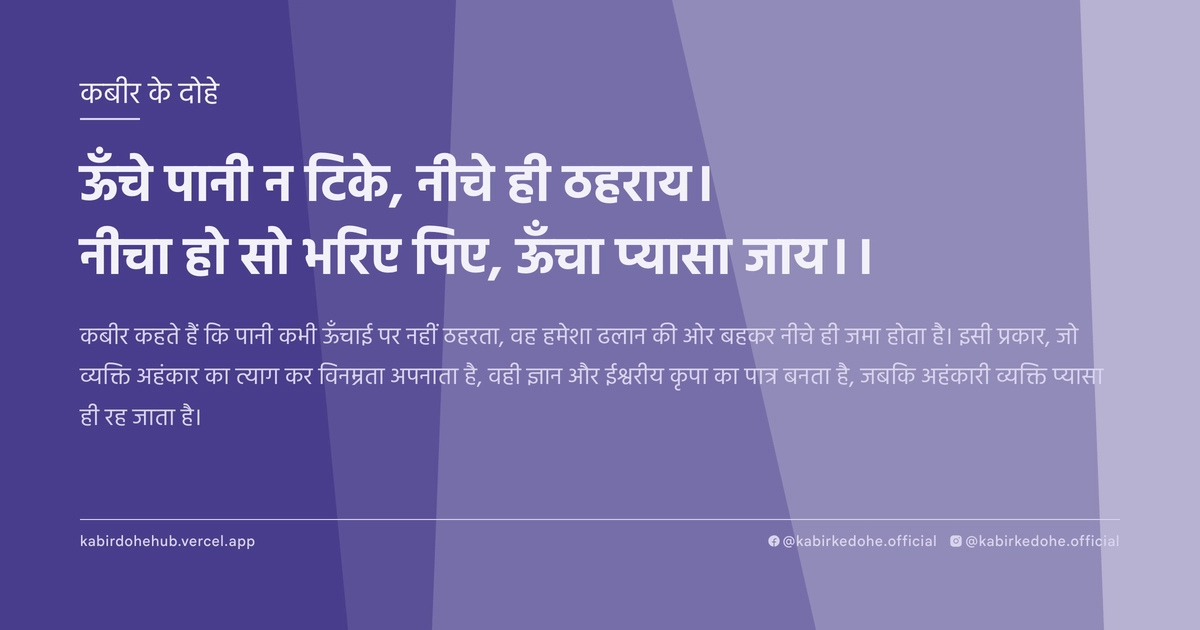
ऊँचे पानी न टिके, नीचे ही ठहराय।
नीचा हो सो भरिए पिए, ऊँचा प्यासा जाय।।
Oonche paani na tike, neeche hi thahray. Neecha ho so bharie piye, ooncha pyaasa jaaye.
इस पृष्ठ पर इस कबीर दोहे का अर्थ (meaning), हिंदी व्याख्या और अंग्रेज़ी अनुवाद, दार्शनिक विश्लेषण और व्यावहारिक जीवन सीख दी गई है। यह दोहा विनम्रता (Humility) विषय से जुड़ा है — Kabir doha meaning and explanation in Hindi and English.
अर्थ (Meaning):
कबीर कहते हैं कि पानी कभी ऊँचाई पर नहीं ठहरता, वह हमेशा ढलान की ओर बहकर नीचे ही जमा होता है। इसी प्रकार, जो व्यक्ति अहंकार का त्याग कर विनम्रता अपनाता है, वही ज्ञान और ईश्वरीय कृपा का पात्र बनता है, जबकि अहंकारी व्यक्ति प्यासा ही रह जाता है।
Kabir observes that water never remains on a height; it always flows downward to settle in the lowlands. Similarly, only those who abandon the pride of the ego and embrace true humility become vessels for divine grace and wisdom, while the arrogant remain spiritually thirsty.
व्याख्या (Interpretation):
इस दोहे का शाब्दिक अर्थ जल के भौतिक स्वभाव से शुरू होता है, लेकिन यह शीघ्र ही एक गहरे आध्यात्मिक रूपक में बदल जाता है। यहाँ 'ऊँचाई' अहंकार, सामाजिक प्रतिष्ठा और मानसिक गर्व का प्रतीक है, जबकि 'नीचा' होना विनम्रता और आत्म-समर्पण का सूचक है। निर्गुण भक्ति के संदर्भ में, जब तक साधक अपनी 'मैं' (अहंकार) को समाप्त नहीं करता, तब तक वह उस निराकार ब्रह्म का अनुभव नहीं कर सकता। माया हमें यह विश्वास दिलाती है कि श्रेष्ठता बाहरी उपलब्धियों या ऊँचे पद में है, परंतु सत्य यह है कि आध्यात्मिक तृप्ति केवल शून्य होने में है। यह विरोधाभास है कि जो खुद को छोटा मानता है, वही वास्तव में अनंत हो जाता है। अंततः, यह दोहा आत्मा और परमात्मा के मिलन के लिए 'अहं' के विसर्जन की अनिवार्यता को रेखांकित करता है।
The literal meaning begins with the physical nature of water, but swiftly transitions into a profound spiritual metaphor. Here, 'height' symbolizes ego, social prestige, and mental pride, while 'being low' signifies humility and total surrender. In the context of Nirgun Bhakti, unless the seeker annihilates the 'I' (ego), they cannot experience the formless Brahman. Maya deceives us into believing that superiority lies in external achievements or high status, yet the truth is that spiritual fulfillment is found only in becoming 'nothing.' It is a divine paradox: he who considers himself the smallest becomes truly infinite. Ultimately, this couplet underscores the necessity of dissolving the ego for the union of the Atman and the Universal Consciousness.
दार्शनिक विश्लेषण (Philosophical Analysis):
कबीर का यह दर्शन उनके समय के कठोर सामाजिक और धार्मिक ढांचे के विरुद्ध एक प्रहार था। उन्होंने देखा कि कैसे ब्राह्मणवादी व्यवस्था और धार्मिक कट्टरपंथ ने 'ऊँच-नीच' के कृत्रिम स्तर बना दिए थे। कबीर इस सामाजिक ऊँचाई को आध्यात्मिक पतन मानते थे। उनका यह विचार अद्वैत वेदांत के करीब है, जहाँ जीव और ब्रह्म की एकता की बात की गई है, लेकिन इस एकता तक पहुँचने का मार्ग 'अहंकार का विलोपन' है।
सूफी मत के 'फना' (स्वयं का विनाश) के सिद्धांत से यह दोहा गहराई से जुड़ा है। जिस प्रकार एक बूंद समुद्र में गिरकर समुद्र बन जाती है, उसी प्रकार मनुष्य जब अपनी पहचान को मिटा देता है, तब वह ईश्वर का रूप हो जाता है। कबीर यहाँ यह स्पष्ट कर रहे हैं कि कर्मकांड, तीर्थयात्रा या शास्त्र पढ़ना तब तक व्यर्थ है जब तक हृदय में विनम्रता न हो।
मनोवैज्ञानिक स्तर पर, अहंकार एक रक्षा तंत्र है जो हमें सत्य से दूर रखता है। जब हम स्वयं को दूसरों से श्रेष्ठ मानते हैं, तो हम एक मानसिक दीवार खड़ी कर लेते हैं जो हमें सीखने और विकसित होने से रोकती है। कबीर इस दीवार को ढहाने का आह्वान करते हैं।
यह दोहा केवल नैतिक उपदेश नहीं है, बल्कि एक आध्यात्मिक विज्ञान है। यह बताता है कि कृपा (Grace) हमेशा नीचे की ओर बहती है। जैसे गुरु का ज्ञान केवल उस शिष्य को मिलता है जो पूरी तरह समर्पित और विनम्र होता है, वैसे ही परमात्मा की अनुभूति केवल विनम्र हृदय में होती है।
अंततः, कबीर यह संदेश देते हैं कि वास्तविक 'ऊँचाई' वह नहीं है जिसे दुनिया देखती है, बल्कि वह आंतरिक गहराई है जिसे केवल विनम्रता के माध्यम से प्राप्त किया जा सकता है। अहंकार व्यक्ति को अलग-थलग करता है, जबकि विनम्रता उसे संपूर्ण ब्रह्मांड से जोड़ देती है।
Kabir's philosophy serves as a direct assault on the rigid social and religious hierarchies of his era. He witnessed how the Brahmanical system and religious orthodoxy created artificial strata of 'high and low.' Kabir viewed this social elevation as spiritual degradation. His thought aligns closely with Advaita Vedanta, which speaks of the oneness of the Jiva and Brahman, but emphasizes that the path to this unity is the 'annihilation of the ego.'
This couplet is deeply connected to the Sufi concept of 'Fana' (the extinction of the self). Just as a drop disappears into the ocean to become the ocean, a human must erase their individual identity to realize the Divine. Kabir clarifies that rituals, pilgrimages, or the study of scriptures are futile if the heart lacks humility.
On a psychological level, the ego is a defense mechanism that distances us from the Truth. When we perceive ourselves as superior, we construct a mental wall that prevents growth and learning. Kabir calls for the demolition of this wall to allow the flow of wisdom.
This verse is not merely a moral lesson but a spiritual science. It posits that Grace always flows downward. Just as a Guru's knowledge is only accessible to a disciple who is completely surrendered and humble, the experience of the Divine occurs only in a humble heart.
Ultimately, Kabir suggests that true 'height' is not what the world perceives, but an internal depth achieved through humility. While ego isolates the individual, humility connects them to the entire cosmos, transforming the thirsty soul into a vessel of fulfillment.
मूल संदेश (Core Message):
- अहंकार ज्ञान के मार्ग में सबसे बड़ी बाधा है।
- विनम्रता वह पात्र है जिसमें ईश्वरीय कृपा ठहरती है।
- श्रेष्ठता का दावा करना वास्तव में आध्यात्मिक दरिद्रता है।
- जब 'मैं' मिटता है, तभी 'वह' प्रकट होता है।
- सत्य की खोज ऊपर चढ़ने में नहीं, बल्कि भीतर उतरने में है।
- Ego is the primary obstacle on the path to enlightenment.
- Humility is the only vessel capable of holding divine grace.
- Claiming superiority is, in reality, a sign of spiritual poverty.
- Only when the 'I' vanishes does the 'Divine' manifest.
- The search for truth is not about ascending, but about descending within.
व्यावहारिक उदाहरण (Practical Example):
वाराणसी के घाटों पर रहने वाले एक वृद्ध विधवा, जानकी की कहानी है। जानकी वर्षों से दूसरों की सेवा करती थीं, लेकिन उनके मन में एक सूक्ष्म अहंकार था कि वे शहर की सबसे 'पवित्र' और 'धार्मिक' महिला हैं क्योंकि वे कठोर नियमों का पालन करती थीं। वे अक्सर अन्य महिलाओं को उनकी कमियों के लिए टोकती थीं और स्वयं को श्रेष्ठ समझती थीं।
एक दिन, शहर में एक अज्ञात फकीर आए। उन्होंने जानकी के गर्व को पहचान लिया। उन्होंने जानकी से कहा, 'माँ, तुम्हारा घड़ा तो बहुत ऊँचा है, लेकिन उसमें पानी नहीं है क्योंकि पानी ढलान की ओर जाता है।'
जानकी को पहले तो यह बात समझ नहीं आई। उन्होंने अपनी तपस्या और नियमों का हवाला दिया। फकीर मुस्कुराए और उन्हें एक ऐसी महिला के पास ले गए जो समाज की नजरों में 'अपवित्र' थी और अत्यंत गरीबी में जी रही थी, लेकिन उसकी आँखों में एक असीम शांति और करुणा थी।
उस महिला ने जानकी का स्वागत इस तरह किया जैसे वे कोई देवी हों, बिना यह जाने कि जानकी उन्हें नीचा समझती थीं। उस महिला की निस्वार्थ सेवा और विनम्रता ने जानकी के भीतर के अहंकार को झकझोर दिया।
जानकी ने महसूस किया कि उनकी 'पवित्रता' वास्तव में एक मानसिक बोझ था, एक ऊँचाई जिसने उन्हें ईश्वर और मानवता से दूर कर दिया था। उन्होंने देखा कि जिस महिला को वे तुच्छ समझ रही थीं, वह वास्तव में आध्यात्मिक रूप से उनसे कहीं अधिक समृद्ध थी।
उस क्षण जानकी का 'अहं' टूट गया। उन्होंने अपनी श्रेष्ठता का मुखौटा उतार फेंका और पहली बार वास्तव में दूसरों के दर्द को महसूस किया।
उन्होंने अपनी दिनचर्या बदली। अब वे केवल नियमों का पालन नहीं करती थीं, बल्कि बिना किसी निर्णय के लोगों की सेवा करने लगीं।
उनकी विनम्रता ने उन्हें वह शांति दी जो वर्षों के कठोर उपवासों और पूजाओं ने नहीं दी थी।
अब वे घाटों पर सबसे 'ऊँची' नहीं, बल्कि सबसे 'सहज' व्यक्ति बन गईं।
यही कबीर का 'ट्विस्ट' था—जब जानकी ने खुद को 'नीचा' किया, तब जाकर उनका जीवन ईश्वरीय प्रेम के जल से भर गया।
This is the story of Janaki, an elderly widow living on the ghats of Varanasi. For years, Janaki served others, but she harbored a subtle ego, believing herself to be the most 'pure' and 'religious' woman in the city due to her strict adherence to rituals. She often corrected other women for their flaws, viewing herself as spiritually superior.
One day, an unknown Fakir arrived in the city. He recognized Janaki's pride and told her, 'Mother, your vessel is placed too high; that is why it remains empty, for water only flows toward the lowlands.'
Janaki did not understand at first. She cited her austerities and discipline. The Fakir smiled and led her to a woman who was considered 'impure' by society and lived in extreme poverty, yet her eyes held an infinite peace and compassion.
This woman welcomed Janaki as if she were a goddess, unaware that Janaki looked down upon her. The woman's selfless service and profound humility shook the foundations of Janaki's ego.
Janaki realized that her 'purity' was actually a mental burden—a height that had distanced her from both God and humanity. She saw that the woman she deemed insignificant was spiritually far wealthier than she was.
In that moment, Janaki's 'I' shattered. She cast off the mask of superiority and, for the first time, truly felt the pain of others.
She changed her way of life. She no longer followed rules for the sake of identity, but began serving people without judgment.
Her humility brought her a peace that years of rigorous fasting and prayers had never provided.
She was no longer the 'highest' person on the ghats, but the most 'natural' and accessible.
This was the 'Kabir Twist'—only when Janaki lowered herself did her life finally fill with the water of divine love.
अभ्यास मार्गदर्शन (Practice Guidance):
- प्रतिदिन 15 मिनट मौन बैठें और विचार करें कि आपकी कौन सी उपलब्धियां आपके भीतर अहंकार पैदा कर रही हैं।
- एक 'अहंकार डायरी' लिखें: उन क्षणों को दर्ज करें जब आपने किसी को खुद से छोटा महसूस कराया और विश्लेषण करें कि उस समय आप वास्तव में क्या छिपा रहे थे।
- सचेत व्यवहार: दिन में कम से कम एक बार किसी ऐसे व्यक्ति की मदद करें जिससे आप आमतौर पर बात नहीं करते या जिसे आप 'नीचा' समझते हैं, और यह अनुभव करें कि आप उनसे क्या सीख सकते हैं।
- निदान चेकलिस्ट: क्या आप दूसरों की आलोचना करते समय संतुष्टि महसूस करते हैं? क्या आप अपनी प्रशंसा न मिलने पर क्रोधित होते हैं? यदि हाँ, तो आप 'ऊँचे' हैं और प्यासे हैं।
- Sit in silence for 15 minutes daily and contemplate which of your achievements are fueling a sense of superiority.
- Maintain an 'Ego Journal': Record moments where you made someone feel inferior and analyze what insecurity you were trying to mask.
- Conscious Action: At least once a day, help someone you usually ignore or perceive as 'lower' in status, and actively seek a lesson from them.
- Diagnostic Checklist: Do you feel a secret satisfaction while criticizing others? Do you feel anger when your virtues are not acknowledged? If yes, you are 'high' and therefore 'thirsty'.
चिंतन प्रश्न (Reflection Questions):
- आपकी वह कौन सी 'पवित्रता' या 'नैतिकता' है जिसका उपयोग आप दूसरों को आंकने के लिए करते हैं?
- यदि आपकी सारी सामाजिक उपाधियाँ और उपलब्धियाँ छीन ली जाएँ, तो आपकी पहचान में क्या बचेगा?
- क्या आप वास्तव में विनम्र हैं, या आप केवल अपनी विनम्रता का प्रदर्शन करके प्रशंसा पाना चाहते हैं?
- आपके जीवन का वह कौन सा क्षेत्र है जहाँ आप अभी भी 'ऊँचे' खड़े होकर दूसरों को छोटा देख रहे हैं?
- क्या आपकी डिजिटल पहचान (सोशल मीडिया) आपके वास्तविक स्वरूप को ढकने वाला एक अहंकारी मुखौटा है?
- What specific 'purity' or 'morality' do you use as a yardstick to judge others?
- If all your social titles and achievements were stripped away, what would remain of your identity?
- Are you truly humble, or are you merely performing humility to gain admiration?
- In which area of your life are you still standing 'high,' looking down upon others?
- Is your digital persona a mask of ego that hides your authentic, vulnerable self?