
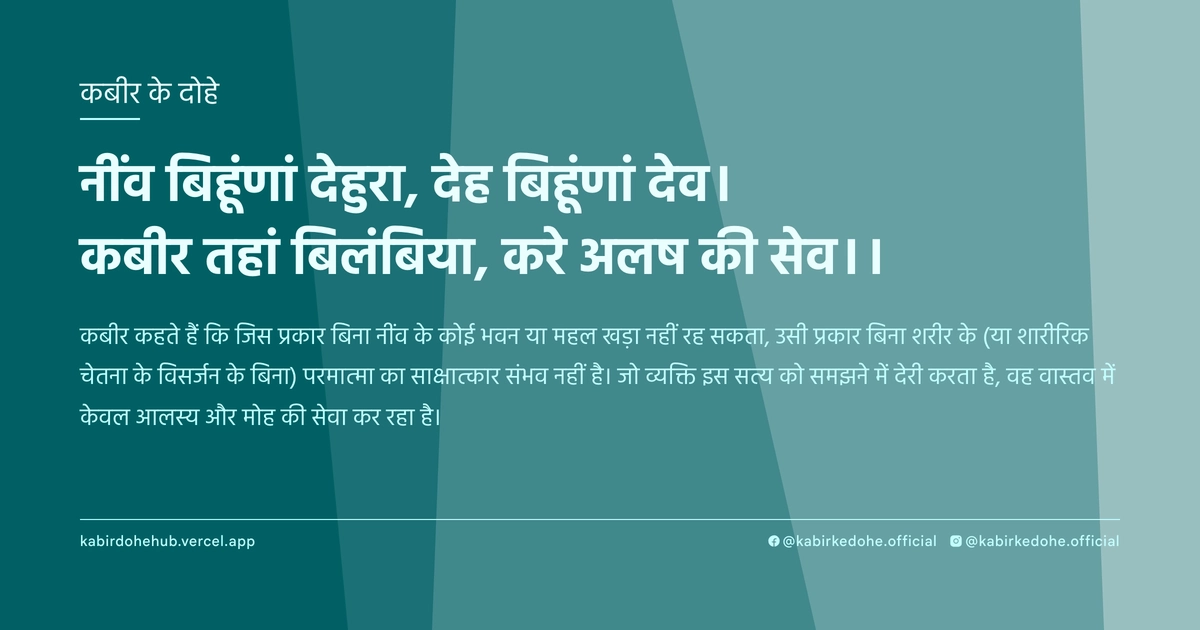
नींव बिहूंणां देहुरा, देह बिहूंणां देव।
कबीर तहां बिलंबिया, करे अलष की सेव।।
Neev bihuna dehura, deh bihuna dev. Kabir tahan bilambiya, kare alash ki sev.
इस पृष्ठ पर इस कबीर दोहे का अर्थ (meaning), हिंदी व्याख्या और अंग्रेज़ी अनुवाद, दार्शनिक विश्लेषण और व्यावहारिक जीवन सीख दी गई है। यह दोहा वैराग्य (Detachment) विषय से जुड़ा है — Kabir doha meaning and explanation in Hindi and English.
अर्थ (Meaning):
कबीर कहते हैं कि जिस प्रकार बिना नींव के कोई भवन या महल खड़ा नहीं रह सकता, उसी प्रकार बिना शरीर के (या शारीरिक चेतना के विसर्जन के बिना) परमात्मा का साक्षात्कार संभव नहीं है। जो व्यक्ति इस सत्य को समझने में देरी करता है, वह वास्तव में केवल आलस्य और मोह की सेवा कर रहा है।
Kabir asserts that just as a grand edifice cannot stand without a solid foundation, the realization of the Divine is impossible without the transcendence of the physical body and its attachments. He warns that those who procrastinate in this spiritual pursuit are merely serving their own inertia and the illusions of the material world.
व्याख्या (Interpretation):
इस दोहे में 'नींव' और 'देह' के बीच एक गहरा रूपक है। शाब्दिक अर्थ यह है कि शरीर वह आधार है जिसके माध्यम से हम आध्यात्मिक यात्रा शुरू करते हैं, लेकिन अंततः इस देह-अभिमान का विसर्जन ही वास्तविक 'नींव' है। निर्गुण भक्ति के अनुसार, जब तक साधक स्वयं को केवल मांस और हड्डियों का पुतला मानता रहता है, वह माया के जाल में फंसा रहता है। अद्वैत वेदांत के परिप्रेक्ष्य में, यह देह एकtemporary आवरण है; जब यह आवरण हटता है, तब आत्मा और ब्रह्म की एकता प्रकट होती है। 'बिलंबिया' शब्द यहाँ उस मानसिक जड़ता को दर्शाता है जहाँ मनुष्य बाहरी कर्मकांडों में उलझा रहता है और आंतरिक रूपांतरण को टालता रहता है। यह विरोधाभास है कि जिसे हम अपना 'अस्तित्व' (देह) समझते हैं, वही वास्तव में परमात्मा के मार्ग में सबसे बड़ी बाधा है।
In this couplet, there is a profound metaphor linking the 'foundation' to the 'body'. Literally, the body is the vehicle for the spiritual journey, but the true foundation of enlightenment is the dissolution of the ego-identity associated with the physical form. According to Nirgun Bhakti, as long as the seeker perceives themselves merely as a biological entity, they remain trapped in Maya (illusion). From the lens of Advaita Vedanta, the body is a transient veil; only when this veil is pierced does the non-duality of Atman and Brahman emerge. The term 'bilambiya' refers to the spiritual procrastination where one prioritizes external rituals over internal alchemy. The central paradox lies in the fact that the very identity we cling to as 'self' is the primary obstacle to realizing the Universal Self.
दार्शनिक विश्लेषण (Philosophical Analysis):
कबीर का यह कथन उनके युग के उस सामाजिक और धार्मिक परिवेश की प्रतिक्रिया है जहाँ धर्म केवल बाहरी दिखावे और शारीरिक शुद्धता तक सीमित था। उन्होंने स्पष्ट किया कि मोक्ष किसी विशेष जाति, कुल या शारीरिक स्थिति से नहीं, बल्कि चेतना के स्तर से प्राप्त होता है। यह सूफी मत के 'फना' (अहंकार का विनाश) के सिद्धांत से मेल खाता है, जहाँ साधक को ईश्वर में विलीन होने के लिए अपनी व्यक्तिगत पहचान को मिटाना पड़ता है।
अद्वैत वेदांत के अनुसार, शरीर 'अधिष्ठान' है, लेकिन सत्य 'अविनाशी' है। कबीर यहाँ चेतावनी दे रहे हैं कि यदि हम शरीर को ही अंतिम सत्य मान लेंगे, तो हम कभी उस निराकार (Nirgun) तत्व को नहीं जान पाएंगे। वे ritualism का विरोध करते हुए कहते हैं कि मंदिर-मस्जिद जाने से अधिक महत्वपूर्ण है अपने भीतर की जड़ता को तोड़ना।
मनोवैज्ञानिक स्तर पर, यह दोहा 'कॉग्निटिव डिसोनेंस' की बात करता है। हम जानते हैं कि मृत्यु निश्चित है और शरीर नश्वर है, फिर भी हम इस भ्रम में जीते हैं कि हम शरीर ही हैं। यह मोह ही वह 'आलस्य' है जिसे कबीर 'अलष की सेव' कहते हैं।
ऐतिहासिक रूप से, कबीर ने जुलाहे के रूप में जीवन व्यतीत किया, जहाँ उन्होंने देखा कि कैसे धागे के बिना कपड़ा नहीं बनता, वैसे ही बिना सही आधार (साधना) के आध्यात्मिक ऊंचाई नहीं मिलती। उनका दृष्टिकोण व्यावहारिक था—वे केवल दर्शन नहीं दे रहे थे, बल्कि एक मनोवैज्ञानिक सर्जरी कर रहे थे ताकि मनुष्य अपनी झूठी पहचान से मुक्त हो सके।
अंततः, यह दोहा हमें सिखाता है कि आध्यात्मिक प्रगति का अर्थ शरीर का त्याग नहीं, बल्कि शरीर के प्रति आसक्ति का त्याग है। जब हम स्वयं को शरीर से ऊपर उठकर देखते हैं, तब हम वास्तव में उस 'नींव' को रख रहे होते हैं जिस पर अनंत शांति का महल खड़ा हो सकता है।
Kabir's assertion is a direct response to the socio-religious climate of his era, where spirituality was often reduced to external displays of piety and physical purity. He clarifies that liberation is not a product of caste, lineage, or physical status, but a result of a shift in consciousness. This aligns closely with the Sufi concept of 'Fana' (annihilation of the self), where the seeker must dissolve their individual ego to merge with the Divine Presence.
According to Advaita Vedanta, the body is the 'adhisthana' (substratum), but the Truth is 'avinashi' (imperishable). Kabir warns that if we mistake the vessel for the essence, we will never encounter the Nirgun (formless) element. He rejects ritualism, suggesting that the act of scrubbing the external body or visiting shrines is futile if the internal inertia of the ego remains untouched.
Psychologically, this verse addresses the state of cognitive dissonance. We are intellectually aware of the body's transience, yet we emotionally cling to it as our primary identity. This clinging is the 'alash' (sloth/inertia) that Kabir describes as a form of servitude to illusion, preventing the soul from awakening.
Historically, as a weaver, Kabir observed that without a warp and weft, no fabric could be created; similarly, without the correct spiritual foundation, no height of consciousness could be reached. His approach was not merely philosophical but surgical, aiming to strip away the false layers of identity to reveal the core truth.
Ultimately, the teaching emphasizes that spiritual progress does not require the physical abandonment of the body, but the psychological abandonment of attachment to it. By transcending the 'body-consciousness', the seeker lays the true foundation upon which the edifice of eternal peace is constructed.
मूल संदेश (Core Message):
- देह केवल एक वस्त्र है, इसे अपनी पहचान न मानें।
- अहंकार का विसर्जन ही वास्तविक आध्यात्मिक नींव है।
- बाहरी कर्मकांड आंतरिक रूपांतरण का विकल्प नहीं हो सकते।
- आलस्य वह है जब हम सत्य को जानते हुए भी उसे टालते हैं।
- परमात्मा का साक्षात्कार 'मैं' के मिटने के बाद ही संभव है।
- The body is but a garment; do not mistake it for your identity.
- The dissolution of ego is the only true spiritual foundation.
- External rituals can never substitute for internal transformation.
- True sloth is knowing the truth yet continuing to postpone its practice.
- Realization of the Divine occurs only after the 'I' vanishes.
व्यावहारिक उदाहरण (Practical Example):
एक समय की बात है, वाराणसी के घाटों पर माधव नाम का एक वृद्ध मूर्तिकार रहता था। माधव अपनी कला में इतना निपुण था कि लोग कहते थे उसकी मूर्तियों में प्राण बसते हैं। लेकिन माधव एक गहरे दुख में था; वह अपनी कला को ही अपनी पहचान मान बैठा था। वह मानता था कि उसकी महानता उसकी उंगलियों के कौशल और उसकी शारीरिक क्षमता में है।
एक दिन एक अज्ञात साधु उसके पास आए और उसकी सबसे सुंदर मूर्ति को देखा। साधु ने मुस्कुराते हुए पूछा, "माधव, यह पत्थर की मूरत इतनी जीवंत कैसे है?" माधव ने गर्व से उत्तर दिया, "यह मेरी वर्षों की तपस्या और मेरे शरीर के कठिन परिश्रम का फल है।"
साधु ने शांति से कहा, "तुम पत्थर को तराश कर मूरत तो बना लेते हो, लेकिन क्या तुमने कभी उस 'मूर्तिकार' को तराशा है जो तुम्हारे भीतर बैठा है? तुम अपनी देह और अपनी कला के अहंकार की सेवा कर रहे हो, जबकि असली नींव तो उस शून्य में है जहाँ 'मैं' मिट जाता है।"
माधव को पहले तो यह बात समझ नहीं आई। वह क्रोधित हुआ कि उसकी मेहनत का अपमान किया गया। लेकिन उस रात उसे नींद नहीं आई। उसने सोचा कि यदि वह कल मर जाए, तो क्या उसकी यह 'शारीरिक कुशलता' उसके साथ जाएगी? क्या उसकी पहचान केवल इस शरीर और इन औजारों तक सीमित है?
अगले कुछ महीनों तक माधव ने अपनी कला जारी रखी, लेकिन उसका दृष्टिकोण बदल गया। अब वह मूर्ति बनाते समय यह नहीं सोचता था कि "मैं बना रहा हूँ", बल्कि वह महसूस करता था कि वह केवल एक माध्यम है। उसने अपने भीतर के अहंकार को धीरे-धीरे पिघलाना शुरू किया।
एक दिन, उसने एक ऐसी मूर्ति बनाई जिसमें कोई चेहरा नहीं था, केवल एक प्रकाश पुंज था। जब लोगों ने पूछा कि यह क्या है, तो माधव ने कहा, "यह वह है जो शरीर के पार है।"
उसने महसूस किया कि जब तक वह अपनी देह और अपनी उपलब्धियों को अपनी नींव मानता था, वह वास्तव में एक मानसिक कैद में था। जैसे ही उसने इस 'देह-अभिमान' को छोड़ा, उसे एक ऐसी शांति मिली जो उसने पहले कभी महसूस नहीं की थी।
माधव अब केवल एक मूर्तिकार नहीं रहा; वह एक मुक्त आत्मा बन गया। उसने जान लिया कि शरीर एक साधन है, साध्य नहीं। उसकी कला अब अहंकार की सेवा नहीं, बल्कि परमात्मा की अभिव्यक्ति बन गई।
उसने अपनी पूरी संपत्ति और ज्ञान गरीबों में बाँट दिया और घाटों पर बैठकर केवल मौन का अभ्यास करने लगा। वह समझ गया कि असली 'नींव' शरीर का विसर्जन है, न कि उसका संचय।
अंत में, माधव की मृत्यु हुई, लेकिन उसकी शांति उसके पीछे रह गई, जो आने वाले कई पीढ़ियों के लिए एक प्रेरणा बनी रही।
Once, on the ghats of Varanasi, lived an elderly sculptor named Madhav. Madhav was so skilled that people claimed his sculptures breathed with life. However, Madhav lived in a subtle sorrow; he had mistaken his art for his identity. He believed his greatness resided solely in the dexterity of his fingers and his physical endurance.
One day, an anonymous monk visited and admired his most exquisite piece. The monk smiled and asked, "Madhav, how does this stone image possess such life?" Madhav replied with pride, "It is the fruit of my years of penance and the grueling labor of my body."
The monk calmly replied, "You carve the stone to create a form, but have you ever carved the 'sculptor' within you? You are serving the ego of your body and your craft, while the true foundation lies in the void where the 'I' vanishes."
Initially, Madhav did not comprehend. He felt insulted that his hard work was being dismissed. But that night, sleep evaded him. He wondered: if he were to die tomorrow, would this 'physical skill' accompany him? Was his identity limited only to this flesh and these tools?
For the next few months, Madhav continued his art, but his perspective shifted. He stopped thinking "I am creating" and began to feel that he was merely a conduit. He started slowly dissolving the ego that had defined him for decades.
One day, he crafted a sculpture that had no face, only a radiating sphere of light. When people asked what it represented, Madhav replied, "This is that which exists beyond the body."
He realized that as long as he viewed his body and achievements as his foundation, he was living in a psychological prison. The moment he let go of this 'body-pride', he accessed a peace he had never known.
Madhav was no longer just a sculptor; he became a liberated soul. He understood that the body is a means, not the end. His art ceased to be a service to the ego and became an expression of the Divine.
He distributed his wealth and knowledge among the poor and spent his remaining days in silent contemplation on the ghats. He understood that the true 'foundation' is the dissolution of the physical identity, not its accumulation.
Eventually, Madhav passed away, but the tranquility he attained remained behind, serving as a beacon for generations to come.
अभ्यास मार्गदर्शन (Practice Guidance):
- प्रतिदिन 20 मिनट 'साक्षी भाव' का अभ्यास करें: अपने शरीर को एक बाहरी वस्तु की तरह देखें, जैसे आप किसी अन्य व्यक्ति को देख रहे हों।
- स्व-पूछताछ जर्नल: प्रतिदिन लिखें—"आज मैंने कितनी बार अपनी शारीरिक पहचान या उपलब्धियों को अपनी श्रेष्ठता का आधार बनाया?"
- मौन व्रत: सप्ताह में एक दिन पूर्ण मौन रहें ताकि बाहरी शोर कम हो और आंतरिक 'नींव' पर ध्यान केंद्रित हो सके।
- डायग्नोस्टिक चेकलिस्ट: यदि आप किसी की आलोचना पर तुरंत क्रोधित होते हैं या अपनी प्रशंसा पर अत्यधिक गर्व, तो समझें कि आप अभी भी 'देह-अभिमान' की सेवा कर रहे हैं।
- Practice 'Witness Consciousness' for 20 minutes daily: Observe your body as an external object, as if you are watching a stranger.
- Self-Inquiry Journaling: Write daily—"How many times today did I use my physical identity or achievements as a basis for my superiority?"
- Vow of Silence: Observe complete silence for one day a week to diminish external noise and focus on the internal 'foundation'.
- Diagnostic Checklist: If you react with immediate anger to criticism or excessive pride to praise, recognize that you are still serving the 'body-ego'.
चिंतन प्रश्न (Reflection Questions):
- यदि आपसे आपकी सभी शारीरिक विशेषताएँ और सामाजिक पद छीन लिए जाएँ, तो आपके पास क्या बचेगा?
- आपकी 'डिजिटल पहचान' (सोशल मीडिया) आपके वास्तविक स्वरूप को कितना ढंक रही है?
- क्या आप वास्तव में आध्यात्मिक खोज में हैं, या आप केवल अपनी मानसिक बेचैनी को शांत करने के लिए अनुष्ठान कर रहे हैं?
- वह कौन सा डर है जो आपको अपनी 'देह-पहचान' को छोड़ने से रोकता है?
- क्या आपकी करुणा दूसरों के प्रति है, या वह केवल आपकी अपनी छवि को बेहतर बनाने का एक तरीका है?
- If all your physical attributes and social titles were stripped away, what would remain of you?
- To what extent does your 'digital identity' obscure your authentic self?
- Are you truly on a spiritual quest, or are you merely performing rituals to soothe mental restlessness?
- What is the specific fear that prevents you from letting go of your 'body-identity'?
- Is your compassion truly for others, or is it a tool to enhance your own self-image?