
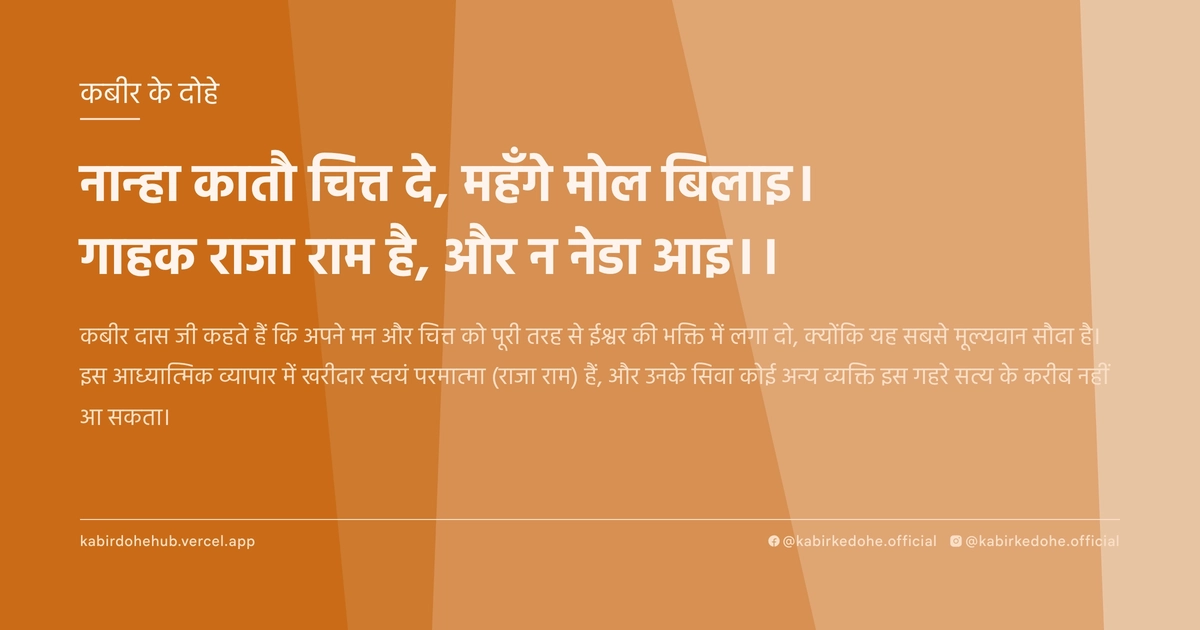
नान्हा कातौ चित्त दे, महँगे मोल बिलाइ।
गाहक राजा राम है, और न नेडा आइ।।
Nanha kaatou chitt de, mahange mol bilai. Gaahak raja ram hai, aur na neda aai.
इस पृष्ठ पर इस कबीर दोहे का अर्थ (meaning), हिंदी व्याख्या और अंग्रेज़ी अनुवाद, दार्शनिक विश्लेषण और व्यावहारिक जीवन सीख दी गई है। यह दोहा भक्ति (Bhakti) विषय से जुड़ा है — Kabir doha meaning and explanation in Hindi and English.
अर्थ (Meaning):
कबीर दास जी कहते हैं कि अपने मन और चित्त को पूरी तरह से ईश्वर की भक्ति में लगा दो, क्योंकि यह सबसे मूल्यवान सौदा है। इस आध्यात्मिक व्यापार में खरीदार स्वयं परमात्मा (राजा राम) हैं, और उनके सिवा कोई अन्य व्यक्ति इस गहरे सत्य के करीब नहीं आ सकता।
Kabir urges the seeker to invest their entire consciousness and heart into the divine, treating it as the most precious transaction of existence. He asserts that the only true Buyer in this spiritual marketplace is the Supreme Being (Raja Ram), and no worldly entity can approach the proximity of this ultimate truth.
व्याख्या (Interpretation):
शाब्दिक रूप से, कबीर यहाँ एक बुनकर की शब्दावली का उपयोग कर रहे हैं जहाँ 'कातना' और 'मोल' व्यापार को दर्शाते हैं। आध्यात्मिक स्तर पर, यह 'चित्त' यानी चेतना के समर्पण की बात है। यहाँ 'राजा राम' सगुण राम नहीं, बल्कि निर्गुण ब्रह्म हैं जो संपूर्ण सृष्टि में व्याप्त हैं। यह दोहा माया के मोह को त्यागकर आत्म-साक्षात्कार की ओर बढ़ने का आह्वान है। जब साधक अपने अहंकार को 'बेच' देता है, तब वह उस शून्य में विलीन हो जाता है जहाँ केवल परमात्मा शेष रहता है। यह अद्वैत वेदांत की उस स्थिति को दर्शाता है जहाँ ज्ञाता, ज्ञान और ज्ञेय का भेद समाप्त हो जाता है। अंततः, यह संदेश देता है कि ईश्वर की प्राप्ति के लिए पूर्ण समर्पण अनिवार्य है, क्योंकि आधा-अधूरा प्रयास आध्यात्मिक मोक्ष नहीं दिला सकता।
Literally, Kabir employs the vocabulary of a weaver, using terms like 'spinning' and 'price' to frame a spiritual transaction. Metaphorically, this refers to the total surrender of the 'Chitt' or consciousness. 'Raja Ram' here does not signify the historical king of Ayodhya, but the Nirgun Brahman—the formless, omnipresent Absolute. The doha calls for the shedding of Maya (illusion) to achieve self-realization. When the seeker 'sells' their ego, they merge into the void where only the Divine remains. This mirrors the Advaita Vedanta concept of non-duality, where the distinction between the knower, the known, and the knowledge dissolves. Ultimately, it emphasizes that spiritual liberation requires absolute surrender, as partial efforts cannot bridge the gap between the finite ego and the infinite Absolute.
दार्शनिक विश्लेषण (Philosophical Analysis):
कबीर का यह दोहा मध्यकालीन भारत के उस सामाजिक-धार्मिक परिवेश में रचा गया था जहाँ कर्मकांड और बाहरी आडंबरों का बोलबाला था। कबीर ने पुरोहितवाद और जातिगत श्रेष्ठता को नकारते हुए 'सहज मार्ग' पर बल दिया। उनका दर्शन सूफीवाद के 'फना' (अहंकार का विनाश) और वेदांत के 'अहं ब्रह्मास्मि' का एक अनूठा संगम है। यहाँ 'महँगे मोल' का अर्थ है कि मोक्ष की कीमत कुछ और नहीं, बल्कि स्वयं का 'मैं' (अहंकार) है।
निर्गुण भक्ति के परिप्रेक्ष्य में, कबीर यह समझाते हैं कि ईश्वर किसी मंदिर या मस्जिद में नहीं, बल्कि शुद्ध अंतःकरण में बसता है। वे ritualism का विरोध करते हैं क्योंकि बाहरी क्रियाएं मन की अशुद्धि को नहीं धो सकतीं। उनके लिए भक्ति एक आंतरिक alchemy है जो तामसिक और राजसिक प्रवृत्तियों को सात्विक चेतना में बदल देती है।
मनोवैज्ञानिक स्तर पर, यह दोहा 'संज्ञानात्मक पुनर्गठन' की बात करता है। जब मनुष्य अपनी पहचान को भौतिक उपलब्धियों से हटाकर सार्वभौमिक चेतना से जोड़ता है, तो वह भय और चिंता से मुक्त हो जाता है। यह अहंकार का विसर्जन है, जो कि आध्यात्मिक यात्रा की सबसे कठिन लेकिन आवश्यक शर्त है।
सूफी मत के 'इश्क-ए-हकीकी' (दिव्य प्रेम) की तरह, कबीर भी एक ऐसे प्रेम की बात करते हैं जिसमें प्रेमी और प्रियतम एक हो जाते हैं। यहाँ 'ग्राहक' होना ईश्वर की उस कृपा को दर्शाता है जो केवल उन्हीं को मिलती है जो पूरी तरह रिक्त हो चुके हैं।
अंततः, कबीर यह स्पष्ट करते हैं कि सत्य तक पहुँचने का कोई मध्यस्थ (intermediary) नहीं होता। 'और न नेडा आइ' का अर्थ है कि कोई भी गुरु, पंडित या मौलवी आपको उस अनुभव तक नहीं ले जा सकता जब तक आप स्वयं अपने चित्त को समर्पित न करें। यह व्यक्तिगत अनुभव की सर्वोच्चता का सिद्धांत है।
This doha was composed during a period of intense religious ritualism and caste rigidity in medieval India. Kabir countered the prevailing priestly hegemony by advocating for the 'Sahaj Marg' (the Natural Path). His philosophy represents a profound synthesis of the Sufi concept of 'Fana' (annihilation of the self) and the Vedantic realization of 'Aham Brahmasmi' (I am Brahman). The 'expensive price' mentioned is not material wealth, but the surrender of the 'I-ness' or the ego.
Within the framework of Nirgun Bhakti, Kabir asserts that the Divine resides not in temples or mosques, but within a purified consciousness. He rejects ritualism because external ceremonies cannot cleanse internal impurities. For Kabir, devotion is an internal alchemy that transmutes tamasic and rajasic tendencies into a state of pure, sattvic awareness.
Psychologically, this doha speaks to a cognitive restructuring. When a human shifts their identity from material achievements to universal consciousness, they are liberated from fear and anxiety. This is the process of ego-dissolution, which is the most arduous yet essential prerequisite for spiritual awakening.
Similar to the Sufi notion of 'Ishq-e-Haqiqi' (Divine Love), Kabir describes a love so consuming that the lover and the Beloved become one. The metaphor of the 'Buyer' signifies the Divine Grace that descends only upon those who have become completely empty of self-importance.
Ultimately, Kabir clarifies that there is no intermediary to the Truth. 'Aur na neda aai' implies that no priest, pandit, or cleric can grant access to this experience; it is a direct, unmediated encounter. This establishes the principle of the supremacy of personal, intuitive experience over scriptural dogma.
मूल संदेश (Core Message):
- अहंकार ही वह अंतिम पर्दा है जो आत्मा को परमात्मा से अलग करता है।
- सच्ची भक्ति बाहरी दिखावे में नहीं, बल्कि आंतरिक समर्पण में निहित है।
- जीवन का सबसे मूल्यवान सौदा स्वयं के 'मैं' का विसर्जन है।
- ईश्वर की प्राप्ति के लिए पात्रता केवल पूर्ण रिक्तता से आती है।
- जब साधक शून्य होता है, तभी वह अनंत से जुड़ पाता है।
- The ego is the final veil separating the individual soul from the Universal Spirit.
- True devotion lies not in external displays, but in absolute internal surrender.
- The most precious transaction in life is the dissolution of the 'I'.
- Eligibility for Divine realization comes only through complete inner emptiness.
- Only when the seeker becomes zero can they connect with the Infinite.
व्यावहारिक उदाहरण (Practical Example):
वाराणसी के एक पुराने घाट पर माधव नाम का एक वृद्ध बुनकर रहता था। माधव अपनी कला में निपुण था और उसके द्वारा बुने गए वस्त्र शहर के सबसे अमीर लोग खरीदते थे। लेकिन माधव के मन में एक गहरी अशांति थी; वह अपनी कला को अपनी पहचान मानता था और इस अहंकार में डूबा रहता था कि उसके बिना कोई श्रेष्ठ वस्त्र नहीं बना सकता।
एक दिन उसकी मुलाकात एक फकीर से हुई जिसने माधव के वस्त्रों की प्रशंसा नहीं की, बल्कि उसकी आँखों में झाँककर कहा, 'तू कपड़ा तो बुन रहा है, पर क्या तूने अपने चित्त को बुना है?' माधव को यह बात समझ नहीं आई, लेकिन वह फकीर के शब्दों में एक अजीब सा खिंचाव महसूस करने लगा।
फकीर ने उसे समझाया कि उसकी कला केवल एक माध्यम है, मंजिल नहीं। उसने कहा कि जब तक वह 'मैं बुनकर हूँ' के भाव में रहेगा, वह केवल धागों से खेल रहा है। जिस दिन वह अपनी कला को ईश्वर को समर्पित कर देगा, वह स्वयं एक दिव्य वस्त्र बन जाएगा।
माधव ने कई दिनों तक इस बात पर विचार किया। उसने देखा कि उसकी श्रेष्ठता का अहंकार उसे दूसरों से अलग कर रहा था। वह अपने शिष्यों को नीचा दिखाता था और अपनी सफलता का श्रेय केवल अपनी मेहनत को देता था।
एक रात, गहन ध्यान के दौरान, माधव ने महसूस किया कि उसकी उंगलियाँ नहीं, बल्कि एक अदृश्य शक्ति उसे चला रही है। उसे अहसास हुआ कि वह केवल एक यंत्र है, और असली बुनकर तो वह परमात्मा है जो पूरी सृष्टि को बुन रहा है।
उसने अपने मन के उस 'अहंकार' को, जिसे वह अपनी सबसे बड़ी पूंजी समझता था, परमात्मा के चरणों में समर्पित कर दिया। उसने तय किया कि वह अब अपनी प्रसिद्धि के लिए नहीं, बल्कि सेवा के लिए बुनेगा।
अगले दिन से माधव का व्यवहार बदल गया। उसने गरीब जरूरतमंदों के लिए मुफ्त में वस्त्र बुनना शुरू किया। उसकी आँखों में अब वह कठोरता नहीं थी, बल्कि एक असीम करुणा थी।
जब लोग उससे उसकी इस नई उदारता का कारण पूछते, तो वह बस मुस्कुरा देता। उसने जान लिया था कि जब 'मैं' मिटता है, तब 'वह' प्रकट होता है। उसका जीवन अब एक निरंतर प्रार्थना बन गया था, जहाँ हर धागा ईश्वर के प्रति उसके प्रेम का प्रतीक था।
On an ancient ghat in Varanasi lived an elderly weaver named Madhav. Madhav was a master of his craft, and his textiles were coveted by the wealthiest citizens of the city. However, Madhav harbored a deep inner restlessness; he identified himself entirely with his skill and was consumed by the ego that he was the sole creator of such perfection.
A chance encounter with a wandering fakir changed his trajectory. The fakir did not praise Madhav's fabrics but looked deep into his eyes and asked, 'You weave cloth, but have you woven your consciousness?' Madhav was perplexed, yet he felt an inexplicable pull toward the fakir's words.
The fakir explained that his art was merely a medium, not the destination. He told him that as long as he clung to the notion of 'I am the weaver,' he was merely playing with threads. The day he surrendered his art to the Divine, he himself would become a divine garment.
Madhav contemplated this for many days. He realized that his pride in his superiority had isolated him from others. He had looked down upon his apprentices and attributed all his success solely to his own effort.
One night, during deep meditation, Madhav felt that it was not his fingers moving, but an invisible cosmic force guiding him. He realized he was merely an instrument, and the true Weaver was the Absolute, weaving the fabric of the entire universe.
He surrendered the 'ego'—which he had previously considered his greatest asset—at the feet of the Divine. He decided that he would no longer weave for fame, but for selfless service.
The following day, Madhav's demeanor shifted. He began weaving clothes for the destitute and the needy free of charge. The hardness in his eyes was replaced by an infinite compassion.
When people questioned the reason for his newfound generosity, he would simply smile. He had understood that when the 'I' vanishes, the 'He' appears. His life became a continuous prayer, where every thread was a symbol of his love for the Divine.
अभ्यास मार्गदर्शन (Practice Guidance):
- प्रतिदिन 20 मिनट मौन ध्यान करें, जहाँ आप अपने विचारों को 'ग्राहक' (ईश्वर) के सामने समर्पित करें और स्वयं को एक रिक्त पात्र मानें।
- एक 'अहंकार डायरी' लिखें: दिन भर में जब भी आप 'मैंने यह किया' या 'मैं श्रेष्ठ हूँ' महसूस करें, उसे लिखें और फिर उसे 'यह उसकी कृपा है' में बदलें।
- सेवा का अभ्यास: सप्ताह में एक बार ऐसा कार्य करें जिसके लिए आपको कोई श्रेय न मिले और जिसे आप पूरी तरह गुप्त रखें।
- निदान चेकलिस्ट: क्या आप अभी भी अपनी उपलब्धियों पर गर्व करते हैं? क्या दूसरों की सफलता आपको ईर्ष्या देती है? यदि हाँ, तो आपका 'चित्त' अभी भी आपके पास है, समर्पित नहीं हुआ है।
- Practice 20 minutes of silent meditation daily, offering your thoughts to the 'Buyer' (the Divine) and visualizing yourself as an empty vessel.
- Maintain an 'Ego Journal': Whenever you feel 'I did this' or 'I am superior' during the day, record it and consciously rephrase it to 'This happened by His grace.'
- Practice Anonymous Service: Once a week, perform an act of kindness for which you receive no credit and keep the act entirely secret.
- Diagnostic Checklist: Do you still take pride in your achievements? Does the success of others evoke jealousy? If yes, your 'consciousness' is still clung to the ego and not yet surrendered.
चिंतन प्रश्न (Reflection Questions):
- वह कौन सी छवि है जिसे मैं दुनिया के सामने बनाए रखने के लिए सबसे अधिक संघर्ष करता हूँ?
- यदि मेरी सारी उपलब्धियाँ और पद छीन लिए जाएँ, तो मेरे पास 'मैं' के रूप में क्या बचेगा?
- क्या मेरी भक्ति वास्तव में समर्पण है, या यह ईश्वर से कुछ पाने की एक और सूक्ष्म इच्छा है?
- मैं किन गुप्त पूर्वाग्रहों को ढो रहा हूँ जो मुझे दूसरों में उसी परमात्मा को देखने से रोकते हैं?
- क्या मैं सत्य को खोजने के लिए तैयार हूँ, या मैं केवल अपने मौजूदा विश्वासों की पुष्टि चाहता हूँ?
- What is the specific image of myself that I struggle most to maintain in the eyes of the world?
- If all my achievements and titles were stripped away, what would remain of 'I'?
- Is my devotion truly surrender, or is it just another subtle desire to gain something from the Divine?
- What hidden biases am I carrying that prevent me from seeing the same Divinity in others?
- Am I truly ready to encounter the Truth, or am I merely seeking confirmation of my existing beliefs?