
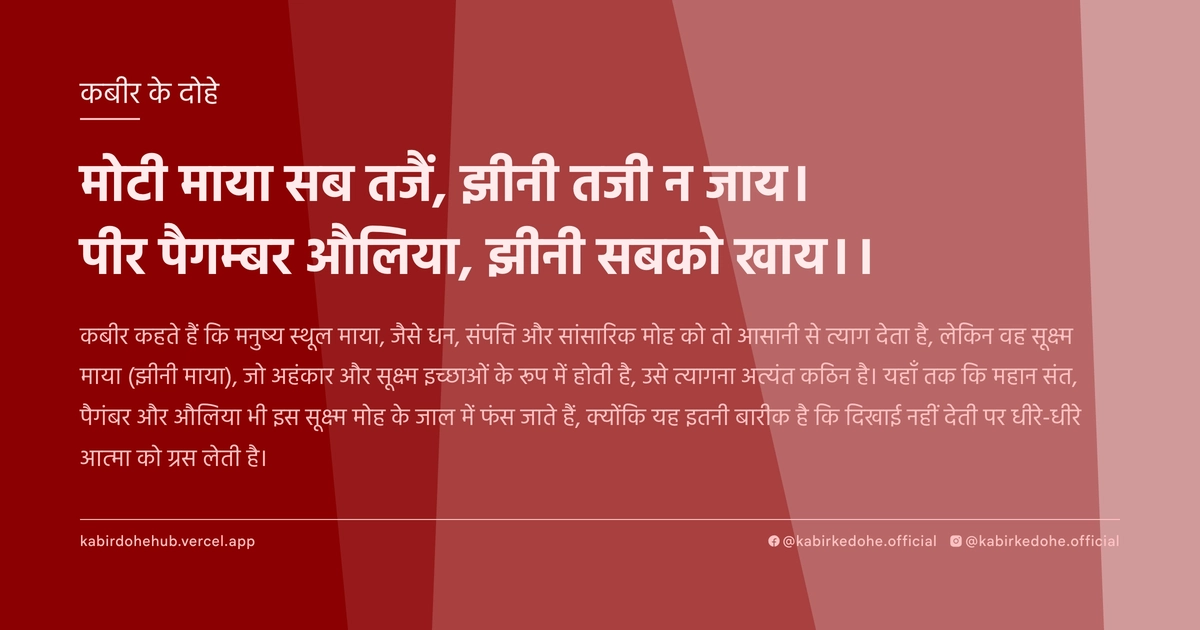
मोटी माया सब तजैं, झीनी तजी न जाय।
पीर पैगम्बर औलिया, झीनी सबको खाय।।
Moti maya sab tajen, jheeni taji na jaaye. Peer paigambar auliya, jheeni sabko khaaye.
इस पृष्ठ पर इस कबीर दोहे का अर्थ (meaning), हिंदी व्याख्या और अंग्रेज़ी अनुवाद, दार्शनिक विश्लेषण और व्यावहारिक जीवन सीख दी गई है। यह दोहा माया (Maya) विषय से जुड़ा है — Kabir doha meaning and explanation in Hindi and English.
अर्थ (Meaning):
कबीर कहते हैं कि मनुष्य स्थूल माया, जैसे धन, संपत्ति और सांसारिक मोह को तो आसानी से त्याग देता है, लेकिन वह सूक्ष्म माया (झीनी माया), जो अहंकार और सूक्ष्म इच्छाओं के रूप में होती है, उसे त्यागना अत्यंत कठिन है। यहाँ तक कि महान संत, पैगंबर और औलिया भी इस सूक्ष्म मोह के जाल में फंस जाते हैं, क्योंकि यह इतनी बारीक है कि दिखाई नहीं देती पर धीरे-धीरे आत्मा को ग्रस लेती है।
Kabir asserts that while a person may easily renounce gross illusions—such as wealth, possessions, and worldly attachments—the subtle illusion (jheeni maya), manifesting as ego and minute desires, remains nearly impossible to discard. Even the most enlightened beings, including Peers, Prophets, and Saints, are susceptible to this insidious, invisible web of attachment that silently consumes the spiritual essence of the seeker.
व्याख्या (Interpretation):
इस दोहे का शाब्दिक अर्थ है कि बड़ी माया का त्याग संभव है, पर सूक्ष्म माया नहीं। रूपक के स्तर पर, 'स्थूल माया' वह है जिसे हम देख सकते हैं—जैसे घर, पद या पैसा। 'झीनी माया' वह अदृश्य पर्दा है जो 'मैं' और 'मेरा' के सूक्ष्म भाव से बनता है। यह निर्गुण भक्ति का मूल है, जहाँ ईश्वर किसी आकार में नहीं बल्कि चेतना में है। जब साधक सोचता है कि 'मैं' मुक्त हो गया हूँ, वही 'मैं' सूक्ष्म माया है। यह अद्वैत वेदांत के उस सिद्धांत को दर्शाता है जहाँ अविद्या (अज्ञान) इतनी गहरी होती है कि वह स्वयं को सत्य मान लेती है। यह विरोधाभास है कि जो व्यक्ति दुनिया छोड़ता है, वह अक्सर अपने 'त्यागी' होने के अहंकार में फंस जाता है।
Literally, the verse suggests that gross illusion is abandonable, but subtle illusion is not. Metaphorically, 'gross maya' refers to tangible attachments like wealth or status. 'Jheeni maya' is the invisible veil woven from the subtle notions of 'I' and 'mine.' This aligns with Nirgun Bhakti, where the Divine is formless and resides in pure consciousness. The central paradox is that the moment a seeker believes 'I have attained liberation,' that very 'I' becomes the subtle maya. This mirrors the Advaita Vedanta concept of Avidya (ignorance), where the illusion is so profound it masquerades as truth. The seeker escapes the prison of the world only to enter the invisible prison of spiritual pride.
दार्शनिक विश्लेषण (Philosophical Analysis):
कबीर का यह कालखंड धार्मिक कट्टरता और बाहरी कर्मकांडों का था। उन्होंने देखा कि लोग तीर्थयात्रा और माला जपकर यह मानते हैं कि उन्होंने माया त्याग दी है, जबकि उनके भीतर जातिगत श्रेष्ठता और अहंकार का सूक्ष्म जहर बना रहता है। यह दोहा कर्मकांड के विरुद्ध एक प्रहार है। कबीर यहाँ सूफी मत के 'फना' (अहंकार का विनाश) और वेदांत के 'माया' सिद्धांत का समन्वय करते हैं।
सूफीवाद में, 'नफ्स' (lower self) को जीतना सबसे कठिन कार्य है। कबीर कहते हैं कि बाहरी त्याग केवल एक शुरुआत है; असली युद्ध आंतरिक है। जब कोई व्यक्ति कहता है कि वह 'संत' है, तो वह शब्द ही एक सूक्ष्म बंधन बन जाता है। यह मनोवैज्ञानिक विश्लेषण है कि कैसे मनुष्य अपनी पहचान को बदलने की कोशिश करता है, लेकिन मूल पहचान (अहंकार) को नहीं मिटाता।
अद्वैत वेदांत के अनुसार, ब्रह्म ही सत्य है और जगत मिथ्या। लेकिन यह मिथ्या केवल बाहरी दुनिया नहीं है, बल्कि वह धारणा भी है कि हम शरीर या मन हैं। झीनी माया वह अंतिम पर्दा है जो आत्मा को ब्रह्म में विलीन होने से रोकता है। यह सूक्ष्म मोह ही है जो हमें यह विश्वास दिलाता है कि हम ईश्वर से अलग हैं।
कबीर का दृष्टिकोण क्रांतिकारी था क्योंकि उन्होंने पैगंबरों और औलियाओं को भी इस खतरे से आगाह किया। यह दर्शाता है कि आध्यात्मिक पतन केवल अज्ञानी को नहीं, बल्कि उच्च कोटि के साधकों को भी हो सकता है यदि वे अपनी सूक्ष्म उपलब्धियों पर गर्व करने लगें। यह 'आध्यात्मिक अहंकार' (Spiritual Ego) की सबसे सटीक व्याख्या है।
अंततः, यह विश्लेषण हमें सिखाता है कि मुक्ति किसी स्थान को छोड़ने या वस्त्र बदलने में नहीं, बल्कि उस सूक्ष्म चेतना को बदलने में है जो स्वयं को कर्ता मानती है। जब तक 'मैं' का सूक्ष्म अंश जीवित है, तब तक माया का प्रभाव बना रहता है। पूर्ण विसर्जन ही एकमात्र मार्ग है।
Kabir lived in an era defined by rigid religious orthodoxy and superficial rituals. He observed people performing pilgrimages and chanting beads, believing they had renounced the world, while the subtle poison of caste superiority and ego remained deeply embedded. This verse is a direct assault on ritualism, synthesizing the Sufi concept of 'Fana' (annihilation of the self) with the Vedantic theory of 'Maya.'
In Sufism, conquering the 'Nafs' (the lower self) is the ultimate struggle. Kabir argues that external renunciation is merely a prelude; the real battle is internal. When a seeker claims the title of 'Saint,' that very label becomes a subtle shackle. This is a psychological insight into how humans attempt to shift their identity rather than dissolve the ego entirely.
According to Advaita Vedanta, Brahman is the only reality, and the world is an illusion. However, this illusion is not just the external world, but the persistent belief that we are a separate body or mind. 'Jheeni Maya' is the final veil preventing the Atman from merging into Brahman. It is the subtle attachment that sustains the illusion of duality.
Kabir’s perspective was radical because he warned even Prophets and Saints of this peril. He suggests that spiritual downfall is not reserved for the ignorant but can strike the most advanced practitioners if they succumb to pride in their achievements. This is a precise diagnosis of the 'Spiritual Ego.'
Ultimately, this analysis teaches that liberation is not found in changing one's location or clothing, but in transforming the subtle consciousness that perceives itself as the 'doer.' As long as a microscopic trace of 'I' exists, Maya persists. Total dissolution is the only path to truth.
मूल संदेश (Core Message):
- बाहरी त्याग अधूरा है यदि आंतरिक अहंकार जीवित है।
- सूक्ष्म इच्छाएँ स्थूल मोह से अधिक शक्तिशाली और घातक होती हैं।
- आध्यात्मिक उपलब्धियों का गर्व सबसे बड़ा आध्यात्मिक अवरोध है।
- सत्य केवल तब प्रकट होता है जब 'मैं' का अंतिम अंश भी मिट जाए।
- मुक्ति वस्तुओं के त्याग में नहीं, बल्कि स्वयं के भ्रम के त्याग में है।
- External renunciation is incomplete if the internal ego survives.
- Subtle desires are more powerful and lethal than gross attachments.
- Pride in spiritual achievements is the greatest spiritual obstacle.
- Truth manifests only when the final trace of 'I' is extinguished.
- Liberation lies not in discarding objects, but in discarding the illusion of self.
व्यावहारिक उदाहरण (Practical Example):
वाराणसी के घाटों पर रहने वाले एक वृद्ध बुनकर थे, जिनका नाम माधव था। माधव ने अपने जीवन के चालीस वर्ष अत्यंत सादगी से बिताए। उन्होंने अपनी सारी संपत्ति दान कर दी थी और एक छोटी सी कुटिया में रहते थे। शहर के लोग उन्हें 'महात्मा' कहकर पुकारते थे और उनके चरणों में झुकते थे।
माधव को इस बात का गहरा संतोष था कि उन्होंने दुनिया की सारी माया त्याग दी है। वह अक्सर दूसरों को उपदेश देते थे कि कैसे धन और मोह मनुष्य को नरक की ओर ले जाते हैं। वह खुद को एक 'मुक्त आत्मा' मानने लगे थे।
एक दिन, एक युवा जिज्ञासु उनके पास आया और माधव की जीवनशैली की प्रशंसा करते हुए कहा, 'आप जैसे त्याग करने वालों के कारण ही दुनिया में धर्म जीवित है।'
इस प्रशंसा ने माधव के भीतर एक सूक्ष्म बीज बो दिया। अब जब भी कोई उनके पास आता, माधव अनजाने में यह देखने लगते कि वह व्यक्ति उन्हें कितना सम्मान दे रहा है। यदि कोई उन्हें पर्याप्त सम्मान नहीं देता, तो उन्हें भीतर ही भीतर क्रोध आने लगता।
वह अब भी फटे कपड़े पहनते थे और जमीन पर सोते थे, लेकिन उनका मन अब 'सम्मान' और 'प्रतिष्ठा' की सूक्ष्म माया में फंस चुका था। वह बाहरी माया (धन) से तो मुक्त थे, लेकिन आंतरिक माया (अहंकार) ने उन्हें जकड़ लिया था।
एक शाम, एक साधारण सा भिखारी उनके पास आया और बिना किसी औपचारिकता के उनसे पानी माँगा। माधव ने उसे पानी तो दिया, लेकिन उनके मन में विचार आया कि यह भिखारी कितना अशिष्ट है, इसे पता ही नहीं कि वह एक महान संत से बात कर रहा है।
तभी उन्हें कबीर का वह दोहा याद आया—'झीनी तजी न जाय'। उन्हें अचानक अहसास हुआ कि जिस माया को वह दुनिया में खोज रहे थे, वह उनके भीतर 'संत' होने के गर्व के रूप में विराजमान है।
माधव की आँखों में आँसू आ गए। उन्होंने महसूस किया कि उनका 'त्याग' ही उनका सबसे बड़ा बंधन बन गया था। उन्होंने अपनी कुटिया के बाहर लगे 'महात्मा' के बोर्ड को हटा दिया और चुपचाप अपनी बुनाई में लग गए।
अब वह सम्मान की इच्छा नहीं करते थे। उन्होंने सीखा कि असली त्याग वह नहीं है जो दुनिया को दिखाया जाए, बल्कि वह है जहाँ 'त्यागी' होने का भाव भी मिट जाए।
माधव अब वास्तव में शांत थे, क्योंकि उन्होंने उस सूक्ष्म पर्दे को फाड़ दिया था जिसने उन्हें सत्य से अलग कर रखा था।
In the ghats of Varanasi lived an elderly weaver named Madhav. Madhav had spent forty years of his life in extreme simplicity. He had donated all his wealth and lived in a tiny hut. The townspeople called him 'Mahatma' and bowed at his feet.
Madhav felt a deep satisfaction knowing he had renounced all worldly illusions. He often lectured others on how wealth and attachment lead humans toward hell. He began to perceive himself as a 'liberated soul.'
One day, a young seeker approached him and praised his lifestyle, saying, 'Because of renunciants like you, faith is still alive in this world.'
This praise planted a subtle seed within Madhav. Now, whenever someone visited, Madhav unconsciously began monitoring how much respect they gave him. If someone failed to show sufficient deference, he felt a surge of internal anger.
He still wore tattered clothes and slept on the floor, but his mind was now trapped in the subtle maya of 'honor' and 'prestige.' He was free from gross maya (money), but internal maya (ego) had ensnared him.
One evening, a simple beggar approached and asked for water without any formality. Madhav gave him the water, but thought to himself, 'How rude this beggar is; he doesn't even realize he is speaking to a great saint.'
At that moment, Kabir's verse flashed through his mind—'Jheeni taji na jaay.' He suddenly realized that the maya he thought he had left behind was residing within him as the pride of being a 'saint.'
Tears welled in Madhav's eyes. He realized that his very 'renunciation' had become his greatest bondage. He removed the sign outside his hut that labeled him a 'Mahatma' and silently returned to his weaving.
He no longer craved respect. He learned that true renunciation is not what is displayed to the world, but the state where even the identity of being a 'renunciant' vanishes.
Madhav was now truly at peace, for he had torn the subtle veil that had separated him from the Truth.
अभ्यास मार्गदर्शन (Practice Guidance):
- दैनिक आत्म-निरीक्षण: दिन के अंत में यह विश्लेषण करें कि किस क्षण आपने 'मैं' या 'मेरा' (चाहे वह आध्यात्मिक श्रेष्ठता ही क्यों न हो) का अनुभव किया।
- मौन साधना: प्रतिदिन 30 मिनट पूर्ण मौन रहें, जहाँ आप न केवल शब्दों को, बल्कि अपने विचारों के 'कर्ता' होने के भाव को भी छोड़ने का प्रयास करें।
- अहंकार की पहचान: जब भी आपको किसी की प्रशंसा मिले, तो तुरंत रुकें और देखें कि आपके भीतर कौन सा 'अहंकार' उसे स्वीकार कर रहा है।
- डायग्नोस्टिक चेकलिस्ट: क्या मैं दूसरों की मदद इसलिए करता हूँ ताकि मैं खुद को 'दयालु' महसूस कर सकूँ? क्या मेरी शांति दूसरों की स्वीकृति पर निर्भर है? यदि हाँ, तो झीनी माया सक्रिय है।
- Daily Self-Inquiry: At the end of each day, analyze the specific moments where you felt 'I' or 'Mine,' especially regarding spiritual or moral superiority.
- Silence Practice: Spend 30 minutes in absolute silence daily, attempting to let go not just of words, but of the sense of being the 'doer' of your thoughts.
- Ego Tracking: Whenever you receive praise, pause immediately and observe which part of your ego is absorbing that validation.
- Diagnostic Checklist: Do I help others so that I can feel 'compassionate'? Is my inner peace dependent on external validation? If yes, the subtle maya is active.
चिंतन प्रश्न (Reflection Questions):
- क्या मेरा 'धार्मिक' या 'नैतिक' होना वास्तव में मेरी विनम्रता है, या यह मेरे अहंकार का एक परिष्कृत रूप है?
- यदि आज दुनिया से मेरी सारी उपलब्धियाँ और पहचान छीन ली जाएँ, तो क्या मेरे भीतर कुछ बचेगा?
- मैं किन सूक्ष्म उम्मीदों के साथ दूसरों की मदद करता हूँ, और जब वे पूरी नहीं होतीं, तो मुझे कैसा महसूस होता है?
- क्या मैं वास्तव में सत्य की खोज कर रहा हूँ, या मैं केवल एक 'सत्य खोजने वाले' की छवि बनाना चाहता हूँ?
- मेरे जीवन का वह कौन सा 'छोटा सा' मोह है जिसे मैं कभी नहीं छोड़ना चाहता, भले ही वह बहुत मामूली लगे?
- Is my 'religious' or 'moral' nature true humility, or is it a refined form of my ego?
- If all my achievements and identities were stripped away today, would anything truly remain within me?
- What subtle expectations do I hold when helping others, and how do I feel when those expectations are not met?
- Am I truly seeking the Truth, or am I merely trying to cultivate the image of a 'truth-seeker'?
- What is that 'tiny' attachment in my life that I refuse to let go of, even if it seems insignificant?