
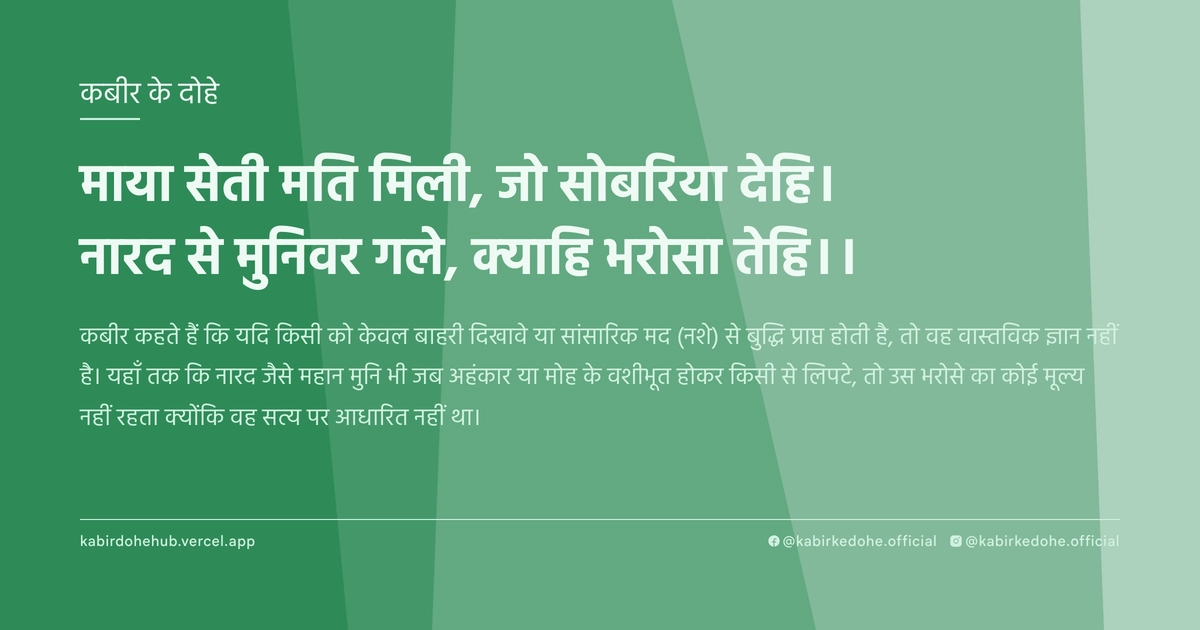
माया सेती मति मिली, जो सोबरिया देहि।
नारद से मुनिवर गले, क्याहि भरोसा तेहि।।
Maya seti mati mili, jo sobariya dehi. Narad se munivar gale, kyahi bharosa tehi.
इस पृष्ठ पर इस कबीर दोहे का अर्थ (meaning), हिंदी व्याख्या और अंग्रेज़ी अनुवाद, दार्शनिक विश्लेषण और व्यावहारिक जीवन सीख दी गई है। यह दोहा विनम्रता (Humility) विषय से जुड़ा है — Kabir doha meaning and explanation in Hindi and English.
अर्थ (Meaning):
कबीर कहते हैं कि यदि किसी को केवल बाहरी दिखावे या सांसारिक मद (नशे) से बुद्धि प्राप्त होती है, तो वह वास्तविक ज्ञान नहीं है। यहाँ तक कि नारद जैसे महान मुनि भी जब अहंकार या मोह के वशीभूत होकर किसी से लिपटे, तो उस भरोसे का कोई मूल्य नहीं रहता क्योंकि वह सत्य पर आधारित नहीं था।
Kabir asserts that intellect derived from worldly intoxication or superficial appearances is not true wisdom. Even when a sage as exalted as Narada embraces another out of a misplaced sense of pride or emotional attachment, such trust is hollow because it is not anchored in the eternal, unchanging Truth.
व्याख्या (Interpretation):
शाब्दिक अर्थ में यह दोहा बाहरी आडंबर और झूठे भरोसे पर प्रहार करता है। रूपकात्मक रूप से, 'सोबरिया' (शराब/नशा) यहाँ माया और अहंकार का प्रतीक है जो विवेक को ढक लेता है। जब साधक अपनी उपलब्धि या पद के मद में चूर होकर दूसरों से जुड़ता है, तो वह मिलन आध्यात्मिक नहीं बल्कि अहंकार का मिलन होता है। यह निर्गुण भक्ति का सिद्धांत है जहाँ आत्मा का परमात्मा से मिलन केवल तब संभव है जब 'मैं' (अहंकार) पूरी तरह मिट जाए। अद्वैत वेदांत के अनुसार, जब तक द्वैत का भ्रम है, तब तक कोई भी भरोसा या संबंध वास्तविक नहीं है, क्योंकि वह माया के अधीन है।
Literally, this couplet attacks external pretension and false reliance. Metaphorically, 'sobariya' (intoxication) symbolizes Maya and the ego that veils true discernment. When a seeker connects with others while intoxicated by their own achievements or status, the union is not spiritual but a collision of egos. This aligns with Nirgun Bhakti, where the union of Atman and Brahman is only possible once the 'I' (ego) is completely annihilated. According to Advaita Vedanta, as long as the illusion of duality persists, no trust or relationship is authentic, for it remains subject to the transient nature of Maya.
दार्शनिक विश्लेषण (Philosophical Analysis):
कबीर का यह दोहा उस समय के सामाजिक और धार्मिक परिवेश पर एक तीखा प्रहार है जहाँ विद्वत्ता को केवल शास्त्रों के ज्ञान या बाहरी वेशभूषा से मापा जाता था। कबीर ने ritualism (कर्मकांड) और caste (जाति) के साथ-साथ 'विद्वत्ता के अहंकार' को भी खारिज किया। वे बताते हैं कि वास्तविक ज्ञान वह है जो मनुष्य को विनम्र बनाए, न कि वह जो उसे दूसरों से श्रेष्ठ महसूस कराए।
यहाँ सूफीवाद का प्रभाव स्पष्ट है, जहाँ 'फना' (अहंकार का विनाश) को ईश्वर तक पहुँचने का एकमात्र मार्ग माना गया है। यदि नारद जैसे मुनि भी किसी भ्रम में हैं, तो साधारण मनुष्य की स्थिति और भी दयनीय है। यह इस बात पर जोर देता है कि आध्यात्मिक उपलब्धियों का दावा करना ही सबसे बड़ी बाधा है।
अद्वैत वेदांत के परिप्रेक्ष्य में, यह दोहा 'अविद्या' (अज्ञान) की चर्चा करता है। जब हम किसी व्यक्ति या वस्तु पर भरोसा करते हैं, तो हम अक्सर उसके बाहरी आवरण (रूप) पर भरोसा करते हैं, न कि उसके भीतर की चेतना पर। कबीर चेतावनी देते हैं कि ऐसा भरोसा रेत की दीवार की तरह है।
मनोवैज्ञानिक स्तर पर, यह 'कॉग्निटिव बायस' या पुष्टिकरण पूर्वाग्रह की बात करता है। जब हम अपनी मान्यताओं के नशे में होते हैं, तो हम केवल वही देखते हैं जो हम देखना चाहते हैं, जिससे हमारा विवेक क्षीण हो जाता है।
अंततः, कबीर यह समझाते हैं कि सत्य का मार्ग बाहरी संबंधों या महान व्यक्तित्वों के सहारे नहीं, बल्कि आंतरिक मौन और अहंकार शून्य समर्पण से प्रशस्त होता है।
Kabir's couplet is a sharp critique of the socio-religious climate of his era, where scholarship was measured by scriptural rote learning or outward attire. Kabir rejected not only ritualism and caste but also the 'ego of erudition.' He posits that true knowledge is that which renders a person humble, rather than that which makes them feel superior to others.
The influence of Sufism is evident here, where 'Fana' (the annihilation of the self) is considered the only path to the Divine. If even a sage like Narada can be clouded by illusion, the state of the ordinary human is far more precarious. This emphasizes that claiming spiritual attainment is, in itself, the greatest obstacle.
From the perspective of Advaita Vedanta, this verse discusses 'Avidya' (ignorance). When we trust a person or an object, we often rely on the external shell (form) rather than the underlying consciousness. Kabir warns that such trust is like a wall built on sand.
On a psychological level, this addresses cognitive bias. When intoxicated by our own beliefs or perceived status, we see only what we wish to see, thereby impairing our discernment (Viveka).
Ultimately, Kabir explains that the path to Truth is not paved through external associations or the patronage of great personalities, but through internal silence and the total surrender of the ego.
मूल संदेश (Core Message):
- बाहरी विद्वत्ता अक्सर आंतरिक अंधकार का पर्दा होती है।
- अहंकार का नशा सत्य के दर्शन में सबसे बड़ी बाधा है।
- सच्चा भरोसा केवल उस सत्य पर करें जो अपरिवर्तनीय है।
- विनम्रता ही वह द्वार है जिससे वास्तविक ज्ञान प्रवेश करता है।
- आत्मा का मिलन केवल 'मैं' के विसर्जन से संभव है।
- External scholarship is often a veil for internal darkness.
- The intoxication of ego is the greatest barrier to perceiving Truth.
- Place your trust only in that Truth which is immutable.
- Humility is the only gateway through which real wisdom enters.
- The union of the soul is possible only through the dissolution of the 'I'.
व्यावहारिक उदाहरण (Practical Example):
एक समय की बात है, बनारस के घाटों पर एक वृद्ध विधवा, जानकी, रहती थी। वह अपना जीवन भिक्षा और पूजा-पाठ में व्यतीत करती थी। जानकी को विश्वास था कि वह शहर की सबसे पवित्र महिला है क्योंकि वह कठोर उपवास करती थी और दिन भर मंत्र जपती थी।
उसका अहंकार इतना सूक्ष्म था कि वह दूसरों की भक्ति को 'अधूरा' मानती थी। वह अक्सर अन्य महिलाओं को उपदेश देती कि कैसे वे शुद्ध नहीं हैं। वह अपनी पवित्रता के नशे (सोबरिया) में चूर थी।
एक दिन, घाट पर एक फकीर आया जिसने कोई बाहरी चोला नहीं पहना था। उसने जानकी से कहा, 'माँ, तुम्हारी माला के दाने तो बहुत हैं, पर क्या तुम्हारे हृदय में करुणा का एक भी दाना है?'
जानकी को क्रोध आया। उसने कहा, 'मैं नारद की तरह तपस्वी हूँ, तुम मुझे क्या सिखाओगे?' फकीर मुस्कुराया और बोला, 'जब नारद जैसा मुनि भी अहंकार में पड़कर भ्रमित हो सकता है, तो तुम अपनी इस कथित पवित्रता पर इतना भरोसा कैसे कर सकती हो?'
यह बात जानकी के हृदय में तीर की तरह लगी। उसने महसूस किया कि उसकी सारी पूजा केवल उसके अहंकार को पोषण दे रही थी। वह जिसे 'भक्ति' समझ रही थी, वह वास्तव में 'श्रेष्ठता का नशा' था।
उस रात जानकी सो नहीं सकी। उसने पहली बार अपनी आंतरिक परतों को देखा और पाया कि वह करुणा से शून्य थी। उसने अपनी श्रेष्ठता का मुखौटा उतार फेंका।
अगले दिन से, जानकी ने उपदेश देना बंद कर दिया। उसने उन लोगों की सेवा करना शुरू किया जिन्हें समाज 'अछूत' या 'अपवित्र' मानता था।
उसने पाया कि जब उसने अपनी 'पवित्रता' का दावा छोड़ा, तब उसे वास्तविक शांति मिली। उसका भरोसा अब बाहरी नियमों पर नहीं, बल्कि आंतरिक प्रेम पर था।
उसका जीवन बदल गया। वह अब एक 'पवित्र विधवा' नहीं, बल्कि एक 'प्रेममयी माँ' बन गई थी, जिसने अंततः अहंकार के नशे से मुक्ति पा ली थी।
यह जानकी का 'कबीर ट्विस्ट' था—जहाँ बाहरी धर्म का अंत हुआ और वास्तविक मानवता का जन्म हुआ।
Once, on the ghats of Varanasi, lived an elderly widow named Janaki. She spent her life in alms and rigorous prayer. Janaki believed she was the most pious woman in the city because of her strict fasts and constant chanting.
Her ego was so subtle that she viewed the devotion of others as 'incomplete.' She often lectured other women on their lack of purity, intoxicated by her own perceived sanctity (the 'sobariya').
One day, a wandering fakir arrived at the ghat, wearing no religious garb. He asked Janaki, 'Mother, your rosary has many beads, but does your heart possess a single bead of compassion?'
Janaki was enraged. She replied, 'I am an ascetic like Narada; what could you possibly teach me?' The fakir smiled and said, 'If even a sage like Narada can be misled by ego, how can you place such absolute trust in your own perceived purity?'
These words pierced Janaki's heart. She realized that all her prayers were merely feeding her ego. What she mistook for 'devotion' was actually the 'intoxication of superiority.'
Janaki could not sleep that night. For the first time, she looked into her internal layers and found them void of true compassion.
She cast aside the mask of her superiority. The next day, she stopped preaching and began serving those whom society deemed 'untouchable' or 'impure.'
She discovered that when she abandoned the claim to be 'pure,' she finally found genuine peace. Her trust was no longer in external rules, but in internal love.
Her life was transformed. She was no longer a 'pious widow' but a 'loving mother,' finally liberated from the intoxication of the ego.
This was Janaki's 'Kabir Twist'—where external religion ended and authentic humanity was born.
अभ्यास मार्गदर्शन (Practice Guidance):
- दैनिक आत्म-निरीक्षण: प्रतिदिन 15 मिनट मौन बैठें और विचार करें कि आज आपने कितनी बार अपनी श्रेष्ठता सिद्ध करने का प्रयास किया।
- अहंकार की पहचान: जब भी आप किसी को 'सही' रास्ता दिखाने की इच्छा करें, रुकें और पूछें, 'क्या यह मेरी करुणा है या मेरा अहंकार?'
- सेवा का अभ्यास: बिना किसी अपेक्षा या पहचान के किसी ऐसे व्यक्ति की मदद करें जिसे आप सामान्यतः अनदेखा करते हैं।
- डायग्नोस्टिक चेकलिस्ट: यदि आप दूसरों की आलोचना करते समय संतुष्टि महसूस करते हैं, तो आप 'सोबरिया' (अहंकार के नशे) में हैं। यदि आप अपनी गलतियों पर मुस्कुरा सकते हैं, तो आप जाग रहे हैं।
- Daily Self-Inquiry: Sit in silence for 15 minutes daily and observe how many times you attempted to prove your superiority today.
- Ego Recognition: Whenever you feel the urge to 'correct' someone's path, stop and ask, 'Is this coming from compassion or from my ego?'
- Practice of Service: Help someone you typically overlook, doing so without any expectation of reward or recognition of your identity.
- Diagnostic Checklist: If you feel a sense of satisfaction while criticizing others, you are under the influence of 'sobariya' (ego-intoxication). If you can smile at your own flaws, you are awakening.
चिंतन प्रश्न (Reflection Questions):
- मेरी कौन सी 'धार्मिक' या 'नैतिक' मान्यताएँ वास्तव में मुझे दूसरों से श्रेष्ठ महसूस कराने का साधन हैं?
- यदि मेरी सारी उपलब्धियाँ और पद छीन लिए जाएँ, तो मेरे पास भरोसे के लिए क्या बचेगा?
- मैं अपनी सार्वजनिक छवि (Public Image) को बनाए रखने के लिए अपने भीतर के किन अंधेरों को छिपा रहा हूँ?
- क्या मेरा प्रेम वास्तव में दूसरे के लिए है, या यह केवल मेरी अपनी 'दाता' होने की छवि को संतुष्ट कर रहा है?
- मैं किन लोगों को 'अयोग्य' मानता हूँ, और यह धारणा मेरे अपने किस डर को दर्शाती है?
- Which of my 'religious' or 'moral' beliefs are actually tools to make me feel superior to others?
- If all my achievements and titles were stripped away, what would remain for me to trust in?
- What internal shadows am I hiding in order to maintain my public image?
- Is my love truly for the other, or is it merely satisfying my own image of being a 'giver'?
- Whom do I deem 'unworthy,' and what fear of my own does this perception reflect?