
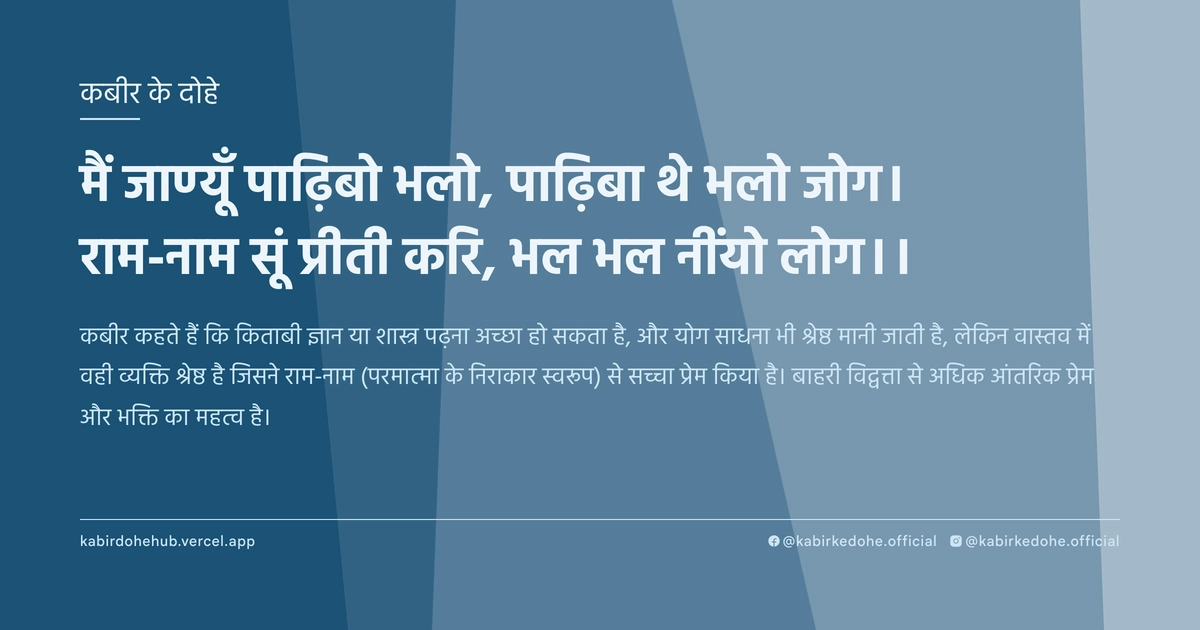
मैं जाण्यूँ पाढ़िबो भलो, पाढ़िबा थे भलो जोग।
राम-नाम सूं प्रीती करि, भल भल नींयो लोग।।
Main jaanyun padhibo bhalo, padhiba the bhalo jog. Ram-naam sun preeti kari, bhal bhal niyo log.
इस पृष्ठ पर इस कबीर दोहे का अर्थ (meaning), हिंदी व्याख्या और अंग्रेज़ी अनुवाद, दार्शनिक विश्लेषण और व्यावहारिक जीवन सीख दी गई है। यह दोहा भक्ति (Bhakti) विषय से जुड़ा है — Kabir doha meaning and explanation in Hindi and English.
अर्थ (Meaning):
कबीर कहते हैं कि किताबी ज्ञान या शास्त्र पढ़ना अच्छा हो सकता है, और योग साधना भी श्रेष्ठ मानी जाती है, लेकिन वास्तव में वही व्यक्ति श्रेष्ठ है जिसने राम-नाम (परमात्मा के निराकार स्वरूप) से सच्चा प्रेम किया है। बाहरी विद्वत्ता से अधिक आंतरिक प्रेम और भक्ति का महत्व है।
Kabir suggests that while academic learning and the disciplined practice of Yoga are commendable, the truly exalted individual is one who has cultivated a profound, heartfelt love for the Divine Name (Ram). True spiritual superiority lies not in intellectual mastery or ritualistic austerity, but in the purity of devotion.
व्याख्या (Interpretation):
इस दोहे में कबीर 'पढ़ने' (शास्त्र ज्ञान) और 'जोग' (तपस्या) की तुलना 'प्रेम' से करते हैं। यहाँ 'पढ़ना' केवल साक्षरता नहीं, बल्कि अहंकारपूर्ण बौद्धिक ज्ञान का प्रतीक है। 'जोग' शारीरिक अनुशासन और बाहरी आडंबरों को दर्शाता है। कबीर का तर्क है कि ज्ञान और योग यदि हृदय के प्रेम से अलग हैं, तो वे केवल मानसिक बोझ हैं। यह निर्गुण भक्ति का सार है जहाँ ईश्वर किसी पुस्तक या कठिन आसन में नहीं, बल्कि प्रेम की सहजता में बसता है। यह अद्वैत वेदांत की उस स्थिति की ओर संकेत करता है जहाँ ज्ञाता और ज्ञात का भेद मिट जाता है और केवल प्रेम शेष रहता है। माया हमें यह विश्वास दिलाती है कि मोक्ष कठिन ग्रंथों या जटिल अनुष्ठानों से मिलेगा, जबकि कबीर इसे एक सरल हृदय की पुकार बताते हैं।
In this couplet, Kabir contrasts 'reading' (scriptural erudition) and 'yoga' (ascetic discipline) with 'love'. Here, 'reading' symbolizes an intellectual ego that believes truth is captured in ink, while 'yoga' represents the external performance of spirituality. Kabir argues that if knowledge and discipline are devoid of heart-centered love, they remain mere mental constructs. This is the essence of Nirgun Bhakti, where the Formless Divine is found not in the rigidity of a book or the strain of a posture, but in the fluidity of devotion. It aligns with Advaita Vedanta's realization that the duality between the seeker and the sought dissolves in the fire of love. Maya tricks the seeker into believing liberation is a product of academic achievement or ritualistic rigor, whereas Kabir posits that the only true bridge to the Absolute is an unconditional longing for the Divine.
दार्शनिक विश्लेषण (Philosophical Analysis):
कबीर का यह दृष्टिकोण उनके युग के सामाजिक और धार्मिक परिवेश की एक सशक्त प्रतिक्रिया है। उस समय ब्राह्मणवादी व्यवस्था में शास्त्रों के ज्ञान को मोक्ष का एकमात्र द्वार माना जाता था, जिससे एक बौद्धिक वर्ग का वर्चस्व स्थापित हुआ। कबीर ने इस 'किताबी ज्ञान' को चुनौती दी, क्योंकि यह अक्सर अहंकार को जन्म देता है। उनके लिए, ज्ञान वह नहीं जो याद किया जाए, बल्कि वह है जो जीवन में उतरा हो।
दार्शनिक स्तर पर, यह सूफी मत के 'इश्क-ए-हकीकी' (ईश्वरीय प्रेम) और भक्ति आंदोलन के 'प्रपत्ति' (पूर्ण समर्पण) का संगम है। सूफी संत मानते हैं कि तर्क बुद्धि को सीमित करता है, जबकि प्रेम असीमित है। कबीर यहाँ तर्क दे रहे हैं कि जब तक मनुष्य 'मैं जानता हूँ' (अहंकार) के भाव में रहता है, वह सत्य से दूर रहता है। जैसे ही वह प्रेम में विलीन होता है, उसका 'स्व' मिट जाता है।
अद्वैत वेदांत के संदर्भ में, यह दोहा 'ज्ञान मार्ग' और 'भक्ति मार्ग' के द्वंद्व को समाप्त करता है। कबीर यह स्पष्ट करते हैं कि बिना प्रेम के ज्ञान शुष्क है और बिना ज्ञान के प्रेम अंधा हो सकता है, लेकिन प्रेम वह उत्प्रेरक है जो ज्ञान को अनुभव में बदल देता है। वे कर्मकांडों का विरोध करते हैं क्योंकि वे आत्मा को बाहरी ढांचे में बांधते हैं।
मनोवैज्ञानिक रूप से, कबीर 'बौद्धिक रक्षा तंत्र' (Intellectual Defense Mechanism) पर प्रहार कर रहे हैं। अक्सर लोग आध्यात्मिक चर्चाओं का उपयोग अपनी आंतरिक रिक्तता को छिपाने के लिए करते हैं। कबीर कहते हैं कि शास्त्रों का रट्टा मारना एक मानसिक सुरक्षा कवच है, जबकि प्रेम करना स्वयं को पूरी तरह असुरक्षित और खुला छोड़ देना है।
अंततः, 'राम-नाम' यहाँ किसी व्यक्ति विशेष का नाम नहीं, बल्कि उस सार्वभौमिक चेतना (Cosmic Consciousness) का प्रतीक है जो कण-कण में व्याप्त है। इस नाम से प्रीति करने का अर्थ है अपनी व्यक्तिगत पहचान को उस विराट अस्तित्व में विलीन कर देना। यही वास्तविक 'जोग' है, जो शरीर को नहीं बल्कि चेतना को संतुलित करता है।
Kabir's perspective is a powerful reaction to the socio-religious climate of his era. During his time, the Brahmanical order positioned scriptural mastery as the sole gateway to liberation, creating an intellectual hegemony. Kabir challenged this 'bookish knowledge' because it frequently birthed a spiritual ego. For him, true knowledge is not that which is memorized, but that which is embodied and lived.
Philosophically, this is a confluence of the Sufi concept of 'Ishq-e-Haqiqi' (Divine Love) and the Bhakti movement's 'Prapatti' (Total Surrender). Sufi saints maintain that logic limits the mind, while love expands it. Kabir argues that as long as a person resides in the state of 'I know' (ego), they remain distanced from the Truth. The moment they dissolve into love, the 'I' vanishes.
In the context of Advaita Vedanta, this couplet resolves the tension between the 'Path of Knowledge' (Jnana Marga) and the 'Path of Devotion' (Bhakti Marga). Kabir clarifies that knowledge without love is arid, and love without knowledge can be blind; however, love is the catalyst that transforms theoretical knowledge into direct experience. He rejects ritualism because it imprisons the soul within external structures.
Psychologically, Kabir is attacking the 'Intellectual Defense Mechanism'. People often use spiritual discourse to mask their internal void. Kabir suggests that reciting scriptures is a mental shield, whereas loving the Divine is an act of becoming completely vulnerable and open.
Ultimately, 'Ram-Nam' here does not refer to a mythological figure but symbolizes the Universal Consciousness pervading every atom. To love this Name is to merge one's individual identity into the vastness of existence. This is the true 'Yoga'—not the alignment of the body, but the alignment of consciousness with the Absolute.
मूल संदेश (Core Message):
- बौद्धिक अहंकार सत्य की प्राप्ति में सबसे बड़ी बाधा है।
- शास्त्रों का ज्ञान केवल दिशा दिखाता है, लेकिन प्रेम ही गंतव्य तक पहुँचाता है।
- वास्तविक योग शरीर को मोड़ना नहीं, बल्कि अहंकार को मिटाना है।
- ईश्वर की खोज बाहरी ग्रंथों में नहीं, बल्कि आंतरिक प्रेम में है।
- प्रेम वह एकमात्र भाषा है जिसे परमात्मा और मनुष्य दोनों समझते हैं।
- Intellectual arrogance is the greatest obstacle to realizing the Truth.
- Scriptural knowledge only points the way; love is the vehicle that reaches the destination.
- True Yoga is not the twisting of the body, but the annihilation of the ego.
- The search for the Divine is not in external texts, but in internal love.
- Love is the only language understood by both the Absolute and the human.
व्यावहारिक उदाहरण (Practical Example):
एक समय की बात है, वाराणसी के घाटों पर एक वृद्ध विधवा रहती थी, जिसका नाम जानकी था। जानकी का पूरा जीवन धर्मग्रंथों के अध्ययन और कठोर नियमों के पालन में बीता था। वह शहर की सबसे विद्वान महिला मानी जाती थी, जिसने वेदों और पुराणों के कठिन श्लोकों को कंठस्थ कर लिया था। वह अपनी शुद्धता और ज्ञान के कारण दूसरों को उपदेश देती थी, लेकिन उसके हृदय में एक अनजानी बेचैनी और कठोरता थी।
उसी घाट के पास एक साधारण नाई रहता था, जो अनपढ़ था। वह दिन भर लोगों के बाल काटता और शाम को बस एक कोने में बैठकर 'राम-राम' गुनगुनाता। उसके चेहरे पर एक ऐसी शांति और मुस्कान थी जिसे जानकी अपनी सारी विद्याओं के बाद भी प्राप्त नहीं कर पाई थी। जानकी अक्सर उस नाई को उसकी अज्ञानता के लिए ताना मारती थी कि वह बिना शास्त्रों को समझे कैसे ईश्वर को पा सकता है।
एक दिन जानकी बहुत बीमार पड़ गई। उसके पास पढ़ने के लिए पुस्तकें तो थीं, लेकिन सेवा करने वाला कोई नहीं। जिस समाज को उसने अपने ज्ञान से प्रभावित किया था, वे सब उसकी बीमारी में दूर रहे। तभी वह अनपढ़ नाई उसके पास आया। उसने बिना किसी संकोच के जानकी की सेवा की, उसके लिए भोजन लाया और उसके सिरहाने बैठकर बस प्रेम से राम-नाम का जाप करता रहा।
नाई की निस्वार्थ सेवा और उसके शब्दों में छिपे गहरे प्रेम ने जानकी के भीतर कुछ तोड़ दिया। उसने महसूस किया कि उसने जीवन भर 'ईश्वर के बारे में' पढ़ा था, लेकिन इस नाई ने 'ईश्वर को' जीया था। जानकी को समझ आया कि उसकी विद्वत्ता एक दीवार बन गई थी जिसने उसे वास्तविक प्रेम से अलग कर दिया था।
उस क्षण जानकी का अहंकार ढह गया। उसने अपनी सारी पुस्तकों को एक तरफ रख दिया और नाई के चरणों में बैठकर पूछा, 'तुमने यह शांति कहाँ से पाई?' नाई ने बस मुस्कुराकर कहा, 'माँ, मैंने कभी पढ़ा नहीं, बस प्रेम करना सीख लिया।'
यह जानकी के लिए 'कबीर ट्विस्ट' था। उसने महसूस किया कि ज्ञान जब तक हृदय तक नहीं पहुँचता, वह केवल शब्दों का ढेर है। उसने अपनी कठोरता को त्याग दिया और अब वह शास्त्रों के विश्लेषण के बजाय लोगों की सेवा और प्रेम में अपना समय बिताने लगी।
उसकी आँखों में अब वह अहंकार नहीं था, बल्कि एक ऐसी करुणा थी जो केवल प्रेम से आती है। उसने सीखा कि ईश्वर किसी व्याकरण या श्लोक में नहीं, बल्कि एक निस्वार्थ हृदय की धड़कन में बसता है।
जानकी अब वाराणसी की सबसे 'विद्वान' महिला नहीं थी, लेकिन वह सबसे 'सुखी' और 'प्रेमपूर्ण' महिला बन गई थी। उसने जान लिया था कि राम-नाम की प्रीति ही वास्तविक योग है।
Once, on the ghats of Varanasi, lived an elderly widow named Janaki. Janaki's entire life had been spent studying religious texts and adhering to rigorous rules. She was considered the most learned woman in the city, having memorized complex shlokas from the Vedas and Puranas. She often lectured others on purity and knowledge, yet within her heart lay an unknown restlessness and rigidity.
Near the same ghat lived a simple barber who was completely illiterate. He spent his days cutting hair and his evenings humming 'Ram-Ram' in a quiet corner. There was a serenity and a smile on his face that Janaki, despite all her learning, had never attained. Janaki frequently mocked the barber for his ignorance, questioning how he could possibly find God without understanding the scriptures.
One day, Janaki fell gravely ill. She had books to read, but no one to care for her. The society she had impressed with her knowledge remained distant during her suffering. It was then that the illiterate barber came to her. Without hesitation, he served her, brought her food, and sat by her bedside, chanting the name of Ram with pure love.
The barber's selfless service and the deep love embedded in his presence broke something inside Janaki. She realized that while she had spent her life reading 'about' God, this barber was 'living' God. Janaki understood that her scholarship had become a wall, separating her from actual love.
In that moment, Janaki's ego collapsed. She pushed her books aside and asked the barber, 'Where did you find this peace?' The barber simply smiled and replied, 'Mother, I never learned to read; I only learned to love.'
This was the 'Kabir Twist' for Janaki. She realized that knowledge, until it reaches the heart, is merely a heap of words. She abandoned her rigidity and began spending her time in service and love rather than scriptural analysis.
There was no longer arrogance in her eyes, but a compassion that only comes from love. She learned that the Divine does not reside in grammar or verses, but in the heartbeat of a selfless heart.
Janaki was no longer the most 'learned' woman in Varanasi, but she became the most 'content' and 'loving' woman. She finally understood that love for the Divine Name is the only true Yoga.
अभ्यास मार्गदर्शन (Practice Guidance):
- दैनिक चिंतन: प्रतिदिन 15 मिनट मौन बैठें और विचार करें कि आपके जीवन में 'ज्ञान' (अहंकार) कहाँ हावी है और 'प्रेम' (विनम्रता) कहाँ कम है।
- आत्म-पूछताछ जर्नल: लिखें कि क्या आप किसी की मदद इसलिए करते हैं क्योंकि यह 'सही' है (बौद्धिक ज्ञान), या इसलिए क्योंकि आप उनके प्रति प्रेम महसूस करते हैं (हृदय का ज्ञान)।
- व्यवहारिक परिवर्तन: दिन में कम से कम एक ऐसा कार्य करें जिसमें कोई प्रशंसा न मिले, केवल निस्वार्थ प्रेम और सेवा की भावना हो।
- निदान चेकलिस्ट: यदि आप दूसरों को सुधारने की तीव्र इच्छा महसूस करते हैं, तो आप 'पढ़ने' (अहंकार) के प्रभाव में हैं। यदि आप दूसरों की त्रुटियों के प्रति करुणा महसूस करते हैं, तो आप 'प्रेम' के मार्ग पर हैं।
- Daily Contemplation: Sit in silence for 15 minutes daily and observe where 'knowledge' (ego) dominates your life and where 'love' (humility) is lacking.
- Self-Inquiry Journal: Record whether you help others because it is 'correct' (intellectual knowledge) or because you feel a genuine love for them (heart-knowledge).
- Behavioral Shift: Perform at least one act of service daily that brings no recognition or praise, driven solely by selfless love.
- Diagnostic Checklist: If you feel an intense urge to 'correct' others, you are operating from the ego of 'reading'. If you feel compassion toward others' flaws, you are walking the path of 'love'.
चिंतन प्रश्न (Reflection Questions):
- क्या मेरी आध्यात्मिक उपलब्धियाँ मुझे दूसरों से श्रेष्ठ महसूस कराती हैं? यदि हाँ, तो क्या यह वास्तव में आध्यात्मिकता है या केवल एक सूक्ष्म अहंकार?
- मैं अपनी पहचान को अपनी डिग्री, पद या ज्ञान से कितना जोड़ता हूँ? यदि ये सब छीन लिए जाएँ, तो मेरा 'स्व' क्या बचेगा?
- मेरे जीवन में ऐसा कौन है जिसे मैं 'अज्ञानी' मानता हूँ, लेकिन जिसकी शांति मुझसे अधिक है? मैं उससे क्या सीख सकता हूँ?
- क्या मेरा प्रेम शर्तों पर आधारित है, या यह उस 'राम-नाम' की तरह है जो बिना किसी भेदभाव के सबको समाहित करता है?
- डिजिटल युग में, क्या मैं ज्ञान का प्रदर्शन (Information) कर रहा हूँ या वास्तव में सत्य का अनुभव (Transformation) कर रहा हूँ?
- Do my spiritual achievements make me feel superior to others? If so, is this truly spirituality or just a subtle ego?
- How much do I tie my identity to my degrees, position, or knowledge? If these were stripped away, what would remain of my 'self'?
- Who in my life do I consider 'ignorant,' yet possesses more peace than I do? What can I learn from them?
- Is my love conditional, or is it like the 'Ram-Nam' that embraces everyone without discrimination?
- In the digital age, am I performing knowledge (Information) or actually experiencing the Truth (Transformation)?