
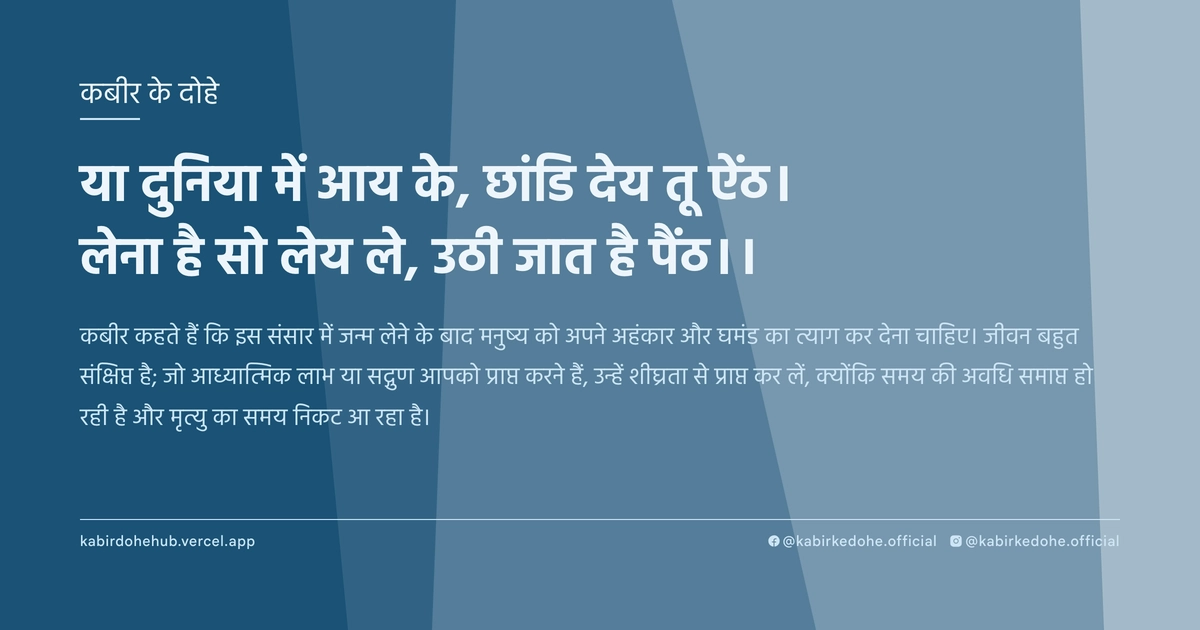
या दुनिया में आय के, छांडि देय तू ऐंठ।
लेना है सो लेय ले, उठी जात है पैंठ।।
Ya duniya me aay ke, chhandi dey tu ainth. Lena hai so ley le, uthi jaat hai painth.
इस पृष्ठ पर इस कबीर दोहे का अर्थ (meaning), हिंदी व्याख्या और अंग्रेज़ी अनुवाद, दार्शनिक विश्लेषण और व्यावहारिक जीवन सीख दी गई है। यह दोहा अहंकार (The Ego) विषय से जुड़ा है — Kabir doha meaning and explanation in Hindi and English.
अर्थ (Meaning):
कबीर कहते हैं कि इस संसार में जन्म लेने के बाद मनुष्य को अपने अहंकार और घमंड का त्याग कर देना चाहिए। जीवन बहुत संक्षिप्त है; जो आध्यात्मिक लाभ या सद्गुण आपको प्राप्त करने हैं, उन्हें शीघ्रता से प्राप्त कर लें, क्योंकि समय की अवधि समाप्त हो रही है और मृत्यु का समय निकट आ रहा है।
Kabir exhorts the seeker to relinquish all pride and arrogance upon entering this worldly existence. Life is a fleeting opportunity; one must swiftly acquire the spiritual treasures and virtues intended for the soul, for the allotted time is rapidly expiring and the final call of death is inevitable.
व्याख्या (Interpretation):
शाब्दिक रूप से, यह दोहा समय की सीमितता और अहंकार की व्यर्थता की चेतावनी देता है। रूपकात्मक स्तर पर, 'ऐंठ' (अहंकार) वह पर्दा है जो आत्मा को परमात्मा से अलग करता है। निर्गुण भक्ति के संदर्भ में, अहंकार ही वह 'माया' है जो जीव को यह विश्वास दिलाती है कि वह शरीर या सामाजिक स्थिति है। जब कबीर 'पैंठ' (समय सीमा/अवधि) की बात करते हैं, तो वे संकेत देते हैं कि भौतिक जीवन केवल एक क्षणिक अवसर है। अद्वैत वेदांत के अनुसार, जब तक 'मैं' का भाव रहता है, तब तक ब्रह्म का अनुभव असंभव है। अतः, अहंकार का विसर्जन ही वह एकमात्र मार्ग है जिससे आत्मा अपने वास्तविक स्वरूप को पहचान सकती है।
Literally, this couplet warns of the finitude of time and the futility of pride. Metaphorically, 'ainth' (arrogance) is the veil that separates the Atman from the Paramatman. In the context of Nirgun Bhakti, ego is the primary manifestation of Maya, deceiving the soul into identifying with the body or social status. When Kabir speaks of 'painth' (the allotted term), he suggests that physical life is but a momentary window. According to Advaita Vedanta, as long as the sense of 'I-ness' persists, the realization of Brahman remains impossible. Thus, the annihilation of the ego is the only gateway through which the soul can recognize its non-dual essence.
दार्शनिक विश्लेषण (Philosophical Analysis):
कबीर का यह विचार उनके समय के सामाजिक और धार्मिक पाखंडों के विरुद्ध एक कड़ा प्रहार है। उन्होंने देखा कि लोग जाति, कुल और धार्मिक अनुष्ठानों के अहंकार में डूबे हुए थे, जबकि उनकी आध्यात्मिक स्थिति शून्य थी। कबीर का दर्शन सूफी मत के 'फना' (अहंकार का विनाश) और वेदांत के 'अहं ब्रह्मास्मि' के बीच एक सेतु बनाता है। वे तर्क देते हैं कि बाहरी आडंबर केवल अहंकार को पोषित करते हैं, जबकि आंतरिक मौन और समर्पण ही सत्य तक ले जाते हैं।
ऐतिहासिक रूप से, कबीर ने उस युग में यह बात कही जब समाज कठोर वर्ण व्यवस्था में बंटा था। 'ऐंठ' केवल व्यक्तिगत घमंड नहीं, बल्कि उस व्यवस्थागत श्रेष्ठता का प्रतीक है जो मनुष्य को मनुष्य से अलग करती है। उनका विरोध केवल ब्राह्मणवाद या मुल्लावाद से नहीं था, बल्कि उस मानसिक अवस्था से था जो स्वयं को दूसरों से ऊपर मानती है।
मनोवैज्ञानिक स्तर पर, अहंकार एक रक्षा तंत्र है जो हमें असुरक्षा से बचाता है, लेकिन आध्यात्मिक रूप से यह एक कारागार है। कबीर सुझाव देते हैं कि जब तक हम अपनी पहचान को बाहरी उपाधियों से जोड़ते हैं, हम सत्य से दूर रहते हैं। वास्तविक परिवर्तन तब होता है जब व्यक्ति यह महसूस करता है कि उसकी सारी उपलब्धियां क्षणभंगुर हैं।
यह दोहा 'समय' (काल) की अवधारणा पर जोर देता है। सूफी परंपरा में, समय को एक शिक्षक माना गया है जो हमें याद दिलाता है कि हम यहाँ केवल मेहमान हैं। कबीर इस तात्कालिकता का उपयोग साधक को आलस्य से जगाने के लिए करते हैं।
अंततः, कबीर का संदेश यह है कि मोक्ष किसी बाहरी अनुष्ठान से नहीं, बल्कि आंतरिक शुद्धि और अहंकार के पूर्ण समर्पण से प्राप्त होता है। यह एक क्रांतिकारी विचार था जिसने भक्ति आंदोलन को आम जनता के करीब लाया और धर्म को कर्मकांड से हटाकर प्रेम और सत्य पर केंद्रित किया।
Kabir's insight is a sharp critique of the social and religious hypocrisies of his era. He observed people immersed in the pride of caste, lineage, and ritualistic purity, while their spiritual depth remained nonexistent. His philosophy constructs a bridge between the Sufi concept of 'Fana' (annihilation of the self) and the Vedantic realization of 'Aham Brahmasmi'. He argues that external rituals only nourish the ego, whereas internal silence and surrender lead to the Truth.
Historically, Kabir spoke during a period of rigid caste stratification. 'Ainth' (pride) is not merely personal arrogance but a symbol of the systemic superiority that divides humanity. His opposition was not directed solely at Brahmanism or the clergy, but at the psychological state of perceiving oneself as superior to others.
Psychologically, the ego serves as a defense mechanism against insecurity, yet spiritually, it acts as a prison. Kabir suggests that as long as we tether our identity to external titles, we remain estranged from the Truth. True transformation occurs when one realizes that all worldly achievements are ephemeral.
This couplet emphasizes the concept of 'Kaal' (Time). In Sufi traditions, time is viewed as a teacher reminding us that we are mere guests in this world. Kabir utilizes this urgency to awaken the seeker from spiritual lethargy.
Ultimately, Kabir's message is that liberation is not achieved through external rites, but through internal purification and the total surrender of the ego. This was a revolutionary thought that brought the Bhakti movement to the masses, shifting the focus of religion from ritualism to love and truth.
मूल संदेश (Core Message):
- अहंकार वह दीवार है जो सत्य को देखने नहीं देती।
- जीवन एक संक्षिप्त अवसर है, इसे घमंड में व्यर्थ न करें।
- बाहरी उपलब्धियां क्षणभंगुर हैं, आंतरिक शांति ही स्थायी है।
- स्वयं को शून्य करना ही पूर्णता की ओर पहला कदम है।
- समय निरंतर बीत रहा है, आध्यात्मिक जागृति में देरी न करें।
- Ego is the wall that obscures the vision of Truth.
- Life is a brief window; do not waste it in arrogance.
- External achievements are fleeting; inner peace is eternal.
- Becoming zero is the first step toward becoming Infinite.
- Time is slipping away; do not delay your spiritual awakening.
व्यावहारिक उदाहरण (Practical Example):
एक समय की बात है, वाराणसी के घाटों पर माधव नाम का एक अत्यंत कुशल मूर्तिकार रहता था। उसकी बनाई मूर्तियाँ इतनी जीवंत होती थीं कि लोग दूर-दूर से उन्हें देखने आते थे। माधव को अपनी कला पर बहुत गर्व था। वह मानता था कि उसके जैसा शिल्पकार पूरे आर्यावर्त में कोई नहीं है। वह अक्सर अन्य मूर्तिकारों का उपहास करता और उन्हें 'अकुशल' कहकर पुकारता। उसका अहंकार उसके व्यक्तित्व का केंद्र बन गया था।
एक दिन, एक वृद्ध संन्यासी उसके पास आए। उन्होंने माधव की सबसे सुंदर मूर्ति को देखा और मुस्कुराते हुए कहा, 'कला अद्भुत है, लेकिन कलाकार अभी भी पत्थर जैसा कठोर है।' माधव को यह बात चुभी। उसने क्रोध में कहा, 'आप मेरी कला की प्रशंसा करने के बजाय मेरी आलोचना कर रहे हैं? क्या आप जानते हैं कि सम्राट भी मेरी कला के कायल हैं?'
संन्यासी ने शांति से उत्तर दिया, 'सम्राट की प्रशंसा केवल तुम्हारी बाहरी कला की है, तुम्हारी आत्मा की नहीं। जिस दिन यह शरीर मिट्टी में मिलेगा, तुम्हारी यह 'ऐंठ' भी उसी मिट्टी में मिल जाएगी। तब क्या बचेगा?'
माधव ने इस बात को अनसुना कर दिया। लेकिन कुछ समय बाद, एक भीषण बाढ़ आई जिसने वाराणसी के कई हिस्सों को तबाह कर दिया। माधव की कार्यशाला बह गई, उसकी सारी कीमती मूर्तियाँ टूट गईं और वह सड़क पर आ गया। जिस अहंकार ने उसे दुनिया का सर्वश्रेष्ठ कलाकार बनाया था, वह अब उसे अकेला और असहाय महसूस करा रहा था।
भूखा और प्यासा, वह उसी संन्यासी के पास पहुँचा जो अब एक छोटी सी कुटिया में रह रहे थे। संन्यासी ने उसे भोजन दिया और बिना किसी उपदेश के केवल इतना कहा, 'अब जब पत्थर टूट गए हैं, तो क्या इंसान जाग गया?'
माधव को अचानक कबीर के शब्दों की याद आई कि समय की अवधि समाप्त हो रही है। उसे महसूस हुआ कि उसने अपना पूरा जीवन केवल अपनी प्रशंसा बटोरने में बिता दिया, लेकिन अपनी आत्मा के लिए कुछ नहीं किया। उसने महसूस किया कि उसकी कला वास्तव में ईश्वर की देन थी, उसकी अपनी नहीं।
उस दिन माधव का अहंकार पूरी तरह टूट गया। उसने फिर से मूर्तियाँ बनाना शुरू किया, लेकिन अब वह अपनी प्रसिद्धि के लिए नहीं, बल्कि ईश्वर की सेवा के लिए बनाता था। वह अब अन्य कलाकारों की मदद करता था और विनम्रता से सीखता था।
उसका जीवन बदल गया। अब वह केवल एक कुशल मूर्तिकार नहीं था, बल्कि एक शांत और करुणामय मनुष्य बन गया था। उसने जान लिया था कि असली कला स्वयं को मिटाकर परमात्मा में विलीन होना है।
Once, on the ghats of Varanasi, lived a master sculptor named Madhav. His sculptures were so lifelike that people traveled from afar to witness them. Madhav was consumed by pride; he believed no other craftsman in all of Aryavarta could match his skill. He often mocked other sculptors, calling them 'unskilled'. His arrogance became the center of his identity.
One day, an elderly sanyasi visited him. After observing Madhav's most beautiful sculpture, the monk smiled and said, 'The art is magnificent, but the artist is still as hard as stone.' Madhav was offended. He snapped, 'You criticize me instead of praising my art? Do you not know that even the Emperor admires my work?'
The sanyasi replied calmly, 'The Emperor admires only your external skill, not your soul. The day this body returns to dust, your pride will vanish into that same dust. What will remain then?'
Madhav ignored the warning. However, some time later, a devastating flood struck Varanasi. His workshop was swept away, his precious sculptures were shattered, and he was left destitute. The very pride that had made him the 'greatest' artist now left him feeling isolated and helpless.
Hungry and exhausted, he sought out the sanyasi, who lived in a small hut. The monk fed him and, without preaching, simply asked, 'Now that the stones have broken, has the human awakened?'
Madhav suddenly recalled the essence of Kabir's words—that the allotted time is running out. He realized he had spent his entire life gathering praise but had done nothing for his own soul. He understood that his talent was a gift from the Divine, not his own creation.
That day, Madhav's ego completely shattered. He began sculpting again, but no longer for fame; he created for the service of the Divine. He started helping other artists and learned from them with humility.
His life was transformed. He was no longer just a skilled sculptor, but a peaceful and compassionate human being. He had learned that the true art is to erase the self and merge into the Infinite.
अभ्यास मार्गदर्शन (Practice Guidance):
- दैनिक आत्म-निरीक्षण: प्रतिदिन 15 मिनट मौन बैठें और उन क्षणों को याद करें जब आपने अपनी श्रेष्ठता सिद्ध करने के लिए दूसरों को नीचा दिखाया।
- अहंकार का विसर्जन अभ्यास: दिन में कम से कम एक बार किसी ऐसे व्यक्ति की निस्वार्थ मदद करें जिससे आपको कोई लाभ न मिले, और इस कार्य को गुप्त रखें।
- लेखन अभ्यास: एक डायरी लिखें जिसमें आप अपनी उन उपलब्धियों की सूची बनाएं जिन्हें आप 'अपना' मानते हैं, और फिर विश्लेषण करें कि उनमें बाहरी कारकों और ईश्वरीय कृपा का कितना योगदान था।
- निदान चेकलिस्ट: क्या मैं दूसरों की आलोचना करते समय गुप्त रूप से अपनी श्रेष्ठता महसूस करता हूँ? क्या मैं प्रशंसा न मिलने पर क्रोधित होता हूँ? क्या मैं अपनी पहचान अपनी उपाधियों से जोड़ता हूँ?
- Daily Self-Inquiry: Spend 15 minutes in silence daily, recalling moments where you belittled others to assert your own superiority.
- Ego-Dissolution Practice: At least once a day, perform a selfless act of service for someone from whom you gain nothing, and keep the act strictly secret.
- Journaling Prompt: List achievements you claim as 'your own,' then analyze the role of external factors and divine grace in those successes.
- Diagnostic Checklist: Do I feel a secret sense of superiority while criticizing others? Do I react with anger when not praised? Do I tether my identity to my titles?
चिंतन प्रश्न (Reflection Questions):
- यदि आज मेरी सारी सामाजिक उपाधियाँ और संपत्ति छीन ली जाए, तो मेरा 'मैं' क्या बचेगा?
- मैं अपनी डिजिटल पहचान (सोशल मीडिया) के माध्यम से किस प्रकार के अहंकार को पोषित कर रहा हूँ?
- क्या मेरी विनम्रता वास्तव में विनम्रता है, या यह दूसरों से प्रशंसा पाने की एक रणनीति है?
- मेरे जीवन का वह कौन सा हिस्सा है जहाँ मैं अभी भी 'सही' होने की जिद में सत्य को नजरअंदाज कर रहा हूँ?
- मृत्यु के क्षण में, मेरी कौन सी 'ऐंठ' मुझे सबसे अधिक बोझिल लगेगी?
- If all my social titles and possessions were stripped away today, what would remain of my 'I'?
- In what ways am I nourishing my ego through my digital identity and social media presence?
- Is my humility genuine, or is it a strategic tool to elicit praise from others?
- In which area of my life am I ignoring the Truth simply to maintain the illusion of being 'right'?
- At the moment of death, which of my prides will feel like the heaviest burden?