
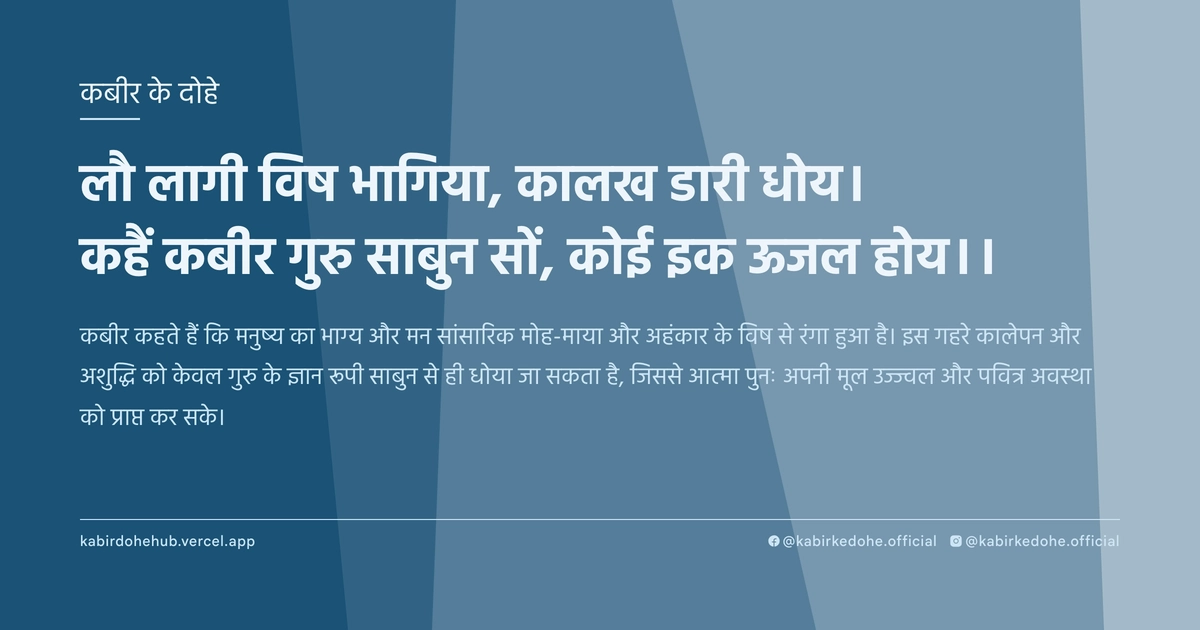
लौ लागी विष भागिया, कालख डारी धोय।
कहैं कबीर गुरु साबुन सों, कोई इक ऊजल होय।।
Lau laagi vish bhaagiya, kaalkh daari dhoy. Kahen Kabir guru saabun son, koi ik ujal hoye.
इस पृष्ठ पर इस कबीर दोहे का अर्थ (meaning), हिंदी व्याख्या और अंग्रेज़ी अनुवाद, दार्शनिक विश्लेषण और व्यावहारिक जीवन सीख दी गई है। यह दोहा गुरु महत्व (The Guru's Importance) विषय से जुड़ा है — Kabir doha meaning and explanation in Hindi and English.
अर्थ (Meaning):
कबीर कहते हैं कि मनुष्य का भाग्य और मन सांसारिक मोह-माया और अहंकार के विष से रंगा हुआ है। इस गहरे कालेपन और अशुद्धि को केवल गुरु के ज्ञान रूपी साबुन से ही धोया जा सकता है, जिससे आत्मा पुनः अपनी मूल उज्ज्वल और पवित्र अवस्था को प्राप्त कर सके।
Kabir explains that human destiny and the mind are stained with the poison of worldly attachments and ego. This deep darkness and impurity can only be cleansed by the 'soap' of the Guru's spiritual wisdom, allowing the soul to return to its original state of pristine purity and luminosity.
व्याख्या (Interpretation):
इस दोहे में 'विष' और 'कालख' केवल बाहरी गंदगी नहीं, बल्कि अविद्या (अज्ञान) और वासनाओं का प्रतीक हैं। शाब्दिक अर्थ में यह सफाई की बात करता है, लेकिन आध्यात्मिक स्तर पर यह 'चित्त शुद्धि' की प्रक्रिया है। कबीर यहाँ निरगुण भक्ति का संदेश देते हैं, जहाँ ईश्वर किसी बाहरी मूर्ति में नहीं बल्कि भीतर की शुद्धि में है। माया ने आत्मा पर जो पर्दा डाला है, वह इतना गहरा है कि साधारण प्रयासों से नहीं हटता। गुरु का ज्ञान वह उत्प्रेरक है जो अहंकार के कठोर आवरण को पिघलाता है। यह अद्वैत वेदांत के उस सत्य की ओर इशारा है जहाँ जीव और ब्रह्म के बीच का अंतर केवल अज्ञान की एक पतली परत है। जब यह परत हटती है, तो आत्मा अपनी वास्तविक 'उज्ज्वल' प्रकृति को पहचान लेती है।
In this couplet, 'poison' and 'darkness' are not physical impurities but symbols of Avidya (ignorance) and deep-seated desires. While the literal meaning refers to cleaning, spiritually it describes the process of 'Chitta Shuddhi' or purification of the consciousness. Kabir emphasizes Nirgun Bhakti, suggesting that the Divine is not found in external idols but in internal purity. The veil of Maya is so dense that ordinary efforts cannot remove it. The Guru's wisdom acts as the catalyst that dissolves the rigid shell of the ego. This aligns with Advaita Vedanta, where the perceived separation between the Atman and Brahman is merely a layer of ignorance. Once this layer is scrubbed away, the soul realizes its inherent luminosity and oneness with the Absolute.
दार्शनिक विश्लेषण (Philosophical Analysis):
कबीर का यह दर्शन उस समय के कट्टरपंथी धार्मिक वातावरण के विरुद्ध एक सशक्त प्रहार था, जहाँ शुद्धि को केवल बाहरी स्नान या कर्मकांडों से जोड़ा जाता था। उन्होंने स्पष्ट किया कि गंगा स्नान या तीर्थयात्रा से वह 'कालख' नहीं मिटती जो मन के भीतर जमी है। यह दृष्टिकोण सूफी मत के 'नफ्स' (अहंकार) के विनाश और अद्वैत वेदांत के 'माया' के निवारण का संगम है।
ऐतिहासिक रूप से, कबीर ने जाति और वर्ण व्यवस्था को चुनौती दी, क्योंकि उन्होंने देखा कि समाज 'बाहरी शुद्धता' के नाम पर भेदभाव कर रहा था। उनके लिए वास्तविक शुद्धता आंतरिक थी। वे तर्क देते हैं कि यदि मन में ईर्ष्या, क्रोध और मोह का विष है, तो बाहरी दिखावा व्यर्थ है।
मनोवैज्ञानिक स्तर पर, यह दोहा 'संज्ञानात्मक पुनर्गठन' की बात करता है। गुरु यहाँ केवल एक व्यक्ति नहीं, बल्कि वह चेतना है जो शिष्य को उसके स्वयं के भ्रमों का दर्पण दिखाती है। जब व्यक्ति यह स्वीकार करता है कि वह 'विषैला' या अशुद्ध है, तभी परिवर्तन की संभावना जन्म लेती है।
यहाँ 'साबुन' का रूपक अत्यंत महत्वपूर्ण है। साबुन गंदगी को केवल ढकता नहीं, बल्कि उसे रासायनिक रूप से अलग कर हटा देता है। इसी तरह, गुरु का ज्ञान केवल सूचना नहीं देता, बल्कि साधक के पुराने मानसिक प्रतिमानों (patterns) को नष्ट कर देता है।
अंततः, यह दोहा इस सत्य को स्थापित करता है कि मोक्ष कोई बाहरी उपलब्धि नहीं है, बल्कि एक 'अनकवरिंग' (uncovering) प्रक्रिया है। हम पहले से ही शुद्ध हैं, बस हम पर अज्ञान की कालिख जमी है। लक्ष्य कुछ नया प्राप्त करना नहीं, बल्कि उस पुराने कचरे को हटाना है जो हमें हमारी दिव्यता देखने से रोक रहा है।
Kabir's philosophy serves as a potent critique of the dogmatic religious environment of his era, where purity was erroneously linked to external rituals and ceremonial baths. He asserts that the 'darkness' ingrained within the mind cannot be washed away by bathing in the Ganges or visiting pilgrimage sites. This perspective represents a synthesis of the Sufi concept of annihilating the 'Nafs' (ego) and the Advaita Vedanta approach to dissolving 'Maya'.
Historically, Kabir challenged the caste system and social hierarchies, observing how society practiced discrimination under the guise of 'external purity'. For him, true purity was internal. He argued that if the mind is saturated with the poison of jealousy, anger, and attachment, all outward displays of piety are futile.
On a psychological level, this Doha speaks to 'cognitive restructuring'. The Guru is not merely a person but a consciousness that acts as a mirror, reflecting the disciple's own delusions. The moment an individual acknowledges their internal 'toxicity' or impurity, the possibility for genuine transformation begins.
The metaphor of 'soap' is crucial here. Soap does not merely cover dirt; it chemically detaches and removes it. Similarly, the Guru's wisdom is not just information but a transformative force that dismantles the seeker's old mental patterns and conditioning.
Ultimately, this teaching establishes that liberation is not an external achievement but a process of 'uncovering'. We are inherently pure; we are simply covered by the soot of ignorance. The goal is not to acquire something new, but to remove the accumulated debris that prevents us from perceiving our own divinity.
मूल संदेश (Core Message):
- बाहरी कर्मकांड आंतरिक अशुद्धि को नहीं मिटा सकते।
- अहंकार वह विष है जो आत्मा की चमक को ढक देता है।
- गुरु का ज्ञान केवल सूचना नहीं, बल्कि एक शोधक प्रक्रिया है।
- विनम्रता ही वह एकमात्र साबुन है जो मन को स्वच्छ करता है।
- वास्तविक दिव्यता स्वयं के अंधकार को मिटाने के बाद प्रकट होती है।
- External rituals cannot erase internal impurities.
- Ego is the poison that obscures the soul's radiance.
- The Guru's wisdom is not mere information, but a purifying process.
- Humility is the only soap that can cleanse the mind.
- True divinity manifests only after the internal darkness is dissolved.
व्यावहारिक उदाहरण (Practical Example):
वाराणसी के एक पुराने घाट पर माधव नाम का एक वृद्ध नाई रहता था। वह शहर के सबसे प्रतिष्ठित लोगों की सेवा करता था और खुद को बहुत 'शुद्ध' मानता था क्योंकि वह दिन में तीन बार स्नान करता था और कठोर नियमों का पालन करता था। लेकिन उसके भीतर एक गहरा अहंकार था; वह अपने से नीचे के लोगों को तुच्छ समझता था और अक्सर उनके प्रति कठोर शब्दों का प्रयोग करता था।
एक दिन उसकी मुलाकात एक घुमक्कड़ फकीर से हुई। फकीर ने माधव की बाहरी स्वच्छता देखी और मुस्कुराते हुए पूछा, 'माधव, शरीर तो चमक रहा है, पर क्या मन की कालिख धोई?' माधव को यह बात चुभी। उसने तर्क दिया कि वह धर्मपरायण है और शुद्ध जीवन जीता है।
फकीर ने उसे एक प्रयोग करने को कहा। उसने माधव को एक गंदा कपड़ा दिया और कहा, 'इसे केवल पानी से धोकर देखो।' माधव ने ऐसा किया, लेकिन कपड़ा अभी भी मटमैला रहा। फिर फकीर ने उसमें थोड़ा साबुन मिलाया और देखते ही देखते कपड़ा सफेद हो गया।
फकीर ने शांति से कहा, 'तुम्हारे नियम और स्नान उस पानी की तरह हैं जो केवल ऊपरी धूल हटाते हैं। लेकिन तुम्हारा अहंकार वह गहरा दाग है जिसे केवल विनम्रता और आत्म-बोध के साबुन से ही धोया जा सकता है।'
माधव को पहली बार महसूस हुआ कि उसकी 'शुद्धता' केवल एक मुखौटा थी। उसने महसूस किया कि उसका दूसरों को छोटा समझना ही वह 'विष' था जिसने उसकी आत्मा को काला कर दिया था।
अगले कुछ महीनों तक, माधव ने अपने व्यवहार में बदलाव लाना शुरू किया। उसने उन लोगों की मदद करना शुरू किया जिन्हें वह पहले अनदेखा करता था। उसने महसूस किया कि जब वह किसी की निस्वार्थ सेवा करता है, तो उसके मन का बोझ हल्का होता है।
उसने पाया कि क्रोध और घृणा के जाने के बाद, उसके भीतर एक ऐसी शांति आई जो किसी भी तीर्थयात्रा से नहीं मिली थी। उसकी बाहरी चमक अब उसकी आंतरिक प्रसन्नता का प्रतिबिंब बन गई थी।
अंत में, माधव ने समझा कि असली 'उज्जवल' होना वह नहीं है जो दुनिया को दिखाए, बल्कि वह है जो स्वयं के भीतर के अंधेरे को स्वीकार कर उसे मिटा दे।
On an ancient ghat in Varanasi lived an elderly barber named Madhav. He served the city's most prestigious citizens and considered himself exceptionally 'pure' because he bathed thrice daily and followed rigorous ritualistic rules. However, deep within him lay a profound ego; he viewed those beneath him in social standing as insignificant and often spoke to them with harshness.
One day, he encountered a wandering Fakir. The Fakir observed Madhav's external cleanliness and smiled, asking, 'Madhav, your body shines, but have you washed the soot from your mind?' Madhav felt offended. He argued that he was a devout man living a pure life.
The Fakir asked him to perform a simple experiment. He gave Madhav a filthy piece of cloth and told him, 'Try washing this with water alone.' Madhav did so, but the cloth remained grey and stained. Then, the Fakir added a bit of soap, and almost instantly, the cloth became white.
The Fakir said calmly, 'Your rituals and baths are like that water—they only remove the surface dust. But your arrogance is a deep stain that can only be washed away by the soap of humility and self-awareness.'
For the first time, Madhav realized that his 'purity' was merely a mask. He understood that his habit of belittling others was the very 'poison' that had blackened his soul.
Over the following months, Madhav began to change his behavior. He started helping those he had previously ignored. He discovered that whenever he served someone selflessly, the heavy burden on his heart lightened.
He found that once anger and hatred departed, a peace descended upon him that no pilgrimage had ever provided. His external glow now became a reflection of his internal joy.
Ultimately, Madhav understood that being truly 'luminous' is not about what one displays to the world, but about acknowledging one's own internal darkness and having the courage to erase it.
अभ्यास मार्गदर्शन (Practice Guidance):
- दैनिक आत्म-निरीक्षण: प्रतिदिन 15 मिनट मौन बैठें और उन विचारों को पहचानें जिनमें ईर्ष्या, क्रोध या श्रेष्ठता का भाव हो। उन्हें 'कालख' के रूप में देखें।
- विनम्रता का अभ्यास: दिन में कम से कम एक बार ऐसे व्यक्ति की निस्वार्थ सहायता करें जिसे आप सामान्यतः अनदेखा करते हैं, ताकि अहंकार की परतें टूटें।
- जर्नलिंग प्रॉम्प्ट: 'मेरे जीवन का वह कौन सा व्यवहार है जो मेरी आंतरिक शुद्धता को बाधित कर रहा है?' इस पर गहराई से लिखें।
- डायग्नोस्टिक चेकलिस्ट: क्या मैं दूसरों की गलती पर तुरंत प्रतिक्रिया देता हूँ? क्या मैं अपनी धार्मिकता का उपयोग दूसरों को नीचा दिखाने के लिए करता हूँ? यदि हाँ, तो 'विष' अभी मौजूद है।
- Daily Self-Observation: Sit in silence for 15 minutes daily and identify thoughts containing jealousy, anger, or superiority. View them as the 'soot' of the mind.
- Practice of Humility: At least once a day, selflessly help someone you typically ignore, allowing the layers of ego to crack.
- Journaling Prompt: 'Which specific behavior in my life is currently obstructing my internal purity?' Write deeply on this.
- Diagnostic Checklist: Do I react instantly to others' mistakes? Do I use my perceived righteousness to belittle others? If yes, the 'poison' is still present.
चिंतन प्रश्न (Reflection Questions):
- क्या मेरी 'नैतिकता' वास्तव में करुणा से उपजी है, या यह केवल दूसरों से बेहतर दिखने का एक साधन है?
- मेरे व्यक्तित्व का वह कौन सा हिस्सा है जिसे मैं दुनिया से छिपाता हूँ क्योंकि वह 'अशुद्ध' है?
- क्या मैं अपनी डिजिटल पहचान (सोशल मीडिया) का उपयोग अपनी आध्यात्मिक श्रेष्ठता दिखाने के लिए कर रहा हूँ?
- यदि मेरे जीवन से सभी पद, प्रतिष्ठा और रिश्ते हटा दिए जाएँ, तो क्या मैं अपनी मूल शुद्धता को पहचान पाऊँगा?
- मैं किन लोगों को 'अशुद्ध' मानता हूँ, और यह धारणा मेरे अपने अहंकार के बारे में क्या बताती है?
- Is my 'morality' truly born of compassion, or is it merely a tool to appear superior to others?
- Which part of my personality do I hide from the world because I perceive it as 'impure'?
- Am I using my digital identity (social media) to perform a facade of spiritual superiority?
- If all titles, status, and relationships were stripped away, would I still recognize my inherent purity?
- Who do I perceive as 'impure', and what does this judgment reveal about my own ego?