
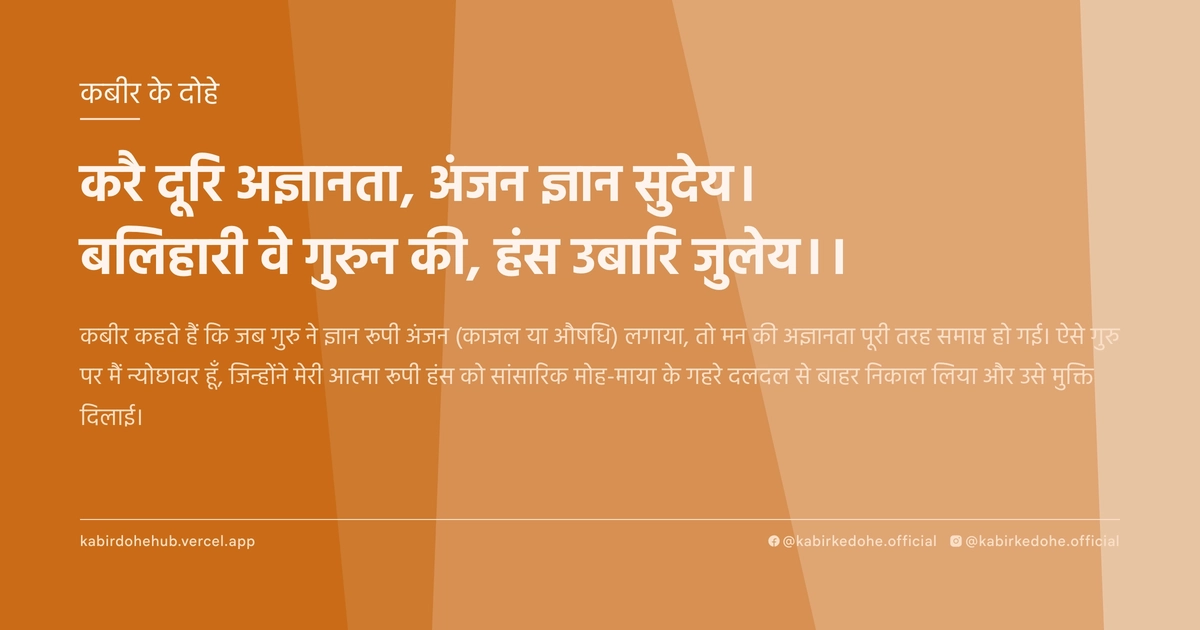
करै दूरि अज्ञानता, अंजन ज्ञान सुदेय।
बलिहारी वे गुरुन की, हंस उबारि जुलेय।।
Karai doori agyaanta, anjan gyaan sudey. Balihari ve gurun ki, hans ubaari juley.
इस पृष्ठ पर इस कबीर दोहे का अर्थ (meaning), हिंदी व्याख्या और अंग्रेज़ी अनुवाद, दार्शनिक विश्लेषण और व्यावहारिक जीवन सीख दी गई है। यह दोहा गुरु महत्व (The Guru's Importance) विषय से जुड़ा है — Kabir doha meaning and explanation in Hindi and English.
अर्थ (Meaning):
कबीर कहते हैं कि जब गुरु ने ज्ञान रूपी अंजन (काजल या औषधि) लगाया, तो मन की अज्ञानता पूरी तरह समाप्त हो गई। ऐसे गुरु पर मैं न्योछावर हूँ, जिन्होंने मेरी आत्मा रूपी हंस को सांसारिक मोह-माया के गहरे दलदल से बाहर निकाल लिया और उसे मुक्ति दिलाई।
Kabir proclaims that when the Guru applied the medicinal salve of true knowledge, the darkness of ignorance vanished. He expresses profound gratitude and surrender to the Guru, who rescued the soul—symbolized as a swan—from the murky depths of worldly attachment and illusion, guiding it toward ultimate liberation.
व्याख्या (Interpretation):
इस दोहे का शाब्दिक अर्थ है कि गुरु के ज्ञान ने अज्ञान के अंधेरे को मिटाया। रूपक के स्तर पर, 'अंजन' वह आध्यात्मिक दृष्टि है जो केवल बाहरी दुनिया नहीं, बल्कि आंतरिक सत्य को देखना सिखाती है। यहाँ 'हंस' जीवात्मा का प्रतीक है, जो स्वभाव से शुद्ध और दिव्य है, लेकिन माया के प्रभाव से अशुद्ध हो गया है। यह निरगुण भक्ति का सार है, जहाँ ईश्वर किसी मूर्ति में नहीं, बल्कि स्वयं के भीतर जागृत चेतना में मिलता है। अद्वैत वेदांत के अनुसार, अज्ञान ही वह पर्दा है जो आत्मा को ब्रह्म से अलग दिखाता है। जब यह पर्दा हटता है, तो साधक को अनुभव होता है कि वह और परमात्मा एक ही हैं। यह विरोधाभास है कि जिसे हम खोज रहे हैं, वह पहले से ही हमारे भीतर है, बस उसे पहचानने के लिए गुरु की कृपा रूपी दृष्टि चाहिए।
Literally, the verse speaks of a teacher removing ignorance through knowledge. Metaphorically, 'Anjan' represents the spiritual alchemy or the 'eye-opener' that allows the seeker to perceive the Absolute beyond the veil of Maya. The 'Hans' (Swan) is a potent symbol of the Jivatma (individual soul), which is inherently pure and celestial but has become entangled in the mire of material existence. This aligns with Nirgun Bhakti, asserting that the Divine is formless and resides within. In the framework of Advaita Vedanta, ignorance (Avidya) is the only barrier separating the Atman from Brahman. The paradox lies in the fact that the soul is already free; it only perceives itself as bound. The Guru does not 'give' liberation but removes the cataracts of ego and illusion, allowing the soul to recognize its own innate divinity and non-dual nature.
दार्शनिक विश्लेषण (Philosophical Analysis):
कबीर का यह दोहा उनके युग के धार्मिक पाखंड और कर्मकांडीय कट्टरता के विरुद्ध एक सशक्त प्रहार है। उस समय समाज ब्राह्मणवादी कर्मकांडों और सूफी बाहरी दिखावे के बीच बंटा हुआ था। कबीर ने स्पष्ट किया कि मुक्ति किसी तीर्थ यात्रा या मंत्रोच्चार से नहीं, बल्कि 'ज्ञान' से मिलती है। यहाँ ज्ञान का अर्थ किताबी शिक्षा नहीं, बल्कि 'अपरोक्षानुभूति' या प्रत्यक्ष अनुभव है।
यह विचार सूफी मत के 'इरफ़ान' (divine knowledge) और अद्वैत वेदांत के 'ज्ञान मार्ग' का संगम है। कबीर का तर्क है कि अहंकार ही वह मुख्य बाधा है जो मनुष्य को सत्य से दूर रखती है। जब गुरु का ज्ञान अहंकार को नष्ट करता है, तब व्यक्ति जाति, धर्म और सामाजिक पहचान के बंधनों से मुक्त हो जाता है।
दार्शनिक रूप से, यह 'अविद्या' के विनाश की प्रक्रिया है। जिस प्रकार अंधेरे कमरे में एक छोटा सा दीपक पूरे अंधकार को मिटा देता है, उसी प्रकार ज्ञान की एक किरण जन्मों के संचित अज्ञान को समाप्त कर देती है। कबीर यहाँ गुरु को केवल एक व्यक्ति नहीं, बल्कि उस 'परम चेतना' के रूप में देखते हैं जो मार्गदर्शक बनती है।
यह विश्लेषण हमें बताता है कि कबीर के लिए भक्ति केवल भावना नहीं, बल्कि एक बौद्धिक और आध्यात्मिक क्रांति थी। उन्होंने सिखाया कि जब तक मनुष्य अपनी आंतरिक अज्ञानता को नहीं पहचानता, तब तक बाहरी पूजा व्यर्थ है। यह मनोवैज्ञानिक रूपांतरण की प्रक्रिया है जहाँ 'मैं' (अहंकार) का विसर्जन होकर 'वह' (ब्रह्म) का उदय होता है।
अंततः, यह दोहा इस सत्य को स्थापित करता है कि मुक्ति बाहरी दुनिया में नहीं, बल्कि आंतरिक दृष्टि के परिष्कार में है। यह उस अवस्था की ओर संकेत करता है जहाँ साधक और साध्य का भेद मिट जाता है, और केवल शुद्ध चेतना शेष रह जाती है।
This Doha is a profound critique of the ritualistic rigidity and religious hypocrisy prevalent during Kabir's era. The society was fractured between Brahmanical orthodoxy and the external forms of Sufi practices. Kabir asserts that liberation is not achieved through pilgrimages or the rote recitation of mantras, but through 'Gyan'—true spiritual knowledge. This is not academic learning, but 'Aparokshanubhuti' or direct, intuitive experience of the Truth.
Philosophically, this represents a synthesis of the Sufi concept of 'Irfan' (gnosis) and the Advaita Vedanta 'Jnana Marga'. Kabir argues that the ego (Ahankara) is the primary obstacle preventing the soul from realizing its oneness with the Divine. When the Guru's knowledge dissolves this ego, the seeker is liberated from the shackles of caste, creed, and social identity.
This is the process of annihilating 'Avidya' (primordial ignorance). Just as a single lamp dispels the darkness of a room, a spark of true knowledge erases the accumulated ignorance of countless lifetimes. For Kabir, the Guru is not merely a human instructor but the manifestation of the Supreme Consciousness guiding the soul home.
This analysis reveals that for Kabir, Bhakti was not merely an emotional surrender but an intellectual and spiritual revolution. He taught that external worship is futile until one acknowledges and confronts their internal ignorance. It is a psychological transformation where the 'I' (the limited ego) is surrendered to the 'That' (the infinite Brahman).
Ultimately, the verse establishes that liberation is found in the refinement of internal vision. It points toward the state of 'Samadhi' or 'Fana', where the distinction between the seeker and the sought vanishes, leaving only the radiance of pure, non-dual consciousness.
मूल संदेश (Core Message):
- अज्ञानता बाहरी नहीं, बल्कि आंतरिक पहचान का भ्रम है।
- सच्चा गुरु वह है जो हमें स्वयं से परिचित कराए।
- ज्ञान का अर्थ सूचना नहीं, बल्कि अहंकार का विसर्जन है।
- आत्मा स्वभाव से मुक्त है, बस माया का पर्दा हटाना है।
- जब 'मैं' मिटता है, तभी 'परमात्मा' का अनुभव होता है।
- मुक्ति किसी बाहरी स्थान में नहीं, बल्कि दृष्टि के परिवर्तन में है।
- Ignorance is not a lack of data, but a delusion of separate identity.
- A true Guru is one who introduces the seeker to their own True Self.
- Knowledge is not the accumulation of facts, but the dissolution of the ego.
- The soul is inherently free; only the veil of Maya needs to be lifted.
- Only when the 'I' vanishes does the experience of the Divine emerge.
- Liberation lies not in a destination, but in a shift of perception.
व्यावहारिक उदाहरण (Practical Example):
वाराणसी के एक पुराने मोहल्ले में माधव नाम का एक वृद्ध बुनकर रहता था। माधव अपनी कला में निपुण था, लेकिन उसका मन हमेशा इस बात से परेशान रहता था कि वह एक 'निम्न जाति' का बुनकर है और कभी मोक्ष प्राप्त नहीं कर पाएगा। वह घंटों मंदिरों के बाहर खड़ा रहता, इस उम्मीद में कि कोई पंडित उसे बताएगा कि स्वर्ग का रास्ता क्या है।
उसका जीवन केवल नियमों, डर और इस विश्वास में बीता कि ईश्वर केवल ऊँची जाति के लोगों की सुनता है। वह अपनी मेहनत को केवल पेट भरने का साधन मानता था, उसमें कोई दिव्यता नहीं देखता था।
एक दिन उसकी मुलाकात एक फकीर से हुई, जिसने माधव के हाथ में मौजूद करघे को देखा और मुस्कुराते हुए कहा, 'माधव, तू जिस ईश्वर को पत्थरों में खोज रहा है, वह इसी धागे की बुनावट में छिपा है। तू धागों को जोड़ रहा है, लेकिन अपने आप को सत्य से अलग मान बैठा है।'
माधव को पहले तो यह बात समझ नहीं आई। उसने पूछा, 'मैं तो अज्ञानी हूँ, मुझे कैसे पता चलेगा?' फकीर ने जवाब दिया, 'तेरा अज्ञान यह नहीं कि तू पढ़ना नहीं जानता, बल्कि यह है कि तू खुद को छोटा मानता है। जिस दिन तू यह जान लेगा कि तू और यह ब्रह्मांड एक ही धागे से बुने हैं, तेरा सारा डर मिट जाएगा।'
यह बात माधव के लिए 'अंजन' की तरह थी। उसने अपनी आँखों से वह पर्दा हटा दिया जिसने उसे सालों से सीमित कर रखा था। उसने महसूस किया कि उसकी बुनाई केवल कपड़ा बनाना नहीं, बल्कि ईश्वर की आराधना है।
अब माधव मंदिर के बाहर खड़ा होकर भीख नहीं माँगता था, बल्कि अपने करघे पर बैठकर ध्यान लगाता था। उसने पाया कि जब वह पूरी तन्मयता से काम करता है, तो वह 'मैं' को भूल जाता है और केवल 'सृजन' बचता है।
उसका व्यवहार बदल गया। वह अब जाति और ऊँच-नीच के भेदभाव से ऊपर उठ गया। वह हर आने वाले व्यक्ति में उसी दिव्य धागे को देखने लगा जिसे वह पहले केवल मंदिर की मूर्तियों में खोजता था।
उसकी शांति देखकर गाँव के लोग हैरान थे। उसने सिद्ध कर दिया कि ज्ञान किसी शास्त्र में नहीं, बल्कि अपनी वास्तविक प्रकृति को पहचानने में है।
माधव का जीवन अब एक उत्सव बन गया था। उसने जान लिया था कि उसका करघा ही उसका मंदिर है और उसकी ईमानदारी ही उसकी सबसे बड़ी पूजा।
अंत में, माधव ने अपनी पूरी संपत्ति और ज्ञान उन युवाओं को दे दिया जो जीवन की दौड़ में खुद को खो चुके थे, उन्हें यह सिखाते हुए कि असली मुक्ति बाहरी दुनिया की जीत में नहीं, बल्कि आंतरिक अज्ञान के अंत में है।
In an ancient lane of Varanasi lived an elderly weaver named Madhav. Madhav was a master of his craft, yet his heart was perpetually heavy with the belief that as a weaver of a 'lower caste,' he was destined to be denied salvation. He spent hours outside temples, hoping a priest would reveal the secret path to heaven.
His entire existence was governed by rules, fear, and the conviction that the Divine only listened to the high-born. He viewed his labor merely as a means of survival, seeing no sanctity in the rhythmic clatter of his loom.
One day, he encountered a wandering Sufi mystic who looked at Madhav's loom and smiled, saying, 'Madhav, the God you seek in cold stones is hidden in the very weave of these threads. You spend your days joining threads, yet you believe you are separate from the Truth.'
Madhav was bewildered. He asked, 'But I am ignorant; how can I possibly know the Truth?' The mystic replied, 'Your ignorance is not a lack of literacy, but the belief that you are small. The moment you realize that you and this universe are woven from the same divine thread, all your fear will vanish.'
These words acted as the 'Anjan' (medicinal salve) for Madhav. He tore away the veil of perceived inferiority that had blinded him for decades. He began to realize that his weaving was not just a job, but a form of meditation and a prayer in motion.
Madhav stopped begging for spiritual crumbs outside the temple. Instead, he turned his loom into his altar. He discovered that when he worked with total presence, the 'I' disappeared, and only the act of creation remained.
His demeanor shifted radically. He rose above the constructs of caste and social hierarchy. He started seeing the same divine thread in every human being he encountered, a divinity he had previously sought only in idols.
The villagers were amazed by his newfound serenity. He proved that true knowledge is not found in scriptures, but in the recognition of one's own essential nature.
Madhav's life became a celebration. He understood that his loom was his temple and his integrity was his highest form of worship.
In his final years, Madhav shared his wisdom and wealth with disillusioned youths, teaching them that true liberation is not found in conquering the external world, but in the annihilation of internal ignorance.
अभ्यास मार्गदर्शन (Practice Guidance):
- दैनिक आत्म-निरीक्षण: प्रतिदिन 20 मिनट मौन बैठें और विचार करें कि कौन सी ऐसी मान्यताएँ हैं जो आपको दूसरों से अलग या छोटा महसूस कराती हैं।
- साक्षी भाव का अभ्यास: दिन भर में होने वाले क्रोध या अहंकार के क्षणों को एक तीसरे व्यक्ति की तरह देखें और पूछें, 'यह कौन बोल रहा है—मेरी आत्मा या मेरा अहंकार?'
- सेवा के माध्यम से अद्वैत: किसी ऐसे व्यक्ति की निस्वार्थ मदद करें जिसे समाज 'निम्न' मानता हो, और इस भावना के साथ करें कि आप स्वयं की ही सेवा कर रहे हैं।
- डायरी लेखन: उन क्षणों को लिखें जब आपने अपनी पूर्वधारणाओं (biases) को टूटते हुए महसूस किया और उस समय की मानसिक स्थिति का विश्लेषण करें।
- डायग्नोस्टिक चेकलिस्ट: क्या मैं अभी भी अपनी पहचान अपनी नौकरी, जाति या पद से जोड़ रहा हूँ? क्या मैं दूसरों में अपनी ही छवि देख पा रहा हूँ? यदि उत्तर 'हाँ' है, तो अज्ञान अभी शेष है।
- Daily Self-Inquiry: Spend 20 minutes in silence daily, examining the beliefs that make you feel separate or inferior to others.
- Practice of Witness Consciousness: Observe moments of anger or ego throughout the day as a third-party observer, asking, 'Who is speaking—my soul or my ego?'
- Advaita through Service: Perform selfless service for someone marginalized by society, consciously feeling that you are serving your own extended Self.
- Journaling the Shift: Document instances where your preconceived biases were shattered and analyze the psychological shift that occurred during that moment.
- Diagnostic Checklist: Am I still defining my identity by my profession, caste, or status? Can I see my own essence in others? If the answer is 'Yes' to the former and 'No' to the latter, ignorance still persists.
चिंतन प्रश्न (Reflection Questions):
- मेरी वह कौन सी 'पहचान' है जिसे मैं सबसे अधिक पकड़ कर रखता हूँ, और यदि वह छीन ली जाए, तो क्या मैं शून्य महसूस करूँगा?
- मैं अपनी डिजिटल छवि (Social Media Ego) को बनाए रखने के लिए अपनी वास्तविक आत्मा की कितनी उपेक्षा करता हूँ?
- क्या मेरा 'ज्ञान' मुझे विनम्र बना रहा है, या यह मेरे भीतर एक नया बौद्धिक अहंकार पैदा कर रहा है?
- मैं किन लोगों को 'अज्ञानी' मानता हूँ, और क्या यह निर्णय मेरी अपनी अज्ञानता का प्रतिबिंब है?
- यदि मैं इस क्षण अपनी सभी सामाजिक और धार्मिक पहचान छोड़ दूँ, तो मेरे भीतर क्या शेष बचेगा?
- क्या मैं वास्तव में मुक्त होना चाहता हूँ, या मैं अपनी जंजीरों के साथ एक 'आध्यात्मिक' दिखने का नाटक कर रहा हूँ?
- Which 'identity' do I cling to most fiercely, and if it were stripped away, would I feel like a void?
- How much of my authentic soul do I neglect in order to maintain my digital persona (Social Media Ego)?
- Is my pursuit of knowledge making me humble, or is it creating a new layer of intellectual arrogance?
- Whom do I label as 'ignorant,' and is this judgment merely a reflection of my own blindness?
- If I were to drop all my social and religious labels this very moment, what would remain within me?
- Do I truly desire liberation, or am I merely performing the role of a 'spiritual person' while clutching my chains?