
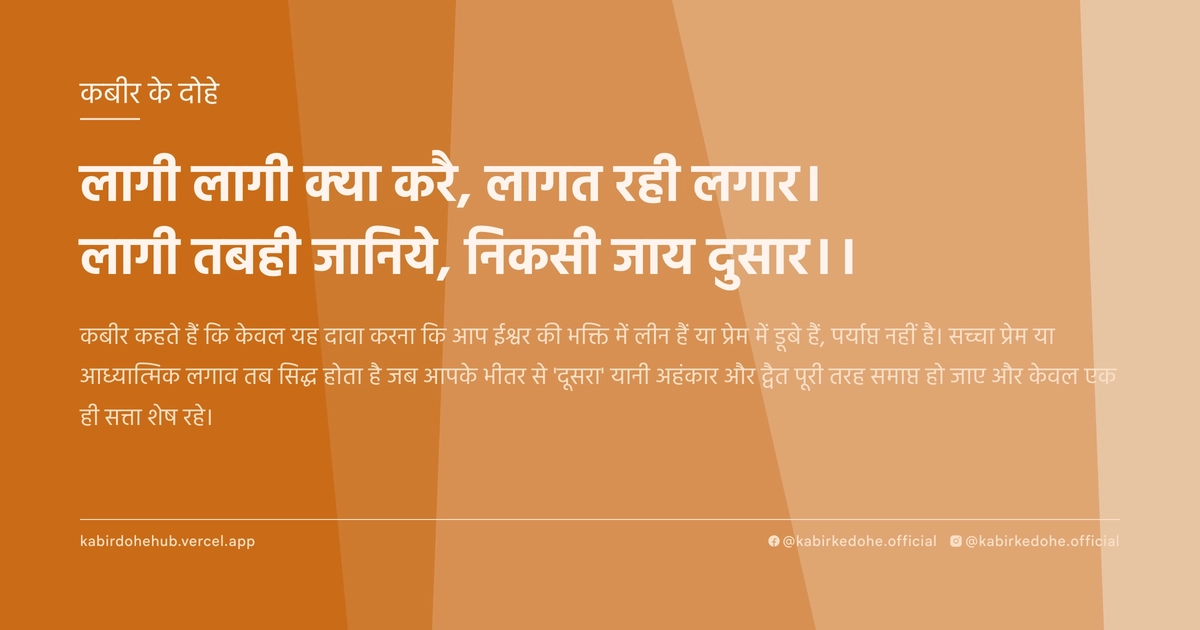
लागी लागी क्या करै, लागत रही लगार।
लागी तबही जानिये, निकसी जाय दुसार।।
Lagi lagi kya karai, lagat rahi lagar. Lagi tabhi janiye, niksi jaye dusar.
इस पृष्ठ पर इस कबीर दोहे का अर्थ (meaning), हिंदी व्याख्या और अंग्रेज़ी अनुवाद, दार्शनिक विश्लेषण और व्यावहारिक जीवन सीख दी गई है। यह दोहा भक्ति (Bhakti) विषय से जुड़ा है — Kabir doha meaning and explanation in Hindi and English.
अर्थ (Meaning):
कबीर कहते हैं कि केवल यह दावा करना कि आप ईश्वर की भक्ति में लीन हैं या प्रेम में डूबे हैं, पर्याप्त नहीं है। सच्चा प्रेम या आध्यात्मिक लगाव तब सिद्ध होता है जब आपके भीतर से 'दूसरा' यानी अहंकार और द्वैत पूरी तरह समाप्त हो जाए और केवल एक ही सत्ता शेष रहे।
Kabir asserts that merely claiming to be immersed in divine love or spiritual longing is insufficient. True attachment or union with the Divine is only realized when the 'other'—the sense of duality and the ego—is completely eradicated, leaving only the singular, absolute reality.
व्याख्या (Interpretation):
इस दोहे का शाब्दिक अर्थ है कि लोग अक्सर कहते हैं कि उन्हें ईश्वर से लगाव लग गया है, लेकिन यह केवल ऊपरी दावा है। गहरा आध्यात्मिक अर्थ यह है कि जब तक 'मैं' और 'तू' का भेद बना रहता है, तब तक वह प्रेम वास्तविक नहीं है। यह निर्गुण भक्ति का सार है जहाँ भक्त और भगवान के बीच की दूरी मिट जाती है। माया वह पर्दा है जो हमें 'दूसरे' का भ्रम देता है। जब यह भ्रम टूटता है, तब आत्मा का ब्रह्म के साथ अद्वैत मिलन होता है। यह विरोधाभास है कि पाने के लिए पहले स्वयं को पूरी तरह खोना पड़ता है। अंततः, जब द्वैत का अंत होता है, तभी वास्तविक मिलन की अनुभूति होती है।
Literally, the verse mocks those who boast of their spiritual longing without experiencing its depth. Metaphorically, it addresses the illusion of duality. In the path of Nirgun Bhakti, the 'other' represents the ego (Ahamkara) and the perceived separation between the Atman and Brahman. Maya creates the veil of 'two-ness,' making us believe we are separate entities seeking a distant God. The central paradox is that union is only possible through the total annihilation of the individual identity. Only when the 'second' person—the egoic self—departs, does the singular truth emerge. This is the transition from duality (Dvaita) to non-duality (Advaita), where the seeker becomes the sought.
दार्शनिक विश्लेषण (Philosophical Analysis):
कबीर का यह दोहा मध्यकालीन भारत के उस दौर का है जब धर्म बाहरी कर्मकांडों और दिखावे में सिमट गया था। कबीर ने इस दिखावे पर प्रहार किया कि केवल माला जपने या तिलक लगाने से ईश्वर नहीं मिलते। वे यहाँ 'प्रेम' को एक अग्नि के समान बताते हैं जिसमें प्रेमी स्वयं जलकर भस्म हो जाता है। यह दृष्टिकोण सूफी मत के 'फना' (Fana) के सिद्धांत से मिलता-जुलता है, जहाँ साधक अपनी हस्ती को मिटाकर ईश्वर में विलीन हो जाता है।
अद्वैत वेदांत के परिप्रेक्ष्य में, यह 'दुसार' या दूसरे का निकलना ही मोक्ष है। जब तक हम स्वयं को शरीर या मन मानते हैं, हम अलग हैं। जैसे ही यह अज्ञान मिटता है, केवल शुद्ध चेतना शेष रहती है। कबीर यहाँ यह स्पष्ट कर रहे हैं कि भक्ति कोई बाहरी उपलब्धि नहीं बल्कि एक आंतरिक रूपांतरण है।
सामाजिक स्तर पर, यह संदेश जाति और वर्ग के भेदों को मिटाने का आह्वान है, क्योंकि यदि ईश्वर एक है और हम सब उसी के अंश हैं, तो 'दूसरा' कोई हो ही नहीं सकता। भेदभाव केवल अहंकार की उपज है।
मनोवैज्ञानिक रूप से, यह 'अहं' के विसर्जन की प्रक्रिया है। जब व्यक्ति अपनी पहचान को सामाजिक लेबल से ऊपर उठाता है, तब वह उस सार्वभौमिक प्रेम को अनुभव करता है जो सीमाओं से परे है।
अतः, कबीर हमें चेतावनी देते हैं कि आध्यात्मिक यात्रा में सबसे बड़ी बाधा हमारा अपना 'होना' है। जब तक 'मैं' मौजूद हूँ, तब तक सत्य ओझल है। सत्य का उदय तभी होता है जब 'मैं' का अंत होता है।
This Doha emerges from an era of rigid ritualism and superficial piety in medieval India. Kabir critiques the performative nature of religion, where spiritual longing was often reduced to a social badge. He presents divine love not as a feeling, but as a transformative fire that consumes the seeker. This aligns profoundly with the Sufi concept of 'Fana' (annihilation), where the mystic's individual identity is extinguished to allow the Divine Presence to manifest.
From the lens of Advaita Vedanta, the 'departure of the second' is the realization of Non-duality. The perceived separation between the subject (I) and the object (God/World) is a product of Avidya (ignorance). When the ego—the 'second' entity—is removed, the illusion of duality collapses, revealing the singular Brahman.
Culturally, Kabir uses this spiritual truth to dismantle the caste system. If the Divine is the only reality, then any distinction based on birth or status is a lie sustained by the ego. The 'other' is a mental construct used to justify oppression and superiority.
Psychologically, this is a call for the death of the persona. The ego thrives on comparison and separation. By urging the 'other' to leave, Kabir is advocating for a state of consciousness where empathy is not a choice, but a natural state because there is no one else to be indifferent toward.
Ultimately, the philosophical core is that the seeker is the obstacle. The distance between the human and the divine is not a physical or temporal gap, but the thickness of the ego. Once that thickness vanishes, the union is instantaneous and absolute.
मूल संदेश (Core Message):
- दिखावे की भक्ति केवल अहंकार का विस्तार है।
- सच्चा प्रेम वह है जो प्रेमी को मिटा दे।
- द्वैत का अंत ही वास्तविक सत्य की शुरुआत है।
- जब 'मैं' जाता है, तभी 'वह' आता है।
- अद्वैत का अनुभव ही जीवन का सर्वोच्च लक्ष्य है।
- Performative devotion is merely an extension of the ego.
- True love is that which annihilates the lover.
- The end of duality is the beginning of ultimate truth.
- When the 'I' departs, the 'Divine' arrives.
- The experience of non-duality is life's highest purpose.
व्यावहारिक उदाहरण (Practical Example):
एक समय की बात है, वाराणसी के घाटों पर रहने वाला एक वृद्ध बुनकर था, जिसका नाम माधव था। माधव अपनी कला में निपुण था, लेकिन वह बहुत अहंकारी था। वह मानता था कि उसके द्वारा बुने गए वस्त्र शहर में सबसे श्रेष्ठ हैं और वह स्वयं को अन्य बुनकरों से श्रेष्ठ समझता था। वह अक्सर कहता था कि वह ईश्वर का सबसे प्रिय भक्त है क्योंकि वह अपनी कला को ईश्वर को समर्पित करता है।
माधव के मन में यह 'मैं' बहुत गहरा था। वह दूसरों की मदद तो करता था, लेकिन उसके मन में यह भाव रहता था कि वह 'दाता' है और सामने वाला 'याचक'। उसके लिए दुनिया दो हिस्सों में बंटी थी: वह स्वयं और बाकी सब।
एक दिन, एक फकीर उसके पास आया। फकीर ने माधव के बेहतरीन वस्त्र देखे और मुस्कुराकर कहा, 'यह वस्त्र सुंदर है, लेकिन इसे पहनने वाला अभी भी अधूरा है क्योंकि इसमें बुनकर का अहंकार अभी भी धागों की तरह उलझा हुआ है।'
माधव को यह बात चुभी। उसने तर्क दिया कि उसकी भक्ति और उसकी कला ही उसकी पहचान है। फकीर ने शांति से उत्तर दिया, 'जब तक तुम यह कहोगे कि 'मैं' भक्त हूँ, तब तक तुम केवल एक दर्पण देख रहे हो जिसमें तुम्हारी अपनी छवि है। जिस दिन दर्पण टूटेगा, तुम उस प्रकाश को देखोगे जो तुम स्वयं हो।'
माधव ने इस बात पर विचार करना शुरू किया। उसने महसूस किया कि उसकी सारी 'भक्ति' वास्तव में उसके अहंकार को पोषण दे रही थी। वह ईश्वर को नहीं खोज रहा था, बल्कि ईश्वर के माध्यम से अपनी श्रेष्ठता खोज रहा था।
धीरे-धीरे माधव ने अपनी पहचान को बदलना शुरू किया। उसने अपनी कला को 'अपनी' कहना छोड़ दिया। उसने उन गरीब बुनकरों की मदद करना शुरू किया जिन्हें वह पहले तुच्छ समझता था, लेकिन अब वह यह नहीं सोचता था कि वह उनकी मदद कर रहा है, बल्कि यह कि वह उन्हीं में स्वयं को देख रहा है।
एक दिन, एक भारी बाढ़ आई और माधव की सारी संपत्ति और करघे बह गए। वह पूरी तरह खाली हो गया। उस क्षण, उसके पास न तो उसकी कला थी और न ही उसकी श्रेष्ठता का दावा। वह पूरी तरह टूट चुका था।
परंतु, उसी शून्यता में उसे एक अजीब सी शांति महसूस हुई। उसे एहसास हुआ कि अब उसके और संसार के बीच कोई दीवार नहीं बची है। वह 'दूसरा' जिसे वह श्रेष्ठता के चश्मे से देखता था, अब गायब हो गया था।
माधव अब केवल एक बुनकर नहीं था; वह उस प्रेम का हिस्सा बन गया था जो बिना किसी शर्त के बहता है। उसने पाया कि जब उसका 'मैं' मरा, तभी उसका वास्तविक मिलन ईश्वर से हुआ।
Once, in the bustling ghats of Varanasi, lived an elderly weaver named Madhav. Madhav was a master of his craft, but his heart was clouded by a subtle, persistent pride. He believed his textiles were the finest in the city and viewed himself as superior to all other weavers. He often claimed to be the most devoted servant of God, believing his artistic excellence was a sign of divine favor.
However, Madhav’s spirituality was a cloak for his ego. He performed acts of charity, but always with the internal narrative that he was the 'benefactor' and the recipient was the 'beggar.' His world was strictly divided into two: the exceptional 'I' and the mediocre 'others.'
One afternoon, a wandering Sufi mystic visited his loom. The mystic looked at the exquisite fabric and smiled, saying, 'The cloth is beautiful, but the weaver is still entangled. Your ego is woven into these threads more tightly than the silk itself.'
Madhav was offended. He argued that his devotion and skill were his identity. The mystic replied calmly, 'As long as you say "I am a devotee," you are merely staring into a mirror, admiring your own reflection. Only when the mirror shatters will you see the Light that you actually are.'
This seed of doubt began to grow in Madhav. He started noticing that his 'devotion' was actually a tool for self-validation. He wasn't seeking God; he was seeking a version of God that applauded his superiority.
He began a conscious practice of shedding his identity. He stopped claiming ownership of his art and started assisting struggling weavers, not as a savior, but as a peer. He tried to erase the boundary between the helper and the helped.
Then, a catastrophic flood hit Varanasi. Madhav lost everything—his home, his looms, and his accumulated wealth. In an instant, he was stripped of every external marker of his identity. He was left with nothing.
In that absolute void, instead of despair, Madhav felt an unprecedented peace. He realized that the wall he had spent a lifetime building between himself and the world had been washed away by the river. The 'other' had vanished.
Madhav was no longer just a weaver or a devotee; he had become a vessel for a love that knew no boundaries. He discovered that only when the 'I' was completely erased did the true union with the Divine begin.
अभ्यास मार्गदर्शन (Practice Guidance):
- प्रतिदिन 20 मिनट मौन ध्यान करें, जहाँ आप अपने विचारों को 'मैं' के बजाय 'एक विचार' के रूप में देखें।
- एक 'अहंकार डायरी' लिखें: दिन भर में उन क्षणों को नोट करें जब आपने स्वयं को दूसरों से श्रेष्ठ या निम्न महसूस किया।
- सेवा का अभ्यास करें, लेकिन इस शर्त के साथ कि आप अपनी मदद की बात किसी को न बताएं और न ही मन में उसका श्रेय लें।
- निदान चेकलिस्ट: क्या मैं अभी भी 'सही' और 'गलत' के द्वैत में फँसा हूँ? क्या मेरी भक्ति मुझे विनम्र बना रही है या मुझे एक आध्यात्मिक श्रेष्ठता का अहसास दे रही है?
- Practice 20 minutes of silent meditation daily, observing your thoughts as 'a thought' rather than 'my thought.'
- Maintain an 'Ego Journal': Record moments throughout the day when you felt superior or inferior to others.
- Engage in selfless service (Seva) with the strict condition of anonymity, ensuring no internal credit is taken for the act.
- Diagnostic Checklist: Am I still trapped in the duality of 'right' and 'wrong'? Is my spirituality fostering humility or creating a sense of spiritual elitism?
चिंतन प्रश्न (Reflection Questions):
- मेरे जीवन में वह 'दूसरा' कौन है जिसे मैं स्वीकार नहीं कर पा रहा हूँ, और वह मेरे अपने अहंकार का कौन सा हिस्सा है?
- क्या मेरी आध्यात्मिक उपलब्धियाँ मुझे दूसरों से अलग कर रही हैं या उन्हें मेरे करीब ला रही हैं?
- यदि मेरी सारी सामाजिक पहचान (पद, प्रतिष्ठा, ज्ञान) छीन ली जाए, तो मेरे भीतर क्या बचेगा?
- मैं अपनी डिजिटल पहचान (सोशल मीडिया) के माध्यम से किस 'छवि' को जीवित रखने की कोशिश कर रहा हूँ?
- क्या मैं वास्तव में सत्य की खोज कर रहा हूँ, या केवल अपनी मान्यताओं की पुष्टि?
- Who is the 'other' in my life that I cannot accept, and which part of my own ego does that person mirror?
- Are my spiritual achievements separating me from others or drawing them closer to me?
- If all my social identifiers (status, reputation, knowledge) were stripped away, what would remain within me?
- What 'image' am I trying to sustain through my digital identity and social media presence?
- Am I truly seeking the Truth, or am I merely seeking confirmation of my own existing beliefs?