
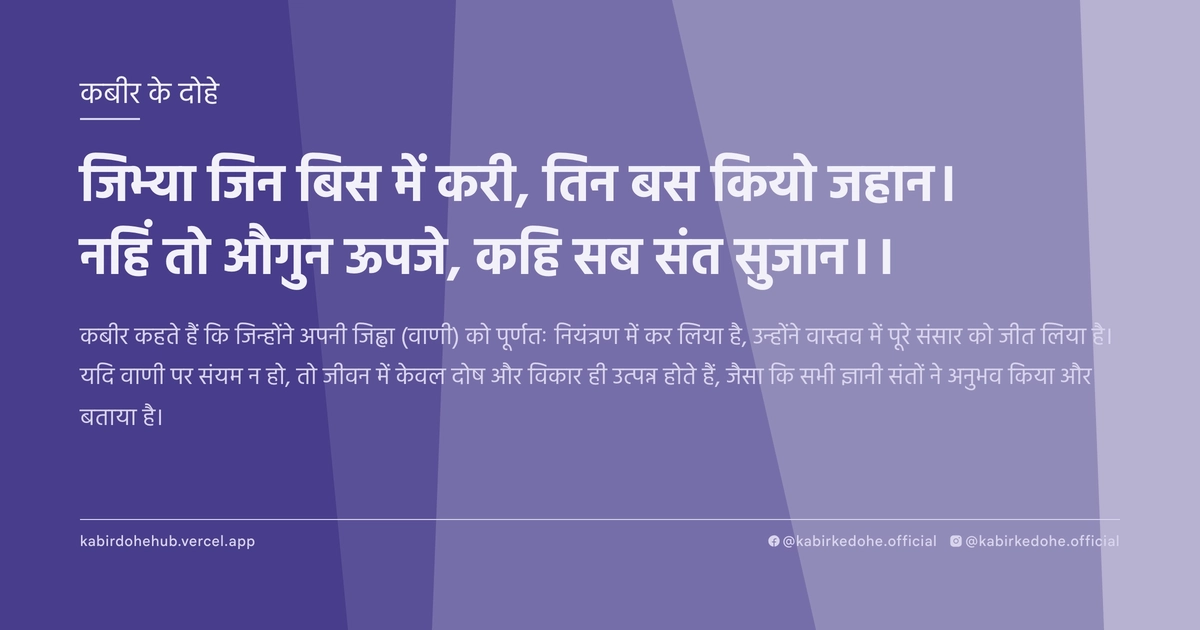
जिभ्या जिन बिस में करी, तिन बस कियो जहान।
नहिं तो औगुन ऊपजे, कहि सब संत सुजान।।
Jibhya jin bis me kari, tin bas kiyo jahan. Nahin to augun upje, kahi sab sant sujan.
इस पृष्ठ पर इस कबीर दोहे का अर्थ (meaning), हिंदी व्याख्या और अंग्रेज़ी अनुवाद, दार्शनिक विश्लेषण और व्यावहारिक जीवन सीख दी गई है। यह दोहा संयम (Self-discipline) विषय से जुड़ा है — Kabir doha meaning and explanation in Hindi and English.
अर्थ (Meaning):
कबीर कहते हैं कि जिन्होंने अपनी जिह्वा (वाणी) को पूर्णतः नियंत्रण में कर लिया है, उन्होंने वास्तव में पूरे संसार को जीत लिया है। यदि वाणी पर संयम न हो, तो जीवन में केवल दोष और विकार ही उत्पन्न होते हैं, जैसा कि सभी ज्ञानी संतों ने अनुभव किया और बताया है।
Kabir asserts that those who have mastered their tongue—bringing their speech under absolute discipline—have effectively conquered the entire world. Without this restraint, only flaws and spiritual impurities arise, a truth echoed by all the wise saints and enlightened souls.
व्याख्या (Interpretation):
शाब्दिक अर्थ यह है कि शब्दों का चयन और मौन का अभ्यास व्यक्ति को शक्तिशाली बनाता है। रूपक के स्तर पर, 'जिह्वा' केवल बोलने के अंग का प्रतीक नहीं है, बल्कि यह हमारी इंद्रियों और इच्छाओं के प्रस्फुटन का द्वार है। निर्गुण भक्ति में, वाणी का संयम 'माया' के प्रभाव को कम करने का पहला कदम है, क्योंकि शब्द ही अहंकार को पुष्ट करते हैं। जब साधक अपनी वाणी को 'बिस' (वश) में करता है, तो वह द्वैत (दोहराव) से मुक्त होकर अद्वैत की स्थिति की ओर बढ़ता है। यह विरोधाभास है कि बाहरी दुनिया को जीतने की चाह रखने वाला व्यक्ति वास्तव में अपनी आंतरिक इंद्रियों का गुलाम होता है। वास्तविक विजय बाहरी साम्राज्य पर नहीं, बल्कि अपने भीतर के शोर पर नियंत्रण पाने में है, जिससे आत्मा और ब्रह्म का मिलन संभव होता है।
Literally, the verse emphasizes that the selection of words and the practice of silence empower an individual. Metaphorically, the 'tongue' is not merely an organ of speech but the gateway through which desires and sensory impulses erupt. In Nirgun Bhakti, the restraint of speech is the primary step in mitigating the influence of 'Maya' (illusion), as words are the primary tools that nourish the ego. When a seeker brings their speech under control, they move from duality toward the state of Advaita (non-duality). There is a profound paradox here: the person striving to conquer the external world is often a slave to their own internal impulses. True victory lies not in dominating an external empire, but in silencing the internal noise, thereby facilitating the union of Atman and Brahman.
दार्शनिक विश्लेषण (Philosophical Analysis):
कबीर का यह दोहा उस युग की सामाजिक और धार्मिक पृष्ठभूमि से उपजा है जहाँ बाहरी आडंबर और शास्त्रार्थ का बोलबाला था। कबीर ने देखा कि लोग धर्म के नाम पर केवल शब्दों का जाल बुनते हैं, जबकि उनके आचरण में सत्य का अभाव है। यहाँ वाणी का नियंत्रण केवल व्याकरणिक या सामाजिक शिष्टाचार नहीं है, बल्कि यह 'अहंकार' के विसर्जन की एक मनोवैज्ञानिक प्रक्रिया है।
अद्वैत वेदांत के परिप्रेक्ष्य में, वाणी वह माध्यम है जो 'मैं' और 'तुम' के बीच भेद पैदा करती है। जब हम बोलते हैं, हम अक्सर अपनी पहचान को दूसरों से अलग और श्रेष्ठ सिद्ध करने का प्रयास करते हैं। कबीर इस भाषाई अहंकार को तोड़कर शून्य की स्थिति में पहुँचने का मार्ग बताते हैं।
सूफी मत के 'नफ्स' (इच्छाओं) के नियंत्रण के सिद्धांत के साथ इसका गहरा संबंध है। सूफीवाद में भी मौन और शब्द-संयम को ईश्वर तक पहुँचने की सीढ़ी माना गया है। कबीर यहाँ यह स्पष्ट करते हैं कि बिना आत्म-अनुशासन के कोई भी आध्यात्मिक उपलब्धि स्थायी नहीं होती।
ritualism (कर्मकांड) के प्रति कबीर का विरोध यहाँ स्पष्ट है; वे कहते हैं कि माला जपना या तीर्थ यात्रा करना व्यर्थ है यदि आपकी जिह्वा अभी भी दूसरों की निंदा या अहंकारपूर्ण शब्दों से भरी है। वास्तविक पूजा वाणी की पवित्रता में निहित है।
अंततः, यह विश्लेषण हमें बताता है कि वाणी का संयम वास्तव में चेतना का विस्तार है। जब शब्द कम होते हैं, तब अनुभव गहरा होता है। यह मनोवैज्ञानिक रूपांतरण है जहाँ व्यक्ति बाहरी प्रतिक्रियाओं के बजाय आंतरिक स्थिरता को चुनता है, जिससे वह संसार के द्वंद्वों से ऊपर उठकर 'बस' (नियंत्रण) प्राप्त करता है।
This couplet emerges from a socio-religious era dominated by external rituals and sterile scholarly debates. Kabir observed that people wove webs of words in the name of religion while their conduct remained devoid of truth. Here, the control of speech is not merely a matter of grammatical correctness or social etiquette, but a psychological process of dissolving the 'Ahamkara' (ego).
From the perspective of Advaita Vedanta, speech is the medium that creates the distinction between 'I' and 'Thou.' When we speak, we often attempt to establish our identity as separate from and superior to others. Kabir suggests a path of breaking this linguistic ego to reach the state of 'Shunya' (void/emptiness).
There is a profound connection here with the Sufi concept of controlling the 'Nafs' (lower self/desires). In Sufism, silence and the discipline of speech are viewed as ladders to reach the Divine. Kabir clarifies that no spiritual achievement is permanent without rigorous self-discipline.
Kabir's opposition to ritualism is evident; he suggests that chanting beads or visiting pilgrimages is futile if the tongue is still steeped in slander or arrogant proclamations. True worship resides in the purity of one's speech.
Ultimately, this analysis reveals that the restraint of speech is actually an expansion of consciousness. As words diminish, experience deepens. This is a psychological transformation where the individual chooses internal stability over external reactions, thereby gaining mastery over the conflicts of the world.
मूल संदेश (Core Message):
- वाणी का अनियंत्रित प्रवाह आध्यात्मिक पतन का मुख्य कारण है।
- मौन केवल शब्दों का अभाव नहीं, बल्कि आंतरिक स्थिरता की उपस्थिति है।
- अहंकार की सबसे पहली अभिव्यक्ति हमारी बातचीत के तरीके में होती है।
- स्वयं पर विजय पाना, बाहरी दुनिया को जीतने से कहीं अधिक कठिन और मूल्यवान है।
- संयम ही वह सेतु है जो व्यक्ति को पशुता से दिव्यता की ओर ले जाता है।
- The uncontrolled flow of speech is a primary cause of spiritual decline.
- Silence is not merely the absence of words, but the presence of inner stability.
- The first manifestation of the ego is found in the manner of our conversation.
- Conquering oneself is far more difficult and valuable than conquering the external world.
- Restraint is the bridge that leads a person from animality to divinity.
व्यावहारिक उदाहरण (Practical Example):
एक समय की बात है, वाराणसी के एक पुराने घाट पर रामदीन नाम का एक वृद्ध नाविक रहता था। रामदीन अपनी कड़वी बातों और गुस्से के लिए पूरे घाट पर कुख्यात था। वह छोटी-छोटी बातों पर यात्रियों से झगड़ता और अपनी नाव पर चढ़ने वालों को कोसता था। उसका मानना था कि वह सच बोल रहा है, इसलिए उसका गुस्सा जायज है। उसके कारण उसका व्यवसाय घट रहा था और लोग उससे बात करने से कतराते थे।
एक दिन, उसकी नाव में एक शांत साधु सवार हुए। रामदीन ने अपनी आदत के अनुसार साधु को भी कुछ तीखे शब्द कहे। साधु ने कोई प्रतिक्रिया नहीं दी, बस मुस्कुराए और बोले, 'बेटा, तुम्हारी नाव तो बहुत मजबूत है, लेकिन तुम्हारी वाणी में छेद है जिससे तुम्हारी सारी शांति बह रही है।'
रामदीन को यह बात चुभी, लेकिन उसने पहली बार सोचा कि क्या उसका 'सच' वास्तव में सत्य है या केवल उसका अहंकार। उसने तय किया कि वह अगले एक महीने तक केवल वही बोलेगा जो आवश्यक हो और किसी के प्रति क्रोध व्यक्त नहीं करेगा।
शुरुआत में यह उसके लिए अत्यंत कठिन था। जब कोई यात्री देरी करता या बहस करता, तो उसका गला रुंध जाता और चेहरा लाल हो जाता। लेकिन वह अपनी जिह्वा को 'बिस' (वश) में रखने का प्रयास करता रहा। वह शब्दों को बोलने से पहले तीन बार सोचता कि क्या यह शब्द किसी का भला करेगा या केवल उसके अहंकार को संतुष्ट करेगा।
धीरे-धीरे, उसके व्यवहार में एक अद्भुत परिवर्तन आया। जो लोग उससे डरते थे, वे अब उससे प्रेम करने लगे। उसकी शांति ने अन्य लोगों को भी शांत कर दिया। घाट के अन्य नाविक, जो पहले उसका मजाक उड़ाते थे, अब उससे सलाह लेने आने लगे।
रामदीन ने महसूस किया कि जब उसने अपनी वाणी को जीता, तो उसने उन सभी लोगों को जीत लिया जिनसे वह नफरत करता था। उसका संघर्ष अब बाहरी दुनिया से नहीं, बल्कि उसके अपने भीतर के आवेगों से था।
एक शाम, जब वह गंगा की लहरों को देख रहा था, उसे अहसास हुआ कि उसकी नाव अब केवल लोगों को पार नहीं करा रही थी, बल्कि वह स्वयं भी एक किनारे से दूसरे किनारे—क्रोध से शांति की ओर—पहुँच गया था।
उसने सीखा कि सत्य बिना करुणा के केवल एक हथियार होता है, लेकिन जब सत्य को संयम के साथ बोला जाता है, तो वह औषधि बन जाता है।
रामदीन का जीवन अब एक उदाहरण बन गया था कि कैसे एक छोटी सी इंद्रिय का नियंत्रण पूरे जीवन की दिशा बदल सकता है। उसने वास्तव में 'जहान' को जीत लिया था, क्योंकि अब उसके भीतर कोई शत्रु शेष नहीं था।
Once, on an ancient ghat in Varanasi, lived an elderly boatman named Ramdeen. Ramdeen was notorious throughout the waterfront for his caustic tongue and explosive temper. He would quarrel with passengers over trivialities and curse those who boarded his boat. He believed that because he spoke the 'truth,' his anger was justified. Consequently, his business dwindled, and people avoided him.
One day, a serene monk boarded his boat. Following his habit, Ramdeen directed some sharp words toward the monk. The monk offered no reaction; he simply smiled and said, 'Son, your boat is very sturdy, but there is a hole in your speech through which all your peace is leaking.'
Ramdeen felt stung, but for the first time, he wondered if his 'truth' was actually truth or merely his ego. He decided that for the next month, he would speak only what was necessary and would not express anger toward anyone.
Initially, this was excruciating. When a passenger delayed or argued, his throat would tighten and his face would flush. But he persisted in bringing his tongue under 'bis' (control). He began thinking three times before speaking, questioning whether the words would benefit another or merely satisfy his own ego.
Gradually, a wonderful transformation occurred in his behavior. People who once feared him began to love him. His stillness began to calm those around him. Other boatmen, who previously mocked him, now came to him for advice.
Ramdeen realized that by conquering his speech, he had conquered all those he once hated. His struggle was no longer with the external world, but with his own internal impulses.
One evening, watching the ripples of the Ganges, he realized that his boat was no longer just transporting people; he himself had crossed from one shore to another—from anger to peace.
He learned that truth without compassion is merely a weapon, but when truth is spoken with restraint, it becomes a medicine.
Ramdeen's life became a testament to how the control of a single sense organ can alter the entire trajectory of a life. He had truly conquered the 'world,' for there was no longer any enemy left within him.
अभ्यास मार्गदर्शन (Practice Guidance):
- दैनिक मौन अभ्यास: प्रतिदिन कम से कम एक घंटा 'पूर्ण मौन' का पालन करें, जिसमें शारीरिक संकेतों से भी संवाद न करें।
- वाणी-निरीक्षण जर्नल: दिन भर में बोले गए उन शब्दों को लिखें जिन्होंने विवाद पैदा किया, और विश्लेषण करें कि उस समय अहंकार का कौन सा हिस्सा सक्रिय था।
- तीन-सेकंड का नियम: किसी भी प्रतिक्रिया देने से पहले तीन गहरी सांसें लें और स्वयं से पूछें, 'क्या यह शब्द सत्य, आवश्यक और दयालु है?'
- निदान चेकलिस्ट: यदि आप दूसरों की आलोचना करते समय आनंद महसूस करते हैं या अपनी बात मनवाने के लिए शब्दों का प्रयोग हथियार की तरह करते हैं, तो समझें कि आपकी जिह्वा अभी वश में नहीं है।
- Daily Silence Practice: Observe at least one hour of 'absolute silence' daily, avoiding communication even through physical gestures.
- Speech-Observation Journal: Record words spoken during the day that triggered conflict, analyzing which part of the ego was active at that moment.
- The Three-Second Rule: Before reacting, take three deep breaths and ask yourself, 'Is this word true, necessary, and kind?'
- Diagnostic Checklist: If you feel a sense of pleasure while criticizing others or use words as weapons to impose your will, recognize that your tongue is not yet under control.
चिंतन प्रश्न (Reflection Questions):
- क्या मेरी वाणी सत्य बोलने के बहाने दूसरों को नीचा दिखाने का एक उपकरण है?
- जब मैं मौन रहता हूँ, तो मुझे अपने भीतर कौन से अनसुलझे डर और शोर सुनाई देते हैं?
- मेरी डिजिटल पहचान (सोशल मीडिया) पर मेरी वाणी मेरे वास्तविक स्वरूप से कितनी भिन्न है?
- क्या मैं अपनी बात को सही सिद्ध करने की इच्छा में शांति की बलि दे रहा हूँ?
- यदि मेरे शब्द मेरे कर्मों का दर्पण होते, तो आज मेरा प्रतिबिंब कैसा दिखता?
- Is my speech a tool to belittle others under the guise of speaking the truth?
- When I remain silent, what unresolved fears and noises do I hear within myself?
- How different is the voice of my digital identity (social media) from my authentic self?
- Am I sacrificing peace for the sake of proving my point correct?
- If my words were a mirror of my actions, what would my reflection look like today?