
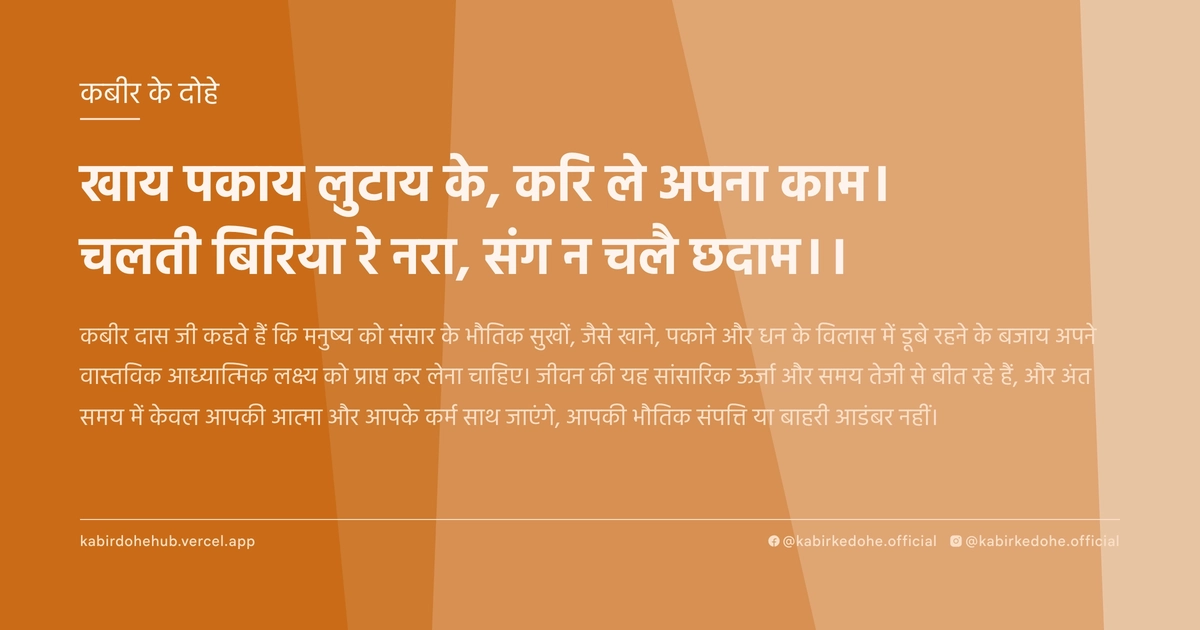
खाय पकाय लुटाय के, करि ले अपना काम।
चलती बिरिया रे नरा, संग न चलै छदाम।।
Khay pakay lutay ke, kari le apna kaam. Chalti biriya re nara, sang na chalai chhadam.
इस पृष्ठ पर इस कबीर दोहे का अर्थ (meaning), हिंदी व्याख्या और अंग्रेज़ी अनुवाद, दार्शनिक विश्लेषण और व्यावहारिक जीवन सीख दी गई है। यह दोहा समय का महत्व (The Value of Time) विषय से जुड़ा है — Kabir doha meaning and explanation in Hindi and English.
अर्थ (Meaning):
कबीर दास जी कहते हैं कि मनुष्य को संसार के भौतिक सुखों, जैसे खाने, पकाने और धन के विलास में डूबे रहने के बजाय अपने वास्तविक आध्यात्मिक लक्ष्य को प्राप्त कर लेना चाहिए। जीवन की यह सांसारिक ऊर्जा और समय तेजी से बीत रहे हैं, और अंत समय में केवल आपकी आत्मा और आपके कर्म साथ जाएंगे, आपकी भौतिक संपत्ति या बाहरी आडंबर नहीं।
Kabir urges the seeker to prioritize spiritual liberation over the endless cycle of material consumption and domestic indulgence. He warns that the vital energy of life is fleeting; while one may spend years in the pursuit of luxury and sensory pleasure, only the realized soul transcends the grave, as material possessions and superficial rituals cannot accompany the spirit in its final journey.
व्याख्या (Interpretation):
इस दोहे का शाब्दिक अर्थ है कि भोजन और विलासिता में समय व्यतीत करते हुए अपने जीवन के वास्तविक उद्देश्य को पूरा कर लो। रूपकात्मक रूप से, 'खाय पकाय' सांसारिक माया और इंद्रिय सुखों का प्रतीक है जो आत्मा को सुलाए रखते हैं। कबीर यहाँ 'बिरिया' (जीवन शक्ति/सांसों) की क्षणभंगता की बात कर रहे हैं। यह निर्गुण भक्ति का सार है, जहाँ बाहरी कर्मकांडों के बजाय आंतरिक शुद्धि पर जोर दिया गया है। यह अद्वैत वेदांत के उस सत्य को दर्शाता है कि शरीर नश्वर है और केवल ब्रह्म या शुद्ध चेतना ही शाश्वत है। यहाँ विरोधाभास यह है कि मनुष्य उसी चीज़ को संचित करने में जीवन बिता देता है जिसे वह अंततः छोड़ देगा।
Literally, the verse advises completing one's spiritual work despite the distractions of eating and luxury. Metaphorically, 'eating and cooking' represent the entanglement in Maya—the cosmic illusion that binds the Atman to sensory gratification. Kabir emphasizes the 'Biriya' (vital breath), signaling that time is the only currency that cannot be recovered. This aligns with Nirgun Bhakti, where the formless Divine is sought within, rejecting the external noise of ritualism. The central paradox is the human tendency to build a 'fortress' of possessions while the foundation of the soul remains neglected. It reflects the Advaita realization that the ego-driven identity is a mask, and only the non-dual awareness survives the dissolution of the physical form.
दार्शनिक विश्लेषण (Philosophical Analysis):
कबीर का यह दोहा उस युग की सामाजिक और धार्मिक जड़ता पर प्रहार करता है जहाँ लोग केवल बाहरी दिखावे और कर्मकांडों में उलझे थे। उन्होंने स्पष्ट किया कि मोक्ष किसी विशेष जाति या बाहरी अनुष्ठान से नहीं, बल्कि आत्म-साक्षात्कार से मिलता है। यह विचार सूफी मत के 'फना' (अहंकार का विनाश) के करीब है, जहाँ साधक अपनी व्यक्तिगत इच्छाओं को ईश्वर की इच्छा में विलीन कर देता है।
दार्शनिक स्तर पर, कबीर यहाँ 'सांख्य' और 'वेदांत' के मिश्रण का उपयोग कर रहे हैं, जहाँ प्रकृति (माया) और पुरुष (चेतना) के बीच का अंतर स्पष्ट किया गया है। वे चेतावनी देते हैं कि जो व्यक्ति केवल भौतिक सुखों (प्रकृति) में लीन रहता है, वह अपनी वास्तविक पहचान (पुरुष) को भूल जाता है।
ritualism या कर्मकांडों का विरोध करते हुए कबीर कहते हैं कि मंदिर, मस्जिद या रसोई के कार्यों से ईश्वर नहीं मिलता, बल्कि मन की एकाग्रता और प्रेम से मिलता है। यह एक मनोवैज्ञानिक परिवर्तन का आह्वान है—बाहरी संचय से आंतरिक विस्तार की ओर।
अद्वैत वेदांत के अनुसार, जब तक 'मैं' और 'मेरा' का भाव रहता है, तब तक बंधन बना रहता है। 'छदाम' या बाहरी आवरण का साथ न चलना यह दर्शाता है कि मृत्यु के समय केवल वह सत्य साथ जाएगा जिसे आपने अनुभव किया है, न कि वह जिसे आपने खरीदा है।
अंततः, यह दोहा समय की अनिवार्यता (Kala) पर जोर देता है। कबीर का दर्शन यह है कि आध्यात्मिक जागृति के लिए कोई 'सही समय' नहीं होता; वर्तमान क्षण ही एकमात्र द्वार है। जो इस क्षण को विलासिता में गँवा देता है, वह जीवन के महानतम अवसर को खो देता है।
Kabir’s verse is a surgical strike against the socio-religious inertia of his era, where spirituality was often reduced to rote ritualism and caste-based exclusivity. By dismissing the importance of 'eating and cooking' (domesticity and luxury), he advocates for a direct, unmediated experience of the Divine, echoing the Sufi concept of 'Fana'—the annihilation of the lower self to make room for the Higher Truth.
Philosophically, this teaching bridges the gap between Advaita Vedanta and the Bhakti movement. It posits that the human condition is characterized by a profound forgetfulness; we mistake the 'mask' (the social and material identity) for the 'face' (the eternal Atman). The 'chhadam' or external coverings refer to the ego-constructs and material wealth that provide a false sense of security but vanish at the moment of transition.
Kabir rejects the notion that spiritual liberation is a reward for performing specific rituals. Instead, he presents it as a psychological shift from accumulation to subtraction. The 'Kabir twist' here is the realization that the very tools we use to find comfort in the world are the chains that prevent us from finding peace within.
From a psychological perspective, the doha addresses the 'hedonic treadmill'—the cycle of wanting more, achieving it, and then wanting even more. Kabir suggests that this cycle is a distraction from the 'Kaam' (the Great Work) of self-realization. He argues that the ego is a phantom that believes it can carry its treasures into the void.
Ultimately, the verse serves as a Memento Mori. It reminds the seeker that the 'Biriya' (life force) is leaking away with every breath. The urgency is not born of fear, but of a compassionate reminder that the window for awakening is narrow, and the distractions of the world are designed to keep the soul asleep.
मूल संदेश (Core Message):
- इंद्रिय सुख क्षणिक हैं, जबकि आत्म-ज्ञान शाश्वत है।
- समय की रेत फिसल रही है; जागृति के लिए अभी समय है।
- बाहरी आडंबर मृत्यु के द्वार पर निरर्थक हो जाते हैं।
- सच्ची संपत्ति वह है जो मृत्यु के बाद भी साथ रहे।
- अहंकार का विसर्जन ही परमात्मा से मिलन का एकमात्र मार्ग है।
- Sensory pleasures are transient; self-realization is eternal.
- The sands of time are slipping; the moment for awakening is now.
- External rituals become meaningless at the threshold of death.
- True wealth is that which survives the dissolution of the body.
- The annihilation of ego is the only bridge to the Universal Truth.
व्यावहारिक उदाहरण (Practical Example):
वाराणसी के एक पुराने मोहल्ले में माधव नाम का एक अत्यंत कुशल बुनकर रहता था। माधव की बनाई साड़ियाँ पूरे शहर में प्रसिद्ध थीं। उसके पास धन की कोई कमी नहीं थी, और वह अपना अधिकांश समय नए-नए विलासिता के सामान खरीदने, भव्य भोज आयोजित करने और अपने सामाजिक प्रभाव को बढ़ाने में बिताता था। वह अक्सर कहता, 'जब मैं पर्याप्त धन कमा लूँगा, तब मैं शांति की खोज करूँगा।'
माधव का जीवन एक अंतहीन दौड़ बन गया था। वह सुबह से रात तक केवल इस चिंता में रहता कि उसकी अगली डिज़ाइन कैसी होगी और वह उससे कितना अधिक मुनाफा कमा पाएगा। उसके घर में बेहतरीन पकवान बनते थे, लेकिन उसके मन में हमेशा एक बेचैनी रहती थी।
एक दिन, उसके मोहल्ले में एक फकीर आया, जिसने माधव को इस दोहे के माध्यम से चुनौती दी: 'तुम रेशम के धागों से कपड़े तो बुन रहे हो, लेकिन क्या तुमने अपनी आत्मा का धागा ईश्वर से जोड़ा है?'
माधव ने पहले तो इसे नज़रअंदाज़ किया, लेकिन उस रात उसे एक सपना आया। उसने देखा कि वह एक विशाल सोने के महल में खड़ा है, लेकिन जैसे ही वह चलने की कोशिश करता, महल की दीवारें रेत की तरह ढहने लगीं। वह चिल्लाया, 'मेरा धन कहाँ गया?' लेकिन उसके पास केवल एक खाली झोला था।
जागने के बाद माधव गहरे संकट में पड़ गया। उसने महसूस किया कि उसने अपना पूरा जीवन 'खाय पकाय' (भोग-विलास) में बिता दिया, जबकि उसकी 'बिरिया' (जीवन शक्ति) कम होती जा रही थी।
उसने एक बड़ा निर्णय लिया। उसने अपनी विलासिता कम की और अपनी कमाई का एक बड़ा हिस्सा गरीबों की सेवा में लगाना शुरू किया। उसने महसूस किया कि असली खुशी संचय में नहीं, बल्कि त्याग में है।
उसने अब केवल लाभ के लिए नहीं, बल्कि प्रेम के लिए बुनना शुरू किया। उसकी साड़ियों में अब एक अलग तरह की शांति और दिव्यता झलकने लगी थी।
माधव ने पाया कि जब उसने बाहरी 'छदाम' (दिखावे) को छोड़ दिया, तो उसे वह आंतरिक शांति मिली जिसे वह सोने के सिक्कों में ढूँढ रहा था।
अब वह शाम को चुपचाप बैठकर केवल अपनी सांसों का अवलोकन करता और उस निराकार ईश्वर का ध्यान करता।
उसका जीवन अब एक प्रदर्शन नहीं, बल्कि एक प्रार्थना बन गया था।
In the ancient lanes of Varanasi lived Madhav, a master weaver whose silks were coveted across the region. Madhav possessed immense wealth and spent his days indulging in the finest delicacies, hosting lavish parties, and expanding his social influence. He often told himself, 'Once I have secured enough gold, I will dedicate my time to spiritual peace.'
Madhav’s life became an endless race. From dawn till dusk, his mind was consumed by the next design and the potential profit it would yield. While his table was always laden with gourmet feasts, his heart remained plagued by a persistent, nameless anxiety.
One afternoon, a wandering ascetic visited his loom and challenged him with Kabir’s wisdom: 'You weave exquisite patterns in silk, but have you woven the thread of your soul into the Divine?'
Initially, Madhav dismissed the remark. However, that night, he had a vivid dream. He saw himself standing in a magnificent palace of gold, but as he tried to move, the walls began to crumble like sand. He screamed, 'Where is my wealth?' only to find he was clutching an empty bag.
Upon waking, Madhav was shaken to his core. He realized he had spent his entire existence in 'Khay Pakay' (sensory indulgence), while his 'Biriya' (vital life force) was silently slipping away.
He made a radical shift. He stripped away his luxuries and began dedicating a significant portion of his earnings to the service of the destitute. He discovered that true fulfillment lay not in accumulation, but in surrender.
He stopped weaving for profit and started weaving for love. His fabrics began to radiate a different kind of beauty—a serenity that transcended material value.
Madhav found that by discarding the 'Chhadam' (the external mask of status), he finally accessed the inner silence he had unsuccessfully sought through gold.
He began spending his evenings in stillness, observing the rhythm of his breath and meditating on the Formless One.
His life was no longer a performance for the world, but a private, sacred prayer.
अभ्यास मार्गदर्शन (Practice Guidance):
- दैनिक चिंतन: प्रतिदिन 20 मिनट मौन बैठें और विचार करें कि आपकी कौन सी इच्छाएं वास्तव में आपकी हैं और कौन सी समाज द्वारा थोपी गई हैं।
- स्व-पूछताछ जर्नल: हर रात लिखें—'आज मैंने कितना समय केवल शरीर को सुख देने में बिताया और कितना समय अपनी आत्मा को जानने में?'
- व्यवहार परिवर्तन: सप्ताह में एक दिन 'अपरिग्रह' का अभ्यास करें, जहाँ आप न्यूनतम संसाधनों के साथ रहें और विलासिता का पूर्ण त्याग करें।
- डायग्नोस्टिक चेकलिस्ट: यदि आप अभी भी अपनी पहचान अपनी संपत्ति, पद या बाहरी प्रशंसा से जोड़ रहे हैं, तो आप 'छदाम' के जाल में हैं। यदि आप अकेलेपन में भी पूर्ण महसूस करते हैं, तो आप सही दिशा में हैं।
- Daily Contemplation: Spend 20 minutes in absolute silence, questioning which of your desires are authentic and which are mere social projections.
- Self-Inquiry Journaling: Each night, record the answer to: 'How much of my day was spent feeding the body versus nourishing the soul?'
- Behavioral Shift: Practice one day of 'Aparigraha' (non-possessiveness) per week, living with minimal resources and consciously abstaining from luxury.
- Diagnostic Checklist: You are still trapped in 'Chhadam' if your self-worth is tied to assets, titles, or external validation. You are progressing if you feel complete and centered even in total solitude.
चिंतन प्रश्न (Reflection Questions):
- यदि आज आपकी सारी भौतिक उपलब्धियाँ छीन ली जाएँ, तो आपके पास 'स्वयं' के रूप में क्या बचेगा?
- आप अपनी सामाजिक छवि (Digital/Social Ego) को बनाए रखने के लिए अपनी आत्मा की कितनी शांति की बलि दे रहे हैं?
- क्या आपका 'धर्म' केवल बाहरी रीति-रिवाजों तक सीमित है, या वह आपके चरित्र में उतरा है?
- आप किन ऐसी चीज़ों को संचित कर रहे हैं जिन्हें आप कभी साथ नहीं ले जा पाएंगे?
- क्या आप वास्तव में जीवित हैं, या आप केवल जीवित रहने की आदतों का पालन कर रहे हैं?
- If all your material achievements were stripped away today, what would remain of 'You'?
- How much of your inner peace are you sacrificing to maintain your social image or digital ego?
- Is your spirituality limited to external rituals, or has it transformed your actual character?
- What are you accumulating with such intensity that you forget it cannot be carried beyond the grave?
- Are you truly alive and awake, or are you merely performing the habit of existing?