
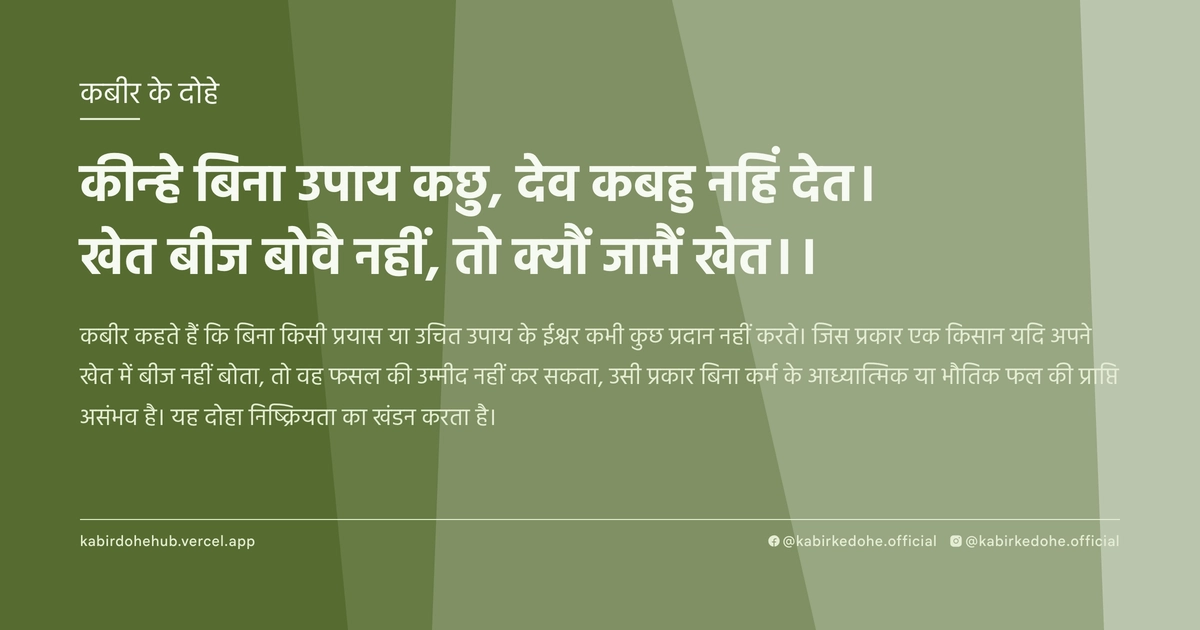
कीन्हे बिना उपाय कछु, देव कबहु नहिं देत।
खेत बीज बोवै नहीं, तो क्यौं जामैं खेत।।
Keenhe bina upay kachu, dev kabhu nahin det. Khet beej bovai nahin, to kyon jamain khet.
इस पृष्ठ पर इस कबीर दोहे का अर्थ (meaning), हिंदी व्याख्या और अंग्रेज़ी अनुवाद, दार्शनिक विश्लेषण और व्यावहारिक जीवन सीख दी गई है। यह दोहा कर्म (Karma) विषय से जुड़ा है — Kabir doha meaning and explanation in Hindi and English.
अर्थ (Meaning):
कबीर कहते हैं कि बिना किसी प्रयास या उचित उपाय के ईश्वर कभी कुछ प्रदान नहीं करते। जिस प्रकार एक किसान यदि अपने खेत में बीज नहीं बोता, तो वह फसल की उम्मीद नहीं कर सकता, उसी प्रकार बिना कर्म के आध्यात्मिक या भौतिक फल की प्राप्ति असंभव है। यह दोहा निष्क्रियता का खंडन करता है।
Kabir asserts that the Divine never grants rewards to those who remain passive and devoid of effort. Just as a farmer cannot expect a harvest without first sowing seeds in the field, one cannot attain spiritual or material fruition without conscious action. It is a stern critique of blind faith devoid of personal striving.
व्याख्या (Interpretation):
शाब्दिक अर्थ यह है कि कर्म के बिना फल नहीं मिलता। आध्यात्मिक स्तर पर, 'बीज' का अर्थ है साधना, आत्म-निरीक्षण और सत्य की खोज। कबीर यहाँ 'देव' (ईश्वर) को एक ऐसी शक्ति के रूप में दिखाते हैं जो प्राकृतिक नियमों से बंधी है। यह निर्गुण भक्ति का मार्ग है जहाँ भक्त को स्वयं को तपाना पड़ता है। माया हमें यह भ्रम देती है कि केवल प्रार्थना से सब मिल जाएगा, परंतु वास्तविक बोध केवल 'उपाय' यानी सचेत प्रयास से आता है। यह आत्मा और परमात्मा के मिलन के लिए आवश्यक व्यक्तिगत पुरुषार्थ पर बल देता है।
Literally, it posits that results require action. Metaphorically, the 'seed' represents spiritual discipline, self-inquiry, and the pursuit of Truth. Kabir presents the Divine not as a capricious granter of wishes, but as a cosmic law of cause and effect. In the context of Nirgun Bhakti, the seeker must actively strip away the layers of Maya (illusion) through effort. The paradox lies in the fact that while the Ultimate Truth is already within, the 'effort' is required to remove the ego that obscures it. It emphasizes that the Atman-Brahman non-duality is realized through the alchemy of conscious practice, not passive waiting.
दार्शनिक विश्लेषण (Philosophical Analysis):
कबीर का यह दृष्टिकोण उनके युग के उस अंधविश्वास पर प्रहार है जहाँ लोग केवल कर्मकांडों और बाहरी प्रार्थनाओं के माध्यम से मोक्ष की कामना करते थे। वे स्पष्ट करते हैं कि ईश्वर कोई बाहरी व्यक्ति नहीं है जो ऊपर बैठकर पुरस्कार बाँटता है, बल्कि वह एक आंतरिक वास्तविकता है जिसे कर्म के माध्यम से जागृत करना पड़ता है।
यह विचार अद्वैत वेदांत के 'कर्म' सिद्धांत से मेल खाता है, जहाँ ज्ञान के साथ-साथ क्रिया की आवश्यकता होती है। कबीर यहाँ सूफीवाद के 'इश्क' (प्रेम) और 'साधना' के मेल को दर्शाते हैं, जहाँ प्रेमी को अपने प्रिय (ईश्वर) तक पहुँचने के लिए कठिन मार्ग तय करना पड़ता है।
वे जाति और धर्म के नाम पर होने वाले पाखंड का विरोध करते हैं, क्योंकि उनके लिए 'उपाय' का अर्थ है हृदय की शुद्धता और सत्य का आचरण, न कि किसी विशेष मंदिर या मस्जिद में जाना। उनके अनुसार, ritualism एक मृत बीज की तरह है जो कभी नहीं उगता।
मनोवैज्ञानिक स्तर पर, यह दोहा व्यक्ति को उसकी अपनी एजेंसी (agency) वापस देता है। यह 'विक्टिम मेंटालिटी' या भाग्यवादिता को समाप्त कर व्यक्ति को अपने जीवन का निर्माता बनाता है। अहंकार का विनाश तब होता है जब व्यक्ति यह समझता है कि वह केवल प्रार्थना करने वाला नहीं, बल्कि कर्म करने वाला है।
अंततः, कबीर यह समझाते हैं कि आध्यात्मिक प्रगति कोई चमत्कार नहीं, बल्कि एक व्यवस्थित प्रक्रिया है। जैसे बीज मिट्टी, पानी और धूप के समन्वय से पौधा बनता है, वैसे ही साधना, धैर्य और विवेक के समन्वय से आत्म-साक्षात्कार होता है।
Kabir’s perspective is a direct assault on the superstitions of his era, where salvation was sought through rote rituals and external pleas. He clarifies that the Divine is not an external entity dispensing rewards, but an immanent reality awakened through intentional action.
This aligns with the Advaita Vedanta principle of Karma, where knowledge (Jnana) must be complemented by right action. Kabir bridges the gap between the Sufi concept of 'Ishq' (divine love) and rigorous discipline, suggesting that the lover must endure the hardship of the path to reach the Beloved.
He rejects caste-based and religious ritualism, arguing that the only true 'upay' (remedy) is the purity of heart and ethical conduct. To Kabir, ritualism is like a dead seed—it possesses the form of faith but lacks the life-force of genuine effort.
Psychologically, this verse restores agency to the individual. It dismantles the 'victim mentality' and the fatalistic belief that destiny is written in stone, urging the seeker to become the architect of their own liberation.
Ultimately, Kabir posits that spiritual evolution is not a miracle but a systematic process. Just as a seed requires the synergy of soil, water, and sun, self-realization requires the synergy of discipline, patience, and discernment.
मूल संदेश (Core Message):
- निष्क्रियता आध्यात्मिक पतन का मार्ग है।
- ईश्वर अवसर देता है, लेकिन उपलब्धि प्रयास से आती है।
- सच्ची भक्ति कर्म के साथ जुड़ी होती है।
- बीज बोना यानी अपनी जिम्मेदारी स्वीकार करना है।
- परिवर्तन की शुरुआत स्वयं के पुरुषार्थ से होती है।
- Passivity is the path to spiritual stagnation.
- The Divine provides the opportunity; effort secures the achievement.
- True devotion is inextricably linked to right action.
- Sowing the seed means accepting absolute personal responsibility.
- Transformation begins with the awakening of individual will.
व्यावहारिक उदाहरण (Practical Example):
वाराणसी के घाटों पर रहने वाले एक वृद्ध विधवा, जानकी, की कहानी है। जानकी ने अपने जीवन के पिछले बीस साल केवल इस उम्मीद में बिता दिए कि उनके पूर्वज उन्हें किसी चमत्कार के माध्यम से गरीबी से निकालेंगे। वे दिन भर मंदिर में बैठकर प्रार्थना करती थीं और मानती थीं कि ईश्वर उनकी स्थिति बदल देंगे।
उनके पड़ोस में एक युवा लड़का था जो मिट्टी के बर्तन बनाता था। उसने जानकी को देखा और उनसे कहा, 'माँ, प्रार्थना आत्मा को शांति देती है, लेकिन पेट भरने के लिए हाथ चलाने पड़ते हैं।' जानकी ने पहले तो इसे अपमान माना, लेकिन फिर उन्होंने महसूस किया कि उनकी प्रार्थनाओं में केवल माँग थी, समर्पण या प्रयास नहीं।
उन्होंने अपने घर के छोटे से आंगन में सब्जियां उगाना शुरू किया। शुरुआत में उन्हें बहुत कठिनाई हुई; उनके हाथ कांपते थे और मिट्टी भारी लगती थी। उन्होंने हर दिन पानी दिया, खरपतवार निकाली और धैर्य रखा।
महीनों बाद, उनके आंगन में हरी-भरी सब्जियां उग आईं। उन्होंने उन्हें बाजार में बेचना शुरू किया। धीरे-धीरे उनकी आर्थिक स्थिति सुधरने लगी और उनके मन की कड़वाहट कम होने लगी।
एक दिन उन्होंने महसूस किया कि जब वे बीज बो रही थीं, तब वे वास्तव में ईश्वर के साथ संवाद कर रही थीं। मेहनत उनके लिए प्रार्थना बन गई थी।
अब वे मंदिर जाती थीं, लेकिन अब वे कुछ माँगने नहीं, बल्कि धन्यवाद करने जाती थीं। उन्होंने समझा कि ईश्वर ने उन्हें बीज और मिट्टी दी थी, लेकिन फसल उगाने का 'उपाय' उन्हें स्वयं करना था।
उनकी इस यात्रा ने मोहल्ले के अन्य लोगों को भी प्रेरित किया। उन्होंने सीखा कि चमत्कार बाहर से नहीं आता, बल्कि हमारे अपने श्रम के माध्यम से प्रकट होता है।
जानकी का जीवन अब केवल प्रतीक्षा का नाम नहीं था, बल्कि सृजन का उत्सव बन गया था। उन्होंने जान लिया कि बिना बीज बोए फसल की उम्मीद करना केवल एक भ्रम है।
Consider the story of Janaki, an elderly widow living on the ghats of Varanasi. For twenty years, Janaki spent her days in a state of passive longing, believing that her ancestors or a divine miracle would suddenly lift her out of poverty.
She spent hours in the temple, praying fervently that the Divine would change her circumstances. She viewed her suffering as a test of faith, waiting for a sign or a windfall that would never come.
Nearby lived a young potter who observed her. He once told her, 'Mother, prayer gives peace to the soul, but it takes the movement of hands to fill the stomach.' Janaki initially felt insulted, but the words planted a seed of doubt in her passivity.
She decided to utilize a small, neglected patch of land in her courtyard to grow vegetables. At first, it was grueling; her hands trembled, and the soil felt heavy and stubborn.
She watered the earth daily, weeded the beds, and endured the scorching sun. She stopped asking 'when will it happen' and started asking 'how can I make it grow.'
After several months, the courtyard flourished with vibrant greens. She began selling the surplus in the local market, slowly stabilizing her meager finances.
During this process, a profound shift occurred. She realized that while she was sowing the seeds, she was in a deeper communion with the Divine than she ever was while sitting idle in the temple.
Her labor became her prayer. She discovered that the 'miracle' was not the harvest itself, but the transformation of her own will and strength.
She continued to visit the temple, but her prayers shifted from desperate pleas for help to expressions of gratitude for the strength to work.
Janaki’s life ceased to be a waiting room and became a garden of creation, proving that the Divine provides the field and the seed, but the harvest belongs to the one who toils.
अभ्यास मार्गदर्शन (Practice Guidance):
- दैनिक आत्म-निरीक्षण: हर रात यह लिखें कि आज आपने अपने लक्ष्य की दिशा में कौन सा 'बीज' (ठोस प्रयास) बोया।
- प्रार्थना का रूपांतरण: अपनी प्रार्थनाओं को 'मुझे यह दे दो' से बदलकर 'मुझे इसे प्राप्त करने का सामर्थ्य और सही मार्ग दिखाओ' में बदलें।
- कर्म-योग अभ्यास: किसी भी कार्य को करते समय यह महसूस करें कि आपका प्रयास ही ईश्वर की सबसे बड़ी पूजा है।
- डायग्नोस्टिक चेकलिस्ट: क्या मैं केवल परिणामों की चिंता कर रहा हूँ? क्या मेरा प्रयास मेरी इच्छा के अनुपात में है? क्या मैं अपनी असफलताओं के लिए भाग्य को दोष दे रहा हूँ?
- Daily Self-Inquiry: Every night, journal the specific 'seed' (concrete action) you sowed today toward your spiritual or material goal.
- Transformation of Prayer: Shift your prayers from 'Give me this' to 'Grant me the strength and discernment to create this.'
- Karma Yoga Practice: While performing any mundane task, consciously perceive your effort as the highest form of worship.
- Diagnostic Checklist: Am I obsessing over results while neglecting the process? Is my effort proportional to my desire? Am I blaming fate for failures that resulted from inaction?
चिंतन प्रश्न (Reflection Questions):
- मेरे जीवन में ऐसा कौन सा क्षेत्र है जहाँ मैं केवल 'चमत्कार' की प्रतीक्षा कर रहा हूँ जबकि बीज बोना मेरे हाथ में है?
- क्या मेरी धार्मिक या आध्यात्मिक मान्यताएँ मुझे आलस्य और निष्क्रियता के लिए एक सुरक्षित बहाना दे रही हैं?
- मैं अपनी बाहरी पहचान (जैसे पद या प्रतिष्ठा) को बनाए रखने के लिए कितना प्रयास करता हूँ, और अपनी आंतरिक शुद्धि के लिए कितना?
- यदि आज मुझे सब कुछ खोना पड़े, तो क्या मेरे पास वह 'बीज' (कौशल और साहस) है जिससे मैं पुनः शून्य से शुरुआत कर सकूँ?
- क्या मैं वास्तव में ईश्वर पर भरोसा करता हूँ, या मैं केवल अपनी जिम्मेदारी से बचने के लिए ईश्वर का नाम ले रहा हूँ?
- In which area of my life am I waiting for a 'miracle' while the act of sowing the seed remains within my power?
- Are my religious or spiritual beliefs providing me with a convenient excuse for laziness and passivity?
- How much effort do I invest in maintaining my external persona versus the effort I put into internal purification?
- If I were to lose everything today, do I possess the 'seed' (skill and courage) to begin again from zero?
- Do I truly trust the Divine, or am I using the name of God to evade my own personal responsibilities?