
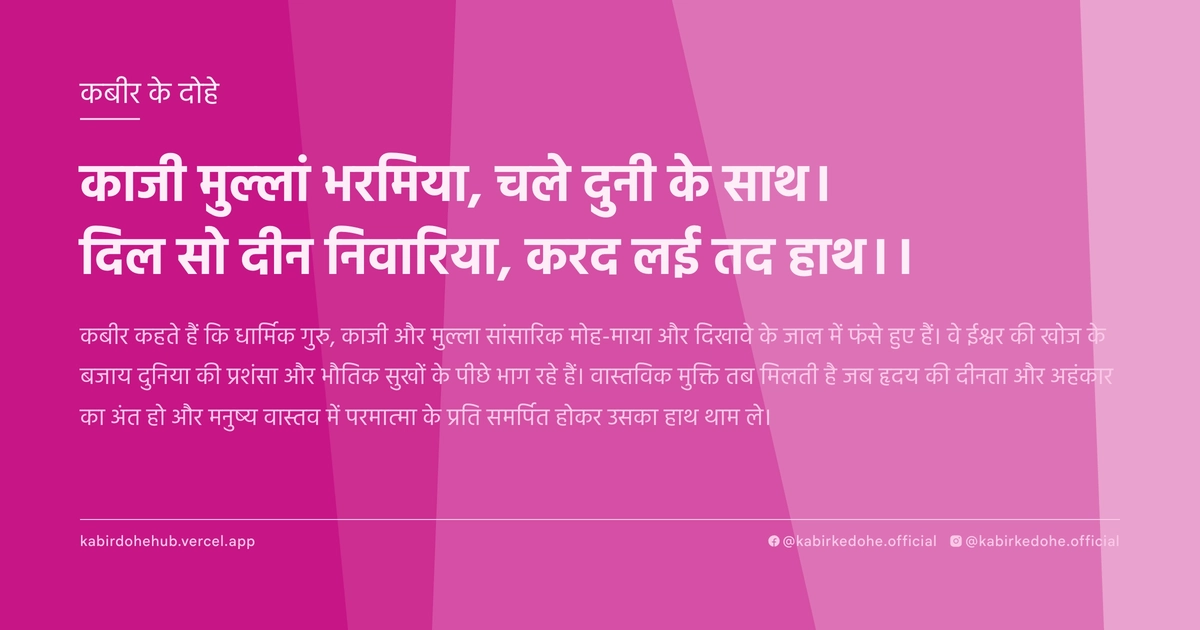
काजी मुल्लां भरमिया, चले दुनी के साथ।
दिल सो दीन निवारिया, करद लई तद हाथ।।
Kaji mullan bharmia, chale duni ke saath. Dil so deen nivaria, karad lai tad haath.
इस पृष्ठ पर इस कबीर दोहे का अर्थ (meaning), हिंदी व्याख्या और अंग्रेज़ी अनुवाद, दार्शनिक विश्लेषण और व्यावहारिक जीवन सीख दी गई है। यह दोहा पंडित-मुल्ला विरोध (Anti-clericalism) विषय से जुड़ा है — Kabir doha meaning and explanation in Hindi and English.
अर्थ (Meaning):
कबीर कहते हैं कि धार्मिक गुरु, काजी और मुल्ला सांसारिक मोह-माया और दिखावे के जाल में फंसे हुए हैं। वे ईश्वर की खोज के बजाय दुनिया की प्रशंसा और भौतिक सुखों के पीछे भाग रहे हैं। वास्तविक मुक्ति तब मिलती है जब हृदय की दीनता और अहंकार का अंत हो और मनुष्य वास्तव में परमात्मा के प्रति समर्पित होकर उसका हाथ थाम ले।
Kabir observes that the religious authorities—the Qazis and Mullahs—are bewildered, drifting aimlessly in the current of worldly attachments. They pursue social prestige and material gain rather than spiritual truth. True liberation occurs only when the poverty of the heart (spiritual emptiness) is removed and one sincerely surrenders to the Divine, grasping the hand of the Eternal Truth.
व्याख्या (Interpretation):
इस दोहे का शाब्दिक अर्थ धार्मिक पाखंड पर प्रहार है, लेकिन इसका गहरा आध्यात्मिक अर्थ 'अहंकार के विसर्जन' से जुड़ा है। 'भरमिया' शब्द उस मानसिक भ्रम को दर्शाता है जहाँ व्यक्ति अपनी धार्मिक पहचान को ही सत्य मान लेता है। यह निरगुण भक्ति का सार है, जहाँ ईश्वर किसी विशेष धर्म या बाहरी कर्मकांड में नहीं, बल्कि हृदय की शुद्धता में बसता है। माया यहाँ केवल धन नहीं, बल्कि वह 'धार्मिक अहंकार' है जो मनुष्य को स्वयं से अलग करता है। जब हृदय से 'दीन' (अहंकारजन्य दरिद्रता) मिटती है, तब आत्मा और परमात्मा का अद्वैत मिलन होता है। यह विरोधाभास है कि जो स्वयं को सबसे बड़ा धार्मिक मानता है, वही वास्तव में सबसे अधिक भ्रमित है।
Literally, the verse critiques religious hypocrisy, but metaphorically, it addresses the 'dissolution of the ego.' The term 'bharmiya' signifies the cognitive dissonance where an individual mistakes their religious identity for the Ultimate Truth. This aligns with Nirgun Bhakti, asserting that the Divine resides not in ritualistic structures but in the purity of the heart. Maya here is not merely material wealth, but the 'spiritual pride' that creates a veil between the Atman and Brahman. When the 'poverty' of the heart—the void created by ego—is erased, the non-duality of the self and the Absolute is realized. It presents the paradox that those who claim the highest religious authority are often the most spiritually adrift.
दार्शनिक विश्लेषण (Philosophical Analysis):
कबीर का यह दोहा उस कालखंड की उपज है जब धर्म और राजनीति का गहरा गठजोड़ था। उन्होंने देखा कि कैसे धर्म के रक्षक ही धर्म के वास्तविक अर्थ को भुलाकर सत्ता और सम्मान के भूखे बन गए थे। यह विश्लेषण केवल इस्लाम या हिंदू धर्म के विरुद्ध नहीं है, बल्कि हर उस व्यवस्था के विरुद्ध है जो सत्य को संस्थागत (Institutionalize) बनाने की कोशिश करती है।
अद्वैत वेदांत के परिप्रेक्ष्य में, कबीर यहाँ 'अविद्या' की बात कर रहे हैं। जब तक मनुष्य स्वयं को एक 'काजी' या 'मुल्ला' (एक सीमित पहचान) के रूप में देखता है, वह पूर्ण सत्य से दूर रहता है। यह पहचान ही वह पर्दा है जो उसे ब्रह्म से अलग करता है। सूफी मत के 'फना' (अहंकार का विनाश) की अवधारणा यहाँ स्पष्ट है; जब तक 'मैं' नहीं मिटता, तब तक 'वह' प्राप्त नहीं होता।
कबीर ritualism (कर्मकांड) को इसलिए नकारते हैं क्योंकि कर्मकांड अक्सर बाहरी प्रदर्शन बन जाते हैं, जो आंतरिक रूपांतरण में बाधा डालते हैं। वे तर्क देते हैं कि ईश्वर को पाने के लिए किसी मध्यस्थ (Intermediary) की आवश्यकता नहीं है। यह सीधा संबंध 'सहज मार्ग' है, जहाँ प्रेम ही एकमात्र पात्रता है।
मनोवैज्ञानिक स्तर पर, यह दोहा 'सोशल आइडेंटिटी थ्योरी' के खतरों को उजागर करता है। जब व्यक्ति अपनी पहचान को किसी समूह या पद से जोड़ लेता है, तो वह अपनी सहज मानवता और अंतरात्मा की आवाज़ खो देता है। वह सत्य की खोज नहीं करता, बल्कि अपनी पहचान की पुष्टि (Validation) खोजता है।
अंततः, कबीर यह संदेश देते हैं कि वास्तविक आध्यात्मिकता 'पाने' में नहीं, बल्कि 'खोने' में है—अपनी झूठी प्रतिष्ठा, अपने अहंकार और अपनी संकीर्ण मान्यताओं को खोने में। जब हृदय पूरी तरह रिक्त और समर्पित होता है, तभी वह परमात्मा के हाथ को थामने के योग्य बनता है।
This couplet emerges from an era of intense intersection between religion and power. Kabir witnessed how the custodians of faith had abandoned the essence of spirituality to pursue social prestige and political influence. His critique is not directed at any specific faith, but at the institutionalization of truth, which often replaces genuine experience with rigid dogma.
From the lens of Advaita Vedanta, Kabir is addressing 'Avidya' (ignorance). As long as a person identifies as a 'Qazi' or 'Mullah'—a limited, socially constructed identity—they remain severed from the Absolute. This identification is the very veil that obscures the non-duality of Atman and Brahman. Similarly, the Sufi concept of 'Fana' (annihilation of the self) is evident here; the 'I' must perish for the 'He' to be realized.
Kabir rejects ritualism because rituals frequently devolve into external performances that obstruct internal transformation. He argues that the Divine requires no intermediary. This is the 'Sahaj Marg' (the Natural Path), where love is the only prerequisite for union.
Psychologically, the verse highlights the perils of 'social identity.' When an individual anchors their worth to a title or a group, they lose touch with their innate humanity and the inner voice. They cease searching for Truth and instead seek validation for their perceived status.
Ultimately, Kabir posits that true spirituality is not about acquisition, but about loss—shedding the false prestige, the ego, and narrow convictions. Only when the heart is emptied of the 'self' does it become capable of grasping the hand of the Eternal.
मूल संदेश (Core Message):
- बाहरी धार्मिक पहचान अक्सर आंतरिक सत्य की सबसे बड़ी बाधा होती है।
- सच्ची भक्ति कर्मकांडों में नहीं, बल्कि अहंकार के विसर्जन में है।
- ईश्वर तक पहुँचने का मार्ग किसी मध्यस्थ से नहीं, बल्कि हृदय की सरलता से है।
- जब तक 'मैं' का भ्रम है, तब तक 'परमात्मा' का अनुभव असंभव है।
- करुणा और सेवा ही वास्तविक धर्म का एकमात्र प्रमाण हैं।
- External religious identity is often the greatest obstacle to internal truth.
- True devotion lies not in rituals, but in the dissolution of the ego.
- The path to the Divine is found through simplicity of heart, not through intermediaries.
- As long as the illusion of 'I' persists, the experience of the Absolute remains impossible.
- Compassion and selfless service are the only authentic proofs of true religion.
व्यावहारिक उदाहरण (Practical Example):
वाराणसी के एक पुराने घाट पर माधव नाम का एक वृद्ध बुनकर रहता था। माधव अपनी कला में निपुण था, लेकिन वह शहर के सबसे बड़े मंदिर के पुजारियों और धर्मगुरुओं के सामने हमेशा सिर झुकाकर चलता था। वह मानता था कि उसकी निम्न जाति और साधारण जीवन उसे ईश्वर से दूर रखते हैं और केवल वे विद्वान पंडित ही मोक्ष का मार्ग जानते हैं।
माधव हर दिन मंदिर के बाहर खड़ा होकर उन पंडितों को देखता जो ऊँचे स्वर में शास्त्रों का पाठ करते और भक्तों से भारी दान लेते थे। वह उनकी वेशभूषा और उनके प्रभाव से इतना प्रभावित था कि उसने अपनी पूरी जमापूंजी उन कर्मकांडों में लगा दी, यह सोचकर कि इससे उसके पाप धुल जाएंगे।
एक दिन, माधव ने देखा कि एक पंडित, जो अभी-अभी शुद्धता के लंबे प्रवचन दे चुका था, एक गरीब भिखारी को दुत्कार कर भगा रहा था क्योंकि उसने पंडित के रेशमी वस्त्रों को छू लिया था। पंडित के चेहरे पर क्रोध था और वह अपनी 'पवित्रता' के अहंकार में चूर था।
उसी समय, माधव की नज़र एक साधारण से व्यक्ति पर पड़ी जो चुपचाप उस भिखारी की मदद कर रहा था और उसके घावों को धो रहा था। वह व्यक्ति कोई बड़ा विद्वान नहीं था, बल्कि एक साधारण मजदूर था। माधव ने देखा कि उस मजदूर की आँखों में जो शांति और करुणा थी, वह उन बड़े-बड़े विद्वानों के चेहरों पर नहीं थी।
माधव के मन में कबीर का वह दोहा गूँजा कि कैसे धर्म के नाम पर लोग भ्रमित हैं और दुनिया की माया में फंसे हैं। उसे अचानक अहसास हुआ कि वह जिसे 'पवित्रता' समझ रहा था, वह केवल एक बाहरी आवरण था। असली धर्म तो उस करुणा में था जो उस मजदूर के हृदय में थी।
उस रात माधव ने अपनी जीवनशैली बदल दी। उसने मंदिर के बाहर खड़े होकर दूसरों की कृपा माँगना बंद कर दिया। उसने महसूस किया कि उसका अपना करघा, उसका ईमानदारी से किया गया काम और उसके हृदय की सरलता ही उसकी असली प्रार्थना है।
उसने अब अपनी कमाई का एक हिस्सा चुपचाप गरीबों की मदद में लगाना शुरू किया, बिना किसी दिखावे या पुण्य की इच्छा के। उसने पाया कि जब उसने अपनी 'दीनता' (हीन भावना) और दूसरों के प्रति निर्भरता को छोड़ा, तो उसे एक अद्भुत आंतरिक शांति मिली।
माधव अब पुजारियों के सामने नहीं झुकता था, बल्कि हर जीवित प्राणी में उसी एक नूर को देखने लगा। उसने जान लिया था कि ईश्वर किसी विशेष पोशाक या पद में नहीं, बल्कि निस्वार्थ सेवा और अहंकार शून्य हृदय में बसता है।
On an ancient ghat in Varanasi lived an elderly weaver named Madhav. Madhav was a master of his craft, yet he always walked with a bowed head before the high priests and religious scholars of the city's grandest temple. He believed his low caste and simple life distanced him from God, and that only these learned pundits held the key to liberation.
Every day, Madhav stood outside the temple, watching the priests chant scriptures in booming voices and collect lavish donations. He was so enamored by their attire and influence that he spent his meager savings on elaborate rituals, believing they would cleanse his sins.
One day, Madhav witnessed a priest, who had just finished a long discourse on purity, harshly rebuffing a poor beggar because the man had accidentally touched his silk robes. The priest's face was contorted with rage, blinded by the arrogance of his own 'sanctity.'
At that moment, Madhav noticed a simple man quietly helping the beggar, washing the man's wounds with tenderness. This man was no scholar; he was a common laborer. Madhav saw in the laborer's eyes a peace and compassion that were entirely absent from the faces of the learned priests.
Kabir's words echoed in Madhav's mind—how those who claim religious authority are often bewildered and trapped in worldly illusions. He suddenly realized that what he had mistaken for 'purity' was merely an external facade. True religion lay in the compassion residing in that laborer's heart.
That night, Madhav transformed his life. He stopped standing outside the temple begging for spiritual crumbs. He realized that his own loom, his honest labor, and the simplicity of his heart were his truest prayers.
He began dedicating a portion of his earnings to help the needy in secret, without any desire for merit or public recognition. He discovered that once he let go of his 'deen' (the feeling of spiritual inferiority) and his dependence on others, an extraordinary inner peace descended upon him.
Madhav no longer bowed to the priests; instead, he began to see the same Divine Light in every living being. He understood that God does not reside in a specific garment or title, but in selfless service and a heart void of ego.
अभ्यास मार्गदर्शन (Practice Guidance):
- प्रतिदिन 20 मिनट मौन बैठें और विचार करें कि आपकी कौन सी सामाजिक पहचान (पद, धर्म, जाति) आपको दूसरों से श्रेष्ठ या निम्न महसूस कराती है।
- एक 'अहंकार डायरी' लिखें: दिन भर में उन क्षणों को नोट करें जब आपने अपनी धार्मिक या नैतिक श्रेष्ठता का प्रदर्शन किया।
- व्यवहार परिवर्तन: किसी ऐसे व्यक्ति की निस्वार्थ सेवा करें जिसे समाज 'अछूत' या 'नीच' मानता है, बिना यह सोचे कि आप 'पुण्य' कमा रहे हैं।
- डायग्नोस्टिक चेकलिस्ट: क्या मैं दूसरों को उनकी मान्यताओं के आधार पर जज करता हूँ? क्या मेरी शांति बाहरी प्रशंसा पर निर्भर है? क्या मैं धर्म को सत्य की खोज के बजाय एक सुरक्षा कवच की तरह उपयोग कर रहा हूँ?
- Spend 20 minutes in daily silence, contemplating which social identities (title, religion, caste) make you feel superior or inferior to others.
- Maintain an 'Ego Journal': Record moments throughout the day when you performed or felt a sense of moral or religious superiority.
- Behavioral Shift: Perform selfless service for someone marginalized by society, consciously stripping away the notion that you are earning 'spiritual merit.'
- Diagnostic Checklist: Do I judge others based on their beliefs? Is my inner peace dependent on external validation? Am I using religion as a protective shield rather than a path to Truth?
चिंतन प्रश्न (Reflection Questions):
- यदि आपसे आपकी सारी उपाधियाँ, धर्म और सामाजिक प्रतिष्ठा छीन ली जाए, तो आपके पास क्या बचेगा?
- क्या आपका धर्म आपको दूसरों के प्रति अधिक करुणामयी बनाता है, या यह आपको दूसरों से अलग करने का एक साधन बन गया है?
- आप अपनी आध्यात्मिक प्रगति का दावा करते हैं, लेकिन क्या यह दावा स्वयं में एक सूक्ष्म अहंकार नहीं है?
- आपकी 'पवित्रता' की परिभाषा क्या है, और क्या यह परिभाषा दूसरों को नीचा दिखाने के लिए इस्तेमाल होती है?
- क्या आप सत्य को खोजने का साहस रखते हैं, या आप केवल उन उत्तरों को स्वीकार करते हैं जो आपकी मौजूदा मान्यताओं की पुष्टि करते हैं?
- If all your titles, religion, and social prestige were stripped away, what would remain of you?
- Does your faith make you more compassionate toward others, or has it become a tool for segregation?
- You claim spiritual progress, but is that very claim not a subtle form of ego?
- What is your definition of 'purity,' and is this definition used to diminish others?
- Do you possess the courage to seek the Truth, or do you only accept answers that validate your existing beliefs?