
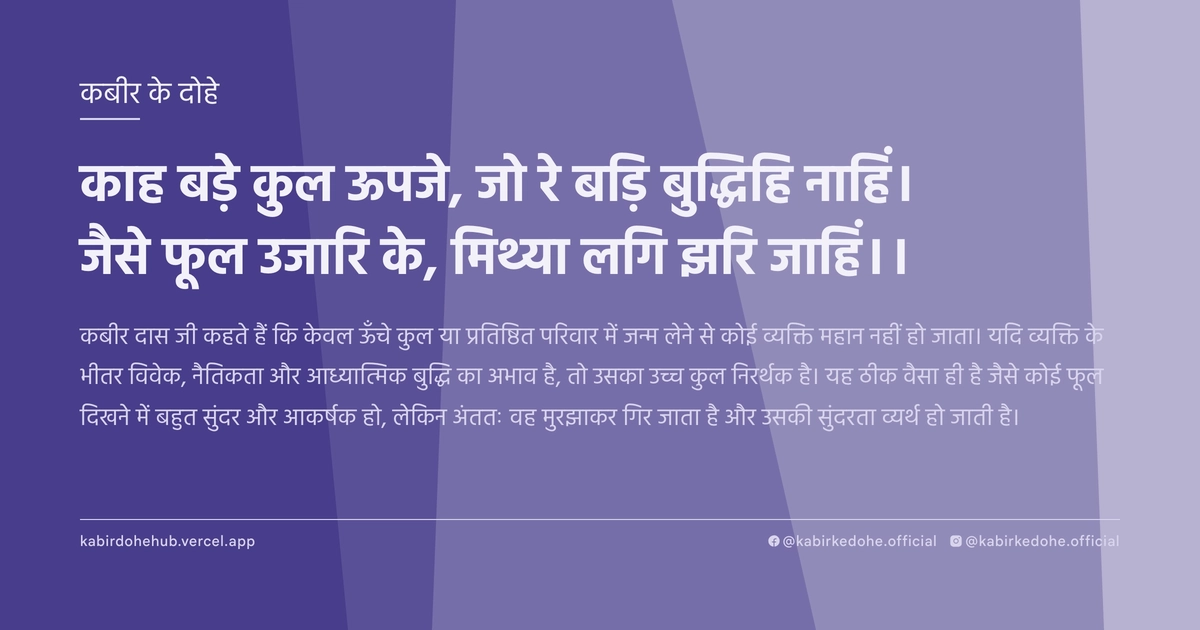
काह बड़े कुल ऊपजे, जो रे बड़ि बुद्धिहि नाहिं।
जैसे फूल उजारि के, मिथ्या लगि झरि जाहिं।।
Kah bade kul upaje, jo re badi buddhihi nahin. Jaise phool ujari ke, mithya lagi jhari jahin.
इस पृष्ठ पर इस कबीर दोहे का अर्थ (meaning), हिंदी व्याख्या और अंग्रेज़ी अनुवाद, दार्शनिक विश्लेषण और व्यावहारिक जीवन सीख दी गई है। यह दोहा पद-प्रतिष्ठा का अहंकार (The Vanity of Status) विषय से जुड़ा है — Kabir doha meaning and explanation in Hindi and English.
अर्थ (Meaning):
कबीर दास जी कहते हैं कि केवल ऊँचे कुल या प्रतिष्ठित परिवार में जन्म लेने से कोई व्यक्ति महान नहीं हो जाता। यदि व्यक्ति के भीतर विवेक, नैतिकता और आध्यात्मिक बुद्धि का अभाव है, तो उसका उच्च कुल निरर्थक है। यह ठीक वैसा ही है जैसे कोई फूल दिखने में बहुत सुंदर और आकर्षक हो, लेकिन अंततः वह मुरझाकर गिर जाता है और उसकी सुंदरता व्यर्थ हो जाती है।
Kabir asserts that being born into a high-born or prestigious lineage does not inherently make a person great. If an individual lacks wisdom, discernment, and moral integrity, their noble ancestry is meaningless. He compares such a person to a flower that blooms with outward brilliance but soon withers and falls, proving its superficial beauty to be an illusion.
व्याख्या (Interpretation):
इस दोहे का शाब्दिक अर्थ है कि कुल की श्रेष्ठता बुद्धि की श्रेष्ठता के बिना शून्य है। रूपक के माध्यम से कबीर 'कुल' को एक बाहरी आवरण और 'बुद्धि' को आंतरिक सार के रूप में प्रस्तुत करते हैं। निर्गुण भक्ति के संदर्भ में, यहाँ 'बुद्धि' का अर्थ केवल बौद्धिक ज्ञान नहीं, बल्कि वह आत्म-बोध है जो माया के भ्रम को काटता है। यह अद्वैत वेदांत के उस सिद्धांत की ओर संकेत करता है जहाँ आत्मा की शुद्धता जाति या वंश से स्वतंत्र होती है। मनुष्य अक्सर अपनी पहचान बाहरी उपाधियों में खोजता है, जो कि एक 'मिथ्या' या भ्रम है। जब तक अहंकार (Ego) का विसर्जन नहीं होता, तब तक कुल का गौरव केवल एक बोझ है। अंततः, यह दोहा इस विरोधाभास को उजागर करता है कि जिसे समाज 'उच्च' मानता है, वह आध्यात्मिक दृष्टि से 'निम्न' हो सकता है यदि उसमें करुणा और विवेक न हो।
Literally, the verse argues that lineage is void without the presence of wisdom. Through a poignant metaphor, Kabir presents 'lineage' as an external shell and 'wisdom' as the internal essence. In the context of Nirgun Bhakti, 'wisdom' refers not to academic knowledge, but to the spiritual awakening that pierces through the veil of Maya. This aligns with Advaita Vedanta, suggesting that the purity of the Atman is entirely independent of caste or ancestry. Humans often mistake their social identity for their true self, which is a 'mithya' or illusion. Until the ego is annihilated, the pride of one's lineage is merely a burden. Ultimately, the Doha highlights the paradox that what society deems 'high' may be spiritually 'low' if devoid of compassion and discernment.
दार्शनिक विश्लेषण (Philosophical Analysis):
कबीर का यह दोहा उनके युग के सामाजिक और धार्मिक पाखंड पर एक तीखा प्रहार है। 15वीं शताब्दी के भारत में, जाति व्यवस्था और जन्म-आधारित श्रेष्ठता चरम पर थी। कबीर ने इस व्यवस्था को चुनौती देते हुए यह स्थापित किया कि मनुष्य की पहचान उसके कर्मों और उसके आंतरिक बोध से होती है, न कि उसके जन्म के प्रमाण पत्र से। यह दृष्टिकोण सूफीवाद के 'इंसान-ए-कामिल' (पूर्ण मानव) की अवधारणा से मेल खाता है, जहाँ व्यक्ति अपनी साधना और नैतिकता से पूर्णता प्राप्त करता है।
दार्शनिक स्तर पर, कबीर यहाँ 'साकार' (रूप) और 'निराकार' (सार) के बीच के अंतर को स्पष्ट कर रहे हैं। कुल का गौरव 'साकार' है, जो समय के साथ नष्ट हो जाता है, जबकि विवेक 'निराकार' सत्य की ओर ले जाता है। यह अद्वैत वेदांत के उस सत्य की पुष्टि करता है कि ब्रह्म (परम सत्य) सबके भीतर समान रूप से विद्यमान है, चाहे वह किसी भी कुल में जन्मा हो।
कबीर ritualism (कर्मकांड) का विरोध करते हैं क्योंकि कर्मकांड अक्सर बाहरी दिखावे और सामाजिक पदानुक्रम को पुष्ट करते हैं। वे तर्क देते हैं कि यदि कोई व्यक्ति वेदों का ज्ञाता है या उच्च कुल का है, लेकिन उसके व्यवहार में अहंकार है, तो वह ज्ञान व्यर्थ है। वास्तविक ज्ञान वह है जो अहंकार का विनाश करे और व्यक्ति को विनम्र बनाए।
मनोवैज्ञानिक रूप से, यह दोहा 'पहचान के संकट' (Identity Crisis) पर बात करता है। जब व्यक्ति अपनी पहचान बाहरी स्रोतों (जैसे परिवार, पद, धन) से जोड़ता है, तो वह अस्थिर हो जाता है क्योंकि ये चीजें नश्वर हैं। कबीर हमें आंतरिक स्थिरता की ओर ले जाते हैं, जहाँ आत्म-साक्षात्कार ही एकमात्र स्थायी उपलब्धि है।
अंततः, यह शिक्षण हमें यह समझने के लिए प्रेरित करता है कि 'श्रेष्ठता' एक अर्जित गुण है, न कि एक विरासत में मिला अधिकार। यह सामाजिक न्याय की नींव रखता है और व्यक्ति को अपनी आध्यात्मिक यात्रा स्वयं तय करने के लिए प्रोत्साहित करता है, बिना किसी बाहरी लेबल के।
This Doha is a sharp critique of the social and religious hypocrisy of Kabir's era. In 15th-century India, the caste system and birth-based superiority were pervasive. Kabir challenged this structure, establishing that a human's identity is defined by their actions and inner realization, not by their birth certificate. This perspective mirrors the Sufi concept of 'Insan-e-Kamil' (the Perfect Human), where perfection is attained through spiritual discipline and ethics.
Philosophically, Kabir distinguishes between the 'Sakar' (form/outward appearance) and the 'Nirakar' (essence/formless truth). The pride of lineage is 'Sakar' and thus subject to decay, while wisdom leads toward the 'Nirakar' truth. This validates the Advaita Vedanta principle that Brahman (the Ultimate Reality) resides equally within all beings, regardless of their social origin.
Kabir opposes ritualism because rituals often reinforce external appearances and social hierarchies. He argues that if a person is a scholar of the Vedas or belongs to a noble clan but harbors ego in their behavior, that knowledge is futile. True wisdom is that which annihilates the ego and fosters humility.
Psychologically, the verse addresses the 'crisis of identity.' When an individual anchors their identity in external sources—such as family, status, or wealth—they become unstable because these elements are transient. Kabir guides us toward internal stability, where self-realization is the only permanent achievement.
Ultimately, this teaching inspires us to understand that 'greatness' is an acquired virtue, not an inherited right. It lays the foundation for social justice and encourages the individual to carve their own spiritual path, free from the constraints of external labels.
मूल संदेश (Core Message):
- वंश का अहंकार आध्यात्मिक अंधापन है।
- विवेक ही वास्तविक श्रेष्ठता की कसौटी है।
- बाहरी पहचान नश्वर है, आंतरिक गुण शाश्वत हैं।
- अहंकार का विसर्जन ही सत्य का द्वार है।
- मानवता का धर्म हर कुल से ऊपर है।
- Pride in lineage is spiritual blindness.
- Wisdom is the only true measure of greatness.
- External identities are transient; inner virtues are eternal.
- The dissolution of ego is the gateway to truth.
- The religion of humanity transcends all clans.
व्यावहारिक उदाहरण (Practical Example):
एक समय की बात है, वाराणसी के घाटों पर एक वृद्ध विधवा रहती थी, जिसका नाम जानकी था। जानकी एक अत्यंत समृद्ध और प्रतिष्ठित ब्राह्मण परिवार से थी, और वह अपनी इस पहचान को अपनी ढाल और गर्व मानती थी। वह अक्सर अन्य महिलाओं को उनके निम्न कुल के कारण नीचा दिखाती थी और मानती थी कि उसकी पवित्रता उसके वंश से आती है।
उसी घाट के पास एक साधारण मल्लाह रहता था, जिसका नाम माधव था। माधव अनपढ़ था और समाज की नजरों में 'अछूत' था, लेकिन उसका हृदय करुणा से भरा था। वह हर सुबह पक्षियों को दाना खिलाता और बीमारों की निस्वार्थ सेवा करता था।
एक बार वाराणसी में भीषण बाढ़ आई। जानकी का अहंकार तब टूट गया जब वह अपनी कीमती साड़ियों और कुल के अभिमान के साथ पानी के तेज बहाव में फंस गई। उसके वे 'उच्च कुल' के रिश्तेदार, जो केवल नाम के लिए उसके साथ थे, उसे बचाने के बजाय अपनी सुरक्षा में लग गए।
तभी माधव ने अपनी जान जोखिम में डालकर जानकी को डूबने से बचाया। जब जानकी ने होश में आकर माधव का हाथ देखा, तो उसे एहसास हुआ कि जिस हाथ को वह 'अपवित्र' मानती थी, उसी ने उसे जीवनदान दिया है।
जानकी ने देखा कि माधव के चेहरे पर कोई अहंकार नहीं था, केवल एक शांत मुस्कान थी। उसने महसूस किया कि उसकी अपनी 'उच्च कुल' की पहचान एक सूखे फूल की तरह थी—दिखने में सुंदर लेकिन भीतर से मृत।
माधव की निस्वार्थ सेवा और विवेक ने जानकी को यह सोचने पर मजबूर कर दिया कि वास्तव में 'बड़ा' कौन है—वह जो कुल का घमंड करता है, या वह जो मानवता की सेवा करता है।
इस घटना के बाद जानकी का जीवन पूरी तरह बदल गया। उसने अपने रेशमी वस्त्र त्याग दिए और अपना समय गरीबों की सेवा में लगाने लगी।
उसने अब अपनी पहचान अपने वंश से नहीं, बल्कि अपने कर्मों से जोड़ना शुरू किया। यह जानकी के जीवन में वह 'कबीर ट्विस्ट' था जिसने उसे बाहरी आडंबरों से मुक्त कर आंतरिक शांति की ओर अग्रसर किया।
Once, on the ghats of Varanasi, lived an elderly widow named Janaki. She hailed from an extremely wealthy and prestigious Brahmin family, and she wore this identity as both her shield and her pride. She often looked down upon other women due to their lower caste, believing her purity was a direct result of her lineage.
Near the same ghat lived a simple boatman named Madhav. Madhav was illiterate and considered 'untouchable' by society, yet his heart overflowed with compassion. Every morning, he fed the birds and selflessly tended to the sick.
One year, a devastating flood hit Varanasi. Janaki's ego shattered when she found herself trapped in the raging currents, clutching her expensive sarees and the pride of her clan. Her 'high-born' relatives, who were connected to her only by name, focused on their own safety rather than rescuing her.
Just then, Madhav risked his own life and pulled Janaki from the drowning waters. When Janaki regained consciousness and looked at Madhav's hand, she realized that the very hand she had deemed 'impure' had granted her a second lease on life.
Janaki noticed that there was no arrogance on Madhav's face, only a serene smile. She realized that her own 'noble' identity was like a withered flower—beautiful in appearance but dead within.
Madhav's selfless service and wisdom forced Janaki to question who was truly 'great'—the one who boasts of their lineage, or the one who serves humanity.
Following this event, Janaki's life underwent a complete transformation. She discarded her silk robes and dedicated her time to serving the poor.
She ceased defining herself by her ancestry and began defining herself by her actions. This was the 'Kabir Twist' in Janaki's life, liberating her from external pretenses and guiding her toward inner peace.
अभ्यास मार्गदर्शन (Practice Guidance):
- प्रतिदिन 15 मिनट मौन meditation करें और विचार करें कि आपकी कौन सी पहचान (नाम, पद, जाति) केवल एक मुखौटा है।
- एक 'अहंकार जर्नल' लिखें: उन क्षणों को दर्ज करें जब आपने किसी को उसकी सामाजिक स्थिति के कारण कमतर आंका, और फिर उसे करुणा से बदलें।
- व्यवहारिक परिवर्तन: सप्ताह में एक बार ऐसे व्यक्ति की सेवा करें जिसे समाज 'निम्न' मानता है, ताकि आप अपनी आंतरिक श्रेष्ठता के भ्रम को तोड़ सकें।
- डायग्नोस्टिक चेकलिस्ट: क्या मैं अपनी उपलब्धियों का श्रेय अपने वंश या भाग्य को देता हूँ? क्या मैं दूसरों के साथ व्यवहार करते समय उनकी योग्यता के बजाय उनकी पृष्ठभूमि देखता हूँ? यदि हाँ, तो आप अभी भी 'मिथ्या' फूल के मोह में हैं।
- Practice 15 minutes of silent meditation daily, contemplating which parts of your identity (name, title, caste) are merely masks.
- Maintain an 'Ego Journal': Record moments where you judged someone based on their social status, and consciously rewrite those interactions with compassion.
- Behavioral Shift: Once a week, serve someone whom society deems 'lowly' to dismantle the illusion of your own inherent superiority.
- Diagnostic Checklist: Do I attribute my achievements to my lineage or luck? Do I judge others by their background rather than their merit? If yes, you are still clinging to the 'illusory flower'.
चिंतन प्रश्न (Reflection Questions):
- यदि आपसे आपकी सारी पारिवारिक और सामाजिक उपाधियाँ छीन ली जाएँ, तो आपके पास क्या बचेगा?
- आपकी 'डिजिटल पहचान' (सोशल मीडिया प्रोफाइल) किस हद तक आपके वास्तविक स्वरूप को छिपाने वाला एक 'सुंदर फूल' है?
- क्या आप वास्तव में उन लोगों का सम्मान करते हैं जिन्हें आप पसंद नहीं करते, या आप केवल उनके पद का सम्मान करते हैं?
- आपके जीवन का वह कौन सा हिस्सा है जहाँ आप अभी भी यह मानते हैं कि आप दूसरों से 'बेहतर' हैं केवल इसलिए क्योंकि आप एक विशिष्ट समूह से हैं?
- क्या आपकी नैतिकता आपके कुल की मर्यादा बनाए रखने के लिए है, या यह आपकी आत्मा की वास्तविक पुकार है?
- If all your familial and social titles were stripped away, what would remain of you?
- To what extent is your 'digital identity' (social media profile) a 'beautiful flower' masking your true self?
- Do you truly respect people you dislike, or do you merely respect their position or status?
- In which area of your life do you still believe you are 'better' than others simply because you belong to a specific group?
- Is your morality designed to maintain the prestige of your lineage, or is it a genuine call from your soul?