
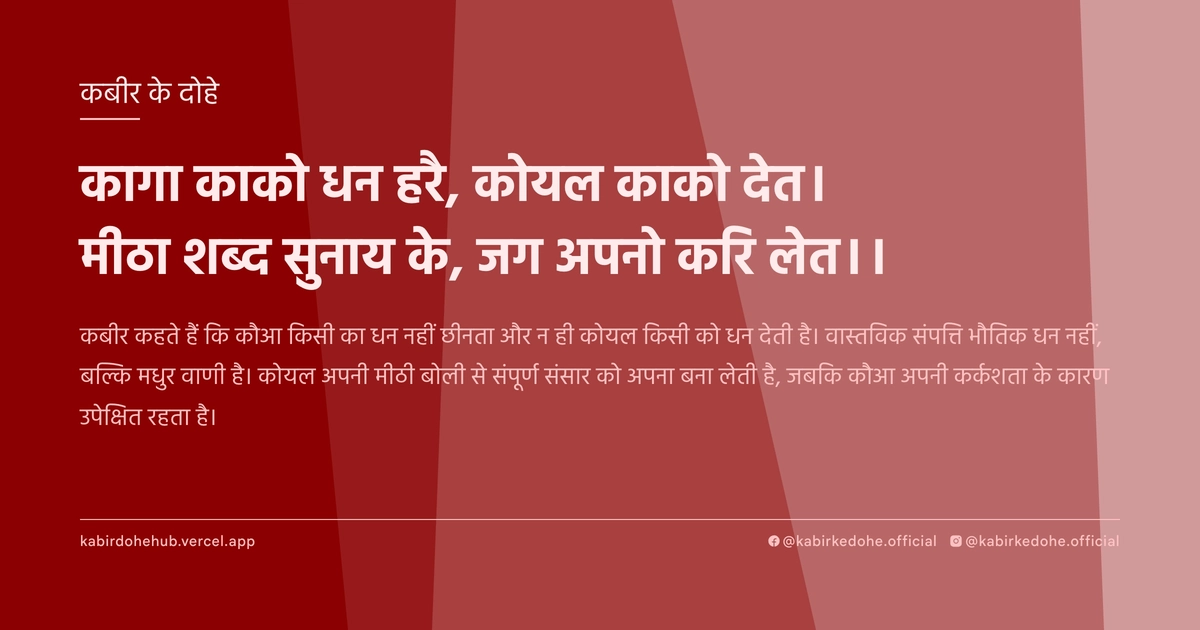
कागा काको धन हरै, कोयल काको देत।
मीठा शब्द सुनाय के, जग अपनो करि लेत।।
Kaga kako dhan harai, koyal kako det. Meetha shabd sunay ke, jag apno kari let.
इस पृष्ठ पर इस कबीर दोहे का अर्थ (meaning), हिंदी व्याख्या और अंग्रेज़ी अनुवाद, दार्शनिक विश्लेषण और व्यावहारिक जीवन सीख दी गई है। यह दोहा विनम्रता (Humility) विषय से जुड़ा है — Kabir doha meaning and explanation in Hindi and English.
अर्थ (Meaning):
कबीर कहते हैं कि कौआ किसी का धन नहीं छीनता और न ही कोयल किसी को धन देती है। वास्तविक संपत्ति भौतिक धन नहीं, बल्कि मधुर वाणी है। कोयल अपनी मीठी बोली से संपूर्ण संसार को अपना बना लेती है, जबकि कौआ अपनी कर्कशता के कारण उपेक्षित रहता है।
Kabir observes that a crow cannot steal one's wealth, nor can a cuckoo bestow riches upon anyone. The true treasure is not material gold but the sweetness of speech. By speaking kindly, the cuckoo wins over the entire world, whereas the crow remains shunned due to its harsh voice.
व्याख्या (Interpretation):
शाब्दिक रूप से यह दोहा पक्षियों के व्यवहार की तुलना है, परंतु आध्यात्मिक स्तर पर यह 'अहंकार' और 'प्रेम' के बीच का द्वंद्व है। कौआ यहाँ उस व्यक्ति का प्रतीक है जो केवल लेने की इच्छा रखता है या अपनी कर्कशता (क्रोध और अहंकार) से दूसरों को दूर करता है। कोयल उस साधक का प्रतीक है जिसने अपनी वाणी को प्रेम और करुणा में परिवर्तित कर लिया है। यह निर्गुण भक्ति का सार है, जहाँ ईश्वर किसी बाहरी कर्मकांड में नहीं, बल्कि हृदय की सरलता और वाणी की मिठास में बसता है। माया हमें यह विश्वास दिलाती है कि धन से प्रभाव बनाया जा सकता है, लेकिन कबीर स्पष्ट करते हैं कि आत्मा का मिलन केवल प्रेमपूर्ण संवाद से संभव है। यह अद्वैत वेदांत के उस सिद्धांत को दर्शाता है जहाँ 'स्व' और 'पर' का भेद मिट जाता है जब हम दूसरे में स्वयं को देखते हैं।
Literally, this couplet compares the behavior of two birds, but spiritually, it represents the conflict between 'Ego' and 'Love'. The crow symbolizes the individual driven by a desire to possess or one who alienates others through harshness (anger and pride). The cuckoo symbolizes the seeker who has transmuted their speech into love and compassion. This is the essence of Nirgun Bhakti, where the Divine resides not in external rituals, but in the simplicity of the heart and the sweetness of words. Maya deceives us into believing that influence is bought with wealth, but Kabir clarifies that the union of souls is only possible through loving communication. This mirrors the Advaita Vedanta principle where the distinction between 'self' and 'other' dissolves when we perceive ourselves in the other.
दार्शनिक विश्लेषण (Philosophical Analysis):
कबीर का यह दोहा उस सामाजिक और धार्मिक परिवेश में लिखा गया था जहाँ बाहरी आडंबरों और जातिगत श्रेष्ठता का बोलबाला था। उन्होंने देखा कि लोग धर्म के नाम पर दूसरों को नीचा दिखाते थे, जो कि एक प्रकार की 'मानसिक कर्कशता' थी। कबीर ने इस सामाजिक विभाजन को चुनौती देते हुए यह स्थापित किया कि मनुष्य की पहचान उसके कुल या धन से नहीं, बल्कि उसके व्यवहार और वाणी से होती है।
दार्शनिक रूप से, यह सूफीवाद के 'इश्क' (प्रेम) और भक्ति मार्ग के 'शरणागति' के करीब है। सूफी संत मानते हैं कि ईश्वर प्रेम है, और जो प्रेम की भाषा बोलता है, वह ईश्वर के करीब होता है। यहाँ 'मीठा शब्द' केवल चापलूसी नहीं है, बल्कि वह सत्य है जो करुणा के साथ बोला गया हो। यह अहंकार के विसर्जन की प्रक्रिया है; जब मैं 'मैं' को छोड़कर 'हम' की भाषा बोलता हूँ, तब मैं वास्तव में कोयल बन जाता हूँ।
अद्वैत वेदांत के परिप्रेक्ष्य में, यह दोहा द्वैत (दो होने का भ्रम) को समाप्त करने का मार्ग बताता है। जब हम किसी से घृणा करते हैं या कर्कश होते हैं, तो हम स्वयं को दूसरे से अलग मानते हैं। मधुर वाणी इस अलगाव को मिटाती है और यह अहसास कराती है कि सामने वाला भी उसी ब्रह्म का अंश है।
कबीर यहाँ भौतिक धन की निरर्थकता पर प्रहार करते हैं। वे कहते हैं कि धन न तो किसी का भाग्य बदल सकता है और न ही स्थायी संबंध बना सकता है। वास्तविक 'धन' वह आध्यात्मिक ऊर्जा है जो एक मनुष्य को दूसरे से जोड़ती है। यह मनोवैज्ञानिक रूपांतरण की बात है—कर्कशता से करुणा की ओर बढ़ना।
अंततः, यह दोहा हमें सिखाता है कि आध्यात्मिक प्रगति का मापदंड कठिन तपस्या या शास्त्रों का ज्ञान नहीं, बल्कि यह है कि हम दूसरों के साथ कैसा व्यवहार करते हैं। यदि आपका ज्ञान आपको विनम्र और मधुर नहीं बनाता, तो वह ज्ञान केवल एक बोझ है।
Kabir wrote this couplet in a socio-religious climate dominated by external pomposity and caste superiority. He observed people belittling others in the name of religion, which was a form of 'mental harshness'. Challenging this social divide, Kabir established that a human's identity is defined not by lineage or wealth, but by their behavior and speech.
Philosophically, this aligns with the Sufi concept of 'Ishq' (Divine Love) and the Bhakti path of 'Sharanagati' (Surrender). Sufi saints believe that God is Love, and those who speak the language of love are closest to the Divine. Here, 'sweet words' are not mere flattery, but truth spoken with compassion. It is a process of ego-annihilation; when I abandon the 'I' and speak the language of 'We', I truly become the cuckoo.
From the perspective of Advaita Vedanta, this verse suggests a path to dissolve duality (the illusion of separation). When we hate or are harsh, we perceive ourselves as separate from the other. Sweet speech erases this separation, fostering the realization that the other is also a manifestation of the same Brahman.
Kabir attacks the futility of material wealth. He asserts that money can neither change one's destiny nor build lasting bonds. The real 'wealth' is the spiritual energy that connects one human to another. This is a call for psychological transformation—moving from harshness to compassion.
Ultimately, the couplet teaches that the metric of spiritual progress is not rigorous penance or scriptural knowledge, but how we treat others. If your knowledge does not make you humble and sweet, that knowledge is merely a burden.
मूल संदेश (Core Message):
- कर्कशता अहंकार का मुखौटा है, मिठास आत्मा का स्वभाव है।
- भौतिक संपत्ति अस्थायी है, लेकिन मधुर व्यवहार स्थायी संबंध बनाता है।
- वाणी का रूपांतरण ही व्यक्तित्व का वास्तविक रूपांतरण है।
- प्रेम की भाषा बिना किसी भेदभाव के सबको जोड़ती है।
- सत्य जब करुणा के साथ बोला जाता है, तभी वह प्रभावी होता है।
- Harshness is the mask of ego; sweetness is the nature of the soul.
- Material wealth is transient, but kind behavior builds eternal bonds.
- The transformation of speech is the true transformation of personality.
- The language of love unites everyone without discrimination.
- Truth becomes effective only when spoken with compassion.
व्यावहारिक उदाहरण (Practical Example):
वाराणसी के एक पुराने घाट पर रामदीन नाम का एक वृद्ध नाविक रहता था। रामदीन स्वभाव से अत्यंत क्रोधी और कड़वा था। वह नाव पर आने वाले यात्रियों को झिड़क कर बात करता और छोटी-छोटी बातों पर चिल्लाता था। उसके व्यवहार के कारण लोग उससे कतराते थे और वह अक्सर अकेला और उदास रहता था, जबकि उसके पास एक अच्छी नाव और अनुभव था।
एक दिन घाट पर एक फकीर आया, जिसने रामदीन के व्यवहार को देखा। फकीर ने उससे कहा, 'बेटा, तू अपनी नाव तो साफ रखता है, पर अपनी जुबान पर जमी गंदगी को क्यों नहीं धोता? तू कौआ बन गया है, जो सबको डराता है, पर कोयल बनना भूल गया है।'
रामदीन को पहले तो गुस्सा आया, लेकिन फकीर की आँखों में एक अजीब सी शांति थी। उसने पूछा, 'कोयल बनने से क्या होगा?' फकीर ने मुस्कुराकर कहा, 'कोयल धन नहीं देती, पर वह सबको अपना बना लेती है। तू देख लेना, जिस दिन तू शब्दों में शहद घोलेगा, तेरी नाव केवल यात्रियों से नहीं, बल्कि प्रेम से भर जाएगी।'
रामदीन ने तय किया कि वह प्रयोग करेगा। अगले दिन जब एक यात्री ने देर होने की शिकायत की, तो रामदीन ने चिल्लाने के बजाय विनम्रता से कहा, 'क्षमा करें भाई साहब, गंगा मैया की लहरें आज थोड़ी धीमी हैं, पर हम जल्द ही पहुँचेंगे।'
यात्री हैरान रह गया। उसने रामदीन से उसकी यात्रा के बारे में पूछा और दोनों के बीच एक गहरा संवाद शुरू हुआ। धीरे-धीरे रामदीन ने अपनी वाणी बदल ली। वह अब यात्रियों को केवल घाट तक नहीं पहुँचाता था, बल्कि उन्हें बनारस की गलियों की कहानियाँ सुनाता और उनकी समस्याओं को ध्यान से सुनता।
लोग अब रामदीन की नाव की तलाश करते थे। वे केवल यात्रा के लिए नहीं, बल्कि उसकी शांति और मीठी बातों के लिए आते थे। रामदीन ने महसूस किया कि उसकी कमाई तो उतनी ही थी, लेकिन उसका मानसिक तनाव खत्म हो गया था और उसके पास अब मित्रों का एक बड़ा समूह था।
एक बार एक अमीर व्यापारी ने उसे बहुत अधिक पैसे देने चाहे ताकि वह उसे विशेष यात्रा कराए, लेकिन रामदीन ने विनम्रता से कहा कि वह सबको समान प्रेम देता है। व्यापारी उसकी इस निस्वार्थता और मधुरता से इतना प्रभावित हुआ कि उसने घाट पर गरीबों के लिए एक मुफ्त चिकित्सा केंद्र खुलवाया।
रामदीन का रूपांतरण केवल उसकी वाणी तक सीमित नहीं था; उसके भीतर का क्रोध शांत हो गया था। उसने सीखा कि शब्द केवल ध्वनि नहीं होते, वे बीज होते हैं। यदि आप कड़वाहट बोते हैं, तो अकेलापन काटते हैं; यदि आप मिठास बोते हैं, तो प्रेम की फसल काटते हैं।
On an old ghat in Varanasi lived an elderly boatman named Ramdeen. Ramdeen was naturally irritable and bitter. He would snap at the passengers on his boat and scream over trivial matters. Because of his behavior, people avoided him, and he often remained lonely and depressed, despite possessing a good boat and vast experience.
One day, a wandering dervish arrived at the ghat and observed Ramdeen's behavior. The dervish said, 'Son, you keep your boat clean, but why don't you wash the filth clinging to your tongue? You have become a crow that frightens everyone, forgetting how to be a cuckoo.'
Ramdeen was initially angered, but there was a strange peace in the dervish's eyes. He asked, 'What will happen if I become a cuckoo?' The dervish smiled and replied, 'The cuckoo doesn't give money, but it makes everyone its own. Mark my words, the day you dissolve honey in your words, your boat will be filled not just with passengers, but with love.'
Ramdeen decided to experiment. The next day, when a passenger complained about the delay, instead of shouting, Ramdeen said politely, 'Forgive me, brother; Mother Ganga's currents are a bit slow today, but we shall arrive soon.'
The passenger was stunned. He began asking Ramdeen about his journey, and a deep conversation blossomed. Gradually, Ramdeen transformed his speech. He no longer just transported people to the ghat; he shared stories of the lanes of Banaras and listened intently to their struggles.
People began seeking out Ramdeen's boat. They came not just for the ride, but for his peace and sweet words. Ramdeen realized that while his earnings remained similar, his mental stress had vanished, and he now had a vast circle of friends.
Once, a wealthy merchant offered him a huge sum to arrange a special trip, but Ramdeen politely declined, stating he gave equal love to everyone. The merchant was so moved by this selflessness and sweetness that he funded a free medical center for the poor on the ghat.
Ramdeen's transformation was not limited to his speech; the anger within him had subsided. He learned that words are not just sounds; they are seeds. If you sow bitterness, you reap loneliness; if you sow sweetness, you reap love.
अभ्यास मार्गदर्शन (Practice Guidance):
- मौन का अभ्यास: प्रतिदिन 30 मिनट पूर्ण मौन रहें। यह आपको यह समझने में मदद करेगा कि हम अक्सर बिना सोचे-समझे प्रतिक्रिया देते हैं।
- सचेत संवाद (Mindful Speech): बोलने से पहले स्वयं से पूछें—'क्या यह सत्य है? क्या यह आवश्यक है? क्या यह दयालु है?'
- करुणा जर्नल: प्रतिदिन एक ऐसी घटना लिखें जहाँ आपने अपनी स्वाभाविक प्रतिक्रिया (क्रोध) को बदलकर मधुरता का उपयोग किया।
- निदानात्मक चेकलिस्ट: यदि आप दिन के अंत में अकेलापन या तनाव महसूस करते हैं, तो विश्लेषण करें कि क्या आपकी वाणी ने आज किसी को दूर किया या करीब लाया।
- Practice of Silence: Remain in complete silence for 30 minutes daily. This helps you realize how often we react impulsively without thought.
- Mindful Speech: Before speaking, ask yourself—'Is it true? Is it necessary? Is it kind?'
- Compassion Journal: Daily record one instance where you replaced your instinctive reaction (anger) with sweetness.
- Diagnostic Checklist: If you feel loneliness or stress at the end of the day, analyze whether your speech pushed people away or drew them closer.
चिंतन प्रश्न (Reflection Questions):
- मेरे शब्दों की कड़वाहट वास्तव में किस आंतरिक डर या असुरक्षा को छिपा रही है?
- क्या मैं केवल उन लोगों के साथ मधुर हूँ जिनसे मुझे कुछ लाभ मिलने की उम्मीद है?
- जब मैं दूसरों की आलोचना करता हूँ, तो क्या मैं अपनी श्रेष्ठता सिद्ध करने की कोशिश कर रहा होता हूँ?
- मेरे डिजिटल संवाद (सोशल मीडिया) में मैं 'कौआ' हूँ या 'कोयल'?
- क्या मेरी विनम्रता वास्तविक है, या यह केवल एक सामाजिक मुखौटा है?
- What internal fear or insecurity is the bitterness of my words actually hiding?
- Am I sweet only to those from whom I expect some benefit?
- When I criticize others, am I merely trying to prove my own superiority?
- In my digital interactions (social media), am I the 'crow' or the 'cuckoo'?
- Is my humility genuine, or is it merely a social mask?