
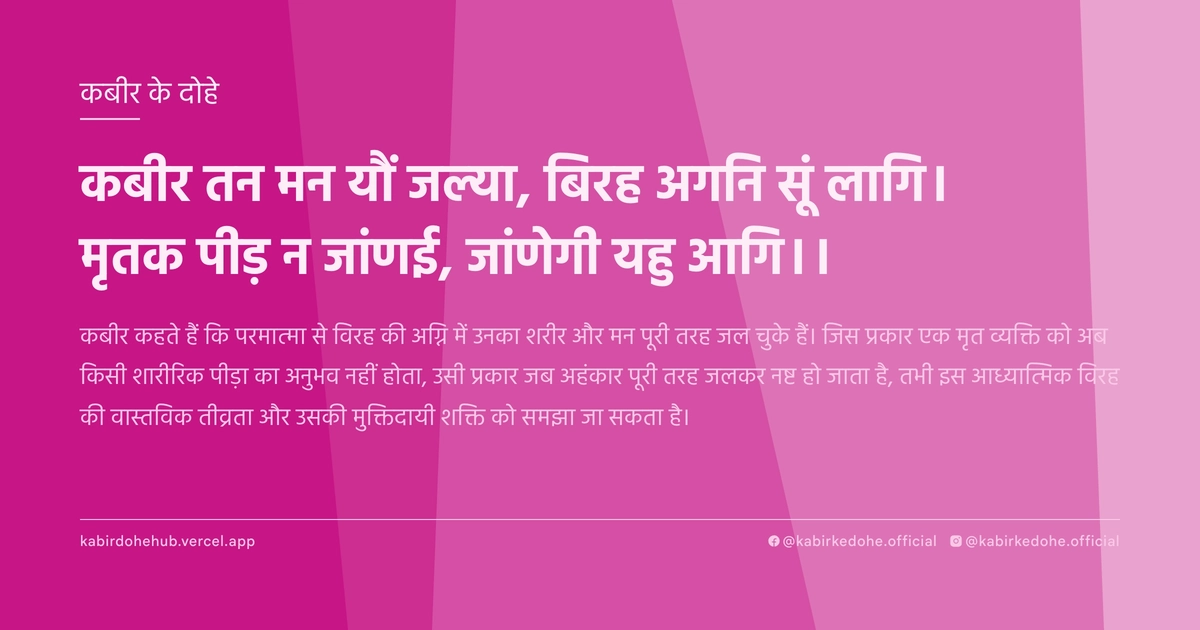
कबीर तन मन यौं जल्या, बिरह अगनि सूं लागि।
मृतक पीड़ न जांणई, जांणेगी यहु आगि।।
Kabir tan man yon jallya, birah agni sun laagi. Mritak peed na jaanai, jaanegi yahu aagi.
इस पृष्ठ पर इस कबीर दोहे का अर्थ (meaning), हिंदी व्याख्या और अंग्रेज़ी अनुवाद, दार्शनिक विश्लेषण और व्यावहारिक जीवन सीख दी गई है। यह दोहा भक्ति (Bhakti) विषय से जुड़ा है — Kabir doha meaning and explanation in Hindi and English.
अर्थ (Meaning):
कबीर कहते हैं कि परमात्मा से विरह की अग्नि में उनका शरीर और मन पूरी तरह जल चुके हैं। जिस प्रकार एक मृत व्यक्ति को अब किसी शारीरिक पीड़ा का अनुभव नहीं होता, उसी प्रकार जब अहंकार पूरी तरह जलकर नष्ट हो जाता है, तभी इस आध्यात्मिक विरह की वास्तविक तीव्रता और उसकी मुक्तिदायी शक्ति को समझा जा सकता है।
Kabir proclaims that his body and mind have been incinerated by the fire of separation from the Divine. He suggests that just as a corpse no longer feels physical pain, only one whose ego has been completely annihilated can truly comprehend the intensity and the liberating nature of this spiritual longing.
व्याख्या (Interpretation):
इसका शाब्दिक अर्थ विरह की पीड़ा है, परंतु गहरा अर्थ 'अहंकार के दहन' से है। यहाँ 'बिरह' केवल दुख नहीं, बल्कि आत्मा की परमात्मा से मिलने की तीव्र तड़प है। यह तड़प एक ऐसी अग्नि है जो अशुद्धियों को जला देती है। जब कबीर कहते हैं कि 'मृतक पीड़ा नहीं जानता', तो वे उस अवस्था की ओर संकेत कर रहे हैं जहाँ 'मैं' (अहती) मर चुका है। निरगुण भक्ति में, ईश्वर बाहर नहीं बल्कि भीतर है, और इस आंतरिक मिलन के लिए बाहरी पहचान का मरना अनिवार्य है। यह अद्वैत वेदांत के उस सत्य को दर्शाता है जहाँ द्वैत (मैं और तुम) समाप्त हो जाता है और केवल ब्रह्म शेष रहता है।
Literally, this speaks of the agony of separation, but metaphorically, it describes the 'incineration of the ego'. Here, 'Birah' is not mere sorrow, but an intense spiritual yearning for the Formless Divine. This longing acts as a purifying fire that consumes all impurities. When Kabir mentions that a 'corpse feels no pain', he refers to the state where the 'I' (the false ego) has died. In Nirgun Bhakti, the Divine is not external but internal; for this union to occur, the external identity must perish. This aligns with Advaita Vedanta, where the duality of 'self' and 'other' dissolves, leaving only the singular, absolute consciousness of Brahman.
दार्शनिक विश्लेषण (Philosophical Analysis):
कबीर का यह दोहा मध्यकालीन भारत के उस दौर का है जब धर्म कर्मकांडों और बाहरी दिखावे में जकड़ा हुआ था। कबीर ने मंदिर-मस्जिद के बजाय 'हृदय की अग्नि' को प्राथमिकता दी। वे बताते हैं कि मोक्ष किसी तीर्थ यात्रा से नहीं, बल्कि आंतरिक तड़प और आत्म-साक्षात्कार से मिलता है।
यह विचार सूफी मत के 'इश्क-ए-हकीकी' (दिव्य प्रेम) से गहराई से जुड़ा है, जहाँ प्रेमी अपने अस्तित्व को मिटाकर परमात्मा में विलीन हो जाता है। सूफीवाद की तरह, कबीर भी 'फना' (अस्तित्व का विनाश) की बात करते हैं, ताकि 'बाका' (शाश्वत जीवन) प्राप्त हो सके।
अद्वैत वेदांत के परिप्रेक्ष्य में, यह विरह वास्तव में माया का पर्दा हटने की प्रक्रिया है। जब तक मनुष्य स्वयं को शरीर मानता है, वह बंधन में है। जैसे ही वह इस भ्रम को जला देता है, वह अपनी वास्तविक प्रकृति को पहचान लेता है।
कबीर यहाँ जाति और वर्ण के भेदों को निरर्थक बताते हैं क्योंकि अग्नि सबको समान रूप से जलाती है। उनके लिए आध्यात्मिक योग्यता का पैमाना केवल यह है कि व्यक्ति ने अपने अहंकार को कितना जलाया है।
मनोवैज्ञानिक स्तर पर, यह 'मृत्यु' शारीरिक नहीं बल्कि मानसिक है। यह पुराने विश्वासों, पूर्वाग्रहों और सामाजिक मुखौटों का अंत है। जब तक पुराना 'स्व' नहीं मरता, नया 'दिव्य स्व' जन्म नहीं ले सकता।
This couplet emerges from a medieval Indian era where religion was stifled by ritualism and outward displays. Kabir prioritizes the 'fire of the heart' over the structures of temples and mosques, asserting that liberation comes not from pilgrimage, but from internal longing and self-realization.
This concept is deeply intertwined with the Sufi notion of 'Ishq-e-Haqiqi' (Divine Love), where the lover annihilates their existence to merge with the Beloved. Much like the Sufi concept of 'Fana' (annihilation), Kabir speaks of the destruction of the self to achieve 'Baqa' (eternal subsistence).
From the perspective of Advaita Vedanta, this separation is actually the process of lifting the veil of Maya. As long as a human identifies with the physical body, they remain in bondage. Once this illusion is incinerated, the true nature of the Atman is revealed.
Kabir renders caste and creed irrelevant here, as the spiritual fire consumes all distinctions equally. For him, the only metric of spiritual attainment is the degree to which one has burned away their ego.
Psychologically, this 'death' is not physical but mental. It is the dissolution of old beliefs, prejudices, and social masks. Until the old 'self' dies, the 'divine self' cannot be born, correcting the misconception that spirituality is about adding something new, rather than stripping away the false.
मूल संदेश (Core Message):
- अहंकार का अंत ही वास्तविक आध्यात्मिक जन्म है।
- दिव्य विरह केवल दुख नहीं, बल्कि शुद्धिकरण की प्रक्रिया है।
- जब 'मैं' मिटता है, तभी 'वह' (परमात्मा) प्रकट होता है।
- बाहरी कर्मकांड व्यर्थ हैं यदि हृदय में तड़प नहीं है।
- शून्य होना ही पूर्णता की ओर पहला कदम है।
- The end of the ego is the true spiritual birth.
- Divine longing is not mere sorrow, but a process of purification.
- Only when the 'I' vanishes does the 'Divine' manifest.
- External rituals are futile without the fire of inner yearning.
- Becoming nothing is the first step toward becoming everything.
व्यावहारिक उदाहरण (Practical Example):
एक समय की बात है, वाराणसी के घाटों पर माधव नाम का एक वृद्ध बुनकर रहता था। माधव अपनी कला में निपुण था, लेकिन उसका मन हमेशा इस बात के अहंकार से भरा रहता था कि उसके द्वारा बुने गए वस्त्र शहर के सबसे श्रेष्ठ हैं। वह दूसरों के काम में कमियाँ निकालता और स्वयं को श्रेष्ठ मानता था।
एक दिन उसकी मुलाकात एक फकीर से हुई जिसने माधव के वस्त्रों की प्रशंसा नहीं की, बल्कि उसकी आत्मा के खालीपन पर सवाल उठाया। फकीर ने कहा, "तेरा कपड़ा तो सुंदर है, पर तेरा मन मैला है।" माधव को यह बात चुभी, लेकिन धीरे-धीरे उसे महसूस हुआ कि उसकी श्रेष्ठता की भावना उसे दूसरों से अलग कर रही है।
वह गहरे अवसाद में चला गया। उसे लगा कि उसने जीवन भर केवल धागों को जोड़ा, लेकिन अपनी आत्मा को परमात्मा से जोड़ना भूल गया। यह अहसास उसके भीतर एक अग्नि की तरह दहकने लगा। वह रातों को जागकर रोता और अपनी गलतियों पर पछताता।
उसकी यह तड़प इतनी तीव्र थी कि उसने अपनी सारी प्रसिद्धि और अहंकार को त्याग दिया। वह अब केवल सेवा के लिए बुनने लगा। वह अब वस्त्रों की बारीकियों पर नहीं, बल्कि उन्हें पहनने वाले की खुशी पर ध्यान देता था।
एक दिन, एक गरीब भिखारी उसके पास आया। माधव ने उसे अपना सबसे कीमती वस्त्र बिना किसी लालच के दे दिया। उस क्षण उसे महसूस हुआ कि जिस 'मैं' के लिए वह लड़ रहा था, वह अब मर चुका है।
जैसे ही उसका अहंकार जला, उसे एक असीम शांति का अनुभव हुआ। वह अब पीड़ा में नहीं था, बल्कि उस आनंद में था जिसे केवल 'मृत' (अहंकार-रहित) व्यक्ति ही जान सकता है।
उसने पाया कि जब तक वह खुद को 'महान बुनकर' समझता था, वह अकेला था। अब जब वह 'कुछ भी नहीं' बन गया, तो वह पूरी सृष्टि के साथ एक हो गया।
माधव की यह यात्रा दिखाती है कि कैसे विरह की अग्नि ने उसके झूठे व्यक्तित्व को जलाकर उसे वास्तविक प्रेम और करुणा से भर दिया।
Once, on the ghats of Varanasi, lived an elderly weaver named Madhav. Madhav was a master of his craft, but his heart was consumed by the pride that his woven fabrics were the finest in the city. He constantly critiqued others and viewed himself as superior.
One day, he encountered a wandering dervish who did not praise his textiles but instead questioned the emptiness of his soul. The dervish said, "Your cloth is beautiful, but your mind is soiled." This stung Madhav, but gradually he realized that his sense of superiority had isolated him from humanity.
He fell into a deep spiritual melancholy. He felt he had spent his life joining threads but had forgotten to join his soul with the Divine. This realization began to burn within him like a fire. He spent sleepless nights in longing and repentance.
This yearning became so intense that he renounced all fame and ego. He began weaving solely for the sake of service. He no longer focused on the intricacy of the weave, but on the joy of the wearer.
One day, a destitute beggar approached him. Madhav gave away his most precious garment without a shred of hesitation or greed. In that moment, he felt that the 'I' he had fought for his entire life had finally died.
As his ego burned away, he experienced an immense, unshakable peace. He was no longer in pain, but in that bliss which only the 'dead' (the ego-less) can comprehend.
He discovered that as long as he identified as the 'Great Weaver', he was alone. Now that he had become 'nothing', he was one with the entire universe.
Madhav's journey illustrates how the fire of separation incinerated his false persona, filling him with genuine love and compassion.
अभ्यास मार्गदर्शन (Practice Guidance):
- दैनिक आत्म-निरीक्षण: प्रतिदिन 20 मिनट मौन बैठें और उन क्षणों को याद करें जब आपका अहंकार (Ego) आपको दूसरों से अलग करता है।
- लेखन अभ्यास: एक डायरी में लिखें कि आपके जीवन का वह कौन सा 'मुखौटा' है जिसे आप सबसे ज्यादा पकड़े हुए हैं, और कल्पना करें कि वह अग्नि में जल रहा है।
- व्यवहार परिवर्तन: दिन भर में कम से कम एक ऐसा कार्य करें जहाँ आप अपनी प्रशंसा की इच्छा को पूरी तरह त्याग दें और गुमनाम रहकर सेवा करें।
- डायग्नोस्टिक चेकलिस्ट: क्या आप अभी भी अपनी उपलब्धियों पर गर्व करते हैं? क्या दूसरों की सफलता आपको विचलित करती है? यदि हाँ, तो आपका 'अहंकार' अभी जीवित है और उसे विरह की अग्नि की आवश्यकता है।
- Daily Self-Inquiry: Sit in silence for 20 minutes daily and observe the moments where your ego creates a sense of separation between you and others.
- Journaling Prompt: Write about the specific 'mask' or identity you cling to most dearly, and visualize it being consumed by a purifying spiritual fire.
- Behavioral Shift: Perform at least one act of service daily where you consciously renounce the desire for recognition or praise, remaining completely anonymous.
- Diagnostic Checklist: Do you still derive your worth from achievements? Does the success of others disturb your peace? If yes, the 'ego' is still alive and requires the fire of longing.
चिंतन प्रश्न (Reflection Questions):
- आपकी वह कौन सी पहचान है जिसे खोने के डर से आप सबसे ज्यादा डरते हैं?
- क्या आपकी आध्यात्मिक खोज वास्तव में परमात्मा के लिए है, या यह आपके अहंकार को 'विशेष' बनाने का एक और तरीका है?
- यदि आज आपकी सारी सामाजिक प्रतिष्ठा छीन ली जाए, तो आपके भीतर क्या बचेगा?
- आपकी डिजिटल पहचान (सोशल मीडिया) आपके वास्तविक आंतरिक शून्य को कितना ढकती है?
- क्या आप वास्तव में मिटने के लिए तैयार हैं, या आप केवल 'सुधार' चाहते हैं?
- Which identity do you cling to so tightly that the thought of losing it terrifies you?
- Is your spiritual quest truly for the Divine, or is it another way for your ego to feel 'special'?
- If all your social status were stripped away today, what would remain within you?
- To what extent does your digital persona mask your internal void?
- Are you truly prepared to be annihilated, or are you merely seeking 'self-improvement'?