
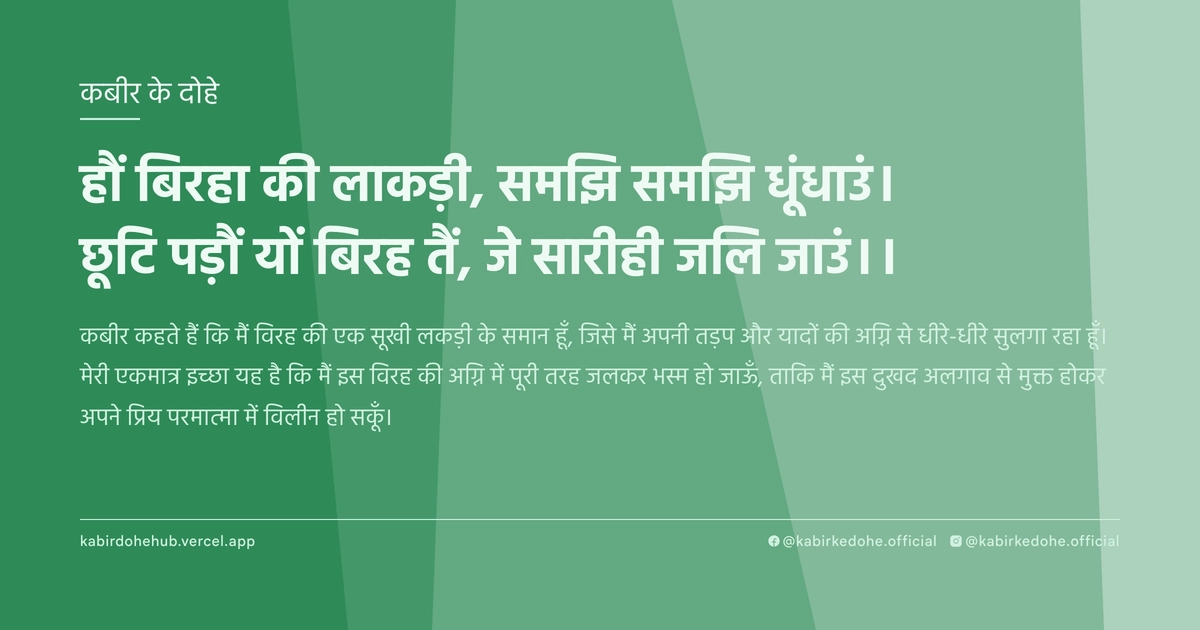
हौं बिरहा की लाकड़ी, समझि समझि धूंधाउं।
छूटि पड़ौं यों बिरह तैं, जे सारीही जलि जाउं।।
Haun birha ki laakadi, samjhi samjhi dhundhaun. Chhoot padaun yon birah tain, je saarihi jali jaaun.
इस पृष्ठ पर इस कबीर दोहे का अर्थ (meaning), हिंदी व्याख्या और अंग्रेज़ी अनुवाद, दार्शनिक विश्लेषण और व्यावहारिक जीवन सीख दी गई है। यह दोहा भक्ति (Bhakti) विषय से जुड़ा है — Kabir doha meaning and explanation in Hindi and English.
अर्थ (Meaning):
कबीर कहते हैं कि मैं विरह की एक सूखी लकड़ी के समान हूँ, जिसे मैं अपनी तड़प और यादों की अग्नि से धीरे-धीरे सुलगा रहा हूँ। मेरी एकमात्र इच्छा यह है कि मैं इस विरह की अग्नि में पूरी तरह जलकर भस्म हो जाऊँ, ताकि मैं इस दुखद अलगाव से मुक्त होकर अपने प्रिय परमात्मा में विलीन हो सकूँ।
Kabir declares himself to be like a piece of dry wood fueled by the agony of separation. He consciously stokes the fire of longing, desiring to be completely consumed by this spiritual yearning. His goal is total annihilation in the flames of separation, for only by burning away the separate self can he finally merge with the Divine Beloved.
व्याख्या (Interpretation):
यहाँ 'बिरह' (विरह) केवल मानवीय दुख नहीं, बल्कि आत्मा की परमात्मा से मिलने की तीव्र व्याकुलता है। कबीर स्वयं को 'लकड़ी' कहते हैं, जो जड़ता और अहंकार का प्रतीक है। 'धूंधाउं' का अर्थ है उस अग्नि को प्रज्वलित करना, जो ज्ञान और प्रेम की तड़प से पैदा होती है। यह विरह की अग्नि वास्तव में शुद्धिकरण की प्रक्रिया है। जब तक 'मैं' (अहंकार) जीवित है, तब तक मिलन असंभव है। अतः, वह पूरी तरह जलकर राख होना चाहते हैं, क्योंकि राख में कोई व्यक्तित्व नहीं होता। यह अद्वैत वेदांत के उस सिद्धांत को दर्शाता है जहाँ द्वैत (दो होने का भाव) समाप्त होता है और केवल ब्रह्म शेष रहता।
In this verse, 'Birha' (separation) is not mere emotional grief but the intense spiritual longing of the Atman for the Brahman. By calling himself 'wood,' Kabir symbolizes the dormant, ego-bound state of human existence. 'Dhoondhaun' refers to the conscious act of intensifying this longing, transforming pain into a spiritual catalyst. This fire of separation is actually a process of purification; it is the alchemy of the soul. The central paradox is that the 'pain' of separation is the only path to the 'pleasure' of union. Only when the individual identity (the wood) is completely incinerated by the fire of devotion does the duality of lover and beloved vanish, leaving only the singular, formless Truth.
दार्शनिक विश्लेषण (Philosophical Analysis):
कबीर का यह दोहा निर्गुण भक्ति की पराकाष्ठा को दर्शाता है, जहाँ ईश्वर किसी मूर्ति या मंदिर में नहीं, बल्कि हृदय की तीव्र तड़प में पाया जाता है। ऐतिहासिक रूप से, कबीर ने अपने समय के कर्मकांडों और बाहरी आडंबरों का विरोध किया, क्योंकि उनका मानना था कि मोक्ष बाहरी अनुष्ठानों से नहीं, बल्कि आंतरिक रूपांतरण से मिलता है।
यह दर्शन सूफीवाद के 'फना' (Fana) के सिद्धांत से गहराई से मेल खाता है, जिसका अर्थ है ईश्वर में स्वयं को पूरी तरह मिटा देना। जिस प्रकार सूफी संत खुदा के प्रेम में अपनी हस्ती मिटाने की बात करते हैं, कबीर भी विरह की अग्नि में जलकर अपने अहंकार को समाप्त करना चाहते हैं।
अद्वैत वेदांत के परिप्रेक्ष्य में, यह 'माया' के पर्दे को हटाने की प्रक्रिया है। माया हमें यह विश्वास दिलाती है कि हम परमात्मा से अलग हैं। विरह वह मानसिक अवस्था है जो इस भ्रम को तोड़ती है और साधक को यह एहसास कराती है कि वह वास्तव में पूर्ण नहीं है जब तक वह अपने मूल स्रोत से न मिल जाए।
यहाँ 'जलने' का अर्थ शारीरिक विनाश नहीं, बल्कि मनोवैज्ञानिक और आध्यात्मिक विखंडन है। यह वासनाओं, सामाजिक पहचानों और मानसिक संस्कारों का दहन है। जब तक व्यक्ति अपनी सामाजिक स्थिति, जाति या ज्ञान के अहंकार को पकड़े रहता है, वह 'सूखी लकड़ी' बना रहता है।
अंततः, कबीर यह संदेश देते हैं कि आध्यात्मिक प्रगति के लिए दुख का स्वागत करना चाहिए। विरह का दुख वास्तव में एक वरदान है क्योंकि यह मनुष्य को उसकी सीमितता का बोध कराता है और उसे अनंत की ओर धकेलता है। बिना इस तड़प के, भक्ति केवल एक यांत्रिक अभ्यास बनकर रह जाती है।
This couplet represents the zenith of Nirgun Bhakti, where the Divine is not sought in idols or temples but within the searing intensity of spiritual longing. Historically, Kabir operated in an era of rigid ritualism and caste hierarchies, which he vehemently rejected. He posited that liberation is not achieved through external rites but through a profound internal transmutation of the soul.
His philosophy resonates deeply with the Sufi concept of 'Fana'—the annihilation of the self in the Divine. Just as the Sufi mystic seeks to dissolve their ego in the ocean of God's love, Kabir views the fire of separation as the necessary tool for this dissolution. The 'wood' of the ego must be burned to release the essence within.
From the lens of Advaita Vedanta, this process is the dismantling of 'Maya' (illusion). Maya creates the false perception of duality, convincing the soul that it is separate from the Absolute. The agony of separation is the psychological trigger that shatters this illusion, forcing the seeker to recognize their inherent incompleteness without the Universal Consciousness.
Crucially, the 'burning' described here is not physical destruction but a psychological and spiritual purging. It is the incineration of desires, social identities, and conditioned patterns of thought. As long as a person clings to their status, caste, or intellectual pride, they remain 'dry wood'—inert and disconnected.
Ultimately, Kabir suggests that spiritual growth requires the embrace of divine discontent. The pain of separation is a blessing because it awakens the soul from its slumber. Without this visceral yearning, devotion remains a mere mechanical exercise. The path to the Infinite begins with the courageous acceptance of one's own spiritual void.
मूल संदेश (Core Message):
- विरह का दुख वास्तव में आध्यात्मिक जागृति का बीज है।
- अहंकार का दहन ही परमात्मा से मिलन का एकमात्र मार्ग है।
- बाहरी कर्मकांड केवल भ्रम हैं; आंतरिक तड़प ही वास्तविक प्रार्थना है।
- जब 'मैं' पूरी तरह मिट जाता है, तब केवल 'सत्य' शेष रहता है।
- पीड़ा से भागना बंधन है, पीड़ा में विलीन होना मुक्ति है।
- आत्मा की प्यास ही उसे अनंत सागर की ओर ले जाती है।
- The pain of separation is actually the seed of spiritual awakening.
- The incineration of the ego is the only path to Divine union.
- External rituals are mere illusions; internal longing is the true prayer.
- When the 'I' is completely erased, only the 'Truth' remains.
- Fleeing from pain is bondage; dissolving into pain is liberation.
- The soul's thirst is what drives it toward the Infinite Ocean.
व्यावहारिक उदाहरण (Practical Example):
वाराणसी के एक पुराने घाट पर माधव नाम का एक वृद्ध बुनकर रहता था। माधव ने अपना पूरा जीवन रेशमी कपड़े बुनने में बिताया, लेकिन उसका मन हमेशा एक अनजानी कमी से व्याकुल रहता था। वह मंदिर जाता, दान करता और शास्त्रों को पढ़ता, फिर भी उसके भीतर एक खालीपन था जिसे वह शब्दों में नहीं ढाल पाता था।
एक दिन उसने एक फकीर को देखा जो सड़क किनारे बैठकर रो रहा था, लेकिन उसके चेहरे पर एक अजीब सी शांति थी। माधव ने पूछा, "आप दुखी हैं या सुखी?" फकीर ने उत्तर दिया, "मैं उस प्रेम की अग्नि में जल रहा हूँ जो मुझे मेरे मूल से अलग करता है। यह जलन ही मेरा एकमात्र सुख है।"
यह बात माधव के हृदय में गहरे तक उतर गई। उसने महसूस किया कि अब तक वह अपनी 'कमी' को भरने की कोशिश कर रहा था—अच्छे कर्मों से, धन से, और सामाजिक सम्मान से। वह उस खालीपन को 'भरना' चाहता था, जबकि फकीर उसे 'जलाने' की बात कर रहा था।
माधव ने अपनी जीवनशैली बदल दी। उसने बाहरी दिखावे के लिए किए जाने वाले धार्मिक कार्यों को छोड़ दिया। अब जब भी वह अकेला होता, वह उस विरह की भावना को दबाने के बजाय उसे पूरी तरह महसूस करने लगा। वह अपनी तड़प को एक ईंधन की तरह इस्तेमाल करने लगा।
शुरुआत में यह बहुत दर्दनाक था। उसे लगा कि वह मानसिक रूप से टूट रहा है। उसका अहंकार, जो उसे एक 'कुशल बुनकर' और 'धार्मिक व्यक्ति' के रूप में परिभाषित करता था, धीरे-धीरे ढहने लगा। वह अपनी पहचान के टुकड़ों को गिरते हुए देख रहा था।
जैसे-जैसे समय बीता, माधव ने पाया कि जिस 'मैं' को वह बचाने की कोशिश कर रहा था, वही उसके और परमात्मा के बीच की सबसे बड़ी बाधा थी। वह अब लकड़ी की तरह जल रहा था—उसका क्रोध, उसका मोह और उसकी श्रेष्ठता की भावना सब भस्म हो रहे थे।
एक शाम, जब वह गंगा किनारे बैठा था, उसे अचानक महसूस हुआ कि वह अब अलग नहीं है। विरह की अग्नि ने उसे इतना जला दिया था कि अब वहाँ कोई 'माधव' नहीं बचा था, केवल एक अनंत शांति थी जो पूरे ब्रह्मांड में व्याप्त थी।
उसने पाया कि जब उसने अपनी पीड़ा से भागना बंद किया और उसमें पूरी तरह डूब गया, तो वही पीड़ा उसके लिए मोक्ष का द्वार बन गई। वह अब एक कुशल बुनकर नहीं था, बल्कि वह स्वयं उस अनंत धागे का हिस्सा बन गया था जिससे पूरा अस्तित्व बुना गया है।
On an ancient ghat in Varanasi lived an elderly weaver named Madhav. Madhav had spent his entire life weaving exquisite silk fabrics, yet his heart was perpetually haunted by an inexplicable void. He visited temples, gave alms, and studied scriptures, but the emptiness remained, a silent ache he could not name.
One day, he encountered a wandering dervish sitting by the road, weeping, yet wearing an expression of profound serenity. Madhav asked, "Are you in sorrow or in joy?" The dervish replied, "I am burning in the fire of a love that separates me from my Source. This burning is my only true joy."
These words pierced Madhav's heart. He realized that until then, he had been trying to 'fill' his void—with good deeds, wealth, and social respect. He wanted to patch the hole in his soul, while the dervish was suggesting that he let the hole become a furnace.
Madhav transformed his life. He abandoned the religious performances he did for social validation. Now, in his solitude, instead of suppressing the feeling of longing, he began to invite it. He started using his spiritual yearning as fuel, consciously stoking the fire of his own restlessness.
Initially, this was excruciating. He felt as though he were mentally disintegrating. His ego, which defined him as a 'master weaver' and a 'pious man,' began to crumble. He watched the fragments of his identity fall away one by one.
As time passed, Madhav discovered that the 'I' he had been trying to protect was the very barrier between him and the Divine. He was now burning like dry wood—his anger, his attachments, and his sense of superiority were all being incinerated.
One evening, sitting by the Ganges, he suddenly felt that the separation had vanished. The fire of longing had consumed him so completely that there was no longer a 'Madhav' left—only a vast, shimmering peace that permeated the entire universe.
He realized that by ceasing to flee from his pain and instead diving deep into it, that very agony had become the gateway to liberation. He was no longer just a weaver of cloth; he had become a thread in the infinite tapestry of existence.
अभ्यास मार्गदर्शन (Practice Guidance):
- दैनिक चिंतन: प्रतिदिन 20 मिनट मौन में बैठें और अपने भीतर के उस खालीपन या विरह को महसूस करें जिसे आप अक्सर व्यस्तता से दबाते हैं।
- आत्म-पूछताछ जर्नल: लिखें कि आपकी कौन सी सामाजिक पहचान (पद, प्रतिष्ठा, रिश्ता) आपको परमात्मा से अलग महसूस कराती है और आप उसे छोड़ने से क्यों डरते हैं।
- व्यवहार परिवर्तन: जब भी जीवन में दुख या अलगाव का अनुभव हो, तो उसे हटाने की कोशिश करने के बजाय यह पूछें, "यह पीड़ा मेरे अहंकार के किस हिस्से को जला रही है?"
- निदान चेकलिस्ट: यदि आप अभी भी अपनी उपलब्धियों पर गर्व करते हैं या दूसरों से श्रेष्ठ महसूस करते हैं, तो आपकी 'लकड़ी' अभी कच्ची है। यदि आप पूर्ण समर्पण और विनम्रता महसूस करते हैं, तो आप विरह की अग्नि में प्रवेश कर चुके हैं।
- Daily Contemplation: Spend 20 minutes in silence daily, focusing on the inner void or longing that you typically suppress with busyness and distraction.
- Self-Inquiry Journaling: Document which social identities (status, title, role) create a sense of separation from the Divine and explore why you fear letting them go.
- Behavioral Shift: Whenever you experience grief or separation, instead of trying to 'fix' it, ask: "Which part of my ego is this pain currently incinerating?"
- Diagnostic Checklist: If you still derive pride from achievements or feel superior to others, your 'wood' is still damp. If you feel a sense of total surrender and profound humility, you have entered the fire of longing.
चिंतन प्रश्न (Reflection Questions):
- आपकी वह कौन सी 'पवित्र' छवि है जिसे आप दुनिया के सामने बनाए रखते हैं, लेकिन वह वास्तव में आपके आध्यात्मिक विकास में बाधा है?
- क्या आप वास्तव में ईश्वर को चाहते हैं, या आप केवल उस सुख को चाहते हैं जो ईश्वर के साथ जुड़ा माना जाता है?
- यदि आपकी सारी सामाजिक पहचानें (नाम, पेशा, धर्म) आज छीन ली जाएं, तो आपके भीतर क्या बचेगा?
- आप अपने जीवन के सबसे गहरे दुख को एक 'उपहार' के रूप में कैसे देख सकते हैं?
- क्या आपका 'डिजिटल अहंकार' (सोशल मीडिया इमेज) आपको वास्तविक आंतरिक विरह का अनुभव करने से रोक रहा है?
- क्या आप जलने के लिए तैयार हैं, या आप केवल किनारे पर खड़े होकर दूसरों को जलते हुए देख रहे हैं?
- What is that 'pious' image you maintain for the world that is actually hindering your spiritual growth?
- Do you truly desire the Divine, or do you only desire the comfort and bliss associated with the Divine?
- If all your social identities (name, profession, religion) were stripped away today, what would remain within you?
- How can you reframe your deepest life agony as a spiritual 'gift' for purification?
- Is your 'digital ego' (social media persona) preventing you from experiencing authentic internal longing?
- Are you truly prepared to burn, or are you merely standing on the shore watching others be consumed?