
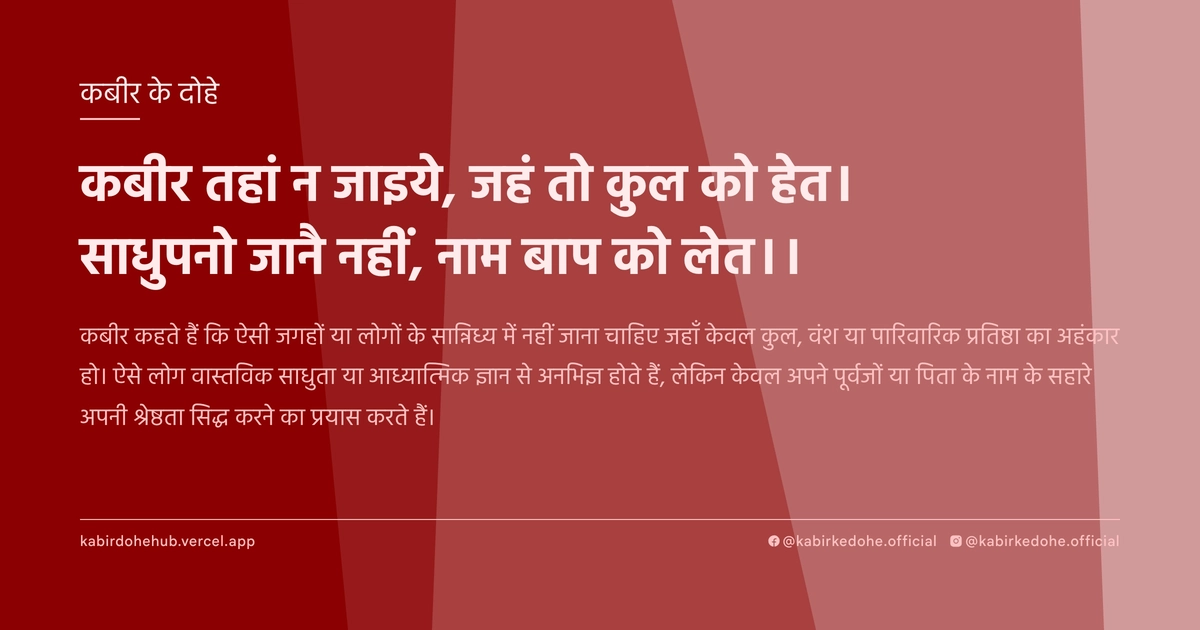
कबीर तहां न जाइये, जहं तो कुल को हेत।
साधुपनो जानै नहीं, नाम बाप को लेत।।
Kabir taha na jaiye, jaha to kul ko het. Sadhupano jaane nahi, naam baap ko let.
इस पृष्ठ पर इस कबीर दोहे का अर्थ (meaning), हिंदी व्याख्या और अंग्रेज़ी अनुवाद, दार्शनिक विश्लेषण और व्यावहारिक जीवन सीख दी गई है। यह दोहा सत्संग (Satsang) विषय से जुड़ा है — Kabir doha meaning and explanation in Hindi and English.
अर्थ (Meaning):
कबीर कहते हैं कि ऐसी जगहों या लोगों के सान्निध्य में नहीं जाना चाहिए जहाँ केवल कुल, वंश या पारिवारिक प्रतिष्ठा का अहंकार हो। ऐसे लोग वास्तविक साधुता या आध्यात्मिक ज्ञान से अनभिज्ञ होते हैं, लेकिन केवल अपने पूर्वजों या पिता के नाम के सहारे अपनी श्रेष्ठता सिद्ध करने का प्रयास करते हैं।
Kabir warns against seeking company or solace in places where lineage, caste, or family prestige is the primary value. Such individuals lack true spiritual realization or 'Sadhupana' (saintliness), yet they rely solely on the inherited name of their ancestors to claim a status they have not earned through their own consciousness.
व्याख्या (Interpretation):
शाब्दिक अर्थ में यह दोहा वंशवाद की आलोचना है, परंतु गहरा अर्थ 'अहंकार' की सूक्ष्म परतों को उघाड़ना है। यहाँ 'कुल' केवल परिवार नहीं, बल्कि वह हर सामाजिक पहचान है जिसे हम अपनी आत्मा से ऊपर रखते हैं। यह निरगुण भक्ति का आह्वान है, जहाँ ईश्वर किसी कुल का नहीं बल्कि शून्य और सर्वव्यापी है। जब व्यक्ति अपनी पहचान बाहरी उपाधियों में खोजता है, तो वह माया के जाल में फँस जाता है। यह विरोधाभास है कि जो व्यक्ति स्वयं को 'उच्च कुल' का मानता है, वह वास्तव में आध्यात्मिक रूप से सबसे दरिद्र है क्योंकि उसने अपनी अंतरात्मा (Atman) को पहचानने के बजाय बाहरी मुखौटों को संजोया है।
Literally, this couplet critiques dynastic pride, but metaphorically, it strips away the subtle layers of the ego. 'Kul' (lineage) represents every social identity we prioritize over the soul. This is a call to Nirgun Bhakti, where the Divine is neither bound by lineage nor form, but is the void and the all-pervading essence. When a person seeks identity in external titles, they fall prey to Maya (illusion). The central paradox is that the one claiming 'high birth' is spiritually the most impoverished, having curated masks instead of realizing the non-duality of Atman and Brahman.
दार्शनिक विश्लेषण (Philosophical Analysis):
कबीर का यह दोहा उस सामाजिक संरचना पर प्रहार करता है जहाँ जन्म को योग्यता माना जाता था। मध्यकालीन भारत में जाति और कुल की कठोरता चरम पर थी। कबीर ने इस व्यवस्था को नकारते हुए यह स्थापित किया कि 'साधुपन' (saintliness) अर्जित किया जाता है, विरासत में नहीं मिलता। यह विचार अद्वैत वेदांत के करीब है, जहाँ आत्मा की कोई जाति या कुल नहीं होता; केवल शुद्ध चेतना होती है।
सूफी मत के 'फना' (अहंकार का विनाश) के सिद्धांत की तरह, कबीर यहाँ सामाजिक अहंकार के विनाश की बात कर रहे हैं। यदि कोई व्यक्ति केवल अपने पिता या पूर्वजों के नाम पर गर्व करता है, तो वह वास्तव में अपनी व्यक्तिगत आध्यात्मिक यात्रा से भाग रहा है। वह एक उधार की पहचान जी रहा है, जो उसे सत्य के मार्ग से दूर ले जाती है।
अनुष्ठानों और बाहरी दिखावे का विरोध कबीर के दर्शन का मूल है। वे कहते हैं कि यदि हृदय में करुणा और ज्ञान नहीं है, तो कुल की श्रेष्ठता केवल एक बोझ है। यह मनोवैज्ञानिक रूपांतरण की मांग करता है जहाँ व्यक्ति 'मैं कौन हूँ' के प्रश्न का उत्तर अपने वंशवृक्ष में नहीं, बल्कि अपने भीतर खोजे।
अक्सर लोग इस दोहे को केवल पारिवारिक विवाद के रूप में देखते हैं, लेकिन यह वास्तव में 'पहचान के भ्रम' (Identity Illusion) का विश्लेषण है। जब तक हम स्वयं को किसी समूह या कुल का हिस्सा मानकर श्रेष्ठता का अनुभव करते हैं, तब तक हम पृथकता (Separation) के भाव में जीते हैं, जो मोक्ष के मार्ग में सबसे बड़ी बाधा है।
अंततः, कबीर यह संदेश देते हैं कि सत्य का मार्ग व्यक्तिगत अनुभव और आंतरिक शुद्धि का है। कुल का नाम लेना केवल एक मानसिक सुरक्षा कवच है जो व्यक्ति को वास्तविक आध्यात्मिक संघर्ष और आत्म-साक्षात्कार से रोकता है।
Kabir’s couplet strikes at the heart of a social structure where birth was equated with merit. In medieval India, the rigidity of caste and lineage was absolute. By rejecting this, Kabir established that 'Sadhupana' (saintliness) is earned through realization, not inherited through bloodlines. This aligns with Advaita Vedanta, which posits that the soul has no caste or lineage; there is only pure, undifferentiated consciousness.
Similar to the Sufi concept of 'Fana' (the annihilation of the ego), Kabir advocates for the destruction of social ego. If an individual prides themselves solely on the name of their ancestors, they are fleeing from their own spiritual journey. They are living a borrowed identity, which creates a veil between the seeker and the Truth.
Opposition to ritualism and outward display is central to Kabir's philosophy. He asserts that without compassion and gnosis in the heart, lineage prestige is merely a burden. This demands a psychological transformation where the answer to 'Who am I?' is sought not in a family tree, but within the depths of the self.
Common literalist interpretations mistake this as a critique of family ties, but it is actually an analysis of the 'Identity Illusion.' As long as we derive a sense of superiority from belonging to a specific group, we exist in a state of separation, which is the primary obstacle to liberation (Moksha).
Ultimately, Kabir teaches that the path to Truth is one of personal experience and internal purification. Relying on the name of a lineage is a psychological defense mechanism that prevents the individual from engaging in the necessary spiritual struggle and self-realization.
मूल संदेश (Core Message):
- वंश का अहंकार सत्य की खोज में सबसे बड़ी बाधा है।
- श्रेष्ठता जन्म से नहीं, बल्कि आंतरिक शुद्धि से आती है।
- उधार की पहचान आत्मा को अंधा कर देती है।
- साधुता एक आंतरिक अवस्था है, कोई सामाजिक लेबल नहीं।
- जब 'मैं' और 'मेरा कुल' मिटता है, तब परमात्मा प्रकट होता है।
- Ancestral pride is the greatest obstacle in the quest for Truth.
- Superiority is born of internal purity, not biological birth.
- A borrowed identity blinds the soul to its own essence.
- Saintliness is an internal state, not a social label.
- When 'I' and 'my lineage' vanish, the Divine manifests.
व्यावहारिक उदाहरण (Practical Example):
एक समय की बात है, बनारस के घाटों पर एक वृद्ध विधवा, जानकी रहती थीं। जानकी का जीवन अत्यंत कठिन था, लेकिन वह अपने परिवार की 'उच्च कुल' की प्रतिष्ठा के बोझ तले दबी रहती थीं। उनके बेटे और पोते शहर में बड़े पदों पर थे और अक्सर उन्हें याद दिलाते थे कि वे कितने प्रतिष्ठित घराने से हैं, जबकि घर के भीतर आपसी कलह और घृणा का वास था।
जानकी को सिखाया गया था कि उनकी श्रेष्ठता उनके कुल के नाम से है, इसलिए वे अन्य गरीब महिलाओं को तुच्छ समझती थीं। वह अक्सर कहती थीं, 'हमारा वंश तो महान संतों का है,' जबकि उनका अपना मन क्रोध और ईर्ष्या से भरा रहता था।
एक दिन उनकी मुलाकात एक साधारण से बुनकर से हुई, जो कबीर की वाणी गा रहा था। उस बुनकर के पास न कोई कुल था, न कोई नाम, लेकिन उसके चेहरे पर एक ऐसी शांति थी जो जानकी ने अपने आलीशान घर में कभी नहीं देखी थी।
बुनकर ने उनसे कहा, 'माता, जिस कुल के नाम पर आप गर्व करती हैं, क्या वह नाम आपके भीतर की अशांति को शांत कर पाया? क्या वह नाम आपको दूसरों के दुख में सहभागी बना पाया?'
जानकी को पहली बार महसूस हुआ कि वह एक ऐसे मुखौटे को पकड़े हुए थीं जिसका कोई वास्तविक अस्तित्व नहीं था। उन्होंने देखा कि उनके परिवार की 'प्रतिष्ठा' केवल एक सामाजिक दिखावा था, जबकि वास्तविक 'साधुपन' उस बुनकर की सरलता में था।
उस रात जानकी ने अपने भीतर के उस अहंकार को विदा किया जो उन्हें दूसरों से अलग करता था। उन्होंने महसूस किया कि कुल का नाम केवल एक बाहरी आवरण है, जबकि आत्मा का कोई कुल नहीं होता।
अगले दिन से जानकी ने अपनी प्रतिष्ठा का मोह छोड़ दिया। उन्होंने घाट पर रहने वाले अन्य बेसहारा लोगों की सेवा करना शुरू किया, बिना यह सोचे कि वे किस कुल के हैं या वह किस कुल की हैं।
उनका व्यवहार बदल गया। अब वे अपनी श्रेष्ठता अपने वंश से नहीं, बल्कि अपनी करुणा से सिद्ध करने लगीं। उनके चेहरे पर वही शांति आ गई जो उस बुनकर के चेहरे पर थी।
यह 'कबीर ट्विस्ट' था—जब उन्होंने बाहरी पहचान (कुल) को त्यागकर आंतरिक पहचान (मानवता) को अपनाया, तब उन्हें वास्तविक शांति मिली।
जानकी अब केवल एक 'उच्च कुल' की विधवा नहीं थीं, बल्कि एक जागृत आत्मा बन चुकी थीं, जिसने पहचान के भ्रम को तोड़ दिया था।
Once, on the ghats of Varanasi, lived an elderly widow named Janaki. Janaki's life was arduous, yet she lived under the oppressive weight of her family's 'high lineage' prestige. Her sons and grandsons held high positions in the city and constantly reminded her of their distinguished ancestry, while inside their home, strife and hatred prevailed.
Janaki had been conditioned to believe her superiority stemmed from her lineage; consequently, she looked down upon other poor women. She often boasted, 'Our lineage descends from great saints,' even as her own heart remained cluttered with anger and envy.
One day, she encountered a simple weaver singing the verses of Kabir. This weaver possessed no lineage, no title, and no fame, yet his face radiated a peace that Janaki had never experienced in her opulent household.
The weaver asked her, 'Mother, has the name of the lineage you pride yourself on been able to quiet the turbulence within you? Has that name made you a companion to the suffering of others?'
For the first time, Janaki realized she was clinging to a mask that had no real substance. She saw that her family's 'prestige' was merely a social facade, whereas true 'Sadhupana' resided in the weaver's simplicity.
That night, Janaki bid farewell to the ego that had separated her from the world. She realized that the name of a lineage is but an outer shell, while the soul possesses no caste or clan.
From the next day, Janaki abandoned her attachment to prestige. She began serving other destitute people on the ghats, without considering their lineage or her own.
Her behavior transformed. She no longer sought to prove her superiority through ancestry, but through compassion. The same peace that graced the weaver's face now appeared on hers.
This was the 'Kabir Twist'—by discarding the external identity (lineage) and embracing the internal identity (humanity), she found genuine tranquility.
Janaki was no longer just a widow of a 'high lineage'; she had become an awakened soul who had shattered the illusion of identity.
अभ्यास मार्गदर्शन (Practice Guidance):
- प्रतिदिन 20 मिनट मौन बैठें और विचार करें कि यदि आपकी सभी सामाजिक उपाधियाँ (पद, कुल, डिग्री) छीन ली जाएँ, तो आप वास्तव में कौन हैं।
- एक 'अहंकार डायरी' बनाएँ। जब भी आप किसी को अपनी पारिवारिक या सामाजिक पृष्ठभूमि के आधार पर आंकें, उसे लिखें और विश्लेषण करें कि वह भावना कहाँ से आई।
- सचेत व्यवहार परिवर्तन: ऐसे व्यक्ति के साथ समय बिताएं जिसे समाज 'निम्न' मानता है, और उनमें छिपी उस दिव्यता को खोजें जो आपके अपने कुल से परे है।
- निदान चेकलिस्ट: क्या मैं दूसरों से बात करते समय अपनी उपलब्धियों या पृष्ठभूमि का उल्लेख बार-बार करता हूँ? क्या मैं किसी की योग्यता को उसके जन्म से जोड़कर देखता हूँ? यदि हाँ, तो मैं अभी भी 'कुल के मोह' में हूँ।
- Sit in silence for 20 minutes daily and contemplate: If all your social titles (rank, lineage, degrees) were stripped away, who would you truly be?
- Maintain an 'Ego Diary.' Whenever you judge someone based on their family or social background, record it and analyze the root of that impulse.
- Conscious Behavioral Shift: Spend time with someone whom society deems 'lowly,' and seek the divinity within them that transcends any notion of lineage.
- Diagnostic Checklist: Do I frequently mention my achievements or background during conversations? Do I link a person's merit to their birth? If yes, I am still trapped in the 'attachment to lineage'.
चिंतन प्रश्न (Reflection Questions):
- मेरी वह कौन सी पहचान है जिसे मैं सबसे अधिक सहेजता हूँ, और यदि वह कल गायब हो जाए, तो क्या मेरा अस्तित्व शून्य हो जाएगा?
- क्या मैं वास्तव में उन मूल्यों का पालन करता हूँ जिनके लिए मेरा परिवार जाना जाता है, या मैं केवल उनके नाम का लाभ उठा रहा हूँ?
- मेरे भीतर का वह कौन सा 'अदृश्य कुल' (जैसे बौद्धिक श्रेष्ठता या नैतिक अहंकार) है जो मुझे दूसरों से अलग करता है?
- क्या मेरी करुणा वास्तव में निस्वार्थ है, या यह एक 'उच्च' व्यक्ति द्वारा 'निम्न' को दिए गए दान का अहंकार है?
- यदि ईश्वर वास्तव में निरगुण और निराकार है, तो मैं अपनी पहचान को भौतिक और सामाजिक सीमाओं में क्यों बांधता हूँ?
- Which identity do I cling to most dearly, and if it vanished tomorrow, would my existence feel void?
- Do I actually embody the values my family is known for, or am I merely coasting on the prestige of their name?
- What is the 'invisible lineage' (such as intellectual superiority or moral ego) within me that separates me from others?
- Is my compassion truly selfless, or is it the ego of a 'superior' person granting a favor to an 'inferior'?
- If the Divine is truly formless and attribute-less, why do I bind my identity to material and social boundaries?