
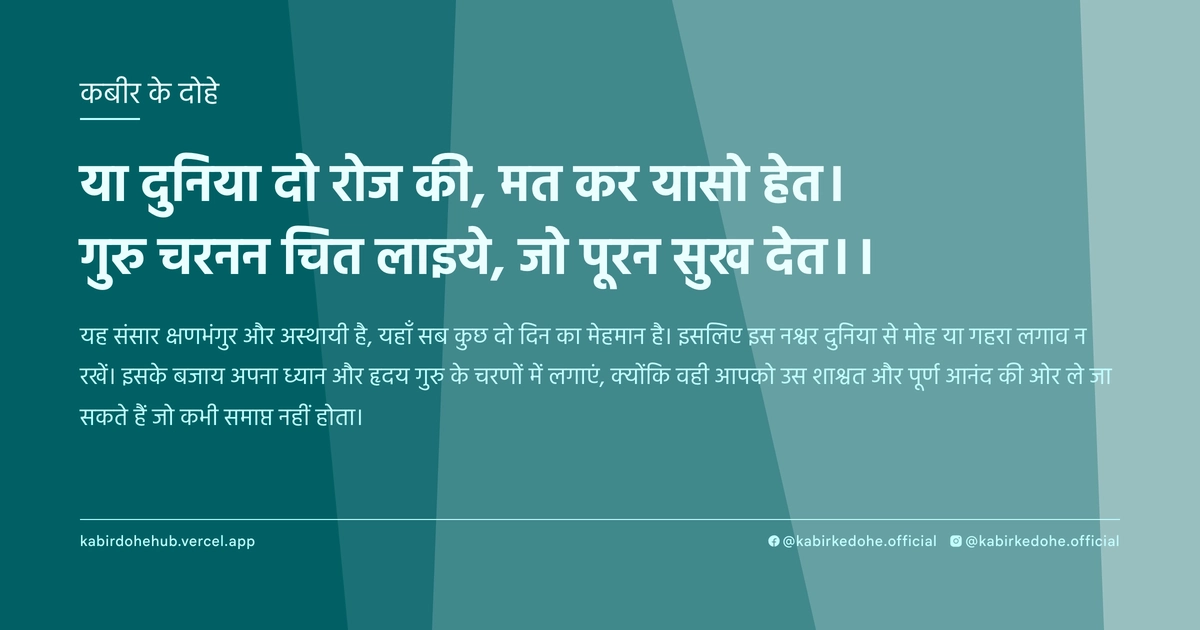
या दुनिया दो रोज की, मत कर यासो हेत।
गुरु चरनन चित लाइये, जो पूरन सुख देत।।
Ya duniya do roj ki, mat kar yaso het. Guru charnan chit layiye, jo puran sukh det.
इस पृष्ठ पर इस कबीर दोहे का अर्थ (meaning), हिंदी व्याख्या और अंग्रेज़ी अनुवाद, दार्शनिक विश्लेषण और व्यावहारिक जीवन सीख दी गई है। यह दोहा गुरु महत्व (The Guru's Importance) विषय से जुड़ा है — Kabir doha meaning and explanation in Hindi and English.
अर्थ (Meaning):
यह संसार क्षणभंगुर और अस्थायी है, यहाँ सब कुछ दो दिन का मेहमान है। इसलिए इस नश्वर दुनिया से मोह या गहरा लगाव न रखें। इसके बजाय अपना ध्यान और हृदय गुरु के चरणों में लगाएं, क्योंकि वही आपको उस शाश्वत और पूर्ण आनंद की ओर ले जा सकते हैं जो कभी समाप्त नहीं होता।
This world is fleeting and transient, lasting only a metaphorical 'two days.' Therefore, do not cultivate deep attachment or emotional longing for its ephemeral pleasures. Instead, anchor your consciousness at the feet of the Guru, for only that spiritual guidance leads to the realization of absolute, eternal bliss that transcends the cycle of birth and death.
व्याख्या (Interpretation):
कबीर यहाँ 'दो रोज' शब्द का प्रयोग समय की सापेक्षता को दर्शाने के लिए करते हैं, जिसका अर्थ है कि ब्रह्मांडीय समय के सामने मानव जीवन अत्यंत संक्षिप्त है। यह दोहा माया के भ्रम को उजागर करता है, जहाँ मनुष्य अस्थायी वस्तुओं को स्थायी मानकर उनमें उलझ जाता है। गुरु के चरणों में चित्त लगाने का अर्थ केवल शारीरिक समर्पण नहीं, बल्कि अहंकार का विसर्जन है। जब साधक अपनी पहचान को गुरु के ज्ञान में विलीन करता है, तो वह द्वैत से अद्वैत की ओर बढ़ता है। यह निरगुण भक्ति का मार्ग है जहाँ बाहरी आडंबरों को त्यागकर अंतर्मन की खोज की जाती है। अंततः, यह पूर्ण सुख की बात करता है जो इंद्रिय सुखों से परे आत्मा का परमात्मा से मिलन है।
Kabir uses the phrase 'two days' to illustrate the relativity of time, suggesting that human existence is a mere blink in the cosmic scale. The verse exposes the veil of Maya, where humans mistakenly perceive transient material possessions as permanent anchors of security. Anchoring the consciousness at the Guru's feet is not a call for blind servitude, but a metaphor for the dissolution of the ego into higher wisdom. As the seeker merges their identity with the Guru's guidance, they transition from duality to the non-dual state of Advaita. This is the essence of Nirgun Bhakti, where external rituals are discarded in favor of internal realization. Ultimately, the 'complete bliss' mentioned is not a sensory pleasure, but the ecstatic union of the Atman with the Brahman.
दार्शनिक विश्लेषण (Philosophical Analysis):
कबीर का यह दर्शन उस समय के सामाजिक और धार्मिक परिवेश की प्रतिक्रिया है जहाँ लोग कर्मकांडों और बाहरी दिखावे में फंसे थे। वे स्पष्ट रूप से बताते हैं कि संसार की कोई भी वस्तु—चाहे वह धन हो, पद हो या संबंध—स्थायी नहीं है। यह विचार बौद्ध धर्म के 'अनित्य' (Impermanence) और सूफीवाद के 'फना' (Annihilation of self) के सिद्धांतों से गहराई से मेल खाता है।
अद्वैत वेदांत के परिप्रेक्ष्य में, यह दोहा हमें याद दिलाता है कि जगत एक मिथ्या है। जब हम संसार से 'हेत' या मोह करते हैं, तो हम अपनी वास्तविक प्रकृति को भूलकर एक झूठी पहचान (अहंकार) को पालते हैं। कबीर का प्रहार उन लोगों पर है जो भौतिक संचय को ही जीवन का लक्ष्य मानते हैं, जबकि वास्तविक लक्ष्य आत्म-साक्षात्कार है।
गुरु की भूमिका यहाँ एक उत्प्रेरक (Catalyst) की है। गुरु वह सेतु है जो जीव को माया के अंधेरे से निकालकर सत्य के प्रकाश की ओर ले जाता है। यहाँ गुरु केवल एक व्यक्ति नहीं, बल्कि वह 'तत्व' या 'ज्ञान' है जो अज्ञानता के पर्दे को हटा देता है।
यह शिक्षण मनोवैज्ञानिक रूपांतरण की मांग करता है। यह हमें सिखाता है कि दुख का मूल कारण 'आसक्ति' है। जब हम यह स्वीकार कर लेते हैं कि सब कुछ नश्वर है, तो भय और लालच समाप्त हो जाते हैं, जिससे मन में एक गहरी शांति और स्थिरता का जन्म होता है।
अंततः, कबीर ritualism (कर्मकांड) का विरोध करते हुए यह स्थापित करते हैं कि मोक्ष किसी तीर्थ या मंदिर में नहीं, बल्कि चेतना के स्तर को ऊपर उठाने में है। पूर्ण सुख वह है जो बाहरी परिस्थितियों पर निर्भर नहीं करता, बल्कि भीतर से प्रस्फुटित होता है।
Kabir's philosophy serves as a visceral reaction to the socio-religious climate of his era, where spirituality had been reduced to hollow rituals and external displays. He asserts that nothing in the phenomenal world—be it wealth, status, or relationships—possesses permanence. This perspective aligns profoundly with the Buddhist concept of 'Anicca' (Impermanence) and the Sufi doctrine of 'Fana' (the annihilation of the lower self in the Divine).
From the lens of Advaita Vedanta, this doha reminds us that the perceived world is 'Mithya' or an illusion. When we cultivate 'Het' (attachment), we cling to a false identity—the ego—forgetting our true nature as the eternal Atman. Kabir critiques those who mistake material accumulation for the purpose of life, redirecting the seeker toward the only enduring goal: Self-realization.
The role of the Guru here is that of a spiritual catalyst. The Guru is the bridge spanning the abyss between the darkness of Maya and the light of Truth. In this context, the Guru is not merely a human figure but the embodiment of 'Gyan' (Knowledge) that strips away the layers of ignorance.
This teaching demands a psychological metamorphosis. It posits that the root of all human suffering is 'Asakti' (attachment). By consciously accepting the transience of existence, the grip of fear and greed loosens, giving rise to an unshakable inner peace and equanimity.
Finally, by rejecting ritualism, Kabir establishes that liberation is not found in pilgrimages or temples, but in the elevation of consciousness. The 'complete bliss' he speaks of is an autonomous joy, independent of external circumstances, arising from the realization of one's unity with the Absolute.
मूल संदेश (Core Message):
- संसार की नश्वरता को स्वीकार करना ही दुखों का अंत है।
- बाहरी उपलब्धियां केवल अस्थायी आवरण हैं, वास्तविक सत्य भीतर है।
- अहंकार का विसर्जन ही गुरु के चरणों में वास्तविक समर्पण है।
- शाश्वत सुख इंद्रियों में नहीं, बल्कि आत्मा के बोध में है।
- मोह से मुक्ति ही वास्तविक स्वतंत्रता का द्वार है।
- Accepting the transience of the world is the end of all suffering.
- External achievements are mere temporary veils; the ultimate truth lies within.
- The dissolution of ego is the only true surrender to the Guru.
- Eternal bliss resides not in the senses, but in the realization of the Soul.
- Liberation from attachment is the gateway to absolute freedom.
व्यावहारिक उदाहरण (Practical Example):
एक समय की बात है, वाराणसी के घाटों पर रहने वाला एक वृद्ध बुनकर था, जिसका नाम माधव था। माधव ने अपना पूरा जीवन रेशमी वस्त्रों की बुनाई में बिता दिया था। उसने अपनी कला में इतनी महारत हासिल कर ली थी कि उसके बनाए वस्त्रों की मांग दूर-दराज के राज्यों में थी। माधव को अपनी कला और अपनी संपत्ति पर बहुत गर्व था। वह मानता था कि उसकी यह समृद्धि उसे जीवन भर सुरक्षा और सम्मान देगी।
जैसे-जैसे समय बीता, माधव की उम्र बढ़ी और उसकी आँखों की रोशनी कम होने लगी। एक दिन एक भीषण आग लगी जिसने उसकी पूरी कार्यशाला और उसके संचित रेशमी वस्त्रों को राख कर दिया। एक ही रात में, माधव का वह साम्राज्य जिसे उसने दशकों तक संजोया था, समाप्त हो गया। वह सड़क पर बैठकर फूट-फूट कर रोने लगा, क्योंकि उसे लगा कि उसने अपना सब कुछ खो दिया है।
उसी समय, एक घुमक्कड़ संत वहां से गुजरे। उन्होंने माधव के विलाप को देखा और शांति से उसके पास बैठकर कहा, 'पुत्र, तू उस वस्त्र के लिए रो रहा है जो आग की लपटों में विलीन हो गया, जबकि तू उस शाश्वत वस्त्र को भूल गया जो तेरी आत्मा ने ओढ़ा है। यह दुनिया दो दिन की सराय है, यहाँ जो आया है वह जाएगा, और जो बनाया है वह मिटेगा।'
माधव को पहले तो यह बात कड़वी लगी, लेकिन संत की आँखों में एक ऐसी शांति थी जिसने माधव को सोचने पर मजबूर कर दिया। उसने महसूस किया कि उसने जीवन भर केवल बाहरी धागों को जोड़ा था, लेकिन अपने भीतर के शून्य को कभी नहीं भरा। उसने संत से पूछा, 'अब मैं क्या करूँ?'
संत ने उसे सिखाया कि कैसे अपने मन को बाहरी दुनिया की इच्छाओं से हटाकर अंतर्मन की शांति की ओर मोड़ा जाए। उन्होंने उसे 'शून्य' के ध्यान और गुरु-तत्व के प्रति समर्पण का मार्ग दिखाया। माधव ने अब अपनी बची हुई ऊर्जा को संपत्ति जुटाने में नहीं, बल्कि आत्म-चिंतन में लगाया।
धीरे-धीरे माधव का नजरिया बदल गया। अब वह अपनी गरीबी में भी एक अजीब सी अमीरी महसूस करने लगा। उसने देखा कि जब उसने दुनिया से उम्मीदें छोड़ दीं, तो उसका दुख गायब हो गया। वह अब घाटों पर बैठकर अन्य दुखी लोगों को सांत्वना देने लगा।
उसने पाया कि जिस 'पूर्ण सुख' की तलाश वह अपनी रेशमी साड़ियों में कर रहा था, वह वास्तव में उसके भीतर की शांति में छिपा था। वह अब वस्त्र तो बुनता था, लेकिन अब वह उनमें मोह नहीं रखता था। वह उन्हें ईश्वर की सेवा मानकर बनाता और खुशी-खुशी बांट देता।
माधव की कहानी हमें सिखाती है कि जब हम इस सत्य को स्वीकार कर लेते हैं कि संसार अस्थायी है, तब हम वास्तव में स्वतंत्र होते हैं। उसका अहंकार टूट चुका था, और उस टूटे हुए अहंकार की जगह अब एक असीम प्रेम और करुणा ने ले ली थी।
Once, in the sacred lanes of Varanasi, lived an elderly weaver named Madhav. Madhav had spent his entire life weaving exquisite silk fabrics. He had attained such mastery that his textiles were coveted in distant kingdoms. Madhav took immense pride in his craft and the wealth it brought him, believing that this prosperity would guarantee him security and respect for a lifetime.
As years passed, Madhav aged, and his eyesight began to fade. One catastrophic night, a fierce fire broke out, reducing his entire workshop and his vast stockpile of silk to ash. In a single night, the empire Madhav had spent decades building vanished. He sat on the street, weeping inconsolably, feeling that he had lost everything that defined him.
At that moment, a wandering monk passed by. Observing Madhav's grief, the monk sat beside him and spoke softly, 'My son, you weep for the fabric that vanished in the flames, yet you forget the eternal garment that your soul wears. This world is but a two-day inn; whatever arrives must depart, and whatever is built must crumble.'
Initially, Madhav found these words harsh, but the profound serenity in the monk's eyes forced him to reflect. He realized that he had spent his life weaving external threads while leaving the void within himself unfilled. He asked the monk, 'What must I do now?'
The monk guided him on how to withdraw his consciousness from worldly desires and redirect it toward inner stillness. He introduced him to the practice of 'Shunya' (Void) meditation and the path of surrender to the Guru-element. Madhav stopped spending his remaining energy on accumulating wealth and instead turned toward self-inquiry.
Slowly, Madhav's perspective shifted. He began to experience a strange kind of richness within his poverty. He discovered that once he ceased expecting permanence from the world, his suffering evaporated. He started spending his days on the ghats, offering solace to other grieving souls.
He realized that the 'complete bliss' he had sought through his luxurious silks was actually hidden in the silence of his own heart. He continued to weave, but the attachment was gone; he now viewed his craft as a service to the Divine, often gifting his work to the needy.
Madhav's story teaches us that true freedom comes from accepting the transience of the world. His ego had been shattered, and in the space where the ego once stood, an infinite capacity for love and compassion had blossomed.
अभ्यास मार्गदर्शन (Practice Guidance):
- दैनिक चिंतन: प्रतिदिन 15 मिनट मौन बैठें और विचार करें कि आपके जीवन की कौन सी वस्तुएं वास्तव में स्थायी हैं और कौन सी अस्थायी।
- आत्म-पूछताछ जर्नल: एक डायरी लिखें जिसमें उन क्षणों का वर्णन हो जब आपने किसी अस्थायी वस्तु के खोने पर अत्यधिक दुख महसूस किया, और फिर विश्लेषण करें कि वह दुख वास्तव में किस 'अहंकार' से जुड़ा था।
- व्यवहारिक परिवर्तन: सप्ताह में एक बार अपनी किसी प्रिय वस्तु का त्याग करें या उसे दान करें, ताकि आप 'अनासक्ति' (Non-attachment) का अभ्यास कर सकें।
- निदान चेकलिस्ट: क्या आप छोटी समस्याओं पर विचलित होते हैं? क्या आप भविष्य की सुरक्षा के लिए वर्तमान की शांति का त्याग कर रहे हैं? यदि हाँ, तो आप अभी भी 'दो रोज की दुनिया' के मोह में हैं।
- Daily Contemplation: Spend 15 minutes in silence daily, reflecting on which aspects of your life are truly permanent and which are merely transient.
- Self-Inquiry Journal: Maintain a journal documenting moments of intense grief over the loss of material things, then analyze which specific 'ego-identity' was wounded during that loss.
- Behavioral Shift: Once a week, consciously give away or donate a prized possession to practice the art of 'Anasakti' (Non-attachment).
- Diagnostic Checklist: Do you get easily agitated by minor setbacks? Are you sacrificing present peace for future security? If yes, you are still entangled in the illusion of the 'two-day world'.
चिंतन प्रश्न (Reflection Questions):
- यदि आज आपकी सारी सामाजिक पहचान और संपत्ति छीन ली जाए, तो आपके भीतर क्या बचेगा?
- आप अपनी डिजिटल छवि (Social Media Identity) को कितना स्थायी मानते हैं और यह आपकी वास्तविक शांति को कैसे प्रभावित करता है?
- क्या आपका 'गुरु' कोई व्यक्ति है, या आपने अपने भीतर के अंतर्ज्ञान को जागृत किया है?
- आप किन चीजों को पकड़ कर बैठे हैं, यह जानते हुए भी कि वे अंततः नष्ट हो जाएंगी?
- क्या आपकी भक्ति केवल भय से प्रेरित है या यह वास्तव में सत्य की खोज है?
- If all your social identities and assets were stripped away today, what would remain of you?
- To what extent do you perceive your digital persona as permanent, and how does this affect your internal peace?
- Is your 'Guru' an external figure, or have you awakened the inner guide within yourself?
- What are you clinging to, despite knowing that it will inevitably perish?
- Is your devotion driven by a fear of loss, or is it a genuine quest for Truth?