
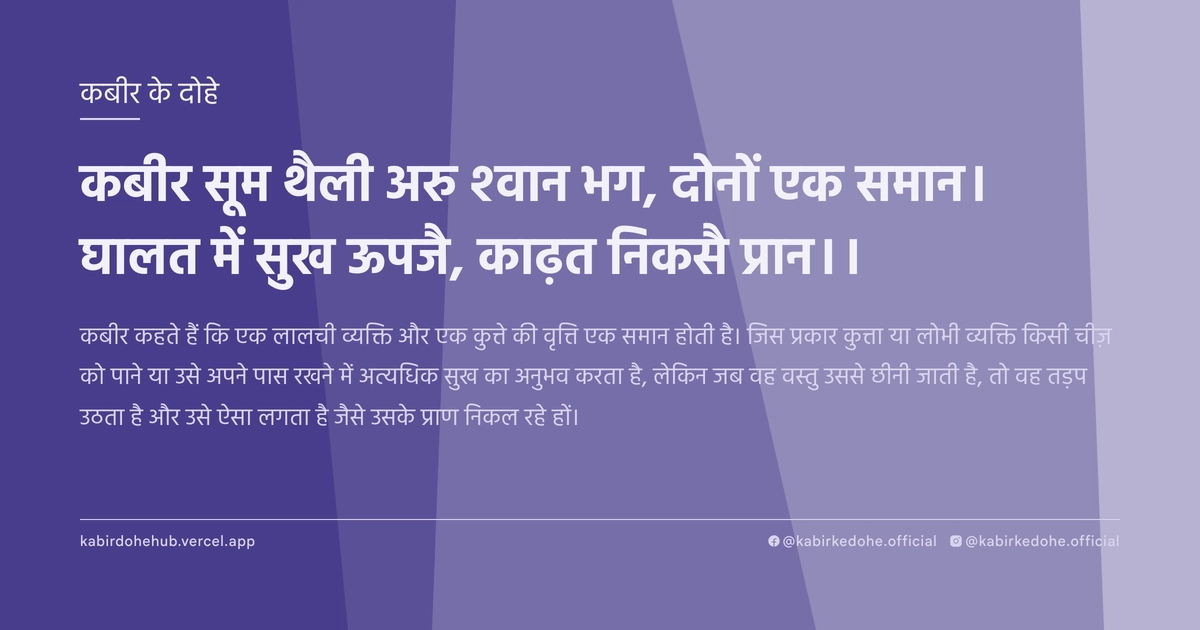
कबीर सूम थैली अरु श्वान भग, दोनों एक समान।
घालत में सुख ऊपजै, काढ़त निकसै प्रान।।
Kabir soom thaili aru shwan bhag, donon ek samaan. Ghaalat me sukh upjai, kaadhat niksai praan.
इस पृष्ठ पर इस कबीर दोहे का अर्थ (meaning), हिंदी व्याख्या और अंग्रेज़ी अनुवाद, दार्शनिक विश्लेषण और व्यावहारिक जीवन सीख दी गई है। यह दोहा लोभ (Greed) विषय से जुड़ा है — Kabir doha meaning and explanation in Hindi and English.
अर्थ (Meaning):
कबीर कहते हैं कि एक लालची व्यक्ति और एक कुत्ते की वृत्ति एक समान होती है। जिस प्रकार कुत्ता या लोभी व्यक्ति किसी चीज़ को पाने या उसे अपने पास रखने में अत्यधिक सुख का अनुभव करता है, लेकिन जब वह वस्तु उससे छीनी जाती है, तो वह तड़प उठता है और उसे ऐसा लगता है जैसे उसके प्राण निकल रहे हों।
Kabir asserts that a greedy person and a dog share the same instinctual nature. Just as a dog clings fiercely to a bone or a greedy man to his possessions, they find immense pleasure in acquiring and holding onto things, but when those possessions are taken away, they suffer an agony so intense it feels as though their very life force is being ripped from them.
व्याख्या (Interpretation):
यहाँ 'सूम थैली' (लोभी व्यक्ति) और 'श्वान' (कुत्ता) का रूपक मोह और आसक्ति की पशुवत प्रकृति को दर्शाता है। कबीर यह समझाना चाहते हैं कि जब मनुष्य अपनी पहचान बाहरी वस्तुओं या संचय से जोड़ता है, तो वह अपनी चेतना को पशु स्तर पर गिरा देता है। यह स्थिति 'माया' के प्रभाव को दर्शाती है, जहाँ व्यक्ति भ्रमित है कि सुख वस्तुओं के स्वामित्व में है। निर्गुण भक्ति के परिप्रेक्ष्य में, यह आसक्ति ही आत्मा और परमात्मा के बीच की सबसे बड़ी बाधा है। जब हम 'पकड़ने' की कोशिश करते हैं, तो हम वास्तव में अपने अहंकार को पोषित कर रहे होते हैं। अद्वैत वेदांत के अनुसार, यह द्वैत—'मेरा' और 'तेरा'—ही दुखों का मूल कारण है। अंततः, यह दोहा इस विरोधाभास को उजागर करता है कि जिसे हम सुख समझकर पकड़ते हैं, वही भविष्य में हमारे दुख का सबसे बड़ा कारण बनता है।
The metaphors of the 'greedy bag' (sum thaili) and the 'dog' (shwan) illustrate the animalistic nature of attachment and craving. Kabir suggests that when a human ties their identity to external acquisitions, they descend to a primal level of consciousness. This state exemplifies the grip of 'Maya' (illusion), where the individual is deceived into believing that happiness resides in ownership. In the context of Nirgun Bhakti, such attachment is the primary veil obscuring the realization of the formless Divine. By attempting to 'grasp,' the seeker merely nourishes the ego, creating a false sense of security. According to Advaita Vedanta, this duality of 'mine' and 'thine' is the root of all suffering. Ultimately, the couplet highlights the central paradox: the very objects we cling to for pleasure become the instruments of our agony when they are inevitably lost.
दार्शनिक विश्लेषण (Philosophical Analysis):
कबीर का यह दोहा उस सामाजिक और धार्मिक पाखंड पर प्रहार करता है जहाँ संचय को समृद्धि और धर्म का प्रतीक माना जाता था। उनके युग में, धार्मिक संस्थाएँ अक्सर बाहरी अनुष्ठानों और भौतिक दान के माध्यम से मोक्ष का दावा करती थीं, जिसे कबीर ने पूरी तरह खारिज कर दिया। वे तर्क देते हैं कि वास्तविक आध्यात्मिकता बाहरी संग्रह में नहीं, बल्कि आंतरिक विरक्ति (Detachment) में है।
दार्शनिक रूप से, यह सूफीवाद के 'फना' (अहंकार का विनाश) और अद्वैत वेदांत के 'नेति-नेति' (यह नहीं, वह नहीं) के सिद्धांतों से मेल खाता है। कबीर का मानना था कि जब तक मनुष्य 'संग्रह' की वृत्ति से मुक्त नहीं होता, वह सत्य का अनुभव नहीं कर सकता। यह केवल भौतिक वस्तुओं की बात नहीं है, बल्कि विचारों, उपाधियों और रिश्तों के प्रति आसक्ति की भी बात है।
यहाँ 'कुत्ते' का उदाहरण केवल अपमान के लिए नहीं, बल्कि मनोवैज्ञानिक विश्लेषण के लिए है। कुत्ता अपनी वस्तु को बचाने के लिए लड़ता है क्योंकि उसे लगता है कि उसकी सत्ता उसी वस्तु पर टिकी है। इसी तरह, मनुष्य अपनी सामाजिक प्रतिष्ठा, संपत्ति और अहंकार को पकड़कर रखता है, यह भूलकर कि मृत्यु के समय ये सब छूट जाएंगे।
कबीर का दृष्टिकोण क्रांतिकारी था क्योंकि उन्होंने भक्ति को मंदिर-मस्जिद से निकालकर व्यक्तिगत मनोविज्ञान और नैतिकता से जोड़ा। उन्होंने स्पष्ट किया कि यदि आपका हृदय लोभ से भरा है, तो आपके द्वारा किए गए हज़ारों जप और तप व्यर्थ हैं। शुद्धता बाहरी स्नान में नहीं, बल्कि आंतरिक लालसा के त्याग में है।
अंततः, यह विश्लेषण हमें सिखाता है कि मुक्ति का मार्ग 'पाने' में नहीं, बल्कि 'छोड़ने' में है। जब हम इस मोह के बंधन को तोड़ते हैं, तब हम उस अनंत आनंद (Satchitananda) का अनुभव करते हैं जो किसी बाहरी वस्तु पर निर्भर नहीं है। यह अहंकार का विसर्जन ही वास्तविक प्रार्थना है।
Kabir's couplet strikes at the heart of the social and religious hypocrisy of his era, where accumulation was often mistaken for prosperity or divine blessing. During his time, religious institutions claimed salvation through external rituals and material offerings, a notion Kabir vehemently rejected. He argued that true spirituality lies not in external gathering, but in internal detachment (Vairagya).
Philosophically, this aligns with the Sufi concept of 'Fana' (the annihilation of the ego) and the Advaita Vedanta practice of 'Neti-Neti' (not this, not that). Kabir believed that as long as a human is driven by the instinct to accumulate, the realization of Truth remains elusive. This refers not only to material wealth but also to the hoarding of ideas, titles, and emotional attachments.
The use of the 'dog' as a metaphor is not merely for insult, but for psychological precision. A dog fights to protect its bone because it perceives its survival and identity as tied to that object. Similarly, humans cling to social status, property, and ego, forgetting that these are transient and will be stripped away at the moment of death.
Kabir's approach was revolutionary because he shifted the focus of devotion from temples and mosques to personal psychology and ethics. He clarified that if the heart is filled with greed, thousands of repetitions of a divine name or rigorous penance are futile. Purity is not found in ritual bathing, but in the relinquishing of internal cravings.
Ultimately, this analysis teaches us that the path to liberation is not found in 'acquiring,' but in 'letting go.' When we break the shackles of attachment, we experience that infinite bliss (Satchitananda) which is independent of any external object. The dissolution of the ego is the only true prayer.
मूल संदेश (Core Message):
- संग्रह की इच्छा वास्तव में एक मानसिक बंधन है।
- बाहरी वस्तुओं में सुख खोजना मृगतृष्णा के समान है।
- अहंकार का विसर्जन ही वास्तविक स्वतंत्रता का द्वार है।
- पकड़ने की प्रवृत्ति हमें पशुवत प्रवृत्तियों की ओर ले जाती है।
- सच्ची शांति स्वामित्व में नहीं, बल्कि विरक्ति में निहित है।
- आत्मा का स्वभाव अनंत है, इसे सीमित वस्तुओं से न बांधें।
- The desire to accumulate is essentially a mental shackle.
- Seeking happiness in external objects is like chasing a mirage.
- The dissolution of ego is the only gateway to true freedom.
- The instinct to grasp reduces human consciousness to animal levels.
- True peace lies not in ownership, but in detachment.
- The soul is infinite; do not bind it to finite possessions.
व्यावहारिक उदाहरण (Practical Example):
एक समय की बात है, वाराणसी के एक पुराने मोहल्ले में माधव नाम का एक बुनकर रहता था। माधव अपनी कला में निपुण था, लेकिन उसका मन हमेशा और अधिक धन कमाने की लालसा में रहता था। वह अपने पास मौजूद कपड़ों और रेशम के थानों को इस तरह जमा करता था जैसे वे उसकी जान हों। वह अन्य बुनकरों से ईर्ष्या करता और अपनी संपत्ति को बचाने के लिए दिन-रात चिंतित रहता था।
एक दिन, शहर में एक wandering संत आए। उन्होंने देखा कि माधव अपने गोदाम के बाहर खड़ा होकर अपनी संपत्ति की गिनती कर रहा था और किसी को अंदर आने नहीं दे रहा था। संत ने मुस्कुराते हुए उससे कहा, "माधव, तुम इस थैली को इतनी मजबूती से पकड़े हुए हो कि तुम्हारी उंगलियां नीली पड़ गई हैं। क्या तुम्हें पता है कि तुम इसे पकड़ नहीं रहे, बल्कि यह तुम्हें जकड़े हुए है?"
माधव को यह बात समझ नहीं आई और उसने संत का उपहास किया। लेकिन कुछ हफ़्तों बाद, एक भीषण आग लगी जिसने माधव के पूरे गोदाम को राख कर दिया। माधव अपनी संपत्ति को बचाने के लिए आग में कूदने को तैयार था। वह चीख रहा था, रो रहा था, और उसे ऐसा महसूस हो रहा था जैसे उसके शरीर का कोई हिस्सा जल रहा हो।
जब आग शांत हुई, माधव राख के ढेर पर बैठकर विलाप कर रहा था। तब वही संत दोबारा वहां आए और बोले, "देखो माधव, जब वह सामान तुम्हारे पास था, तब तुम खुश नहीं थे, तुम डरे हुए थे कि कोई उसे छीन न ले। और आज जब वह चला गया, तो तुम्हें लग रहा है कि तुम्हारे प्राण निकल रहे हैं। क्या यह वही स्थिति नहीं है जो एक कुत्ते की होती है जब उससे उसकी हड्डी छीन ली जाती है?"
माधव को अचानक एक गहरा झटका लगा। उसने महसूस किया कि उसकी पूरी खुशी बाहरी वस्तुओं पर टिकी थी। उसने देखा कि वह अब तक एक 'सूम थैली' की तरह जी रहा था, जिसका अस्तित्व केवल संचय पर आधारित था।
उस दिन के बाद, माधव ने अपना जीवन बदल लिया। उसने फिर से बुनना शुरू किया, लेकिन अब वह लाभ के लिए नहीं, बल्कि सेवा और कला के लिए बुनता था। उसने अपने घर के दरवाजे सभी जरूरतमंदों के लिए खोल दिए।
उसने पाया कि जब उसने 'पकड़ने' की इच्छा छोड़ दी, तो उसके मन में एक ऐसा सुकून आया जो उसने करोड़ों रुपयों के संचय में कभी महसूस नहीं किया था। वह अब वास्तव में स्वतंत्र था।
माधव की कहानी हमें सिखाती है कि आसक्ति एक मानसिक जेल है। जब हम वस्तुओं को अपनी पहचान बना लेते हैं, तो हम अपनी मानवीय गरिमा खो देते हैं और पशुवत प्रवृत्तियों के गुलाम बन जाते हैं।
Once, in an old neighborhood of Varanasi, lived a weaver named Madhav. Madhav was skilled in his craft, but his mind was perpetually consumed by the desire to earn more wealth. He hoarded fabrics and silk bolts as if they were his very life, envying other weavers and spending his nights worrying about the security of his treasures.
One day, a wandering saint arrived in the city. He observed Madhav standing guard outside his warehouse, counting his stock and refusing to let anyone enter. The saint smiled and said, "Madhav, you are clutching this bag so tightly that your fingers have turned blue. Do you not realize that you are not holding the bag, but the bag is holding you captive?"
Madhav did not understand and mocked the saint. However, a few weeks later, a devastating fire broke out, reducing Madhav's entire warehouse to ash. Madhav was nearly ready to jump into the flames to save his possessions. He screamed and wailed, feeling as though a part of his own body was being incinerated.
When the fire died down, Madhav sat amidst the ruins, weeping inconsolably. The saint returned and spoke softly, "Look, Madhav. When those things were yours, you were not happy; you were terrified that someone would steal them. And today, now that they are gone, you feel as if your life is leaving you. Is this not the exact state of a dog when its bone is snatched away?"
Madhav felt a profound jolt of realization. He understood that his entire happiness had been anchored to external objects. He saw that he had been living as a 'greedy bag,' whose existence was based solely on accumulation.
From that day forward, Madhav transformed his life. He resumed weaving, but no longer for profit; he wove for service and the love of art. He opened the doors of his home to all those in need.
He discovered that once he relinquished the desire to 'grasp,' a peace descended upon his mind that he had never experienced while hoarding millions. He was, for the first time, truly free.
Madhav's story teaches us that attachment is a mental prison. When we make objects our identity, we lose our human dignity and become slaves to animalistic instincts.
अभ्यास मार्गदर्शन (Practice Guidance):
- दैनिक अभ्यास: प्रतिदिन 15 मिनट मौन बैठें और उन तीन चीजों की सूची बनाएं जिनसे आप सबसे अधिक जुड़े हुए हैं। विचार करें कि यदि वे कल गायब हो जाएं, तो आपकी पहचान पर क्या प्रभाव पड़ेगा।
- आत्म-पूछताछ जर्नल: लिखें कि 'मेरा' शब्द का उपयोग करते समय आप कैसा महसूस करते हैं। क्या यह सुरक्षा की भावना देता है या डर की? इस डर के मूल स्रोत को खोजें।
- व्यवहारिक परिवर्तन: सप्ताह में एक बार ऐसी वस्तु दान करें जिसे आप बहुत पसंद करते हैं लेकिन जिसकी आपको आवश्यकता नहीं है। इस प्रक्रिया के दौरान उठने वाले मानसिक प्रतिरोध (Resistance) को observe करें।
- डायग्नोस्टिक चेकलिस्ट: यदि आप किसी वस्तु के खोने पर अत्यधिक क्रोधित होते हैं, या दूसरों की सफलता से अपनी कमी महसूस करते हैं, तो यह संकेत है कि आप अभी भी 'सूम थैली' की वृत्ति में हैं।
- Daily Practice: Sit in silence for 15 minutes daily and list three things you are most attached to. Contemplate how your identity would be affected if they vanished tomorrow.
- Self-Inquiry Journal: Write about the emotions triggered when you use the word 'Mine.' Does it provide a sense of security or a seed of fear? Trace the root of this anxiety.
- Behavioral Shift: Once a week, donate an item you deeply cherish but do not strictly need. Observe the mental resistance that arises during the act of letting go.
- Diagnostic Checklist: If you react with disproportionate anger to a loss, or feel a sense of lack when seeing others' success, it is a sign that you are still operating from the 'greedy bag' instinct.
चिंतन प्रश्न (Reflection Questions):
- मेरी कौन सी ऐसी 'डिजिटल संपत्ति' (फॉलोअर्स, लाइक्स, स्टेटस) है जिसे खोने का विचार मुझे विचलित करता है?
- क्या मेरा परोपकार वास्तव में निस्वार्थ है, या यह मेरी 'अच्छे इंसान' होने की छवि को संचित करने का एक तरीका है?
- जब मैं किसी की सफलता देखता हूँ, तो क्या मैं वास्तव में खुश होता हूँ, या मेरा अहंकार अपनी तुलनात्मक कमी को महसूस करता है?
- मेरे जीवन की वह कौन सी 'हड्डी' है जिसे मैं कुत्ते की तरह पकड़े हुए हूँ और जिसे छोड़ने का साहस मुझमें नहीं है?
- यदि आज मेरी सारी सामाजिक उपाधियाँ छीन ली जाएं, तो मेरे पास 'मैं' के रूप में क्या बचेगा?
- क्या मेरी प्रार्थनाएं ईश्वर को पाने के लिए हैं, या ईश्वर के माध्यम से अपनी इच्छाओं की पूर्ति के लिए?
- What 'digital assets' (followers, likes, status) do I cling to, such that the thought of losing them disturbs my peace?
- Is my philanthropy truly selfless, or is it a way to accumulate an image of being a 'good person'?
- When I witness another's success, am I genuinely happy, or does my ego feel a comparative deficiency?
- What is that one 'bone' in my life that I am clutching like a dog, lacking the courage to let go?
- If all my social titles were stripped away today, what would remain of 'I'?
- Are my prayers intended to reach the Divine, or are they merely tools to fulfill my own desires through the Divine?