
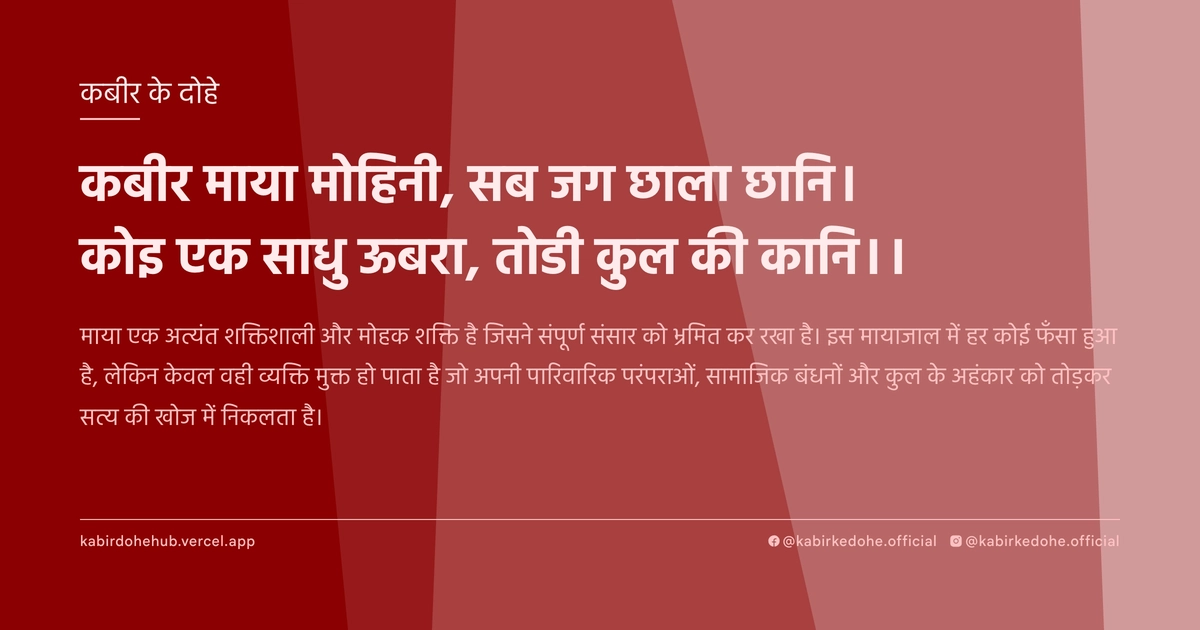
कबीर माया मोहिनी, सब जग छाला छानि।
कोइ एक साधु ऊबरा, तोडी कुल की कानि।।
Kabir maya mohini, sab jag chhala chhani. Koi ek sadhu ubara, todi kul ki kani.
इस पृष्ठ पर इस कबीर दोहे का अर्थ (meaning), हिंदी व्याख्या और अंग्रेज़ी अनुवाद, दार्शनिक विश्लेषण और व्यावहारिक जीवन सीख दी गई है। यह दोहा माया (Maya) विषय से जुड़ा है — Kabir doha meaning and explanation in Hindi and English.
अर्थ (Meaning):
माया एक अत्यंत शक्तिशाली और मोहक शक्ति है जिसने संपूर्ण संसार को भ्रमित कर रखा है। इस मायाजाल में हर कोई फँसा हुआ है, लेकिन केवल वही व्यक्ति मुक्त हो पाता है जो अपनी पारिवारिक परंपराओं, सामाजिक बंधनों और कुल के अहंकार को तोड़कर सत्य की खोज में निकलता है।
Maya is an incredibly potent and enchanting force that has deceived the entire world. Everyone is trapped in this web of illusion, and only the rare seeker—the true Sadhu—manages to escape by breaking the shackles of lineage, ancestral pride, and the restrictive norms of their social caste.
व्याख्या (Interpretation):
यहाँ 'माया' को एक 'मोहिनी' के रूप में चित्रित किया गया है, जो अपनी सुंदरता और आकर्षण से सत्य को ओझल कर देती है। इसका शाब्दिक अर्थ है कि संसार की भौतिक वस्तुएं और रिश्ते हमें भ्रमित करते हैं। आध्यात्मिक स्तर पर, यह 'अविद्या' है जो आत्मा को उसके वास्तविक स्वरूप (ब्रह्म) से अलग दिखाती है। 'कुल की कानि' का अर्थ है वह सामाजिक पहचान और पारिवारिक प्रतिष्ठा जिसे मनुष्य अपना गौरव मानता है, परंतु वास्तव में वह एक मानसिक कारागार है। जब साधक इस पहचान को त्यागता है, तब वह द्वैत से अद्वैत की ओर बढ़ता है। यह प्रक्रिया अहंकार के पूर्ण विसर्जन की मांग करती है। अंततः, मुक्ति केवल तभी संभव है जब व्यक्ति 'मैं' और 'मेरा' के दायरे से बाहर निकलकर निर्गुण ब्रह्म में लीन हो जाए।
Maya is personified here as a 'Mohini,' an enchantress who veils the ultimate truth with the shimmering facade of materiality. Literally, it suggests that worldly attachments blind us; metaphorically, it refers to 'Avidya' (ignorance) that creates the illusion of separation between the Atman and Brahman. The phrase 'Kul ki kaani' refers to the perceived prestige of lineage and caste, which acts as a psychological anchor preventing spiritual ascent. By breaking these ancestral chains, the seeker transitions from the fragmented identity of the ego to the unified consciousness of Nirgun Bhakti. The central paradox is that one must lose their social identity to find their cosmic identity. This is the path of non-duality, where the illusion of 'the other' is dissolved. Only through the annihilation of the social self can the universal self emerge.
दार्शनिक विश्लेषण (Philosophical Analysis):
कबीर का यह दोहा मध्यकालीन भारत के सामाजिक और धार्मिक परिवेश पर एक तीखा प्रहार है। उस समय समाज जाति, कुल और कर्मकांडों में गहराई से बंटा हुआ था। कबीर ने 'माया' को केवल धन-संपत्ति नहीं, बल्कि उस मानसिक प्रोग्रामिंग के रूप में देखा जो हमें यह विश्वास दिलाती है कि हम अपने कुल या जाति के कारण श्रेष्ठ हैं। यह दृष्टिकोण अद्वैत वेदांत के करीब है, जहाँ माना जाता है कि केवल ज्ञान (Jnana) ही अज्ञान के पर्दे को हटा सकता है।
सूफी मत के 'फना' (अहंकार का विनाश) के सिद्धांत के साथ इसका गहरा संबंध है। कबीर तर्क देते हैं कि जब तक व्यक्ति अपनी पारिवारिक और सामाजिक पहचान को ढोता रहता है, वह ईश्वर के करीब नहीं पहुँच सकता क्योंकि ईश्वर किसी कुल या जाति का नहीं, बल्कि संपूर्ण अस्तित्व का है। यह 'निर्गुण भक्ति' का सार है—एक ऐसे ईश्वर की उपासना जो निराकार है और जिसे किसी मंदिर, मस्जिद या कुल की सीमाओं में नहीं बांधा जा सकता।
कबीर यहाँ ritualism (कर्मकांड) का विरोध करते हैं। उनके अनुसार, कुल की परंपराओं का पालन करना आध्यात्मिक प्रगति नहीं, बल्कि एक मानसिक बंधन है। वे बताते हैं कि समाज जिसे 'सम्मान' कहता है, वह वास्तव में आत्मा की बेड़ियाँ हैं। यह विश्लेषण मनोवैज्ञानिक स्तर पर भी सटीक है; हमारा 'ईगो' हमारी सामाजिक पहचान से निर्मित होता है, और जब तक यह पहचान बनी रहती है, हम सत्य के प्रति अंधे रहते हैं।
इस दोहे में 'साधु' शब्द का प्रयोग किसी विशेष वस्त्रधारी व्यक्ति के लिए नहीं, बल्कि उस 'जागरूक चेतना' के लिए किया गया है जिसने माया के खेल को पहचान लिया है। वह व्यक्ति जो यह समझ जाता है कि संसार एक स्वप्न है, वही वास्तव में जागृत है। यह बोध ही उसे भीड़ से अलग करता है और उसे उस परम सत्य की ओर ले जाता जहाँ कोई भेद नहीं बचता।
अंततः, कबीर यह संदेश देते हैं कि मुक्ति का मार्ग बाहरी नहीं, आंतरिक है। यह बाहरी दुनिया की जीत नहीं, बल्कि आंतरिक अहंकार की हार है। जब हम यह स्वीकार कर लेते हैं कि हमारा कुल, हमारा नाम और हमारी प्रतिष्ठा केवल माया के द्वारा रचे गए मुखौटे हैं, तब हम वास्तव में स्वतंत्र होते हैं। यही वह बिंदु है जहाँ मानव अपनी सीमितता को छोड़कर अनंतता में विलीन हो जाता है।
Kabir’s couplet is a profound critique of the socio-religious fabric of medieval India, a period characterized by rigid caste hierarchies and ritualistic obsession. He expands the definition of 'Maya' beyond mere material wealth, framing it as a psychological conditioning that binds an individual to their perceived social status and ancestral lineage. This aligns closely with Advaita Vedanta, which posits that 'Avidya' (ignorance) is the primary obstacle to realizing the oneness of the soul and the Absolute.
There is a striking resonance here with the Sufi concept of 'Fana'—the annihilation of the self. Kabir argues that as long as a person clings to the identity provided by their 'Kul' (clan), they remain trapped in duality. Since the Divine is Nirgun (formless and attributeless), it cannot be accessed through the narrow corridors of caste or kinship. The rejection of ritualism is central here; Kabir suggests that adhering to ancestral norms is not a virtue but a spiritual shackle that prevents the soul from experiencing universal love.
From a psychological perspective, Kabir identifies the 'social ego' as the primary veil. The prestige we derive from our family name is a construct of Maya, designed to keep us anchored in the realm of illusion. By urging the seeker to 'break the chain of the clan,' Kabir is calling for a radical psychological shift—a movement from the conditional identity ('I am a son of X' or 'I belong to Y caste') to the unconditional identity ('I am the Eternal Spirit').
The 'Sadhu' mentioned is not a religious mendicant but a symbol of awakened consciousness. This individual has achieved 'Viveka' (discernment), the ability to distinguish between the transient (Maya) and the eternal (Brahman). The struggle described is not against an external enemy, but against the internal tendency to seek validation through social structures.
Ultimately, Kabir posits that liberation is an act of courage. It requires the bravery to be an outcast in the eyes of the world to become an insider in the realm of Truth. By dismantling the ego's reliance on lineage, the seeker transcends the human condition of limitation and enters the state of Kaivalya or Moksha, where the distinction between the seeker and the sought vanishes entirely.
मूल संदेश (Core Message):
- माया एक सुंदर भ्रम है जो सत्य को ढकता है।
- सामाजिक पहचान आत्मा की वास्तविक स्वतंत्रता में बाधा है।
- कुल और जाति का अहंकार आध्यात्मिक प्रगति का शत्रु है।
- मुक्ति केवल अहंकार के पूर्ण विसर्जन से संभव है।
- सत्य किसी परंपरा का नहीं, बल्कि सार्वभौमिक चेतना का है।
- Maya is a beautiful illusion that veils the ultimate truth.
- Social identity is a barrier to the soul's true liberation.
- The pride of lineage and caste is the enemy of spiritual growth.
- Liberation is possible only through the total dissolution of the ego.
- Truth belongs to universal consciousness, not to any specific tradition.
व्यावहारिक उदाहरण (Practical Example):
एक समय की बात है, राजस्थान के एक छोटे से गाँव में माधव नाम का एक कुम्हार रहता था। माधव का परिवार पीढ़ियों से राजाओं के लिए विशेष मिट्टी के पात्र बनाता था, और उन्हें अपने 'राज-कुम्हार' होने के अहंकार में बहुत गर्व था। माधव का पूरा जीवन इसी पहचान को बनाए रखने में बीता। वह अन्य साधारण कुम्हारों को तुच्छ समझता था क्योंकि उसका कुल 'उच्च' माना जाता था।
एक दिन गाँव में एक फकीर आया, जिसने माधव के घमंड को चुनौती दी। फकीर ने कहा, 'मिट्टी तो सबकी एक है, फिर तुम इस मिट्टी के बर्तन को ऊँचा और उस मिट्टी के बर्तन को नीचा कैसे कह सकते हो?' माधव को यह बात चुभी, लेकिन उसने अपनी कुल की प्रतिष्ठा के कारण फकीर का अपमान किया।
कुछ समय बाद, भीषण अकाल पड़ा। राजा का दरबार बिखर गया और माधव की सारी प्रतिष्ठा मिट्टी में मिल गई। वह भूख से तड़पने लगा। तब उसे याद आया कि जिन 'साधारण' कुम्हारों को वह तुच्छ समझता था, वे एक-दूसरे की मदद कर रहे थे और शांति से जी रहे थे।
माधव ने महसूस किया कि उसकी 'राज-कुम्हार' वाली पहचान ने उसे वास्तव में अकेला कर दिया था। वह पहचान एक माया थी जिसने उसे मानवता से दूर रखा था। उसने अपने भीतर के उस अहंकार को देखा जो उसे दूसरों से श्रेष्ठ बताता था।
एक रात, उसने अपनी पुरानी पारिवारिक वंशावली और उन सभी प्रमाण पत्रों को जला दिया जो उसकी 'श्रेष्ठता' सिद्ध करते थे। उसने तय किया कि वह अब किसी कुल का हिस्सा नहीं, बल्कि केवल एक इंसान है।
उसने गाँव के सबसे गरीब कुम्हार के पास जाकर माफी मांगी और उसके साथ मिलकर काम करना शुरू किया। उसने पाया कि जब उसने अपनी 'कुल की कानि' (कुल की मर्यादा/अहंकार) को तोड़ा, तो उसे एक ऐसी शांति मिली जो उसे कभी राज-दरबार में नहीं मिली थी।
अब वह केवल बर्तन नहीं बनाता था, बल्कि वह मिट्टी के माध्यम से प्रेम और समानता का संदेश फैलाता था। उसकी कला में अब एक नई गहराई थी क्योंकि वह अब अहंकार से नहीं, बल्कि समर्पण से सृजन कर रहा था।
माधव का यह रूपांतरण इस बात का प्रमाण था कि जब तक हम अपनी सामाजिक पहचान के पिंजरे में बंद रहते हैं, हम सत्य को नहीं देख पाते। जैसे ही वह पिंजरा टूटता है, आत्मा का विस्तार होता है।
गाँव के लोग अब उसे 'राज-कुम्हार' नहीं, बल्कि 'साधु माधव' कहने लगे। उसने माया की मोहिनी शक्ति को पहचान लिया था और अब वह वास्तव में स्वतंत्र था।
उसकी कहानी यह सिखाती है कि असली प्रतिष्ठा कुल में नहीं, बल्कि उस करुणा में है जो हमें हर जीव से जोड़ती है।
Once, in a small village in Rajasthan, lived a potter named Madhav. His family had been crafting exclusive pottery for royalty for generations, and they took immense pride in their identity as 'Royal Potters.' Madhav spent his entire life upholding this prestige, viewing other ordinary potters as inferior because his lineage was considered 'superior.'
One day, a wandering mystic arrived in the village and challenged Madhav's pride. The mystic asked, 'The clay is the same for everyone; how can you claim one vessel is higher than another simply because of who molded it?' Madhav felt insulted, and driven by his ancestral pride, he dismissed the mystic with contempt.
Soon after, a devastating famine struck the region. The royal court collapsed, and Madhav's perceived status vanished overnight. He found himself starving and destitute, stripped of the prestige he had clung to his whole life.
In his desperation, he noticed that the 'ordinary' potters, whom he had once looked down upon, were surviving by supporting one another. They shared their meager resources and lived in harmony, untouched by the vanity of rank.
Madhav realized that his identity as a 'Royal Potter' was a veil of Maya. It had not provided him security or peace; instead, it had isolated him from his fellow humans and blinded him to the truth of equality.
One night, in a moment of profound clarity, he burned the ancestral scrolls and certificates that documented his 'superior' lineage. He decided that he was no longer a member of a specific clan, but simply a human being.
He approached the poorest potter in the village, asked for forgiveness, and began working alongside him. He discovered that by breaking the 'Kul ki kaani' (the shackles of lineage), he attained a serenity that the royal courts could never offer.
His art underwent a transformation. He no longer created vessels to impress power, but to express love and humility. His work gained a spiritual depth because it was born from surrender rather than ego.
Madhav's transformation proved that as long as we are imprisoned by our social identities, we cannot perceive the ultimate truth. The moment the cage of identity breaks, the soul expands to encompass the universe.
The villagers stopped calling him the 'Royal Potter' and began calling him 'Sadhu Madhav.' He had seen through the enchantments of Maya and was finally free.
His story teaches that true nobility does not reside in one's ancestry, but in the compassion that connects us to every living soul.
अभ्यास मार्गदर्शन (Practice Guidance):
- प्रतिदिन 20 मिनट मौन ध्यान करें, जहाँ आप अपनी सभी सामाजिक पहचानों (नाम, पद, जाति, परिवार) को मानसिक रूप से उतार दें और केवल एक 'साक्षी' के रूप में स्वयं को देखें।
- एक 'अहंकार डायरी' लिखें: उन क्षणों को दर्ज करें जब आपको अपनी पारिवारिक या शैक्षिक श्रेष्ठता के कारण दूसरों पर गर्व महसूस हुआ, और फिर विश्लेषण करें कि उस भावना ने आपको सत्य से कैसे दूर किया।
- सचेत व्यवहार परिवर्तन: सप्ताह में एक बार किसी ऐसे व्यक्ति की सेवा करें जिसे समाज 'निम्न' मानता है, और इस प्रक्रिया में अपनी श्रेष्ठता के भाव को पूरी तरह मिटाने का प्रयास करें।
- निदान चेकलिस्ट: क्या मैं अपनी पहचान के लिए दूसरों की स्वीकृति पर निर्भर हूँ? क्या मुझे अपनी कुल/जाति की बात सुनकर गर्व या क्रोध आता है? यदि हाँ, तो आप अभी भी माया के प्रभाव में हैं।
- Practice 20 minutes of silent meditation daily, mentally stripping away all social identities (name, title, caste, family) and observing yourself solely as a 'Witness' (Sakshi).
- Maintain an 'Ego Journal': Record moments when you felt a sense of superiority based on your lineage or education, then analyze how that feeling created a barrier between you and others.
- Conscious Behavioral Shift: Once a week, perform a selfless act of service for someone marginalized by society, focusing entirely on dissolving any internal sense of hierarchy.
- Diagnostic Checklist: Do I rely on external validation of my status? Do I feel a surge of pride or anger when my lineage/caste is mentioned? If yes, you are still under the spell of Maya.
चिंतन प्रश्न (Reflection Questions):
- यदि आपसे आपकी सारी पारिवारिक और व्यावसायिक पहचान छीन ली जाए, तो 'आप' वास्तव में कौन बचेंगे?
- आपकी कौन सी ऐसी गुप्त मान्यताएं हैं जो आपको दूसरों से श्रेष्ठ महसूस कराती हैं, और वे आपकी आध्यात्मिक यात्रा को कैसे बाधित कर रही हैं?
- क्या आपका 'डिजिटल व्यक्तित्व' (सोशल मीडिया प्रोफाइल) आधुनिक युग की एक नई 'माया' है, जो आपको वास्तविक आत्म-साक्षात्कार से दूर ले जा रही है?
- आप अपनी परंपराओं का पालन श्रद्धा से कर रहे हैं या केवल इसलिए क्योंकि आप अपने कुल की 'मर्यादा' को बनाए रखना चाहते हैं?
- क्या आप वास्तव में स्वतंत्र हैं, या आप केवल उन बेड़ियों के अभ्यस्त हो चुके हैं जिन्हें समाज 'सम्मान' कहता है?
- If all your familial and professional identities were stripped away, who would 'you' actually be?
- What hidden beliefs make you feel superior to others, and how are they obstructing your spiritual journey?
- Is your 'digital persona' (social media profile) a modern form of Maya, distancing you from authentic self-realization?
- Do you follow your traditions out of genuine spiritual conviction or simply to maintain the 'honor' of your lineage?
- Are you truly free, or have you simply become accustomed to the chains that society labels as 'prestige'?