
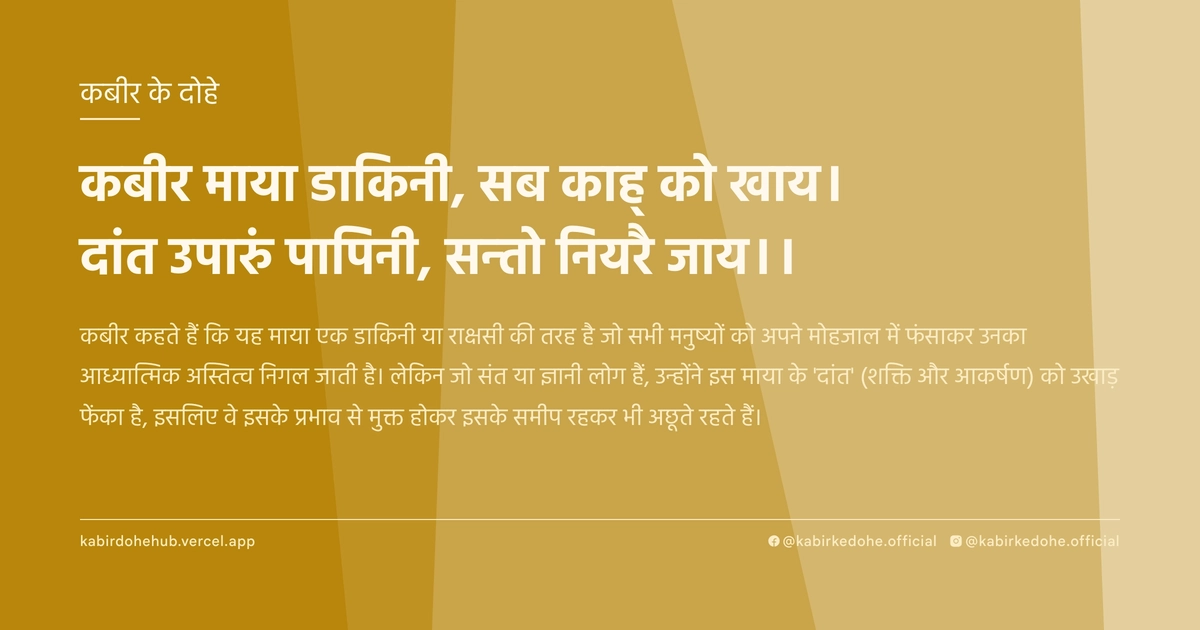
कबीर माया डाकिनी, सब काह् को खाय।
दांत उपारुं पापिनी, सन्तो नियरै जाय।।
Kabir maya dakini, sab kah ko khaye. Dant uparun papini, santo niyare jaaye.
इस पृष्ठ पर इस कबीर दोहे का अर्थ (meaning), हिंदी व्याख्या और अंग्रेज़ी अनुवाद, दार्शनिक विश्लेषण और व्यावहारिक जीवन सीख दी गई है। यह दोहा माया (Maya) विषय से जुड़ा है — Kabir doha meaning and explanation in Hindi and English.
अर्थ (Meaning):
कबीर कहते हैं कि यह माया एक डाकिनी या राक्षसी की तरह है जो सभी मनुष्यों को अपने मोहजाल में फंसाकर उनका आध्यात्मिक अस्तित्व निगल जाती है। लेकिन जो संत या ज्ञानी लोग हैं, उन्होंने इस माया के 'दांत' (शक्ति और आकर्षण) को उखाड़ फेंका है, इसलिए वे इसके प्रभाव से मुक्त होकर इसके समीप रहकर भी अछूते रहते हैं।
Kabir describes Maya as a predatory demoness (Dakini) who consumes the spiritual essence of all human beings through attachment and illusion. However, the enlightened saints have effectively 'plucked out the teeth' of this illusory power, meaning they have neutralized its grip, allowing them to exist within the material world without being consumed by it.
व्याख्या (Interpretation):
यहाँ 'माया' को एक डाकिनी के रूप में चित्रित करना उसकी विनाशकारी और भ्रामक प्रकृति को दर्शाता है। शाब्दिक अर्थ में, माया वह पर्दा है जो सत्य को छुपाता है, लेकिन रूपक के स्तर पर, यह अहंकार और भौतिक इच्छाओं का जाल है। 'दांत उपारना' का अर्थ है विवेक (Discernment) के माध्यम से माया के आकर्षण को समाप्त करना। यह निर्गुण भक्ति का सार है, जहाँ ईश्वर किसी मूर्ति में नहीं बल्कि उस शून्य में है जहाँ माया का अंत होता है। जब साधक यह जान लेता है कि संसार नश्वर है, तो माया की शक्ति समाप्त हो जाती है। यह अद्वैत वेदांत के उस सिद्धांत को पुष्ट करता है जहाँ जीव और ब्रह्म की एकता को पहचानने पर द्वैत का भ्रम मिट जाता है। अंततः, यह दोहे का संदेश है कि संसार से भागना समाधान नहीं है, बल्कि संसार में रहकर उससे निर्लिप्त रहना ही वास्तविक मुक्ति है।
The depiction of Maya as a 'Dakini' serves as a powerful metaphor for the predatory nature of illusion that devours human consciousness. Literally, Maya is the veil that obscures the Absolute Truth; metaphorically, it represents the cycle of desire and ego. 'Plucking out the teeth' symbolizes the use of Viveka (spiritual discernment) to neutralize the seductive power of the material world. This aligns with Nirgun Bhakti, where the Divine is realized not through form, but through the dissolution of the illusory self. In the framework of Advaita Vedanta, this process is the realization of non-duality, where the perceived separation between the Atman and Brahman is revealed as a falsehood. The central paradox presented is that the saint does not flee from the world but dwells within it, yet remains untouched, transforming the world from a prison into a playground of consciousness.
दार्शनिक विश्लेषण (Philosophical Analysis):
कबीर का यह दोहा उस सामाजिक और धार्मिक परिवेश की प्रतिक्रिया है जहाँ कर्मकांड और बाहरी आडंबरों को मोक्ष का मार्ग बताया जाता था। कबीर ने स्पष्ट किया कि असली शत्रु कोई बाहरी राक्षस नहीं, बल्कि आंतरिक 'माया' है जो मनुष्य को संकीर्ण पहचानों, जाति और धर्म के अहंकार में बांधे रखती है। यह दृष्टिकोण सूफीवाद के 'फना' (अहंकार का विनाश) के करीब है, जहाँ साधक अपनी व्यक्तिगत पहचान को ईश्वर की इच्छा में विलीन कर देता है।
दार्शनिक रूप से, कबीर यहाँ माया को एक सक्रिय शक्ति के रूप में देखते हैं जो अज्ञानता (Avidya) को पोषित करती है। जब तक मनुष्य स्वयं को शरीर और मन मानता है, वह माया का ग्रास बना रहता है। अद्वैत वेदांत के अनुसार, माया वास्तव में 'मिथ्या' है, लेकिन इसकी प्रभावशीलता तब तक बनी रहती है जब तक ज्ञान का उदय न हो। कबीर का 'दांत उखाड़ने' का आह्वान वास्तव में उस मानसिक रूपांतरण की मांग है जहाँ व्यक्ति भौतिक सुखों के प्रति अपनी आसक्ति को पूरी तरह समाप्त कर देता है।
यह दोहा ritualism के विरुद्ध एक कड़ा प्रहार है। कबीर का तर्क है कि तीर्थयात्रा या व्रत रखने से माया का अंत नहीं होता, क्योंकि ये क्रियाएं स्वयं माया के विस्तार का हिस्सा हो सकती हैं यदि उनमें अहंकार छिपा हो। वास्तविक शुद्धि केवल आंतरिक साक्षी भाव (Witness Consciousness) से आती है।
मनोवैज्ञानिक स्तर पर, यह दोहा संज्ञानात्मक पुनर्गठन (Cognitive Restructuring) की बात करता है। माया वह मानसिक प्रोग्रामिंग है जो हमें बताती है कि 'यह मेरा है' या 'मैं यह हूँ'। जब यह प्रोग्रामिंग टूटती है, तो व्यक्ति भय और लोभ से मुक्त हो जाता है।
अंततः, कबीर एक ऐसे मार्ग का प्रस्ताव करते हैं जहाँ आध्यात्मिक उपलब्धि का पैमाना यह नहीं है कि आप दुनिया से कितना दूर गए, बल्कि यह है कि दुनिया आपके भीतर कितनी कम प्रभावी रही। यह 'सहज' मार्ग है, जहाँ गृहस्थ जीवन जीते हुए भी निर्वाण संभव है।
This couplet is a profound critique of the socio-religious climate of Kabir's era, where ritualism and external piety were falsely marketed as paths to liberation. Kabir identifies the true adversary not as an external demon, but as the internal 'Maya'—the psychological construct of attachment that binds humans to narrow identities of caste, creed, and ego. This perspective mirrors the Sufi concept of 'Fana' (annihilation of the self), where the individual ego is dissolved into the Divine Will.
Philosophically, Kabir treats Maya as an active force that nourishes Avidya (spiritual ignorance). As long as the individual identifies with the physical body and the fluctuating mind, they remain prey to this illusory force. In Advaita Vedanta, Maya is described as 'Mithya' (relative reality), yet its grip is absolute until the dawn of Jnana (knowledge). Kabir's metaphor of 'plucking the teeth' is a call for a radical mental shift—the total neutralization of the seductive pull of material existence.
This teaching is a direct assault on ritualism. Kabir argues that pilgrimages or fasts cannot defeat Maya if they are performed with a sense of spiritual pride, as such acts merely reinforce the ego. True liberation comes only through the cultivation of the Witness Consciousness (Sakshi), which observes the world without being entangled by it.
Psychologically, the doha addresses the process of cognitive restructuring. Maya is the mental programming that whispers 'this is mine' or 'I am this.' When this identification is severed through self-inquiry, the grip of fear and greed vanishes, leaving behind a state of equanimity.
Ultimately, Kabir proposes a path where spiritual achievement is not measured by the distance one travels from the world, but by the degree to which the world ceases to exert power over the inner self. This is the 'Sahaja' path—the way of spontaneous enlightenment within the ordinary flow of life.
मूल संदेश (Core Message):
- माया एक भ्रम है जो हमें हमारी वास्तविक दिव्यता से दूर रखता है।
- अहंकार और आसक्ति ही वे दांत हैं जिनसे माया हमें जकड़ती है।
- विवेक और ज्ञान के माध्यम से इस मोहजाल को तोड़ा जा सकता है।
- संसार का त्याग नहीं, बल्कि संसार के प्रति आसक्ति का त्याग ही मुक्ति है।
- जब 'मैं' मिट जाता है, तब केवल शाश्वत सत्य शेष रहता है।
- Maya is the cosmic illusion that obscures our inherent divinity.
- Ego and attachment are the teeth through which illusion consumes us.
- Discernment and self-knowledge are the only tools to break this cycle.
- Liberation is not fleeing the world, but dissolving attachment to it.
- When the false 'I' vanishes, only the Eternal Truth remains.
व्यावहारिक उदाहरण (Practical Example):
एक समय की बात है, वाराणसी के घाटों पर रहने वाले एक वृद्ध विधवा, जानकी, का जीवन अत्यंत कठिन था। वह दूसरों के घरों में छोटे-मोटे काम करके अपना गुजारा करती थी। समाज ने उसे 'अशुभ' मानकर हाशिए पर धकेल दिया था, और वह स्वयं भी इस दुख और तिरस्कार को अपनी नियति मानकर गहरे अवसाद में डूबी रहती थी। वह मानती थी कि उसका जीवन केवल कष्ट सहने के लिए है।
एक दिन उसकी मुलाकात एक घुमंतू साधु से हुई, जिसने उसे कबीर का यह दोहा सुनाया। साधु ने उसे समझाया कि उसकी पीड़ा बाहरी समाज के कारण नहीं, बल्कि इस भ्रम के कारण है कि वह केवल एक 'अशुभ विधवा' है। यह पहचान ही वह 'माया' है जिसने उसके जीवन के आनंद के दांत उखाड़ दिए थे।
जानकी ने गहराई से विचार किया। उसने महसूस किया कि वह जिस दुख को अपना सच मान रही थी, वह वास्तव में समाज द्वारा थोपी गई एक कहानी थी। उसने तय किया कि वह अब अपनी पहचान इस सामाजिक लेबल से नहीं, बल्कि अपनी आंतरिक शांति से जोड़ेगी।
शुरुआत में यह कठिन था। जब लोग उसे ताने देते, तो उसे क्रोध आता। लेकिन वह हर बार खुद से कहती, 'यह माया की डाकिनी है जो मुझे फिर से पकड़ना चाहती है।' उसने अपने भीतर के उस 'दांत' को उखाड़ने का प्रयास किया जो उसे दूसरों की स्वीकृति का भूखा बनाता था।
धीरे-धीरे, जानकी का व्यवहार बदलने लगा। उसने घाट पर आने वाले अनाथ बच्चों को पढ़ाना शुरू किया। उसने अपने छोटे से कमरे को एक ऐसी जगह बना दिया जहाँ कोई भी बिना किसी भेदभाव के आकर बैठ सकता था।
उसकी आँखों में अब करुणा थी, न कि शिकायत। लोग हैरान थे कि जो महिला कभी झुककर चलती थी, अब वह इतनी गरिमा और आत्मविश्वास के साथ कैसे बात करती है।
एक दिन एक अमीर व्यापारी ने उसे दान देना चाहा, लेकिन जानकी ने विनम्रता से मना कर दिया। उसने कहा, 'मुझे अब किसी बाहरी सहारे की आवश्यकता नहीं है, मैंने अपनी खुशी का स्रोत अपने भीतर खोज लिया है।'
यह जानकी का 'कबीर ट्विस्ट' था। उसने माया (सामाजिक पहचान और तिरस्कार) को पूरी तरह नष्ट नहीं किया, बल्कि उसके प्रभाव को समाप्त कर दिया। वह उसी समाज में रही, लेकिन अब वह समाज उसे नियंत्रित नहीं करता था।
उसका जीवन अब एक जीवित उदाहरण था कि कैसे एक व्यक्ति अपनी सबसे बड़ी कमजोरी को अपनी सबसे बड़ी ताकत में बदल सकता है।
अंत में, जानकी ने सिद्ध किया कि जब हम अपनी झूठी पहचान के मोह को छोड़ देते हैं, तो हम दुनिया के बीच रहकर भी मुक्त हो सकते हैं।
Once, in the bustling ghats of Varanasi, lived an elderly widow named Janaki. Her life was a grueling cycle of poverty and social exclusion. Having been labeled 'inauspicious' by the community, she was pushed to the fringes of society. Janaki had internalized this stigma, believing that her existence was defined solely by suffering and rejection. She lived in a deep, suffocating depression, convinced that her identity was that of a victim.
One afternoon, she encountered a wandering mystic who recited Kabir's doha about the demoness Maya. The mystic explained that her agony did not stem from the society's cruelty, but from the illusion that she was merely an 'unlucky widow.' This false identity was the 'Maya' that had devoured her spirit.
Janaki began to contemplate this. She realized that the pain she carried was not an inherent truth, but a narrative imposed upon her by others, which she had blindly accepted. She decided to stop seeking validation from a world that had rejected her and instead anchor her identity in her own inner stillness.
The transition was not easy. Whenever people sneered at her, old wounds would reopen. However, she began to observe her reactions as if they belonged to someone else. She would tell herself, 'This is the Dakini of Maya trying to pull me back into the trap of ego and pain.' She consciously worked to 'pluck out the teeth' of her dependency on social approval.
Gradually, a transformation took place. Janaki started teaching the orphaned children who wandered the ghats. Her small, dilapidated room became a sanctuary where anyone, regardless of caste or status, could find peace and a listening ear.
Her eyes, once clouded with resentment, now shone with an unconditional compassion. The townspeople were bewildered; the woman who once walked with a hunched back now carried herself with an aura of immense dignity and quiet power.
One day, a wealthy merchant, moved by her serenity, offered her a large sum of money. Janaki politely declined, stating, 'I no longer require external anchors for my peace; I have discovered the source of joy within.'
This was Janaki's 'Kabir Twist.' She did not flee the society that hated her, nor did she try to change the world through force. Instead, she changed her internal relationship with the world. She remained in the same environment, but the environment no longer had power over her.
Her life became a living testament to the fact that the greatest liberation is not the absence of struggle, but the absence of identification with that struggle.
In the end, Janaki proved that when one ceases to believe in the lie of a limited identity, they become invincible even in the midst of adversity.
अभ्यास मार्गदर्शन (Practice Guidance):
- दैनिक साक्षी भाव: दिन में तीन बार 10 मिनट के लिए बैठें और अपने विचारों को ऐसे देखें जैसे आप किसी अजनबी को देख रहे हों। यह पहचानें कि 'मैं' विचार नहीं, बल्कि विचार का दृष्टा हूँ।
- माया की पहचान डायरी: जब भी आप अत्यधिक क्रोध, लोभ या ईर्ष्या महसूस करें, तो उसे लिखें। विश्लेषण करें कि किस 'झूठी पहचान' (माया) ने आपको इस भावना में धकेला।
- अनासक्ति अभ्यास: किसी ऐसी वस्तु या स्थिति का चयन करें जिससे आप बहुत जुड़े हुए हैं। सचेत रूप से यह दोहराएं, 'यह अस्थायी है, यह मैं नहीं हूँ', और धीरे-धीरे अपनी मानसिक पकड़ ढीली करें।
- डायग्नोस्टिक चेकलिस्ट: क्या मैं दूसरों की राय से विचलित होता हूँ? क्या मेरी खुशी बाहरी परिस्थितियों पर निर्भर है? क्या मैं अपनी पहचान अपनी उपलब्धियों या दुखों से जोड़ता हूँ? यदि हाँ, तो माया अभी भी प्रभावी है।
- Daily Witnessing: Spend 10 minutes three times a day observing your thoughts as if they belong to a stranger. Affirm: 'I am not the thought, I am the observer of the thought.'
- Maya Mapping Journal: Whenever you feel intense anger, greed, or jealousy, record it. Analyze which 'false identity' or attachment (Maya) triggered this specific emotional response.
- Detachment Exercise: Identify an object or social status you are deeply attached to. Consciously repeat, 'This is transient; this is not my essence,' and gradually loosen the mental grip.
- Diagnostic Checklist: Do I feel destabilized by others' opinions? Is my happiness contingent on external conditions? Do I define myself by my achievements or my traumas? If yes, Maya's 'teeth' are still intact.
चिंतन प्रश्न (Reflection Questions):
- मेरी वह कौन सी 'सामाजिक पहचान' है जिसे मैं सबसे अधिक सहेज कर रखता हूँ, और यदि वह छीन ली जाए, तो क्या मैं शून्य महसूस करूँगा?
- मेरे जीवन में 'माया' ने किस रूप में प्रवेश किया है—सफलता के अहंकार के रूप में या असफलता के शोक के रूप में?
- क्या मैं वास्तव में स्वतंत्र हूँ, या मेरी पसंद और विचार केवल दूसरों की अपेक्षाओं का प्रतिबिंब हैं?
- मेरे भीतर का वह कौन सा डर है जो मुझे सत्य को स्वीकार करने से रोकता है?
- यदि मैं अपनी सभी उपलब्धियों और रिश्तों को हटा दूँ, तो जो बचेगा, क्या मैं उसके साथ रहने का साहस रखता हूँ?
- Which 'social identity' do I cling to most fiercely, and if it were stripped away, would I feel like a void?
- In what form does Maya operate in my life—as the arrogance of success or the mourning of failure?
- Am I truly autonomous, or are my choices and beliefs merely reflections of external expectations?
- What is the specific fear within me that prevents me from accepting the Absolute Truth?
- If I remove all my achievements and relationships, do I have the courage to exist with the silence that remains?