
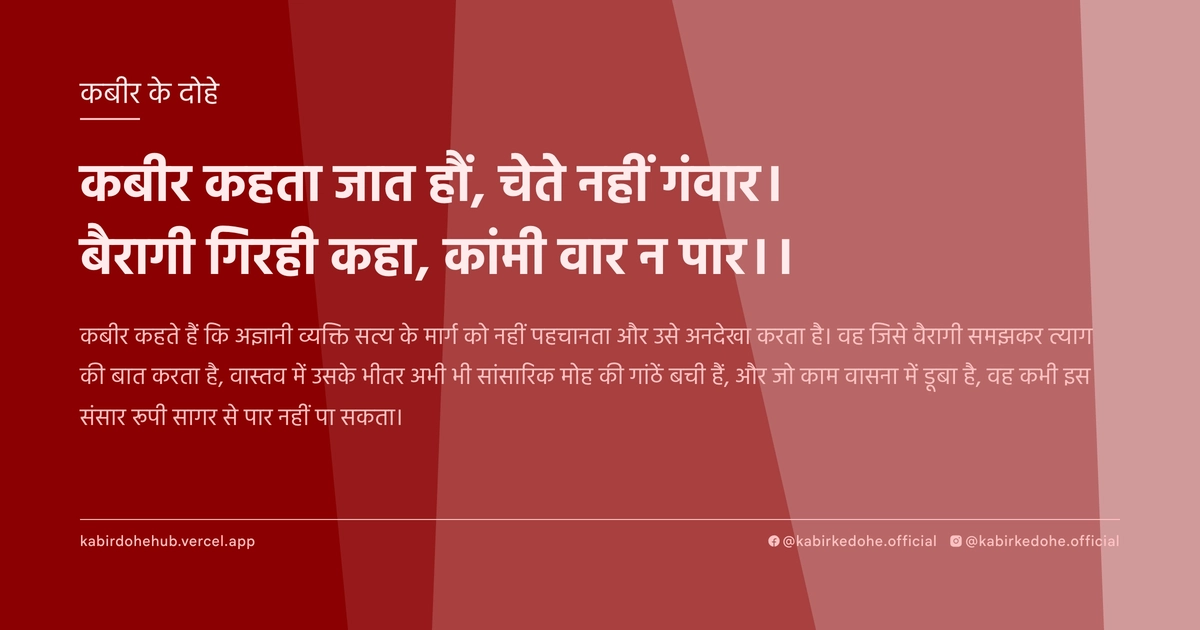
कबीर कहता जात हौं, चेते नहीं गंवार।
बैरागी गिरही कहा, कांमी वार न पार।।
Kabir kahta jaat haun, chete nahi ganvaar. Bairagi girhi kaha, kaami vaar na paar.
इस पृष्ठ पर इस कबीर दोहे का अर्थ (meaning), हिंदी व्याख्या और अंग्रेज़ी अनुवाद, दार्शनिक विश्लेषण और व्यावहारिक जीवन सीख दी गई है। यह दोहा अहंकार (The Ego) विषय से जुड़ा है — Kabir doha meaning and explanation in Hindi and English.
अर्थ (Meaning):
कबीर कहते हैं कि अज्ञानी व्यक्ति सत्य के मार्ग को नहीं पहचानता और उसे अनदेखा करता है। वह जिसे वैरागी समझकर त्याग की बात करता है, वास्तव में उसके भीतर अभी भी सांसारिक मोह की गांठें बची हैं, और जो काम वासना में डूबा है, वह कभी इस संसार रूपी सागर से पार नहीं पा सकता।
Kabir asserts that the ignorant person fails to recognize and heed the call of the ultimate truth. He suggests that those who merely pretend to be ascetics often harbor hidden knots of attachment, while those consumed by worldly desires and lust remain trapped, unable to cross the turbulent ocean of existence.
व्याख्या (Interpretation):
इस दोहे का शाब्दिक अर्थ यह है कि अज्ञानी व्यक्ति आध्यात्मिक जागृति के संकेतों को नहीं पहचानता। रूपक के स्तर पर, 'गंवार' वह मन है जो अहंकार के कारण सत्य को देखने में असमर्थ है। 'गिरही' या गांठ उन सूक्ष्म आसक्तियों का प्रतीक है जो बाहरी त्याग के बावजूद भीतर बनी रहती हैं। यह निर्गुण भक्ति का सार है, जहाँ बाहरी वेशभूषा के बजाय आंतरिक शुद्धि पर बल दिया गया है। कबीर यहाँ माया के उस भ्रम की बात कर रहे हैं जहाँ व्यक्ति सोचता है कि केवल घर छोड़ने से वह मुक्त हो गया, जबकि वास्तविक बंधन मन के भीतर हैं। यह आत्मा और ब्रह्म के मिलन में आने वाली बाधाओं—काम और मोह—को रेखांकित करता है।
Literally, the verse speaks of the ignorant failing to perceive spiritual truth. Metaphorically, the 'ganvaar' (ignorant) represents the ego-driven mind that is blind to the divine presence. The 'girhi' (knot) symbolizes the subtle attachments that persist even when one adopts the external appearance of a renunciant. This aligns with Nirgun Bhakti, emphasizing internal purity over external ritualism. Kabir highlights the illusion of Maya, where a seeker believes that physical renunciation equals spiritual liberation. The central paradox is that one can be a 'Bairagi' (ascetic) in dress but still a prisoner of desire, illustrating the gap between the perceived self and the true Atman-Brahman non-duality.
दार्शनिक विश्लेषण (Philosophical Analysis):
कबीर का यह दोहा उनके युग के पाखंड और कर्मकांडीय धर्म पर एक तीखा प्रहार है। उस समय धर्म केवल बाहरी प्रतीकों—जैसे गेरुए वस्त्र या माला—तक सीमित हो गया था। कबीर ने इस 'दिखावे की वैराग्य' को चुनौती दी और बताया कि वास्तविक वैराग्य मन का होता है, शरीर का नहीं। यह दृष्टिकोण अद्वैत वेदांत के करीब है, जहाँ अज्ञान (Avidya) को ही बंधन का मूल कारण माना गया है।
सूफी मत के 'फना' (अहंकार का विनाश) के समान, कबीर यहाँ काम और मोह के विनाश की बात करते हैं। उनके अनुसार, जब तक 'मैं' और 'मेरा' की भावना (ego) जीवित है, तब तक कोई भी व्यक्ति मुक्त नहीं हो सकता। वे स्पष्ट करते हैं कि केवल शास्त्र पढ़ने या तीर्थ यात्रा करने से मोक्ष नहीं मिलता, बल्कि अंतर्मन की गहराइयों में उतरकर वासनाओं का त्याग करना आवश्यक है।
ऐतिहासिक रूप से, कबीर ने जाति और वर्ग की सीमाओं को तोड़कर सत्य को सार्वभौमिक बनाया। उन्होंने यह स्थापित किया कि ईश्वर किसी विशेष समुदाय या वेशभूषा का नहीं है, बल्कि वह 'निर्गुण' है और हर उस हृदय में वास करता है जो वासनाओं से मुक्त है। यह सामाजिक क्रांति का आह्वान था, जहाँ व्यक्ति को अपनी आंतरिक स्थिति का विश्लेषण करने के लिए प्रेरित किया गया।
मनोवैज्ञानिक स्तर पर, यह दोहा संज्ञानात्मक विसंगति (cognitive dissonance) को दर्शाता है—जहाँ व्यक्ति बाहरी दुनिया को तो त्याग देता है, लेकिन आंतरिक इच्छाओं को दबाता है, जिससे वे और अधिक शक्तिशाली हो जाती हैं। कबीर सुझाव देते हैं कि इन 'गांठों' को पहचानना और उन्हें खोलना ही एकमात्र मार्ग है।
अंततः, यह शिक्षण हमें यह समझने पर मजबूर करता है कि आध्यात्मिक यात्रा बाहरी यात्रा नहीं, बल्कि एक आंतरिक यात्रा है। यह उस बिंदु की ओर ले जाता है जहाँ साधक यह महसूस करता है कि वह स्वयं ही वह सत्य है जिसे वह बाहर खोज रहा था, बशर्ते वह अपनी कामुक और मोहक प्रवृत्तियों को पूरी तरह विसर्जित कर दे।
This couplet is a sharp critique of the hypocrisy and ritualistic religion prevalent during Kabir's era. Spirituality had become reduced to external symbols—saffron robes or prayer beads. Kabir challenged this 'performative renunciation,' arguing that true detachment is a state of mind, not a change of wardrobe. This perspective aligns closely with Advaita Vedanta, where ignorance (Avidya) is identified as the root cause of bondage.
Similar to the Sufi concept of 'Fana' (the annihilation of the ego), Kabir emphasizes the destruction of lust and attachment. He posits that as long as the sense of 'I' and 'mine' persists, liberation remains an impossibility. He clarifies that salvation is not achieved through the rote reading of scriptures or pilgrimages, but through a descent into the depths of the soul to dissolve desires.
Historically, Kabir dismantled caste and class barriers by universalizing the truth. He established that the Divine is not the property of a specific community or attire but is 'Nirgun' (formless) and resides in every heart cleansed of passion. This was a call for social revolution, urging individuals to analyze their internal state rather than their social standing.
Psychologically, the verse addresses cognitive dissonance—where an individual renounces the world externally but suppresses desires internally, making them more potent. Kabir suggests that identifying and untying these 'knots' of attachment is the only viable path to peace.
Ultimately, this teaching forces us to realize that the spiritual journey is not an outward migration but an inward exploration. It leads the seeker to the realization that they are the very truth they seek, provided they completely surrender their lustful and clinging tendencies to the universal consciousness.
मूल संदेश (Core Message):
- बाहरी त्याग व्यर्थ है यदि आंतरिक वासनाएँ जीवित हैं।
- अहंकार सत्य को देखने के मार्ग में सबसे बड़ी बाधा है।
- वास्तविक वैराग्य मन की शांति है, न कि वस्त्रों का परिवर्तन।
- मोह की गांठें ही आत्मा को जन्म-मरण के चक्र में बांधती हैं।
- स्वयं को जानना ही संसार रूपी सागर से पार पाने का एकमात्र उपाय है।
- External renunciation is futile if internal lusts remain alive.
- The ego is the greatest obstacle on the path to perceiving Truth.
- True detachment is a state of mental peace, not a change of clothes.
- The knots of attachment bind the soul to the cycle of birth and death.
- Self-realization is the only way to cross the turbulent ocean of existence.
व्यावहारिक उदाहरण (Practical Example):
एक समय की बात है, वाराणसी के घाटों पर माधव नाम का एक वृद्ध बुनकर रहता था। माधव अपनी सादगी और ईमानदारी के लिए जाना जाता था, लेकिन उसके मन में एक गहरी टीस थी—वह अपने बेटे को शहर भेजकर बड़ा व्यापारी बनाना चाहता था। वह दिन-रात मेहनत करता ताकि उसका बेटा विलासिता का जीवन जी सके।
एक दिन माधव की मुलाकात एक घुमंतू साधु से हुई, जो कबीर के पदों का गान कर रहे थे। साधु ने माधव को देखा और मुस्कुराते हुए कहा, "तुम दुनिया के लिए बुनकर हो, लेकिन अपने मन के भीतर मोह की कितनी बड़ी गांठें बुन रहे हो?"
माधव को पहले तो यह बात समझ नहीं आई। उसने सोचा कि बेटे के लिए प्रेम करना क्या गलत है? लेकिन जैसे-जैसे दिन बीते, उसने महसूस किया कि उसका यह 'प्रेम' वास्तव में उसकी अपनी अधूरी इच्छाओं का प्रतिबिंब था। वह चाहता था कि उसका बेटा वह मुकाम हासिल करे जो वह खुद नहीं कर पाया।
उसका बेटा शहर जाकर अहंकारी हो गया और उसने अपने पिता की सादगी का उपहास करना शुरू कर दिया। माधव टूट गया। उसे अहसास हुआ कि उसने जिस 'सफलता' का सपना देखा था, वह वास्तव में एक मानसिक बंधन था जिसने उसे और उसके बेटे, दोनों को अलग कर दिया था।
उस रात माधव ने कबीर के उसी दोहे को याद किया। उसने महसूस किया कि वह बाहरी तौर पर तो एक साधारण बुनकर था, लेकिन भीतर से वह 'काम' और 'मोह' की उन गांठों से बंधा था, जिन्हें वह प्रेम समझ बैठा था।
उसने तय किया कि वह अब अपने बेटे की भौतिक सफलता के लिए नहीं, बल्कि उसकी आत्मिक शांति के लिए प्रार्थना करेगा। उसने अपनी उम्मीदों का बोझ उतार फेंका और अपने काम को ईश्वर की सेवा मानकर करने लगा।
जैसे ही माधव ने अपनी आंतरिक 'गिरही' (गांठ) खोली, उसके मन में एक असीम शांति छा गई। उसने पाया कि जब उसने पकड़ना छोड़ दिया, तो वह वास्तव में स्वतंत्र हो गया।
कुछ समय बाद, उसका बेटा भी जीवन की भागदौड़ से थककर वापस लौटा। उसने अपने पिता की आँखों में वह शांति देखी जो उसे करोड़ों रुपयों में नहीं मिली थी। माधव के इस रूपांतरण ने उसके बेटे को भी सत्य की ओर मोड़ दिया।
Once in the ghats of Varanasi, there lived an elderly weaver named Madhav. Madhav was known for his simplicity and honesty, but within him lay a deep, hidden ache—he desperately wanted his son to become a wealthy merchant in the city. He worked tirelessly, day and night, so his son could live a life of luxury.
One day, Madhav encountered a wandering monk who was singing the verses of Kabir. The monk looked at Madhav and smiled, saying, "You are a weaver for the world, but how many great knots of attachment are you weaving within your own mind?"
At first, Madhav did not understand. He wondered, "Is it wrong to love my son and want the best for him?" But as days passed, he realized that this 'love' was actually a reflection of his own unfulfilled desires. He wanted his son to achieve the status he himself had failed to attain.
His son, after moving to the city, became arrogant and began to mock his father's simplicity. Madhav was devastated. He realized that the 'success' he had dreamed of was actually a mental shackle that had estranged him from his own child.
That night, Madhav recalled Kabir's couplet. He understood that while he appeared as a simple weaver externally, internally he was bound by 'knots' of desire and attachment, which he had mistaken for love.
He decided that he would no longer pray for his son's material success, but for his spiritual peace. He dropped the burden of his expectations and began to treat his weaving as a service to the Divine.
As soon as Madhav untied the internal 'girhi' (knot), an infinite peace descended upon his heart. He discovered that the moment he stopped clinging, he truly became free.
After some time, his son returned, exhausted by the rat race of city life. He saw in his father's eyes a serenity that millions of rupees could not buy. Madhav's transformation eventually led his son back toward the path of truth.
अभ्यास मार्गदर्शन (Practice Guidance):
- प्रतिदिन 20 मिनट मौन ध्यान करें, जहाँ आप अपने भीतर उठने वाली इच्छाओं को केवल एक साक्षी (witness) की तरह देखें, बिना उन्हें सही या गलत ठहराए।
- एक 'आसक्ति पत्रिका' (Attachment Journal) बनाएँ। लिखें कि आप किन लोगों या वस्तुओं से इतने गहराई से जुड़े हैं कि उनके बिना आप अधूरा महसूस करते हैं, और विश्लेषण करें कि यह प्रेम है या अहंकार।
- व्यवहार परिवर्तन: दिन में कम से कम एक ऐसा कार्य करें जिसमें आपको कोई श्रेय (credit) न मिले और जिसे आप पूरी तरह गुमनामी में करें, ताकि 'अहंकार की गांठ' ढीली हो सके।
- निदान चेकलिस्ट: क्या मैं अपनी पहचान अपने पद, संपत्ति या रिश्तों से जोड़ता हूँ? क्या दूसरों की सफलता मुझे बेचैन करती है? क्या मैं बाहरी दिखावे को आंतरिक शांति से अधिक महत्व देता हूँ? यदि हाँ, तो आप अभी भी 'गंवार' अवस्था में हैं।
- Practice 20 minutes of silent meditation daily, observing the desires arising within you as a detached witness, without judging them as right or wrong.
- Maintain an 'Attachment Journal.' List the people or objects you are so deeply tied to that you feel incomplete without them, and analyze whether this is genuine love or egoic clinging.
- Behavioral Change: Perform at least one act of service daily that brings you no credit and is done in total anonymity, to loosen the 'knot of ego.'
- Diagnostic Checklist: Do I define my identity by my position, wealth, or relationships? Does the success of others make me restless? Do I value external appearances over internal peace? If yes, you are still in the state of the 'ignorant' (ganvaar).
चिंतन प्रश्न (Reflection Questions):
- मैं दुनिया को जो चेहरा दिखाता हूँ, और जो मैं वास्तव में भीतर हूँ, उनके बीच कितना अंतर है?
- मेरे जीवन की वह कौन सी 'गांठ' है जिसे मैं खोलने से सबसे ज्यादा डरता हूँ?
- क्या मेरी आध्यात्मिक खोज वास्तव में मुक्ति के लिए है, या यह केवल मेरी ईगो को 'विशेष' महसूस कराने का एक तरीका है?
- यदि मुझसे मेरी सभी सामाजिक पहचानें (नाम, पद, रिश्ता) छीन ली जाएँ, तो मेरे पास क्या बचेगा?
- मैं किन सूक्ष्म इच्छाओं को 'प्रेम' का नाम देकर अपने भीतर पाल रहा हूँ?
- How wide is the gap between the face I show the world and who I truly am inside?
- Which specific 'knot' in my life am I most afraid to untie?
- Is my spiritual quest truly for liberation, or is it just a way for my ego to feel 'special'?
- If all my social identities (name, rank, relationships) were stripped away, what would remain of me?
- Which subtle desires am I nurturing within, masking them under the name of 'love'?