
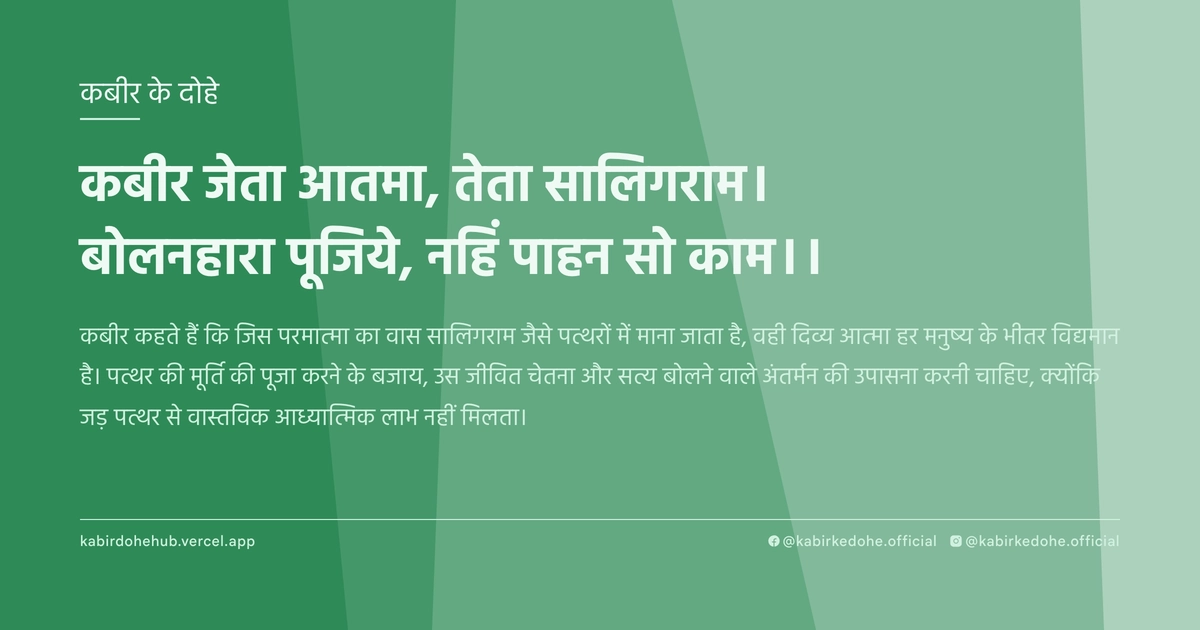
कबीर जेता आतमा, तेता सालिगराम।
बोलनहारा पूजिये, नहिं पाहन सो काम।।
Kabir jeta aatma, teta saligram. Bolanhaara poojiye, nahin pahan so kaam.
इस पृष्ठ पर इस कबीर दोहे का अर्थ (meaning), हिंदी व्याख्या और अंग्रेज़ी अनुवाद, दार्शनिक विश्लेषण और व्यावहारिक जीवन सीख दी गई है। यह दोहा अंतर ज्योति (The Inner Light) विषय से जुड़ा है — Kabir doha meaning and explanation in Hindi and English.
अर्थ (Meaning):
कबीर कहते हैं कि जिस परमात्मा का वास सालिगराम जैसे पत्थरों में माना जाता है, वही दिव्य आत्मा हर मनुष्य के भीतर विद्यमान है। पत्थर की मूर्ति की पूजा करने के बजाय, उस जीवित चेतना और सत्य बोलने वाले अंतर्मन की उपासना करनी चाहिए, क्योंकि जड़ पत्थर से वास्तविक आध्यात्मिक लाभ नहीं मिलता।
Kabir asserts that the same divine essence attributed to the Saligram stone resides within the human soul. Instead of venerating a lifeless stone, one should worship the living consciousness and the speaking spirit within, for a silent stone cannot provide the spiritual liberation that a living realization can.
व्याख्या (Interpretation):
इस दोहे का शाब्दिक अर्थ है कि आत्मा और सालिगराम एक ही तत्व हैं। कबीर यहाँ एक गहरे विरोधाभास को उजागर करते हैं: मनुष्य ईश्वर को खोजने के लिए मंदिरों और पत्थरों की शरण लेता है, जबकि वह स्वयं उस ईश्वर का प्रतिबिंब है। यह 'निर्गुण भक्ति' का सार है, जहाँ ईश्वर किसी आकार या मूर्ति में नहीं, बल्कि निराकार चेतना में है। 'बोलनहारा' शब्द केवल वाणी के लिए नहीं, बल्कि उस जीवंत सत्य के लिए है जो अनुभव के माध्यम से प्रकट होता है। यह अद्वैत वेदांत के उस सिद्धांत को पुष्ट करता है जहाँ आत्मा और ब्रह्म एक ही हैं, और माया के कारण हम स्वयं को पत्थर और ईश्वर को अलग मानते हैं।
Literally, the verse suggests that the soul and the Saligram are identical in essence. Kabir highlights a profound paradox: humanity seeks the Divine in external stones while ignoring the living spark within. This is the core of Nirgun Bhakti, where God is not a sculpted form but a formless consciousness. The term 'Bolanhara' (the speaker) refers not to vocal speech, but to the living Truth that manifests through direct experience. It reinforces the Advaita Vedanta principle of non-duality, where the Atman and Brahman are one, and the illusion of Maya creates a false separation between the seeker and the sought.
दार्शनिक विश्लेषण (Philosophical Analysis):
कबीर का यह दोहा उनके युग के धार्मिक पाखंड और कर्मकांडीय कट्टरता पर एक तीखा प्रहार है। उस समय समाज मूर्ति पूजा और बाहरी अनुष्ठानों में इतना लिप्त था कि वे आंतरिक शुद्धि को पूरी तरह भूल चुके थे। कबीर ने स्पष्ट किया कि यदि ईश्वर सर्वव्यापी है, तो वह केवल एक विशिष्ट पत्थर में कैसे सीमित हो सकता है? यह विचार सूफीवाद के 'वहदत-अल-वजूद' (अस्तित्व की एकता) के करीब है, जहाँ पूरा ब्रह्मांड एक ही ईश्वरीय नूर का प्रतिबिंब है।
दार्शनिक स्तर पर, कबीर यहाँ 'जड़' (Inert) और 'चेतन' (Conscious) के बीच अंतर कर रहे हैं। पत्थर की पूजा करना मनोवैज्ञानिक रूप से एक सुरक्षा तंत्र है, जहाँ मनुष्य अपनी जिम्मेदारी से बचकर एक बाहरी वस्तु पर निर्भर हो जाता है। इसके विपरीत, आत्मा की पूजा करना स्वयं के भीतर उतरने का साहस है। यह अहंकार के विसर्जन की प्रक्रिया है, क्योंकि जब आप यह पहचान लेते हैं कि आप स्वयं वह दिव्य तत्व हैं, तो 'मैं' और 'वह' का द्वैत समाप्त हो जाता है।
अद्वैत वेदांत के परिप्रेक्ष्य में, यह दोहा 'नेति-नेति' (यह नहीं, वह नहीं) की प्रक्रिया है। कबीर कहते हैं कि सत्य न तो मंदिर में है, न मस्जिद में, और न ही किसी पत्थर की आकृति में। सत्य वह शुद्ध चेतना है जो शब्दों और रूपों से परे है। यह विश्लेषण हमें सिखाता है कि धर्म केवल परंपराओं का पालन नहीं है, बल्कि स्वयं के वास्तविक स्वरूप की खोज है।
कबीर की यह दृष्टि सामाजिक समानता को भी जन्म देती है। यदि हर व्यक्ति के भीतर वही 'सालिग्राम' (दिव्यता) है, तो जाति, वर्ण और वर्ग का कोई आधार नहीं रह जाता। यह विचार उस समय के ब्राह्मणवादी वर्चस्व को चुनौती देता था, जो केवल कुछ विशिष्ट लोगों को ही ईश्वर के करीब मानता था।
अंततः, यह दोहा मनोवैज्ञानिक रूपांतरण की बात करता है। जब साधक बाहरी प्रतीकों को त्यागकर आंतरिक मौन और जीवंतता की ओर बढ़ता है, तब वह वास्तव में 'जागृत' होता है। यह पत्थर की मृत शांति से आत्मा की जीवंत शांति की ओर संक्रमण है।
This couplet is a sharp critique of the religious hypocrisy and ritualistic rigidity of Kabir's era. Society was so immersed in idol worship and external rituals that internal purification was entirely neglected. Kabir argues that if God is omnipresent, how can He be confined to a specific stone? This aligns closely with the Sufi concept of 'Wahdat-al-Wujud' (Unity of Existence), where the entire universe is a reflection of a single Divine Light.
On a philosophical level, Kabir distinguishes between the 'Jad' (Inert) and the 'Chetan' (Conscious). Worshipping a stone is psychologically a defense mechanism, where the individual avoids personal responsibility by relying on an external object. In contrast, worshipping the soul requires the courage to dive inward. This is the process of ego-annihilation; once you realize you are that divine element, the duality of 'I' and 'Thou' vanishes.
From the perspective of Advaita Vedanta, this verse embodies the process of 'Neti-Neti' (not this, not that). Kabir posits that Truth resides neither in temples, nor mosques, nor in sculpted forms. Truth is the pure consciousness beyond words and shapes. This analysis teaches us that religion is not the adherence to tradition, but the discovery of one's true nature.
Kabir's vision also fosters social equality. If the same 'Saligram' (divinity) resides within every person, then caste, creed, and class lose their validity. This challenged the Brahmanical hegemony of the time, which claimed that only a few privileged individuals were close to the Divine.
Ultimately, the verse speaks of psychological transformation. When a seeker abandons external symbols for internal silence and vitality, they truly 'awaken.' It is a transition from the dead silence of stone to the living peace of the soul.
मूल संदेश (Core Message):
- बाहरी प्रतीकों का मोह आध्यात्मिक अंधापन है।
- सत्य किसी पत्थर में नहीं, बल्कि जीवित चेतना में है।
- अहंकार का विसर्जन ही वास्तविक पूजा है।
- मानवता की सेवा ही ईश्वर की सच्ची आराधना है।
- आत्मा और परमात्मा के बीच का भेद केवल एक भ्रम है।
- Attachment to external symbols is spiritual blindness.
- Truth resides not in stone, but in living consciousness.
- The dissolution of ego is the only true worship.
- Serving humanity is the sincerest adoration of God.
- The distinction between soul and Supreme Soul is a mere illusion.
व्यावहारिक उदाहरण (Practical Example):
वाराणसी के एक पुराने घाट पर माधव नाम का एक वृद्ध मूर्तिकार रहता था। माधव का पूरा जीवन पत्थरों को तराशने और उन्हें देवताओं का रूप देने में बीता था। वह मानता था कि उसकी कला ही उसे मोक्ष दिलाएगी और वह अपनी बनाई मूर्तियों की पूजा में घंटों बिताता था।
एक दिन, माधव की मुलाकात एक फकीर से हुई जो घाट की सीढ़ियों पर चुपचाप बैठा था। माधव ने गर्व से अपनी सबसे सुंदर मूर्ति दिखाई और कहा, 'देखो, मैंने ईश्वर को पत्थर में उतार दिया है।' फकीर मुस्कुराया और माधव की आँखों में देखते हुए पूछा, 'क्या यह पत्थर तुम्हें बता सकता है कि तुम कौन हो?'
माधव चुप रहा। उसने कभी इस बारे में नहीं सोचा था। फकीर ने कहा, 'तुम पत्थर को तो जीवित कर देते हो, लेकिन अपने भीतर की जीवित आत्मा को पत्थर बना चुके हो। तुम उस पत्थर की पूजा कर रहे हो जिसे तुमने बनाया है, जबकि तुम्हें उस बनाने वाले की पूजा करनी चाहिए जो तुम्हारे भीतर है।'
यह बात माधव के हृदय में गहरे तक उतर गई। उसने महसूस किया कि वह बाहरी सुंदरता के मोह में इतना अंधा हो गया था कि उसने अपने भीतर के शून्य और शांति को कभी महसूस ही नहीं किया। उसने देखा कि वह अपनी मूर्तियों के प्रति तो समर्पित था, लेकिन अपने आस-पास के दुखी लोगों के प्रति पूरी तरह उदासीन था।
अगले कुछ दिनों तक माधव ने मूर्ति बनाना बंद कर दिया। वह केवल मौन रहकर अपने भीतर की हलचल को देखने लगा। उसने महसूस किया कि जब वह किसी भूखे को रोटी देता है या किसी रोते हुए को सांत्वना देता है, तो उसे वही शांति मिलती है जो वह मंदिर की मूर्तियों में खोजता था।
एक शाम, जब वह गंगा किनारे बैठा था, उसे अचानक यह अहसास हुआ कि वह स्वयं एक जीवित मूर्ति है। उसकी करुणा, उसका प्रेम और उसकी जागरूकता ही असली 'सालिग्राम' हैं। उसने महसूस किया कि पत्थर की पूजा केवल एक माध्यम हो सकती है, लेकिन मंजिल तो स्वयं की आत्मा में विलीन होना है।
माधव का व्यवहार पूरी तरह बदल गया। अब वह मूर्तियाँ तो बनाता था, लेकिन उन्हें 'ईश्वर' मानकर नहीं, बल्कि कला के रूप में। उसने अपना अधिकांश समय गरीबों की सेवा और आत्म-चिंतन में लगाना शुरू कर दिया।
उसने पाया कि जब वह स्वयं को दूसरों में देखने लगा, तो उसका अहंकार गल गया। अब वह पत्थर की मूर्तियों के सामने सिर नहीं झुकाता था, बल्कि हर जीवित प्राणी में उस दिव्य आत्मा को प्रणाम करता था। यही उसकी वास्तविक आध्यात्मिक यात्रा की शुरुआत थी।
On an old ghat in Varanasi lived an elderly sculptor named Madhav. Madhav had spent his entire life carving stones and giving them the forms of deities. He believed his art would grant him salvation and spent hours worshipping the idols he created.
One day, Madhav met a fakir sitting silently on the steps of the ghat. Madhav proudly showed him his most beautiful sculpture and said, 'Look, I have brought God down into stone.' The fakir smiled and, looking into Madhav's eyes, asked, 'Can this stone tell you who you truly are?'
Madhav remained silent. He had never considered this. The fakir replied, 'You give life to stone, but you have turned the living soul within you into stone. You worship the stone you created, while you should worship the Creator who resides within you.'
These words pierced Madhav's heart. He realized he had been so blinded by external beauty that he had never felt the void and peace within. He noticed that while he was devoted to his idols, he was completely indifferent to the suffering people around him.
For the next few days, Madhav stopped sculpting. He sat in silence, observing the turbulence within. He discovered that when he fed a hungry person or comforted someone weeping, he felt the same peace he had sought in temple idols.
One evening, sitting by the Ganges, he suddenly realized that he himself was a living idol. His compassion, his love, and his awareness were the true 'Saligrams.' He understood that worshipping stone could be a medium, but the destination was merging with one's own soul.
Madhav's behavior transformed completely. He continued to sculpt, but no longer as 'Gods,' but as art. He dedicated most of his time to serving the poor and self-reflection.
He found that as he began to see himself in others, his ego dissolved. He no longer bowed before stone idols; instead, he bowed to the divine soul in every living being. This was the true beginning of his spiritual journey.
अभ्यास मार्गदर्शन (Practice Guidance):
- प्रतिदिन 20 मिनट 'साक्षी भाव' का अभ्यास करें: अपने विचारों को बिना किसी निर्णय के देखें, जैसे आप किसी बाहरी वस्तु को देख रहे हों।
- आत्म-पूछताछ जर्नल: प्रतिदिन एक प्रश्न लिखें—'आज मैंने किस व्यक्ति में अपनी ही आत्मा का प्रतिबिंब देखा?' और उसका ईमानदारी से विश्लेषण करें।
- व्यवहार परिवर्तन: किसी ऐसे व्यक्ति की निस्वार्थ सेवा करें जिससे आपका वैचारिक मतभेद हो, यह याद रखते हुए कि वह भी उसी एक चेतना का हिस्सा है।
- निदान चेकलिस्ट: क्या मैं अभी भी बाहरी प्रतीकों या दूसरों की मान्यता पर अपनी शांति निर्भर करता हूँ? क्या मैं जीवित मनुष्यों की तुलना में मृत परंपराओं को अधिक महत्व दे रहा हूँ?
- Practice 'Witness Consciousness' for 20 minutes daily: Observe your thoughts without judgment, as if you are watching an external object.
- Self-Inquiry Journal: Write one question daily—'In which person did I see a reflection of my own soul today?' and analyze it honestly.
- Behavioral Shift: Perform selfless service for someone with whom you have a conceptual disagreement, remembering they are part of the same single consciousness.
- Diagnostic Checklist: Am I still relying on external symbols or others' validation for my peace? Am I prioritizing dead traditions over living human beings?
चिंतन प्रश्न (Reflection Questions):
- मैं अपनी पहचान बाहरी उपलब्धियों और उपाधियों से जोड़ता हूँ या अपनी आंतरिक शांति से?
- क्या मेरी धार्मिकता दूसरों को नीचा दिखाने का एक साधन बन गई है?
- जब मैं किसी अजनबी को देखता हूँ, तो क्या मैं उसके सामाजिक मुखौटे को देखता हूँ या उसकी आत्मा को?
- मेरे जीवन का वह कौन सा 'पत्थर' (जड़ विश्वास) है जिसे मैं सत्य मानकर पकड़े हुए हूँ?
- क्या मैं अपनी आंतरिक आवाज़ सुनने के बजाय बाहरी शोर और परंपराओं को प्राथमिकता देता हूँ?
- Do I tie my identity to external achievements and titles, or to my internal peace?
- Has my religiosity become a tool to make others feel inferior?
- When I look at a stranger, do I see their social mask or their soul?
- What is the 'stone' (inert belief) in my life that I am clinging to as the absolute truth?
- Do I prioritize external noise and traditions over listening to my own inner voice?