
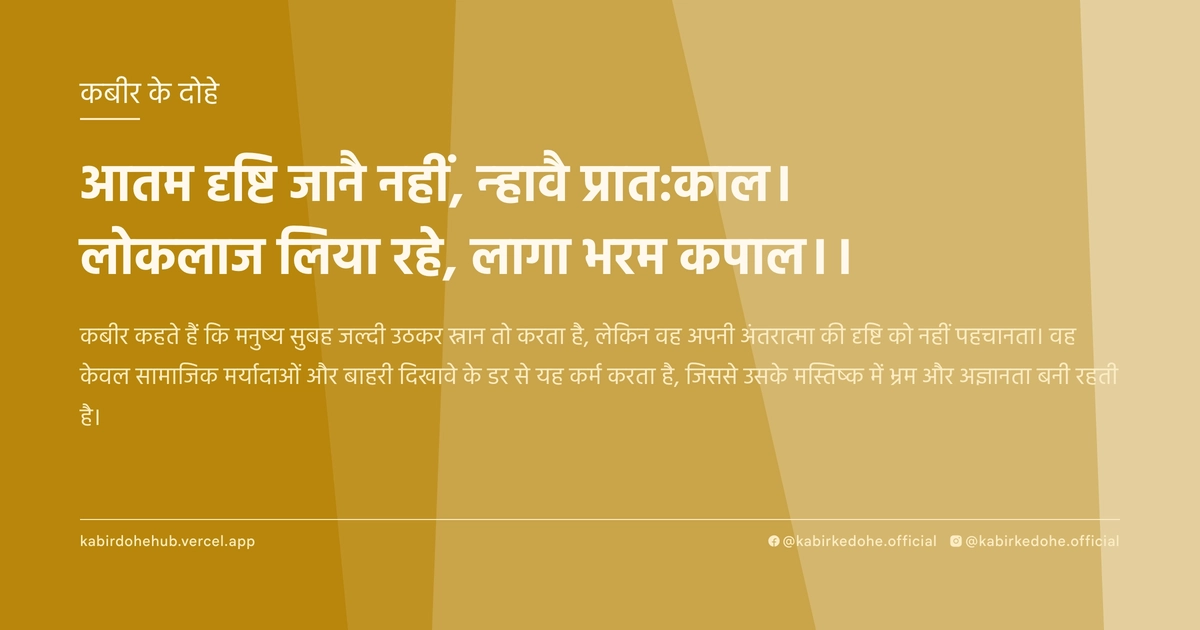
आतम दृष्टि जानै नहीं, न्हावै प्रात:काल।
लोकलाज लिया रहे, लागा भरम कपाल।।
Aatam drishti jaanai nahi, nhavai praat:kaal. Loklaaj liya rahe, laaga bharam kapaal.
इस पृष्ठ पर इस कबीर दोहे का अर्थ (meaning), हिंदी व्याख्या और अंग्रेज़ी अनुवाद, दार्शनिक विश्लेषण और व्यावहारिक जीवन सीख दी गई है। यह दोहा आत्मनिरीक्षण (Self-introspection) विषय से जुड़ा है — Kabir doha meaning and explanation in Hindi and English.
अर्थ (Meaning):
कबीर कहते हैं कि मनुष्य सुबह जल्दी उठकर स्नान तो करता है, लेकिन वह अपनी अंतरात्मा की दृष्टि को नहीं पहचानता। वह केवल सामाजिक मर्यादाओं और बाहरी दिखावे के डर से यह कर्म करता है, जिससे उसके मस्तिष्क में भ्रम और अज्ञानता बनी रहती है।
Kabir observes that a person bathes early in the morning to maintain a facade of purity, yet remains blind to the vision of the soul. Driven by the fear of social judgment and the desire for public approval, they cling to ritualistic habits while their mind remains clouded by deep-seated delusion.
व्याख्या (Interpretation):
इस दोहे का शाब्दिक अर्थ बाहरी शुद्धि और आंतरिक अज्ञान के बीच के विरोधाभास को दर्शाता है। यहाँ 'स्नान' केवल जल से शरीर धोना नहीं है, बल्कि उन सभी कर्मकांडों का प्रतीक है जो समाज में सम्मान पाने के लिए किए जाते हैं। 'आतम दृष्टि' का अर्थ है वह बोध जिससे आत्मा स्वयं को ब्रह्म के रूप में पहचानती है। कबीर तर्क देते हैं कि जब तक व्यक्ति 'लोकलाज' यानी सामाजिक प्रतिष्ठा के मोह में बंधा है, वह माया के प्रभाव में है। यह स्थिति अद्वैत वेदांत के उस सिद्धांत को पुष्ट करती है जहाँ अज्ञान (Avidya) के कारण जीव स्वयं को शरीर मानता है न कि शुद्ध चेतना। अंततः, यह दोहा बताता है कि बिना आत्म-साक्षात्कार के, सभी धार्मिक क्रियाएँ केवल एक मानसिक भ्रम हैं जो अहंकार को और पुष्ट करती हैं।
The literal meaning highlights the stark contrast between external cleansing and internal ignorance. Here, 'bathing' is not merely the act of washing the body with water, but a metaphor for all ritualistic performances executed to gain social validation. 'Aatam Drishti' refers to the spiritual insight through which the soul recognizes its identity as the formless Brahman. Kabir argues that as long as an individual is bound by 'Loklaaj'—the fear of social judgment—they remain trapped in the web of Maya. This aligns with the Advaita Vedanta principle where Avidya (ignorance) causes the soul to misidentify with the physical body rather than the pure consciousness. Ultimately, the couplet asserts that without self-realization, all religious rituals are mere mental delusions that serve only to reinforce the ego's fragility.
दार्शनिक विश्लेषण (Philosophical Analysis):
कबीर का यह दोहा उनके युग के उस सामाजिक परिवेश पर प्रहार करता है जहाँ धर्म केवल बाहरी प्रतीकों और कठोर कर्मकांडों तक सीमित हो गया था। उन्होंने स्पष्ट किया कि मोक्ष किसी विशेष समय पर स्नान करने या तीर्थयात्रा करने से नहीं, बल्कि अंतर्मुखी होने से मिलता है। यह दृष्टिकोण निर्गुण भक्ति मार्ग का आधार है, जहाँ ईश्वर को किसी मूर्ति या मंदिर में नहीं, बल्कि अपने भीतर खोजा जाता है।
दार्शनिक स्तर पर, कबीर यहाँ 'अहंकार' और 'सामाजिक मुखौटे' के बीच के संबंध को उजागर करते हैं। जब हम समाज को दिखाने के लिए धर्म का पालन करते हैं, तो हम वास्तव में ईश्वर की नहीं, बल्कि अपनी छवि (Image) की पूजा कर रहे होते हैं। यह सूफीवाद के 'नफ्स' (Khadir/Ego) के विचार के समान है, जहाँ अहंकार का विनाश ही सत्य तक पहुँचने का एकमात्र मार्ग है।
अद्वैत वेदांत के अनुसार, आत्मा और परमात्मा एक ही हैं। लेकिन 'लोकलाज' या सामाजिक दबाव एक ऐसी दीवार बन जाता है जो व्यक्ति को उसकी वास्तविक प्रकृति से दूर करता है। कबीर कहते हैं कि जो व्यक्ति बाहरी दुनिया की नजरों में 'पवित्र' दिखने की कोशिश करता है, वह वास्तव में अपनी आंतरिक पवित्रता को खो देता है क्योंकि उसका ध्यान बाहर है, भीतर नहीं।
यह दोहा जातिगत और श्रेणीगत श्रेष्ठता के दावों को भी चुनौती देता है। यदि पवित्रता केवल स्नान या वस्त्रों से आती, तो कोई भी बाहरी दिखावा व्यक्ति को संत बना देता। कबीर इस भ्रम को तोड़ते हुए कहते हैं कि वास्तविक शुद्धि मन के विकारों के अंत से होती है, न कि शरीर पर जल डालने से।
अंततः, कबीर मनोवैज्ञानिक रूपांतरण की बात करते हैं। वे चाहते हैं कि साधक 'भ्रम' (Delusion) के खोल को तोड़कर उस स्थिति में पहुँचे जहाँ न कोई देखने वाला हो और न ही दिखाने वाला। जब 'मैं' और 'मेरा' समाप्त हो जाता है, तभी वह 'आतम दृष्टि' जागृत होती है जो शाश्वत और अपरिवर्तनीय है।
This couplet strikes at the heart of the socio-religious climate of Kabir's era, where spirituality had been reduced to external symbols and rigid ritualism. He clarifies that liberation is not achieved through bathing at a specific hour or visiting pilgrimages, but through an inward journey. This perspective forms the bedrock of the Nirgun Bhakti path, where the Divine is sought not in idols or temples, but within the depths of one's own being.
On a philosophical level, Kabir exposes the symbiotic relationship between the 'ego' and the 'social mask.' When we practice religion to satisfy the gaze of society, we are not worshipping God, but rather our own curated image. This mirrors the Sufi concept of 'Nafs' (the lower self/ego), suggesting that the annihilation of the ego is the only gateway to Truth.
According to Advaita Vedanta, the Atman and Brahman are non-dual. However, 'Loklaaj' or social pressure acts as a veil that separates the individual from their true nature. Kabir posits that the person striving to appear 'pure' in the eyes of the world effectively loses their internal purity because their focus is shifted outward, away from the center of existence.
Furthermore, this verse challenges the claims of caste-based or hierarchical superiority. If purity were merely a result of bathing or wearing specific clothes, any superficial performance could create a saint. Kabir shatters this illusion, asserting that true purification occurs through the eradication of mental impurities, not the washing of the skin.
Ultimately, Kabir advocates for a psychological transformation. He urges the seeker to break the shell of 'Bharam' (delusion) and reach a state where there is no longer an observer to please nor a performer to be seen. Only when the 'I' and 'Mine' dissolve does the 'Aatam Drishti' awaken—a vision that is eternal, unchanging, and absolute.
मूल संदेश (Core Message):
- बाहरी कर्मकांड आंतरिक शून्यता को नहीं भर सकते।
- सामाजिक प्रतिष्ठा एक मानसिक जेल है जो आत्मा को कैद करती है।
- सच्ची पवित्रता व्यवहार में है, अनुष्ठानों में नहीं।
- अहंकार का विसर्जन ही वास्तविक ज्ञान का द्वार है।
- स्वयं को पहचानना ही सबसे बड़ा धर्म है।
- External rituals cannot fill an internal void of consciousness.
- Social prestige is a mental prison that incarcerates the soul.
- True purity resides in conduct, not in ceremonial acts.
- The dissolution of ego is the only gateway to real knowledge.
- Self-realization is the highest and only true religion.
व्यावहारिक उदाहरण (Practical Example):
एक समय की बात है, वाराणसी के घाटों पर रहने वाला एक वृद्ध बुनकर था जिसका नाम माधव था। माधव अपनी पूरी जिंदगी धर्म के कठोर नियमों का पालन करने में बिता चुका था। वह हर दिन सूर्योदय से पहले गंगा में डुबकी लगाता, माथे पर चंदन लगाता और शहर के सबसे बड़े मंदिर में घंटों प्रार्थना करता। लोग उसे एक अत्यंत पवित्र और धार्मिक व्यक्ति मानते थे और उसकी सलाह लेने आते थे।
लेकिन माधव के भीतर एक गहरा असंतोष था। वह बाहर से तो शांत दिखता था, पर उसके मन में अपने परिवार और पड़ोसियों के प्रति ईर्ष्या और क्रोध की अग्नि जलती रहती थी। वह अक्सर अपने बेटों को अनुशासन के नाम पर कठोरता से डांटता और दूसरों की गलतियों पर उन्हें नीचा दिखाता, जबकि खुद अंदर से असुरक्षित महसूस करता था।
एक दिन माधव की मुलाकात एक घुमंतू फकीर से हुई, जो घाट की सीढ़ियों पर चुपचाप बैठा था। फकीर ने माधव को देखा और मुस्कुराते हुए कहा, 'माधव, तुम रोज शरीर तो धोते हो, पर क्या कभी उस दर्पण को साफ किया जिसमें तुम्हारी आत्मा दिखती है?'
माधव को यह बात चुभी। उसने गर्व से कहा, 'मैं शहर का सबसे शुद्ध व्यक्ति हूँ, मैं हर सुबह ब्रह्म मुहूर्त में स्नान करता हूँ।' फकीर ने शांति से उत्तर दिया, 'स्नान जल से शरीर की मैल हटाता है, लेकिन अहंकार की मैल केवल आत्म-बोध से हटती है। तुम गंगा में नहीं, बल्कि समाज की नजरों में नहा रहे हो।'
यह बात माधव के हृदय पर बिजली की तरह गिरी। उसने महसूस किया कि उसका पूरा धार्मिक जीवन केवल एक 'परफॉरमेंस' था। वह इसलिए स्नान नहीं करता था कि वह ईश्वर से मिलना चाहता था, बल्कि इसलिए करता था ताकि लोग उसे 'पवित्र' कहें। उसकी पूरी पहचान 'लोकलाज' और सामाजिक प्रतिष्ठा पर टिकी थी।
अगले कुछ महीनों तक माधव ने बाहरी दिखावे को कम किया और मौन का अभ्यास शुरू किया। उसने गौर किया कि जब वह दूसरों को नीचा दिखाता था, तो वह वास्तव में अपने भीतर के डर को छिपा रहा होता था। उसने अपनी 'आतम दृष्टि' को जगाने के लिए आत्म-निरीक्षण करना शुरू किया।
उसने पाया कि असली शांति तब नहीं मिली जब वह मंदिर गया, बल्कि तब मिली जब उसने अपने बेटों को बिना किसी शर्त के क्षमा किया और अपने पड़ोसियों के प्रति करुणा महसूस की। उसने समझा कि पवित्रता का अर्थ यह नहीं है कि आप क्या पहनते हैं या कहाँ नहाते हैं, बल्कि यह है कि आप दूसरों के साथ कैसा व्यवहार करते हैं।
माधव अब भी सुबह स्नान करता था, लेकिन अब वह जल की बूंदों में अपनी आत्मा की गूँज सुनता था। वह अब 'पवित्र' दिखने की कोशिश नहीं करता था, बल्कि वह वास्तव में पवित्र होने लगा था। उसका जीवन अब सामाजिक दबाव से मुक्त होकर सहज और प्रेमपूर्ण हो गया था।
Once, in the ancient ghats of Varanasi, lived an elderly weaver named Madhav. Madhav had spent his entire life adhering to the strictest religious codes. Every day, before the first ray of sun, he would plunge into the Ganges, apply sandalwood paste to his forehead, and spend hours in prayer at the city's largest temple. The locals revered him as a man of immense purity and often sought his spiritual guidance.
However, beneath this facade, Madhav harbored a deep, simmering discontent. While he appeared serene to the world, his heart was a cauldron of jealousy and anger toward his family and neighbors. He often berated his sons in the name of discipline and belittled others' flaws, all while feeling profoundly insecure within himself.
One day, Madhav encountered a wandering fakir sitting silently on the stone steps of the ghat. The fakir looked at Madhav and smiled, asking, 'Madhav, you wash your body every day, but have you ever cleaned the mirror in which your soul is reflected?'
Stung by the remark, Madhav replied with pride, 'I am the purest man in this city; I bathe every morning during the Brahma Muhurta.' The fakir calmly responded, 'Water removes the grime from the skin, but the grime of the ego is removed only by self-awareness. You are not bathing in the Ganges; you are bathing in the eyes of society.'
These words struck Madhav like a bolt of lightning. He realized that his entire religious life had been a mere 'performance.' He didn't bathe because he longed for the Divine, but because he wanted the world to label him as 'pure.' His entire identity was anchored in 'Loklaaj'—the fear of social judgment and the hunger for prestige.
Over the following months, Madhav reduced his outward displays of piety and began practicing silence. He noticed that whenever he belittled others, he was actually trying to mask his own internal fears. He began a rigorous process of self-inquiry to awaken his 'Aatam Drishti.'
He discovered that true peace did not arrive when he entered the temple, but when he forgave his sons unconditionally and felt genuine compassion for his neighbors. He understood that purity is not defined by what one wears or where one bathes, but by how one treats another human being.
Madhav continued to bathe every morning, but now he listened for the echo of his soul in every drop of water. He no longer strove to 'look' pure; he began to actually 'be' pure. His life, once shackled by social pressure, became effortless, spontaneous, and filled with love.
अभ्यास मार्गदर्शन (Practice Guidance):
- प्रतिदिन 20 मिनट का मौन अभ्यास करें, जहाँ आप केवल अपने विचारों के साक्षी बनें, बिना उन्हें सही या गलत ठहराए।
- एक 'अहंकार डायरी' लिखें: दिन भर में उन क्षणों को नोट करें जब आपने किसी कार्य को केवल दूसरों को प्रभावित करने या अपनी छवि सुधारने के लिए किया।
- व्यवहार परिवर्तन: सप्ताह में एक बार ऐसा कार्य करें जो आपके सामाजिक स्तर या छवि के विपरीत हो, लेकिन नैतिक रूप से सही हो, ताकि आप 'लोकलाज' के डर को जीत सकें।
- डायग्नोस्टिक चेकलिस्ट: क्या मैं यह कार्य इसलिए कर रहा हूँ क्योंकि यह मेरी आत्मा की पुकार है, या इसलिए क्योंकि लोग इसे 'अच्छा' मानेंगे? यदि उत्तर दूसरा है, तो रुकें और पुनः विचार करें।
- Practice 20 minutes of daily silence, acting solely as a witness to your thoughts without judging them as right or wrong.
- Maintain an 'Ego Journal': Note moments throughout the day when you performed an action specifically to impress others or polish your public image.
- Behavioral Shift: Once a week, perform an act that contradicts your social standing or expected image but is ethically right, to consciously dismantle the fear of 'Loklaaj.'
- Diagnostic Checklist: Ask yourself, 'Am I doing this because it is a call from my soul, or because society deems it virtuous?' If the latter, pause and recalibrate.
चिंतन प्रश्न (Reflection Questions):
- मेरे जीवन के कौन से 'स्नान' (दिखावे) हैं जिन्हें मैं केवल समाज के डर से करता हूँ?
- यदि कल दुनिया से मेरी सारी सामाजिक पहचान मिट जाए, तो मेरे भीतर क्या बचेगा?
- क्या मेरी धार्मिकता दूसरों के प्रति मेरी करुणा को बढ़ाती है या मेरे अहंकार को पुष्ट करती है?
- मैं अपनी 'डिजिटल इमेज' को बनाए रखने के लिए अपनी आत्मा की कितनी सच्चाई की बलि देता हूँ?
- मेरे भीतर का वह कौन सा हिस्सा है जो अभी भी दूसरों की स्वीकृति का भूखा है?
- What are the 'ritual baths' in my life that I perform solely out of fear of social judgment?
- If all my social identities were erased tomorrow, what would remain of my inner self?
- Does my spirituality increase my compassion for others, or does it merely reinforce my own ego?
- How much of my soul's truth do I sacrifice to maintain a curated 'digital image'?
- Which part of me is still starving for the validation of strangers?