
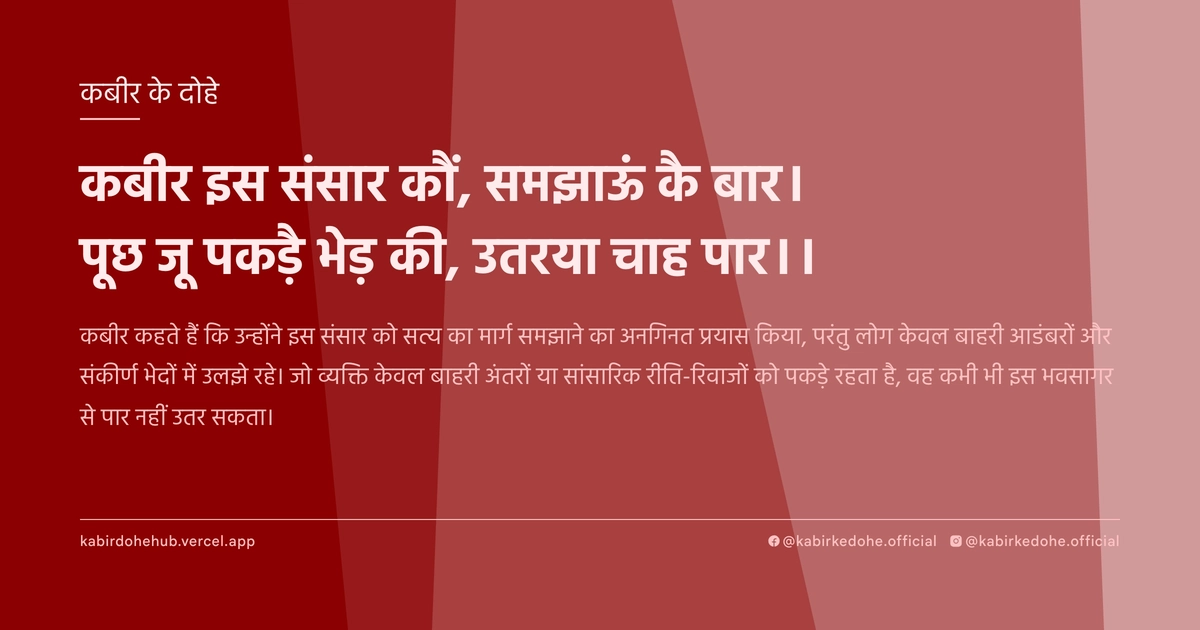
कबीर इस संसार कौं, समझाऊं कै बार।
पूछ जू पकडै़ भेड़ की, उतरया चाह पार।।
Kabir is sansar kaun, samjhaun kai baar. Poochh ju pakdai bhed ki, utarya chah paar.
इस पृष्ठ पर इस कबीर दोहे का अर्थ (meaning), हिंदी व्याख्या और अंग्रेज़ी अनुवाद, दार्शनिक विश्लेषण और व्यावहारिक जीवन सीख दी गई है। यह दोहा माया (Maya) विषय से जुड़ा है — Kabir doha meaning and explanation in Hindi and English.
अर्थ (Meaning):
कबीर कहते हैं कि उन्होंने इस संसार को सत्य का मार्ग समझाने का अनगिनत प्रयास किया, परंतु लोग केवल बाहरी आडंबरों और संकीर्ण भेदों में उलझे रहे। जो व्यक्ति केवल बाहरी अंतरों या सांसारिक रीति-रिवाजों को पकड़े रहता है, वह कभी भी इस भवसागर से पार नहीं उतर सकता।
Kabir laments that he has tried countless times to awaken the world to the ultimate truth, yet people remain clung to superficial differences and ritualistic divisions. He asserts that one who grasps only the 'horn' of duality or external distinctions can never cross the turbulent ocean of worldly existence.
व्याख्या (Interpretation):
इस दोहे का शाब्दिक अर्थ है कि संसार अपनी जिद और भेदों में अंधा है। यहाँ 'भेड़' या 'सींग' पकड़ने का रूपक उन मानसिक जकड़नों को दर्शाता है जहाँ मनुष्य जाति, धर्म और संप्रदाय के अहंकार में फंसा रहता है। निर्गुण भक्ति के परिप्रेक्ष्य में, यह 'माया' का प्रभाव है जो आत्मा को उसके वास्तविक स्वरूप (ब्रह्म) से अलग कर एक कृत्रिम पहचान देता है। जब तक साधक इस द्वैत (Duality) को नहीं छोड़ता, वह अद्वैत वेदांत के उस सत्य को नहीं पा सकता जहाँ आत्मा और परमात्मा एक हैं। यह विरोधाभास है कि मनुष्य मुक्ति चाहता है, लेकिन उन जंजीरों को कसकर पकड़े रहता है जो उसे बंधन में रखती हैं।
Literally, the verse describes the futility of preaching to those blinded by prejudice. The metaphor of 'grasping the horn' symbolizes the stubborn attachment to external identities and sectarian divisions. In the context of Nirgun Bhakti, this represents the grip of Maya, which creates a false sense of separation between the self and the Absolute. According to Advaita Vedanta, the illusion of duality is the primary obstacle to liberation. The central paradox highlighted here is the human tendency to seek liberation while simultaneously clinging to the very ego-driven labels that ensure their bondage. Only by releasing the 'horn' of distinction can one merge into the formless unity of Brahman.
दार्शनिक विश्लेषण (Philosophical Analysis):
कबीर का यह दोहा उनके युग के सामाजिक और धार्मिक पाखंड पर एक तीखा प्रहार है। 15वीं शताब्दी में, जब समाज जातिगत श्रेष्ठता और कर्मकांडों में विभाजित था, कबीर ने 'सहज मार्ग' का उपदेश दिया। उन्होंने स्पष्ट किया कि ईश्वर किसी मंदिर, मस्जिद या विशेष जाति के अधिकार में नहीं है, बल्कि वह 'घट-घट' में व्याप्त है। यह दृष्टिकोण सूफी मत के 'वहदत-अल-वजूद' (अस्तित्व की एकता) से मेल खाता है, जहाँ केवल एक ही परम सत्य है और बाकी सब उसका प्रतिबिंब है।
दार्शनिक स्तर पर, कबीर यहाँ 'अहंकार' के विलोपन की बात कर रहे हैं। जब मनुष्य कहता है 'मैं हिंदू हूँ' या 'मैं मुसलमान हूँ', तो वह वास्तव में सत्य के मार्ग में एक बाधा खड़ी कर रहा होता है। यह द्वैतवाद उसे सत्य के अनुभव से दूर ले जाता है। कबीर का तर्क है कि ज्ञान केवल शास्त्रों को पढ़ने से नहीं, बल्कि आंतरिक अनुभव और भेदों के त्याग से आता है।
वेदांत के अनुसार, जब तक 'मैं' और 'तू' का भेद रहता है, तब तक दुख बना रहता है। कबीर इस मनोवैज्ञानिक सत्य को सरल भाषा में समझाते हैं कि बाहरी पहचान एक बोझ है। जो व्यक्ति अपनी पहचान को सामाजिक श्रेणियों में खोजता है, वह वास्तव में अपनी आत्मा की अनंतता को सीमित कर रहा है।
यहाँ ritualism (कर्मकांड) की अस्वीकृति केवल बाहरी विरोध नहीं है, बल्कि एक आंतरिक आवश्यकता है। कर्मकांड अक्सर अहंकार को पुष्ट करते हैं ('मैं यह पूजा करता हूँ, इसलिए मैं श्रेष्ठ हूँ')। कबीर इस मनोवैज्ञानिक जाल को तोड़कर साधक को शून्य की ओर ले जाना चाहते हैं, जहाँ कोई भेद न रहे।
अंततः, यह दोहा हमें सिखाता है कि आध्यात्मिक प्रगति का अर्थ अधिक ज्ञान प्राप्त करना नहीं, बल्कि उस अज्ञान और उन पूर्वाग्रहों को छोड़ना है जिन्हें हमने अपनी पहचान मान लिया है। यह 'अन-लर्निंग' की प्रक्रिया है, जहाँ हम अपनी कृत्रिम परतों को हटाकर शुद्ध चेतना में विलीन होते हैं।
This couplet is a scathing critique of the social and religious hypocrisy prevalent during Kabir's era in the 15th century. At a time when society was rigidly fragmented by caste hierarchies and ritualistic dogma, Kabir advocated for the 'Sahaj Marg' (the Natural Path). He asserted that the Divine is not the property of any specific temple, mosque, or caste, but is immanent within every living being. This philosophy aligns closely with the Sufi concept of 'Wahdat-al-Wujud' (Unity of Existence), suggesting that there is only one Ultimate Reality, and all diversities are merely reflections of it.
On a deeper philosophical level, Kabir addresses the annihilation of the ego. When an individual identifies themselves through labels—such as religion or social status—they construct a mental barrier between themselves and the Truth. This duality is the root of all suffering. Kabir argues that true gnosis is not achieved through the rote memorization of scriptures, but through the experiential realization of oneness and the shedding of all distinctions.
From the lens of Advaita Vedanta, as long as the perception of 'I' and 'Other' persists, liberation remains elusive. Kabir simplifies this complex psychological truth: external identity is a burden. By seeking identity in social categories, a human being limits their infinite spiritual nature to a finite, fragile label.
His rejection of ritualism is not merely a social protest but a spiritual necessity. Rituals often reinforce the ego by creating a sense of spiritual superiority ('I perform this rite, therefore I am holier'). Kabir seeks to dismantle this psychological trap, guiding the seeker toward the state of 'Shunya' (Void/Zero), where all distinctions vanish.
Ultimately, the verse teaches that spiritual evolution is not about accumulating more knowledge, but about the process of 'un-learning.' It is the systematic removal of the artificial layers of identity to reveal the pure, unadulterated consciousness beneath. The 'horn' is the ego's grip on a false reality; letting go is the only way to cross the ocean of existence.
मूल संदेश (Core Message):
- बाहरी पहचान एक भ्रम है जो आत्मा को कैद करती है।
- सत्य किसी विशेष धर्म या जाति की बपौती नहीं है।
- अहंकार का त्याग ही वास्तविक आध्यात्मिक प्रगति है।
- द्वैत (भेद) को मिटाना ही अद्वैत (एकता) का मार्ग है।
- मुक्ति बाहरी कर्मकांडों में नहीं, आंतरिक शून्यता में है।
- जब 'मैं' मिटता है, तभी 'वह' प्रकट होता है।
- External identity is an illusion that imprisons the soul.
- Truth is not the monopoly of any specific religion or caste.
- The surrender of ego is the only genuine spiritual progress.
- Erasing duality is the only path to experiencing non-duality.
- Liberation lies not in rituals, but in internal emptiness.
- Only when the 'I' vanishes does the 'Divine' manifest.
व्यावहारिक उदाहरण (Practical Example):
वाराणसी के एक पुराने घाट पर माधव नाम का एक वृद्ध नाविक रहता था। माधव का जीवन केवल नाव चलाने और यात्रियों को पार उतारने तक सीमित था, लेकिन उसका मन हमेशा इस बात से अशांत रहता था कि वह एक 'निम्न' जाति से आता है और बड़े पंडितों के सामने सिर झुकाकर बात करता है। वह मानता था कि मुक्ति केवल उन लोगों को मिलेगी जिन्होंने वेदों का अध्ययन किया है या जो ऊँचे कुल में जन्मे हैं।
एक दिन, माधव की नाव पर एक फकीर सवार हुआ, जिसकी आँखों में एक अजीब सी शांति थी। फकीर ने देखा कि माधव बार-बार अपनी जाति और अपनी 'अयोग्यता' का जिक्र कर रहा था। फकीर ने मुस्कुराते हुए माधव से पूछा, "नाविक, जब तू किसी यात्री को नदी के पार ले जाता है, तो क्या तू उससे उसकी जाति पूछता है? क्या पानी केवल ऊँची जाति वालों को ही पार जाने देता है?"
माधव चुप रहा। फकीर ने आगे कहा, "नदी का पानी सबको एक समान देखता है। तूने अपनी पहचान को एक ऐसी रस्सी बना लिया है जिसने तुझे खुद से ही बाँध रखा है। तू मुक्ति की तलाश बाहर कर रहा है, जबकि तू खुद उस पार उतरने का माध्यम है।"
माधव को लगा जैसे किसी ने उसके दिमाग की खिड़की खोल दी हो। उसने महसूस किया कि वह जिस 'भेद' को पकड़कर बैठा था, वही उसकी सबसे बड़ी बाधा थी। उसने अब तक खुद को एक 'छोटा नाविक' माना था, लेकिन अब उसने महसूस किया कि वह केवल एक 'चेतना' है, जिसका कोई नाम या जाति नहीं है।
अगले कुछ महीनों में, माधव के व्यवहार में गहरा बदलाव आया। उसने पंडितों के सामने झुकना बंद नहीं किया, लेकिन अब वह डर या हीन भावना से नहीं, बल्कि करुणा से झुकता था। उसने महसूस किया कि सामने वाला व्यक्ति भी उसी भ्रम में फंसा है जिसमें वह खुद था।
उसने अपने साथ काम करने वाले अन्य नाविकों को भी यह बात समझानी शुरू की। उसने उन्हें सिखाया कि उनकी असली पहचान उनकी मेहनत और उनकी ईमानदारी है, न कि वह लेबल जो समाज ने उन्हें दिया है।
एक समय ऐसा आया जब माधव ने अपनी नाव को केवल पैसे कमाने का साधन नहीं, बल्कि एक 'साधना' बना लिया। वह हर यात्री को यह महसूस कराता कि वे सब एक ही सत्य के अंश हैं।
माधव की कहानी यह दिखाती है कि जब हम अपनी सामाजिक पहचान के 'सींग' को छोड़ देते हैं, तब हम वास्तव में स्वतंत्र होते हैं। उसकी मुक्ति किसी तीर्थ यात्रा से नहीं, बल्कि अपने भीतर के भेद को मिटाने से हुई।
In the ancient ghats of Varanasi lived an elderly boatman named Madhav. Madhav's life revolved around rowing passengers across the river, but his mind was perpetually troubled by the belief that he belonged to a 'low' caste. He lived in a state of perceived inferiority, believing that liberation was reserved for those who had studied the Vedas or were born into high-born families.
One day, a wandering dervish with eyes full of profound peace boarded his boat. The dervish noticed Madhav repeatedly mentioning his caste and his 'unworthiness' to reach the Divine. The dervish smiled and asked, "Boatman, when you ferry a passenger across this river, do you ask for their caste? Does the water allow only the high-born to cross?"
Madhav remained silent. The dervish continued, "The river treats everyone as one. You have turned your identity into a rope that has bound you to your own limitations. You seek liberation externally, while you yourself are the medium for crossing over."
It felt as if a window had been flung open in Madhav's mind. He realized that the 'distinction' he had been clinging to was the very obstacle preventing his peace. He had spent his life identifying as a 'lowly boatman,' never realizing he was simply 'consciousness'—without name, caste, or label.
Over the following months, a deep transformation occurred in Madhav. He stopped bowing to the priests out of fear or inferiority; instead, he bowed out of genuine compassion, realizing that those priests were also trapped in the same illusion of identity.
He began sharing this realization with other boatmen. He taught them that their true identity lay in their integrity and their service, not in the labels imposed upon them by a rigid society.
Eventually, Madhav transformed his boat into a place of spiritual practice. Every passenger he ferried was treated not as a customer, but as a fragment of the same Universal Truth.
Madhav's story illustrates that when we release the 'horn' of social identity, we find true freedom. His liberation did not come from a pilgrimage to a distant shrine, but from the annihilation of the internal divide.
अभ्यास मार्गदर्शन (Practice Guidance):
- दैनिक आत्म-निरीक्षण: दिन में तीन बार रुकें और स्वयं से पूछें, "इस समय मैं कौन हूँ?" क्या मैं अपनी नौकरी, अपनी जाति, या अपने धर्म की पहचान से बात कर रहा हूँ, या मैं केवल एक साक्षी (Observer) हूँ?
- मौन अभ्यास: प्रतिदिन 20 मिनट पूर्ण मौन में बैठें। जब भी मन में किसी व्यक्ति के प्रति कोई निर्णय (Judgment) या भेद आए, तो उसे केवल देखें और कहें, "यह मेरा अहंकार बोल रहा है, मैं नहीं।"
- सेवा बिना पहचान के: किसी ऐसे व्यक्ति की मदद करें जिसके प्रति आपके मन में स्वाभाविक रूप से कोई पूर्वाग्रह हो। यह अनुभव करें कि आपकी मदद करने की इच्छा और उनकी प्राप्त करने की आवश्यकता, दोनों एक ही स्रोत से आ रही हैं।
- डायग्नोस्टिक चेकलिस्ट: यदि आप अभी भी दूसरों को उनकी पहचान से आंकते हैं, या अपनी उपलब्धियों पर गर्व करते हैं, तो आप अभी भी 'सींग' पकड़े हुए हैं। यदि आप हर व्यक्ति में स्वयं का प्रतिबिंब देखते हैं, तो आप पार उतर रहे हैं।
- Daily Self-Inquiry: Three times a day, pause and ask yourself, "Who am I in this moment?" Am I speaking from the identity of my profession, my caste, or my religion, or am I simply the Witness (Sakshi)?
- Silence Practice: Sit in absolute silence for 20 minutes daily. Whenever a judgment or a sense of distinction arises toward another person, observe it and mentally note, "This is the ego speaking, not the True Self."
- Anonymous Service: Perform an act of kindness for someone toward whom you hold a subconscious prejudice. Experience the realization that your will to help and their need to receive both stem from the same universal source.
- Diagnostic Checklist: If you still categorize people by their labels or derive pride from your social status, you are still 'grasping the horn.' If you perceive your own reflection in every human being, you are successfully crossing the ocean.
चिंतन प्रश्न (Reflection Questions):
- मेरे जीवन का वह कौन सा 'सींग' (पहचान) है जिसे मैं सबसे मजबूती से पकड़े हुए हूँ और जिसे छोड़ने से मुझे डर लगता है?
- क्या मेरी धार्मिक या सामाजिक मान्यताएं मुझे दूसरों से जोड़ रही हैं, या वे मेरे चारों ओर एक दीवार खड़ी कर रही हैं?
- यदि कल मेरी सारी सामाजिक उपलब्धियां और पहचान छीन ली जाएं, तो मेरे भीतर क्या बचेगा?
- मैं अक्सर किन लोगों को 'अपने जैसा' और किनको 'अलग' मानता हूँ, और यह भेद मेरे भीतर किस डर से पैदा होता है?
- क्या मेरा आध्यात्मिक अभ्यास मुझे अधिक विनम्र बना रहा है, या यह मेरे भीतर एक 'आध्यात्मिक अहंकार' पैदा कर रहा है?
- What is the 'horn' (identity) in my life that I am clinging to most tightly, and why does the thought of letting it go terrify me?
- Do my religious or social beliefs connect me to others, or are they constructing a wall of separation around me?
- If all my social achievements and labels were stripped away tomorrow, what would actually remain within me?
- Whom do I categorize as 'like me' and whom as 'different,' and from what internal fear does this distinction arise?
- Is my spiritual practice making me more humble, or is it merely fueling a subtle 'spiritual ego'?