
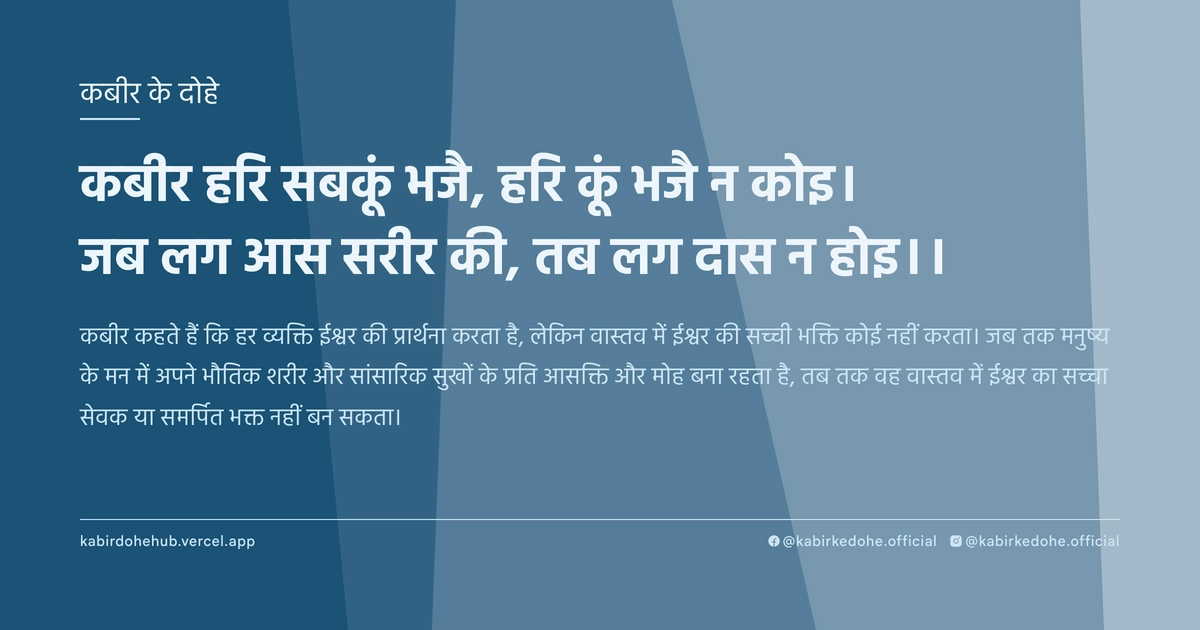
कबीर हरि सबकूं भजै, हरि कूं भजै न कोइ।
जब लग आस सरीर की, तब लग दास न होइ।।
Kabir hari sabkoon bhajai, hari koon bhajai na koi. Jab lag aas sareer ki, tab lag daas na hoye.
इस पृष्ठ पर इस कबीर दोहे का अर्थ (meaning), हिंदी व्याख्या और अंग्रेज़ी अनुवाद, दार्शनिक विश्लेषण और व्यावहारिक जीवन सीख दी गई है। यह दोहा भक्ति (Bhakti) विषय से जुड़ा है — Kabir doha meaning and explanation in Hindi and English.
अर्थ (Meaning):
कबीर कहते हैं कि हर व्यक्ति ईश्वर की प्रार्थना करता है, लेकिन वास्तव में ईश्वर की सच्ची भक्ति कोई नहीं करता। जब तक मनुष्य के मन में अपने भौतिक शरीर और सांसारिक सुखों के प्रति आसक्ति और मोह बना रहता है, तब तक वह वास्तव में ईश्वर का सच्चा सेवक या समर्पित भक्त नहीं बन सकता।
Kabir observes that while everyone claims to worship God, very few actually do so with true sincerity. As long as an individual remains attached to the physical body and clings to worldly desires and bodily existence, they cannot become a true servant or a genuine devotee of the Divine.
व्याख्या (Interpretation):
इस दोहे का शाब्दिक अर्थ है कि लोग ईश्वर को याद तो करते हैं, पर उनके उद्देश्य भौतिक होते हैं। गहरा आध्यात्मिक विश्लेषण यह दर्शाता है कि 'हरि' यहाँ केवल एक देवता नहीं, बल्कि उस निराकार ब्रह्म (Nirgun Brahman) का प्रतीक है जो सर्वव्यापी है। कबीर 'शरीर की आस' को माया का सबसे प्रबल बंधन बताते हैं। जब तक अहंकार (Ego) शरीर की पहचान से जुड़ा रहता है, वह आत्मा और परमात्मा के बीच एक दीवार बनकर खड़ा रहता है। यह द्वैत (Duality) ही दुख का कारण है। जब शरीर का मोह मिटता है, तब 'दास' भाव जागृत होता है, जिसका अर्थ दासता नहीं बल्कि पूर्ण समर्पण और अहंकार का विलीनीकरण है। यह अद्वैत वेदांत के उस सिद्धांत को पुष्ट करता है जहाँ स्वयं को मिटाकर ही पूर्णता प्राप्त की जा सकती है।
Literally, the verse suggests that people pray to God, but their motives are often material. A deeper metaphorical analysis reveals that 'Hari' represents not a deity, but the formless Absolute (Nirgun Brahman) that permeates all existence. Kabir identifies the 'hope for the body' as the strongest shackle of Maya (illusion). As long as the ego identifies itself with the physical vessel, it acts as a barrier between the Atman (individual soul) and Brahman (universal consciousness). This duality is the root of all suffering. The state of being a 'daas' (servant) does not imply servitude, but the total surrender of the ego and the dissolution of the 'I'. This aligns with Advaita Vedanta, where the annihilation of the false self is the only path to realizing the non-dual truth.
दार्शनिक विश्लेषण (Philosophical Analysis):
कबीर का यह विचार उनके समय के कर्मकांडीय धर्म के विरुद्ध एक सशक्त प्रहार था। उन्होंने देखा कि लोग मंदिरों और मस्जिदों में जाते थे, लेकिन उनके हृदय में अभी भी जाति, प्रतिष्ठा और शारीरिक सुखों की लालसा थी। कबीर के अनुसार, ऐसी भक्ति केवल एक सामाजिक प्रदर्शन है, आध्यात्मिक साधना नहीं। वे यहाँ 'शरीर' को केवल मांस और हड्डियों का ढांचा नहीं, बल्कि उस मानसिक पहचान के रूप में देखते हैं जिसे हम 'मैं' कहते हैं।
यह दर्शन सूफीवाद के 'फना' (Fana) के सिद्धांत से मेल खाता है, जहाँ साधक को अपनी व्यक्तिगत पहचान को ईश्वर की इच्छा में विलीन करना होता है। यदि आप शरीर की लंबी आयु, स्वास्थ्य या भौतिक सुख की कामना कर रहे हैं, तो आप ईश्वर की नहीं, बल्कि अपनी इच्छाओं की पूजा कर रहे हैं। यह एक मनोवैज्ञानिक विरोधाभास है: हम ईश्वर को पाने की बात करते हैं, लेकिन वास्तव में हम अपनी इच्छाओं की पूर्ति के लिए ईश्वर का उपयोग करना चाहते हैं।
निर्गुण भक्ति मार्ग में, ईश्वर किसी मूर्ति में नहीं बल्कि अंतरात्मा में वास करता है। जब तक साधक बाहरी आवरण (शरीर) को ही सत्य मानता रहता है, वह आंतरिक सत्य से वंचित रहता है। कबीर यहाँ चेतावनी देते हैं कि शरीर की आसक्ति ही वह पर्दा है जो सत्य को ढकता है।
सामाजिक संदर्भ में, यह संदेश जातिगत श्रेष्ठता को भी चुनौती देता है। जब व्यक्ति शरीर के मोह से मुक्त होता है, तो वह यह भूल जाता है कि वह किस जाति या कुल में पैदा हुआ है। वह केवल एक चेतना बन जाता है। यह शारीरिक पहचान का त्याग ही वास्तविक समानता का आधार है।
अंततः, यह दोहा मनोवैज्ञानिक रूपांतरण की बात करता है। यह सिखाता है कि वास्तविक भक्ति वह नहीं है जो माँगती है, बल्कि वह है जो सब कुछ सौंप देती है। जब 'मैं' समाप्त होता है, तभी 'वह' प्रकट होता है। यह शून्य की अवस्था है जहाँ भक्त और भगवान के बीच का अंतर समाप्त हो जाता है।
Kabir's insight serves as a potent critique of the ritualistic religion of his era. He observed people frequenting temples and mosques, yet their hearts remained tethered to caste, prestige, and physical gratifications. To Kabir, such devotion is merely a social performance, not a spiritual discipline. He views the 'body' not just as a biological entity, but as the psychological construct of the 'I' or the ego.
This philosophy resonates deeply with the Sufi concept of 'Fana' (annihilation), where the seeker must dissolve their individual identity into the Divine Will. If one prays for longevity, health, or material gain, they are not worshipping God, but rather their own desires. This is a psychological paradox: we claim to seek the Divine, yet we often use the Divine as a tool to satisfy the ego.
In the path of Nirgun Bhakti, the Divine resides not in idols but within the inner consciousness. As long as the practitioner perceives the external shell (the body) as the ultimate reality, they remain blind to the internal truth. Kabir warns that attachment to the physical form is the veil that obscures the Absolute.
Socially, this message challenges the notion of caste superiority. When a person transcends the attachment to the body, they cease to identify with the caste or lineage into which they were born. They become pure consciousness. This shedding of physical identity is the only true foundation for human equality.
Ultimately, the verse speaks of a psychological metamorphosis. It teaches that true devotion is not about asking, but about offering everything. When the 'I' vanishes, the 'He' (the Divine) appears. This is the state of Shunya (void), where the distinction between the devotee and the Deity evaporates completely.
मूल संदेश (Core Message):
- बाहरी पूजा केवल एक मुखौटा है यदि आंतरिक अहंकार जीवित है।
- शरीर की पहचान ही आत्मा की मुक्ति में सबसे बड़ी बाधा है।
- सच्ची भक्ति माँगने में नहीं, बल्कि पूर्ण समर्पण में निहित है।
- जब 'मैं' का विसर्जन होता है, तब ईश्वरीय चेतना का उदय होता है।
- भौतिक सुखों की लालसा आध्यात्मिक गहराई को नष्ट कर देती है।
- External worship is a mere mask if the internal ego remains alive.
- Identification with the body is the greatest obstacle to spiritual liberation.
- True devotion lies not in asking, but in absolute surrender.
- When the 'I' is dissolved, the Divine consciousness emerges.
- The craving for material comforts erodes spiritual depth.
व्यावहारिक उदाहरण (Practical Example):
एक समय की बात है, वाराणसी के घाटों पर माधव नाम का एक वृद्ध बुनकर रहता था। माधव अपनी कला में निपुण था और शहर के सबसे अमीर व्यापारियों को रेशमी वस्त्र बेचता था। वह प्रतिदिन घंटों शिव मंदिर में पूजा करता था और दान-पुण्य करता था, लेकिन उसका मन हमेशा इस बात में लगा रहता था कि उसकी प्रसिद्धि बढ़े और उसके शरीर को कभी कोई बीमारी न छुए। वह अपनी सुंदरता और स्वास्थ्य पर बहुत गर्व करता था और इसे ही ईश्वर का आशीर्वाद मानता था।
एक दिन माधव की मुलाकात एक फकीर से हुई, जिसने उसकी महंगी पोशाक और उसके चेहरे के गर्व को देख लिया। फकीर ने उससे पूछा, "माधव, तुम किसे पूजते हो? उस ईश्वर को जो अविनाशी है, या उस शरीर को जो हर पल मर रहा है?"
माधव ने गर्व से कहा, "मैं महादेव का भक्त हूँ और उन्होंने ही मुझे यह स्वस्थ शरीर और वैभव दिया है।"
फकीर मुस्कुराया और उसने माधव को एक पुराने, सड़े हुए कपड़े के टुकड़े की ओर इशारा किया जो नदी की लहरों में बह रहा था। फकीर ने कहा, "यह कपड़ा कभी बहुत सुंदर था, लेकिन समय ने इसे नष्ट कर दिया। तुम्हारा शरीर भी इसी कपड़े की तरह है। तुम उस मालिक की पूजा नहीं कर रहे, तुम तो बस उस लिबास से प्यार कर रहे हो जिसे तुमने ओढ़ा है।"
माधव को पहले तो यह बात चुभी, लेकिन उस रात उसे नींद नहीं आई। उसने महसूस किया कि उसकी सारी भक्ति वास्तव में उसके अपने अहंकार की तुष्टि थी। वह ईश्वर से प्रेम नहीं करता था, बल्कि वह उस छवि से प्रेम करता था जो ईश्वर की नजर में वह खुद को देखना चाहता था।
अगले कुछ महीनों में माधव का जीवन बदल गया। उसने अपनी प्रसिद्धि की चाह छोड़ दी। उसने अपने वस्त्रों की सुंदरता के बजाय उनमें छिपे श्रम और सत्य को देखना शुरू किया। उसने बीमारों की सेवा करना शुरू किया, जहाँ उसे अपनी शारीरिक सुख-सुविधाओं का त्याग करना पड़ा।
एक दिन जब वह एक अत्यंत बीमार व्यक्ति की सेवा कर रहा था, उसे महसूस हुआ कि शरीर की पीड़ा और गंदगी के बीच भी एक ऐसी शांति है जिसे उसने अपने आलीशान महल में कभी नहीं पाया था। उसे समझ आया कि जब वह अपने शरीर की सुख-सुविधाओं की चिंता छोड़कर दूसरे के दुख में लीन हुआ, तब वह वास्तव में 'दास' बना।
उसने पाया कि अब उसकी प्रार्थनाओं में कोई माँग नहीं थी, केवल एक गहरा मौन था। उसने शरीर को एक साधन माना, साध्य नहीं।
माधव अब केवल एक बुनकर नहीं था, वह एक मुक्त आत्मा बन गया था। उसने जान लिया था कि जब तक वह अपने शरीर की 'आस' में था, वह केवल एक पाखंडी था, लेकिन जब उसने शरीर को विसर्जित किया, तब उसने वास्तव में हरि को पा लिया।
Once, on the ghats of Varanasi, lived an elderly weaver named Madhav. Madhav was a master of his craft, selling exquisite silk garments to the city's wealthiest merchants. He spent hours daily in the Shiva temple, donating generously and praying fervently, yet his mind was always preoccupied with his growing fame and the desire that his physical body remain forever youthful and disease-free. He took immense pride in his health and appearance, viewing it as the ultimate blessing of God.
One day, Madhav encountered a wandering fakir who noticed the expensive attire and the subtle pride etched on Madhav's face. The fakir asked, "Madhav, who do you truly worship? The God who is timeless and indestructible, or the body that is decaying with every passing breath?"
Madhav replied with pride, "I am a devotee of Mahadev, and it is He who has granted me this healthy body and this prosperity."
The fakir smiled and pointed to a piece of old, rotting cloth drifting away in the river currents. He said, "This cloth was once beautiful, but time destroyed it. Your body is exactly like this cloth. You are not worshipping the Master; you are merely in love with the garment you are wearing."
Initially, Madhav felt offended, but that night, he found no sleep. He realized that all his devotion had been a tool for satisfying his own ego. He didn't love God; he loved the image of himself as a 'blessed' man in the eyes of God.
Over the next few months, Madhav's life underwent a transformation. He let go of the craving for fame. Instead of focusing on the outward beauty of his silks, he began to see the labor and truth embedded within them. He started serving the sick, which forced him to abandon his physical comforts and hygiene standards.
One day, while tending to a severely ill patient, he experienced a profound peace amidst the pain and filth—a peace he had never found in his luxurious home. He realized that only when he stopped worrying about his own bodily comfort and immersed himself in another's suffering did he truly become a 'daas' (servant).
He discovered that his prayers no longer contained requests; they were filled with a deep, resonant silence. He began to treat the body as a vehicle, not the destination.
Madhav was no longer just a weaver; he had become a liberated soul. He understood that as long as he clung to the 'hope' of the body, he was merely a pretender, but once he surrendered the body, he truly found Hari.
अभ्यास मार्गदर्शन (Practice Guidance):
- प्रतिदिन 20 मिनट 'साक्षी भाव' का अभ्यास करें: अपने शरीर की संवेदनाओं को देखें और स्वयं को उनसे अलग एक दृष्टा के रूप में महसूस करें।
- स्व-अन्वेषण जर्नल: लिखें कि आप ईश्वर या ब्रह्मांड से क्या माँगते हैं। फिर विश्लेषण करें कि क्या वह माँग आपकी आत्मा के लिए है या केवल आपके शरीर/अहंकार के सुख के लिए।
- सेवा का अभ्यास: सप्ताह में एक बार ऐसा कार्य करें जिसमें आपको शारीरिक असुविधा हो (जैसे किसी की सफाई करना या कठिन श्रम), ताकि शरीर के प्रति मोह कम हो सके।
- निदान चेकलिस्ट: क्या मैं अपनी पहचान अपने पद, रूप या स्वास्थ्य से जोड़ रहा हूँ? क्या मेरी प्रार्थनाएँ केवल 'सुविधा' के लिए हैं? यदि हाँ, तो मैं अभी भी 'शरीर की आस' में हूँ।
- Practice 'Witness Consciousness' for 20 minutes daily: Observe your bodily sensations and consciously feel yourself as the observer, distinct from the physical form.
- Self-Inquiry Journaling: List everything you ask from God or the Universe. Analyze whether these requests are for the growth of your soul or merely for the comfort of your body and ego.
- Service Practice: Once a week, engage in a task that involves physical discomfort (such as cleaning a public space or manual labor) to diminish the attachment to bodily luxury.
- Diagnostic Checklist: Am I identifying myself by my status, appearance, or health? Are my prayers primarily requests for 'convenience'? If yes, I am still clinging to the 'hope of the body'.
चिंतन प्रश्न (Reflection Questions):
- यदि आज मेरा शरीर अपनी सुंदरता, शक्ति या पद खो दे, तो क्या मेरी भक्ति और मेरा आत्म-सम्मान बना रहेगा?
- मैं जिस 'ईश्वर' की पूजा करता हूँ, क्या वह मेरी इच्छाओं को पूरा करने वाला एक नौकर है या वह सत्य है जिसके सामने मैं झुकना चाहता हूँ?
- मेरे जीवन का कौन सा हिस्सा केवल 'दिखावे' के लिए है और कौन सा वास्तव में मेरी आत्मा की पुकार है?
- क्या मैं अपनी डिजिटल पहचान (सोशल मीडिया इमेज) को अपना नया 'शरीर' मानकर उससे चिपका हुआ हूँ?
- क्या मैं वास्तव में मुक्त होना चाहता हूँ, या मैं केवल एक 'सुखद बंधन' की तलाश में हूँ?
- If my body were to lose its beauty, strength, or status today, would my devotion and self-worth remain intact?
- Is the 'God' I worship a servant who fulfills my desires, or the Truth before which I am willing to bow?
- Which part of my life is merely a performance for others, and which part is a genuine cry of my soul?
- Am I clinging to my digital identity (social media image) as if it were my new 'physical body'?
- Do I truly desire liberation, or am I merely searching for a more 'comfortable bondage'?