
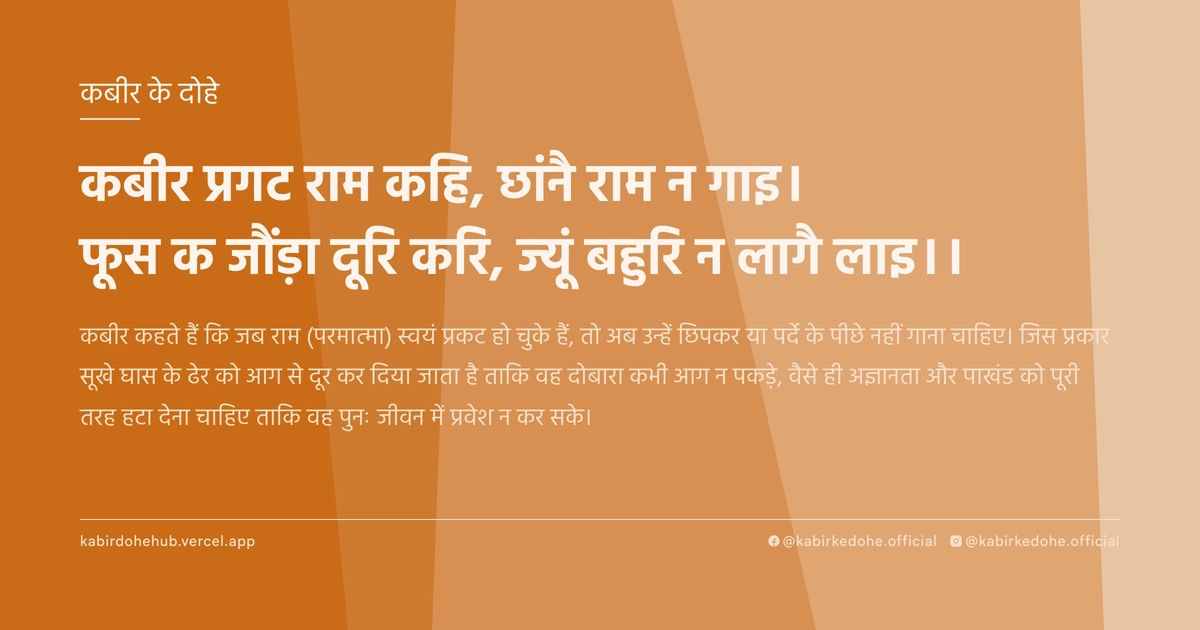
कबीर प्रगट राम कहि, छांनै राम न गाइ।
फूस क जौंड़ा दूरि करि, ज्यूं बहुरि न लागै लाइ।।
Kabir pragat ram kahi, chhannai ram na gaai. Phoos ka jounda doori kari, jyun bahuri na laagai laai.
इस पृष्ठ पर इस कबीर दोहे का अर्थ (meaning), हिंदी व्याख्या और अंग्रेज़ी अनुवाद, दार्शनिक विश्लेषण और व्यावहारिक जीवन सीख दी गई है। यह दोहा सहज योग (Sahaja Yoga) विषय से जुड़ा है — Kabir doha meaning and explanation in Hindi and English.
अर्थ (Meaning):
कबीर कहते हैं कि जब राम (परमात्मा) स्वयं प्रकट हो चुके हैं, तो अब उन्हें छिपकर या पर्दे के पीछे नहीं गाना चाहिए। जिस प्रकार सूखे घास के ढेर को आग से दूर कर दिया जाता है ताकि वह दोबारा कभी आग न पकड़े, वैसे ही अज्ञानता और पाखंड को पूरी तरह हटा देना चाहिए ताकि वह पुनः जीवन में प्रवेश न कर सके।
Kabir asserts that once the Divine (Ram) has manifested within, there is no need to sing of Him in secrecy or through hidden veils. Just as a pile of dry straw is cast far away from the fire to ensure it never ignites again, one must completely eradicate the remnants of ignorance and hypocrisy so they may never return to haunt the soul.
व्याख्या (Interpretation):
यह दोहा आंतरिक जागरण और बाहरी आडंबर के बीच के विरोधाभास को दर्शाता है। 'प्रगट राम' का अर्थ है वह अवस्था जहाँ साधक को अपनी आत्मा में ही परमात्मा का साक्षात्कार हो चुका है। यहाँ 'छांनै' (परदे) का अर्थ उन धार्मिक कर्मकांडों और सामाजिक मुखौटों से है जिन्हें हम पवित्रता के नाम पर ओढ़ते हैं। कबीर एक शक्तिशाली रूपक का उपयोग करते हैं—'फूस क जौंड़ा' (सूखी घास का ढेर), जो मानवीय अहंकार और संचित संस्कारों का प्रतीक है। जिस प्रकार सूखी घास अत्यंत ज्वलनशील होती है, उसी प्रकार अहंकार और अज्ञानता थोड़े से प्रलोभन या क्रोध से फिर से भड़क सकते हैं। अतः, मुक्ति केवल अनुभव नहीं, बल्कि उस अज्ञानता का पूर्ण विलोपन है जो हमें सत्य से अलग करती है। यह निर्गुण भक्ति का सार है: जब सत्य प्रत्यक्ष है, तो प्रतीकों की आवश्यकता समाप्त हो जाती है।
This couplet illustrates the paradox between internal awakening and external pretension. 'Pragat Ram' refers to the state where the seeker has realized the Divine within their own essence. The 'chhanne' (veil) symbolizes the religious rituals and social masks worn in the name of piety. Kabir employs a potent metaphor—the 'phoos ka jounda' (pile of dry straw), representing human ego and accumulated karmic impressions. Just as dry straw is highly flammable, ego and ignorance can be reignited by the slightest provocation or desire. Therefore, liberation is not merely an experience but the total annihilation of the ignorance that separates the self from Truth. This is the essence of Nirgun Bhakti: when the Truth is manifest, the need for symbols and intermediaries vanishes, leading to the non-duality of Atman and Brahman.
दार्शनिक विश्लेषण (Philosophical Analysis):
कबीर का यह दर्शन उनके युग के कट्टरपंथ और कर्मकांडीय धर्म के विरुद्ध एक सशक्त प्रहार है। १५वीं शताब्दी के भारत में, धर्म अक्सर बाहरी प्रतीकों—जैसे माला, तिलक और मंदिर—तक सीमित था। कबीर ने 'राम' शब्द का प्रयोग किया, लेकिन उनका राम दशरथ का पुत्र नहीं, बल्कि वह 'अविनाशी तत्व' है जो कण-कण में व्याप्त है। यह दृष्टिकोण अद्वैत वेदांत के करीब है, जहाँ जीव और ब्रह्म की एकता पर बल दिया गया है।
सूफी मत के 'फना' (अहंकार का विनाश) की अवधारणा यहाँ स्पष्ट रूप से दिखाई देती है। कबीर का तर्क है कि यदि आप सत्य को पा चुके हैं, तो आप उसे 'गा' नहीं सकते, क्योंकि गाने वाला और गाना अलग-अलग होते हैं; सत्य में विलीन होने पर केवल सत्य ही शेष रहता है। वे चेतावनी देते हैं कि केवल एक बार अनुभव कर लेना पर्याप्त नहीं है; अज्ञानता की जड़ों को पूरी तरह उखाड़ना होगा।
यहाँ 'फूस' या सूखी घास का उदाहरण मनोवैज्ञानिक स्तर पर 'संस्कारों' (latent impressions) की ओर इशारा करता है। हम अक्सर सोचते हैं कि हमने अपने क्रोध या लोभ पर विजय पा ली है, लेकिन वे अवचेतन में सुप्त अवस्था में रहते हैं। जब परिस्थितियाँ अनुकूल होती हैं, तो ये पुराने संस्कार पुनः सक्रिय हो जाते हैं।
कबीर जाति और वर्ग के भेदभाव को भी इसी 'फूस' के समान मानते हैं। उनके लिए सामाजिक ऊँच-नीच केवल एक मानसिक भ्रम (माया) है। जब व्यक्ति यह जान लेता है कि वह स्वयं ब्रह्म है, तो वह किसी भी बाहरी पहचान से ऊपर उठ जाता है।
अंततः, यह दोहा एक पूर्ण रूपांतरण की मांग करता है। यह केवल सुधार (Improvement) की बात नहीं है, बल्कि पूर्ण विलोपन (Erasure) की बात है। जिस प्रकार आग लगने के बाद राख बची रहती है, उसी प्रकार अहंकार के जलने के बाद केवल शुद्ध चेतना बचनी चाहिए।
Kabir's philosophy here is a powerful strike against the bigotry and ritualistic religion of his era. In 15th-century India, religion was often confined to external symbols—beads, tilaks, and temples. Kabir used the word 'Ram,' but his Ram was not the son of Dasharatha, but the 'Indestructible Element' pervading every atom. This perspective aligns closely with Advaita Vedanta, emphasizing the oneness of the Jiva (individual soul) and Brahman (Universal Soul).
The Sufi concept of 'Fana' (the annihilation of the ego) is clearly visible here. Kabir argues that if you have attained the Truth, you cannot 'sing' of it, for the singer and the song are distinct; in total union, only the Truth remains. He warns that a fleeting experience is insufficient; the roots of ignorance must be completely uprooted.
The example of 'phoos' or dry straw points toward 'Samskaras' (latent psychological impressions) on a subconscious level. We often believe we have conquered anger or greed, but these remain dormant. When triggered by external circumstances, these old patterns reignite instantly.
Kabir views caste and class distinctions as similar to this 'straw'—mere mental illusions (Maya). Once an individual realizes they are Brahman, they transcend all external identities and social hierarchies.
Ultimately, this couplet demands a total transformation. It is not about incremental improvement but absolute erasure. Just as only ash remains after a fire, only pure consciousness should remain after the ego has been incinerated.
मूल संदेश (Core Message):
- बाहरी पूजा केवल एक पर्दा है, आंतरिक शुद्धि ही वास्तविक मार्ग है।
- अहंकार की सूक्ष्म जड़ें ही जीवन में बार-बार दुखों का कारण बनती हैं।
- सत्य का अनुभव शब्दों में नहीं, बल्कि व्यवहार के रूपांतरण में होता है।
- जब तक 'मैं' का भाव है, तब तक 'राम' का पूर्ण साक्षात्कार असंभव है।
- पूर्ण मुक्ति का अर्थ है अज्ञानता के हर अवशेष का पूर्ण विनाश।
- External worship is but a veil; internal purification is the only true path.
- The subtle roots of ego are the recurring cause of all suffering in life.
- The experience of Truth lies not in words, but in the transformation of behavior.
- As long as the sense of 'I' exists, the full realization of the Divine is impossible.
- Total liberation means the absolute annihilation of every remnant of ignorance.
व्यावहारिक उदाहरण (Practical Example):
वाराणसी के एक पुराने घाट पर, माधव नाम का एक वृद्ध बुनकर रहता था। माधव अपनी कला में निपुण था, लेकिन उसका स्वभाव अत्यंत क्रोधी और अहंकारी था। वह मानता था कि उसकी श्रेष्ठता उसकी कला और उसके कुल की वजह से है। वह हर दिन मंदिर जाता, घंटों पूजा करता और दूसरों को उपदेश देता, लेकिन घर लौटते ही अपनी पत्नी और बच्चों पर चिल्लाता था।
एक दिन, एक फकीर उसके पास आया और माधव के बनाए सबसे महंगे रेशमी कपड़े को देखा। फकीर ने मुस्कुराते हुए कहा, "माधव, यह कपड़ा तो सुंदर है, लेकिन इसके पीछे जो बुनकर है, वह अभी भी सूखी घास के ढेर जैसा है—थोड़ी सी चिंगारी और वह जल उठता है।"
माधव को यह बात चुभी। उसने पूछा, "मैं तो ईश्वर का भक्त हूँ, मैं हर दिन राम का नाम लेता हूँ, फिर आप मुझे घास क्यों कह रहे हैं?"
फकीर ने जवाब दिया, "तुम्हारी पूजा एक पर्दा है। तुम राम को बाहर गाते हो, लेकिन तुम्हारे भीतर का राम अभी भी क्रोध और अहंकार की घास के नीचे दबा है। जब तक तुम इस घास को जलाकर दूर नहीं करोगे, तुम्हारी भक्ति केवल एक दिखावा है।"
माधव को पहली बार महसूस हुआ कि उसकी धार्मिकता केवल एक मुखौटा थी। उसने महसूस किया कि वह मंदिर में तो शांत रहता था, लेकिन उसके भीतर का अहंकार अभी भी जीवित था, जो छोटी-छोटी बातों पर भड़क जाता था।
अगले कुछ महीनों तक, माधव ने बाहरी दिखावे को छोड़कर आत्म-निरीक्षण शुरू किया। जब भी उसे क्रोध आता, वह खुद से पूछता, "क्या यह मेरी ईश्वरीय चेतना है या मेरी पुरानी घास?"
धीरे-धीरे, उसने अपने भीतर के उस क्रोध को पहचानना और उसे त्यागना शुरू किया। उसने महसूस किया कि असली राम मंदिर की मूर्तियों में नहीं, बल्कि उसके व्यवहार की विनम्रता में हैं।
एक दिन, उसके सबसे बड़े प्रतिद्वंद्वी ने उसकी दुकान में आग लगा दी। पुराने माधव के लिए यह विनाशकारी होता, लेकिन नए माधव ने शांत रहकर उसकी मदद की।
उसने महसूस किया कि अब उसके भीतर वह 'सूखी घास' नहीं बची थी जिसे कोई बाहरी आग जला सके। वह वास्तव में मुक्त हो चुका था।
माधव की यह रूपांतरण यात्रा यह सिद्ध करती है कि जब तक आंतरिक अशुद्धियाँ पूरी तरह समाप्त नहीं होतीं, तब तक बाहरी भक्ति केवल एक भ्रम है।
On an ancient ghat in Varanasi lived an elderly weaver named Madhav. Madhav was a master of his craft, but his nature was intensely volatile and arrogant. He believed his superiority stemmed from his artistic skill and his lineage. Every day he visited the temple, prayed for hours, and lectured others, yet upon returning home, he would scream at his wife and children.
One day, a wandering dervish arrived and looked at the most expensive silk cloth Madhav had woven. The dervish smiled and said, "Madhav, this cloth is beautiful, but the weaver behind it is still like a pile of dry straw—a single spark and he ignites."
Madhav felt insulted. He asked, "I am a devotee of God, I chant the name of Ram every day, why do you call me straw?"
The dervish replied, "Your worship is a veil. You sing of Ram externally, but the Ram within you is still buried under the straw of anger and ego. Until you burn this straw and cast it away, your devotion is merely a performance."
For the first time, Madhav realized that his religiosity was just a mask. He saw that while he remained calm in the temple, his ego was still alive and well, triggering outbursts over the smallest inconveniences.
Over the next few months, Madhav abandoned external pretenses and began a journey of deep self-inquiry. Whenever anger surfaced, he would ask himself, "Is this my divine consciousness, or is this my old straw?"
Slowly, he began to identify and discard those internal triggers. He realized that the true Ram did not reside in temple idols, but in the humility of his own behavior.
One day, his biggest rival set fire to his shop. For the old Madhav, this would have been a catastrophe, but the new Madhav remained calm and even helped the rival.
He realized that the 'dry straw' within him was gone; there was no longer any fuel for the fire of hatred to consume.
Madhav's transformation proves that until internal impurities are completely eradicated, external devotion remains a mere illusion.
अभ्यास मार्गदर्शन (Practice Guidance):
- दैनिक आत्म-निरीक्षण: प्रतिदिन 20 मिनट मौन बैठें और उन क्षणों को याद करें जब आपका अहंकार या क्रोध जागा। यह पहचानें कि वह 'सूखी घास' कहाँ से आई।
- मुखौटा विलोपन अभ्यास: दिन भर में एक बार ऐसा कार्य करें जहाँ आप अपनी सामाजिक छवि (Image) की चिंता छोड़कर पूरी तरह ईमानदार और सरल बनें।
- जर्नलिंग प्रॉम्प्ट: लिखें—"यदि मेरी सारी उपाधियाँ, संपत्ति और धार्मिक पहचान छीन ली जाए, तो मेरे भीतर क्या शेष बचेगा? क्या वह शेष हिस्सा शांत है?"
- डायग्नोस्टिक चेकलिस्ट: (1) क्या मैं दूसरों को उपदेश देते समय खुद को श्रेष्ठ महसूस करता हूँ? (2) क्या मेरी शांति केवल बाहरी परिस्थितियों पर निर्भर है? (3) क्या मैं अपनी गलतियों को स्वीकार करने के बजाय उन्हें धर्म या परिस्थिति के पीछे छुपाता हूँ?
- Daily Self-Inquiry: Sit in silence for 20 minutes daily and recall moments when your ego or anger was triggered. Identify where that 'dry straw' originated from.
- Mask-Removal Practice: Once a day, perform an action where you completely disregard your social image or reputation to be authentically honest and simple.
- Journaling Prompt: Write—"If all my titles, possessions, and religious identities were stripped away, what would remain within me? Is that remaining essence peaceful?"
- Diagnostic Checklist: (1) Do I feel superior while giving advice to others? (2) Is my peace dependent solely on external circumstances? (3) Do I hide my mistakes behind religious justifications or situational excuses?
चिंतन प्रश्न (Reflection Questions):
- मेरे जीवन में वह कौन सा 'पर्दा' है जिसे मैं पवित्रता के नाम पर ओढ़े हुए हूँ?
- क्या मेरी धार्मिकता वास्तव में मुझे विनम्र बना रही है, या यह मेरे अहंकार को एक नया आधार दे रही है?
- मेरे भीतर वह कौन सी 'सूखी घास' (पुरानी आदत) है जो आज भी एक छोटी सी बात पर भड़क उठती है?
- क्या मैं सत्य को खोज रहा हूँ, या मैं केवल सत्य होने का ढोंग करने में कुशल हो गया हूँ?
- यदि मैं अपनी सार्वजनिक छवि को पूरी तरह नष्ट कर दूँ, तो क्या मैं अपने अकेलेपन में खुश रह पाऊँगा?
- मेरे वे कौन से पूर्वाग्रह हैं जिन्हें मैं 'सिद्धांत' कहकर सही ठहराता हूँ?
- What is the 'veil' in my life that I wear under the guise of purity or righteousness?
- Is my spirituality truly making me humble, or is it providing a new foundation for my ego?
- What is the 'dry straw' (old habit) within me that still ignites over the smallest provocation?
- Am I actually seeking the Truth, or have I merely become skilled at pretending to be truthful?
- If I completely destroyed my public persona, would I be able to find happiness in my own solitude?
- Which of my biases do I justify by calling them 'principles'?