
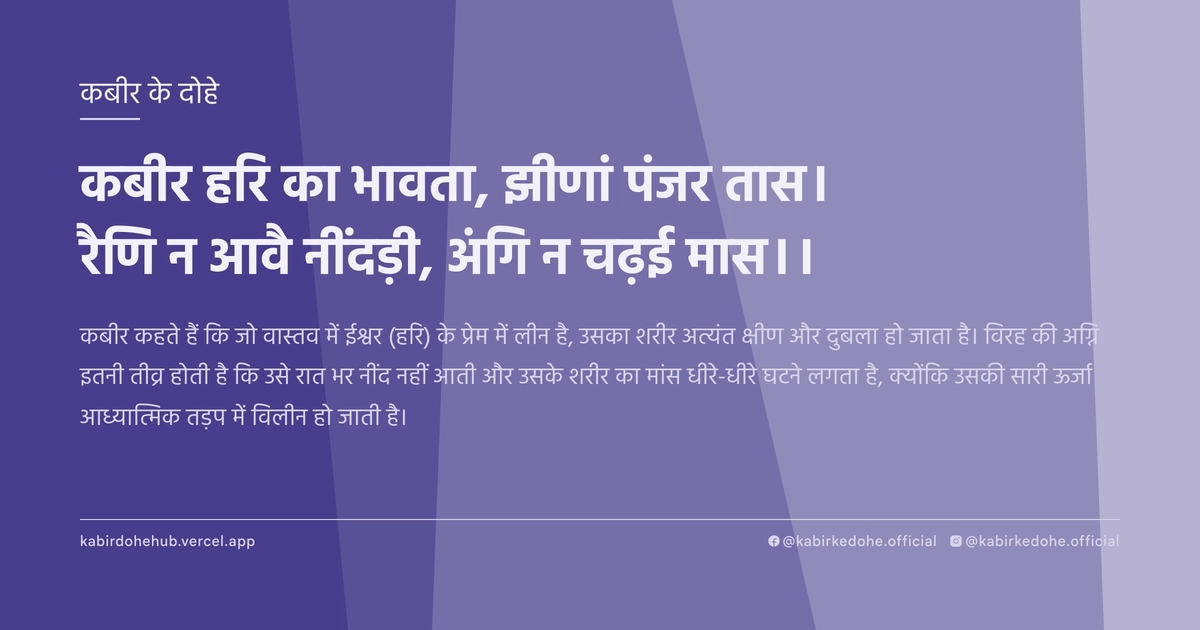
कबीर हरि का भावता, झीणां पंजर तास।
रैणि न आवै नींदड़ी, अंगि न चढ़ई मास।।
Kabir hari ka bhaavta, jheena panjar taas. Raini na aavai neendadi, angi na chadhai maas.
इस पृष्ठ पर इस कबीर दोहे का अर्थ (meaning), हिंदी व्याख्या और अंग्रेज़ी अनुवाद, दार्शनिक विश्लेषण और व्यावहारिक जीवन सीख दी गई है। यह दोहा भक्ति (Bhakti) विषय से जुड़ा है — Kabir doha meaning and explanation in Hindi and English.
अर्थ (Meaning):
कबीर कहते हैं कि जो वास्तव में ईश्वर (हरि) के प्रेम में लीन है, उसका शरीर अत्यंत क्षीण और दुबला हो जाता है। विरह की अग्नि इतनी तीव्र होती है कि उसे रात भर नींद नहीं आती और उसके शरीर का मांस धीरे-धीरे घटने लगता है, क्योंकि उसकी सारी ऊर्जा आध्यात्मिक तड़प में विलीन हो जाती है।
Kabir asserts that one who is truly immersed in the longing for the Divine (Hari) experiences a profound physical wasting. The fire of separation is so intense that sleep vanishes from their nights, and the flesh of their body diminishes, as all physical vitality is consumed by the spiritual yearning for the Absolute.
व्याख्या (Interpretation):
यह दोहा विरह की पराकाष्ठा को दर्शाता है। यहाँ 'झीणां पंजर' (दुबला शरीर) केवल शारीरिक कमजोरी नहीं, बल्कि अहंकार के विसर्जन का प्रतीक है। जब साधक निर्गुण ब्रह्म की खोज में डूबता है, तो वह सांसारिक सुखों और शारीरिक आवश्यकताओं से ऊपर उठ जाता है। यह अवस्था अद्वैत वेदांत के उस बिंदु को छूती है जहाँ 'मैं' (अहंकार) मिट जाता है और केवल 'वह' (ब्रह्म) शेष रहता है। नींद का न आना इस बात का संकेत है कि आत्मा अब माया की निद्रा से जाग चुकी है। यह एक विरोधाभास है: शरीर कमजोर होता है, लेकिन आत्मा अपनी उच्चतम शक्ति और चैतन्यता को प्राप्त करती है।
This couplet depicts the pinnacle of spiritual longing (Viraha). The 'jheena panjar' or frail frame is not merely physical weakness but a metaphor for the dissolution of the ego. As the seeker plunges into the search for the Nirgun Brahman, they transcend worldly pleasures and bodily needs. This state aligns with Advaita Vedanta's realization where the 'I' (ego) vanishes, leaving only the 'Absolute'. The absence of sleep signifies that the soul has awakened from the slumber of Maya. It presents a divine paradox: while the physical vessel weakens, the internal consciousness attains its peak potency and luminosity.
दार्शनिक विश्लेषण (Philosophical Analysis):
कबीर का यह दृष्टिकोण सूफी मत के 'इश्क-ए-हकीकी' (ईश्वरीय प्रेम) और भारतीय भक्ति परंपरा के 'विरह' भाव का संगम है। कबीर उस समय के कर्मकांडों और बाहरी दिखावे का खंडन कर रहे थे, जहाँ लोग केवल माला फेरकर या तीर्थ यात्रा करके मोक्ष की कामना करते थे। उनके लिए भक्ति कोई बाहरी क्रिया नहीं, बल्कि एक आंतरिक अग्नि है जो साधक के अस्तित्व को जलाकर शुद्ध कर देती है।
दार्शनिक स्तर पर, यह 'अहं' के विनाश की प्रक्रिया है। जब तक शरीर की तृप्तियाँ और अहंकार जीवित रहते हैं, तब तक सत्य का साक्षात्कार असंभव है। यह शरीर का क्षय वास्तव में उस 'माया' के आवरण का हटना है जो आत्मा को परमात्मा से अलग दिखाता है। कबीर यहाँ यह समझा रहे हैं कि आध्यात्मिक उत्थान के लिए एक प्रकार की 'मृत्यु' आवश्यक है—जीवित रहते हुए अपनी वासनाओं और पहचान का विसर्जन।
यह विश्लेषण हमें बताता है कि कबीर का मार्ग केवल शांति का नहीं, बल्कि एक तीव्र संघर्ष का है। यह संघर्ष स्वयं के साथ है। जिस प्रकार सोने को शुद्ध करने के लिए उसे आग में तपाना पड़ता है, उसी प्रकार आत्मा को शुद्ध करने के लिए विरह की तड़प अनिवार्य है। यह तड़प ही वह ईंधन है जो साधक को अज्ञानता के अंधकार से बाहर निकालती है।
यहाँ 'हरि' शब्द का प्रयोग केवल एक देवता के लिए नहीं, बल्कि उस सार्वभौमिक चेतना के लिए किया गया है जो सर्वव्यापी है। कबीर का यह संदेश है कि जब तक प्रेम में वह तीव्रता नहीं आती कि वह आपके अस्तित्व की भौतिक सीमाओं को चुनौती दे, तब तक वह प्रेम सच्चा नहीं है। यह भौतिक शरीर केवल एक माध्यम है, और जब यह माध्यम पारदर्शी हो जाता है, तब दिव्य प्रकाश स्वतः प्रकट होता है।
अंततः, यह दोहा हमें सिखाता है कि वास्तविक भक्ति में एक प्रकार का त्याग निहित है। यह त्याग केवल वस्तुओं का नहीं, बल्कि स्वयं के 'होने' के भ्रम का है। जब साधक पूरी तरह रिक्त हो जाता है, तभी वह उस अनंत ब्रह्म से भर पाता है। यह शून्यता ही पूर्णता की पहली सीढ़ी है।
Kabir's perspective is a confluence of the Sufi concept of 'Ishq-e-Haqiqi' (Divine Love) and the Bhakti tradition's 'Viraha' (longing in separation). He vehemently rejects the ritualism of his era, where salvation was sought through rote chanting or pilgrimages. For Kabir, devotion is not an external act but an internal fire that incinerates the seeker's impurities to reveal the core truth.
Philosophically, this describes the process of ego-annihilation. As long as bodily gratifications and the sense of 'I' persist, the realization of Truth remains elusive. The wasting of the body is a metaphor for the stripping away of 'Maya'—the illusion that separates the Atman from Brahman. Kabir suggests that spiritual ascension requires a form of 'death' while living: the systematic dissolution of desires and identity.
This analysis reveals that Kabir's path is not one of passive peace, but of intense struggle. It is a war against the self. Just as gold must be purified in a furnace, the soul must be tempered in the fire of longing. This yearning is the fuel that propels the seeker out of the darkness of ignorance and into the light of consciousness.
The term 'Hari' here does not refer to a sectarian deity but to the Universal Consciousness. Kabir posits that unless love reaches a frequency that challenges the physical boundaries of existence, it remains superficial. The body is merely a vessel; when it becomes transparent through the erosion of ego, the Divine Light manifests spontaneously.
Ultimately, this couplet teaches that true devotion necessitates a profound surrender. This is not a surrender of possessions, but a surrender of the illusion of separate existence. Only when the seeker becomes completely empty can they be filled with the Infinite. This void is the first step toward absolute wholeness.
मूल संदेश (Core Message):
- अहंकार का विसर्जन ही सत्य की पहली शर्त है।
- शारीरिक सुखों का त्याग आत्मा की जागृति का मार्ग है।
- ईश्वरीय प्रेम में तड़प ही अज्ञानता को जलाती है।
- बाहरी रिक्तता आंतरिक पूर्णता का द्वार खोलती है।
- सच्ची भक्ति में समर्पण का अर्थ है स्वयं को मिटा देना।
- The dissolution of ego is the primary prerequisite for Truth.
- Renouncing bodily pleasures paves the way for spiritual awakening.
- The agony of Divine longing incinerates the veil of ignorance.
- External emptiness opens the gateway to internal fullness.
- True devotion means erasing the self to merge with the Whole.
व्यावहारिक उदाहरण (Practical Example):
वाराणसी के एक पुराने घाट पर माधव नाम का एक वृद्ध बुनकर रहता था। माधव अपनी पूरी जिंदगी रेशमी कपड़े बुनने में बिता चुका था, लेकिन उसका मन हमेशा एक अनसुलझे प्रश्न में उलझा रहता था—"वह परम सत्य क्या है?" उसने कई पंडितों से बात की, कई ग्रंथ पढ़े, लेकिन उसे शांति नहीं मिली।
एक दिन उसने कबीर के इस दोहे को सुना। माधव ने महसूस किया कि वह अब तक केवल 'ज्ञान' इकट्ठा कर रहा था, उसने कभी 'प्रेम' नहीं किया था। उसने तय किया कि वह अपनी सारी ऊर्जा उस अदृश्य सत्ता की खोज में लगाएगा। उसने धीरे-धीरे अपनी भौतिक सुख-सुविधाओं का त्याग करना शुरू कर दिया।
वह घंटों मौन रहकर केवल उस एक विचार में डूब जाता कि वह परमात्मा का अंश है। उसकी भूख और नींद कम होने लगी। उसके शरीर की मांसपेशियां ढीली पड़ गईं और वह बहुत दुबला हो गया। उसके परिवार वाले चिंतित थे कि वह बीमार हो रहा है, लेकिन माधव के चेहरे पर एक अलौकिक चमक थी।
एक शाम, जब वह घाट पर बैठा था, एक अहंकारी अमीर व्यापारी उसके पास आया और उसका मजाक उड़ाते हुए बोला, "तुम इस हालत में क्या खोज रहे हो? देखो मुझे, मेरे पास सब कुछ है, फिर भी मैं खुश नहीं हूँ।"
माधव ने मंद मुस्कान के साथ उत्तर दिया, "भाई, तुम इसलिए दुखी हो क्योंकि तुम्हारा शरीर और तुम्हारा अहंकार बहुत भारी है। तुमने खुद को इतना भरा हुआ रखा है कि ईश्वर के लिए वहां कोई जगह ही नहीं बची। मैंने खुद को खाली किया है, ताकि वह मुझमें समा सके।"
व्यापारी स्तब्ध रह गया। उसने देखा कि माधव के पास भौतिक रूप से कुछ नहीं था, लेकिन उसकी आँखों में जो शांति और आनंद था, वह करोड़ों की संपत्ति से भी अधिक मूल्यवान था।
उस पल व्यापारी को समझ आया कि जिसे वह 'बीमारी' या 'कमजोरी' समझ रहा था, वह वास्तव में आध्यात्मिक परिपक्वता थी। माधव का दुबला शरीर उसकी तपस्या का प्रमाण था, न कि उसकी विफलता का।
व्यापारी ने उसी दिन अपना अहंकार त्यागने का संकल्प लिया। उसने महसूस किया कि बाहरी चमक-धमक केवल एक पर्दा है। माधव की 'खाली' अवस्था ही वास्तव में 'पूर्ण' अवस्था थी।
इस अनुभव ने व्यापारी के जीवन को बदल दिया। उसने अपनी संपत्ति का उपयोग दूसरों की सेवा के लिए करना शुरू किया और आंतरिक शांति की खोज में लग गया।
माधव की वह 'झीणां पंजर' वाली अवस्था वास्तव में एक जीवित उदाहरण थी कि जब मनुष्य अपनी भौतिक पहचान को मिटा देता है, तो वह ब्रह्मांडीय प्रेम का अनुभव करने योग्य बन जाता है।
In the ancient ghats of Varanasi lived an elderly weaver named Madhav. Madhav had spent his entire life weaving exquisite silk fabrics, yet his mind was perpetually haunted by a single question: "What is the Ultimate Truth?" He consulted scholars and read scriptures, but found no lasting peace.
One day, he encountered this specific Doha of Kabir. Madhav realized that he had been merely collecting 'knowledge' without ever experiencing 'love'. He decided to channel all his energy into the longing for the Invisible Absolute. He began to consciously detach himself from material comforts.
He would spend hours in profound silence, meditating on the thought that he was a spark of the Divine. Gradually, his appetite and need for sleep diminished. His muscles wasted away, and he became incredibly frail. His family feared he was falling ill, but a celestial glow emanated from his face.
One evening, while sitting by the river, an arrogant wealthy merchant approached him and mocked him, saying, "What are you searching for in this wretched state? Look at me; I have everything, yet I am not happy."
Madhav replied with a gentle smile, "Brother, you are unhappy because your body and your ego are too heavy. You have filled yourself so much that there is no room left for the Divine. I have emptied myself so that He may dwell within me."
The merchant was stunned. He noticed that while Madhav possessed nothing materially, the peace and bliss in his eyes were more valuable than all the gold in the world.
In that moment, the merchant understood that what he perceived as 'sickness' or 'weakness' was actually spiritual maturity. Madhav's frail frame was a testament to his austerity, not a sign of failure.
This realization transformed the merchant's life. He vowed to dismantle his ego and began using his wealth for the selfless service of others, seeking internal stillness.
He understood that external splendor is merely a veil. Madhav's 'empty' state was, in reality, the state of 'fullness'.
Madhav's frail existence served as a living example that when a human erases their material identity, they become capable of experiencing universal, cosmic love.
अभ्यास मार्गदर्शन (Practice Guidance):
- दैनिक चिंतन: प्रतिदिन 20 मिनट मौन बैठें और विचार करें कि आपकी कौन सी भौतिक इच्छाएं आपके आध्यात्मिक विकास में बाधा बन रही हैं।
- स्व-अन्वेषण जर्नल: लिखें कि 'मैं' कौन हूँ? क्या मैं यह शरीर हूँ, मेरी उपलब्धियां हैं, या वह चेतना जो इन सबको देख रही है?
- व्यवहारिक परिवर्तन: दिन में कम से कम एक बार अपनी सुख-सुविधा का त्याग करें (जैसे उपवास या सादगी अपनाना) ताकि आप शरीर के ऊपर मन के नियंत्रण का अनुभव कर सकें।
- डायग्नोस्टिक चेकलिस्ट: क्या आप छोटी बातों पर विचलित होते हैं? क्या आपकी नींद केवल शारीरिक थकान से आती है या मानसिक शांति से? यदि आप अभी भी बाहरी प्रशंसा के भूखे हैं, तो आपका 'अहंकार' अभी भारी है।
- Daily Contemplation: Spend 20 minutes in silence daily, reflecting on which material desires are acting as barriers to your spiritual evolution.
- Self-Inquiry Journaling: Write a detailed exploration of 'Who am I?' Am I this body, these achievements, or the consciousness observing them all?
- Behavioral Shift: Once a day, consciously renounce a comfort (such as fasting or practicing extreme simplicity) to experience the mind's mastery over the body.
- Diagnostic Checklist: Do you get easily agitated by trivialities? Does your sleep come from physical exhaustion or mental stillness? If you still crave external validation, your 'ego' is still too heavy.
चिंतन प्रश्न (Reflection Questions):
- यदि आज आपकी सारी सामाजिक पहचान (पद, पैसा, रिश्ता) छीन ली जाए, तो आपके भीतर क्या बचेगा?
- आपकी 'नींद' क्या वास्तव में विश्राम है, या यह वास्तविकता से बचने का एक तरीका है?
- क्या आप ईश्वर को पाने की इच्छा रखते हैं, या केवल ईश्वर के नाम पर मिलने वाली प्रशंसा की?
- आपके जीवन का वह कौन सा 'भारी' हिस्सा है जिसे आप छोड़ने से डरते हैं?
- क्या आप अपनी शारीरिक सुख-सुविधाओं के इतने आदी हो चुके हैं कि आप अब आत्मा की पुकार नहीं सुन सकते?
- If all your social identities (status, wealth, relationships) were stripped away today, what would remain within you?
- Is your 'sleep' truly a state of rest, or is it a mechanism to escape reality?
- Do you truly desire the Divine, or do you desire the admiration that comes from appearing devout?
- What is the 'heavy' part of your existence that you are most afraid to let go of?
- Have you become so addicted to physical comforts that you can no longer hear the call of the soul?