
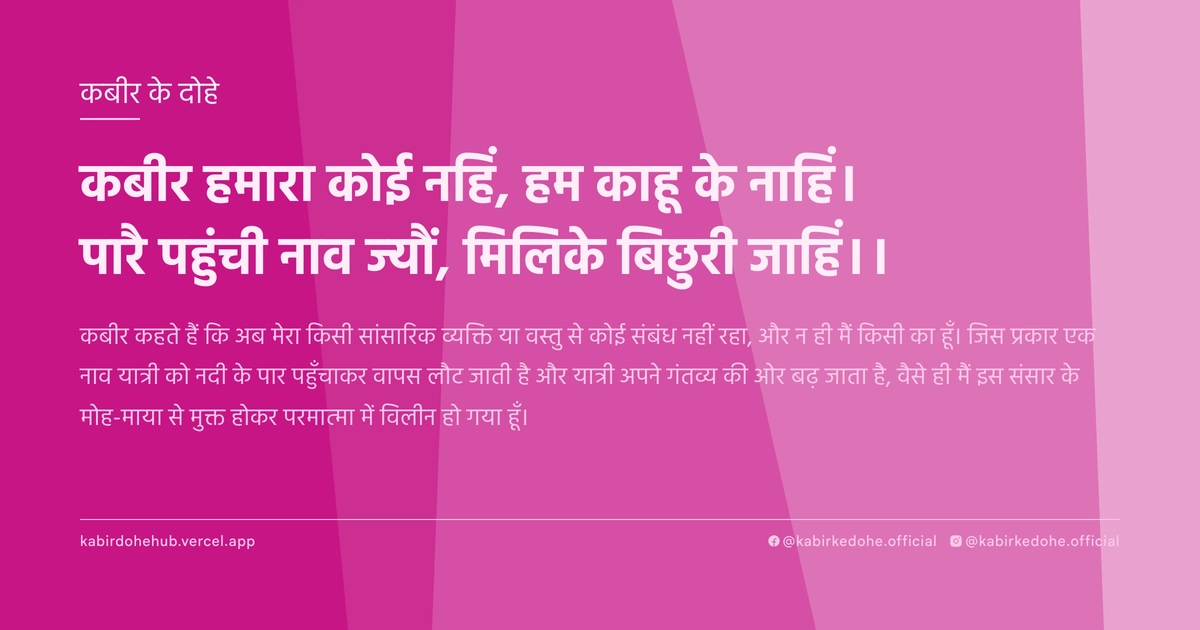
कबीर हमारा कोई नहिं, हम काहू के नाहिं।
पारै पहुंची नाव ज्यौं, मिलिके बिछुरी जाहिं।।
Kabir hamara koi nahin, hum kaahu ke naahin. Paare pahunchi naav jyaun, milike bichhuri jaahin.
इस पृष्ठ पर इस कबीर दोहे का अर्थ (meaning), हिंदी व्याख्या और अंग्रेज़ी अनुवाद, दार्शनिक विश्लेषण और व्यावहारिक जीवन सीख दी गई है। यह दोहा वैराग्य (Detachment) विषय से जुड़ा है — Kabir doha meaning and explanation in Hindi and English.
अर्थ (Meaning):
कबीर कहते हैं कि अब मेरा किसी सांसारिक व्यक्ति या वस्तु से कोई संबंध नहीं रहा, और न ही मैं किसी का हूँ। जिस प्रकार एक नाव यात्री को नदी के पार पहुँचाकर वापस लौट जाती है और यात्री अपने गंतव्य की ओर बढ़ जाता है, वैसे ही मैं इस संसार के मोह-माया से मुक्त होकर परमात्मा में विलीन हो गया हूँ।
Kabir declares that he no longer possesses any worldly attachments, nor does he belong to anyone in the material realm. Just as a boat serves its purpose by carrying a passenger across a river and then departs, leaving the traveler to their destination, he has transcended all earthly bonds to merge with the Divine.
व्याख्या (Interpretation):
यह दोहा पूर्ण वैराग्य और आत्म-साक्षात्कार की स्थिति का वर्णन करता है। 'हमारा कोई नहिं' का अर्थ केवल अकेलेपन से नहीं, बल्कि अहंकार के विसर्जन से है। यहाँ नाव एक माध्यम है—जैसे गुरु या साधना—जो साधक को संसार रूपी सागर से पार कराती है। जब लक्ष्य (परमात्मा) प्राप्त हो जाता है, तो माध्यम की आवश्यकता समाप्त हो जाती है। यह अद्वैत वेदांत की उस स्थिति को दर्शाता है जहाँ 'मैं' और 'तू' का भेद मिट जाता है। माया का पर्दा हटने पर व्यक्ति पाता है कि वह न तो शरीर है, न नाम, और न ही किसी रिश्ते का हिस्सा। यह विछोह दुखद नहीं, बल्कि मुक्तिदायी है, क्योंकि यह सीमित पहचान से अनंत पहचान की ओर संक्रमण है।
This couplet describes the state of absolute detachment and self-realization. The phrase 'I belong to no one' does not signify loneliness, but the dissolution of the ego. The boat serves as a metaphor for the means—such as a Guru or a spiritual practice—that carries the seeker across the ocean of worldly existence. Once the destination (the Divine) is reached, the medium is no longer required. This mirrors the Advaita Vedanta state where the duality between 'I' and 'Thou' vanishes. Upon the lifting of Maya's veil, the individual realizes they are neither the body, nor the name, nor a part of any social bond. This separation is not sorrowful but liberating, marking the transition from a limited identity to an infinite consciousness.
दार्शनिक विश्लेषण (Philosophical Analysis):
कबीर का यह विचार उनके 'निर्गुण भक्ति' मार्ग का चरम बिंदु है, जहाँ ईश्वर किसी आकार या मानवीय रिश्ते में नहीं, बल्कि शून्य और पूर्णता के मिलन में है। ऐतिहासिक रूप से, कबीर ने जाति और धर्म के उन बंधनों को चुनौती दी जो मनुष्य को एक संकीर्ण पहचान में बांधते थे। उनका 'कोई नहिं' का उद्घोष वास्तव में सामाजिक और मानसिक बेड़ियों को तोड़ने का आह्वान है।
दार्शनिक स्तर पर, यह सूफीवाद के 'फना' (अहंकार का विनाश) के सिद्धांत से मेल खाता है। जब तक मनुष्य 'मेरा' और 'तेरा' के द्वंद्व में रहता है, वह सत्य से दूर रहता है। कबीर यहाँ समझाते हैं कि मुक्ति का मार्ग 'संग्रह' में नहीं, बल्कि 'त्याग' में है। यह त्याग भौतिक वस्तुओं का नहीं, बल्कि उस मानसिक धारणा का है जो हमें दूसरों से अलग करती है।
अद्वैत वेदांत के अनुसार, आत्मा और ब्रह्म एक ही हैं। जब तक अविद्या (अज्ञान) है, हम स्वयं को अलग मानते हैं। कबीर की नाव का उदाहरण यह स्पष्ट करता है कि साधना केवल एक उपकरण है। कई लोग साधना के उपकरणों (कर्मकांडों) को ही लक्ष्य मान लेते हैं, जबकि सत्य उन उपकरणों के पार है।
कबीर ritualism (कर्मकांड) का विरोध करते हुए यह बताते हैं कि बाहरी दिखावे या रिश्तों की पवित्रता से मोक्ष नहीं मिलता। मोक्ष तब मिलता है जब व्यक्ति अपनी पहचान को पूरी तरह मिटा देता है। यह मनोवैज्ञानिक रूपांतरण है जहाँ व्यक्ति 'स्व' से 'सर्व' की ओर बढ़ता है।
अंततः, यह दोहा हमें सिखाता है कि वास्तविक स्वतंत्रता किसी को पाने में नहीं, बल्कि सब कुछ खो देने के साहस में है। जब हम किसी के नहीं रहते, तब हम वास्तव में सबके हो जाते हैं, क्योंकि अब हमारे बीच कोई दीवार नहीं बचती।
Kabir's thought here represents the zenith of the 'Nirgun Bhakti' path, where the Divine is found not in forms or human relationships, but in the union of the void and the absolute. Historically, Kabir challenged the caste and religious bonds that confined humans to narrow identities. His proclamation of 'belonging to no one' is a call to break both social and mental shackles.
On a philosophical level, this aligns with the Sufi concept of 'Fana' (the annihilation of the ego). As long as a human exists in the duality of 'mine' and 'thine,' they remain distant from the Truth. Kabir explains that the path to liberation lies not in accumulation, but in renunciation. This is not a renunciation of material objects, but of the mental construct that separates us from others.
According to Advaita Vedanta, the Atman and Brahman are one. As long as Avidya (ignorance) persists, we perceive ourselves as separate. Kabir's metaphor of the boat clarifies that spiritual practice is merely a tool. Many mistake the tools of practice (rituals) for the goal, whereas the Truth lies beyond these instruments.
Opposing ritualism, Kabir demonstrates that salvation is not achieved through external displays or the perceived purity of relationships. Liberation occurs when one completely erases their individual identity. This is a psychological transformation where the individual moves from the 'self' to the 'universal.'
Ultimately, this couplet teaches us that true freedom is not found in possessing something, but in the courage to lose everything. When we belong to no one, we truly belong to everyone, for the walls of separation have finally crumbled.
मूल संदेश (Core Message):
- अहंकार की पहचान ही दुखों का मूल कारण है।
- साधना एक नाव है, लक्ष्य नहीं; इसे किनारे पर छोड़ना सीखें।
- सच्ची स्वतंत्रता तब है जब आप किसी के 'होने' की इच्छा छोड़ दें।
- व्यक्तिगत संबंधों से ऊपर उठकर सार्वभौमिक प्रेम को अपनाएं।
- शून्य होना ही वास्तव में पूर्ण होना है।
- The ego's identity is the root cause of all suffering.
- Practice is a boat, not the destination; learn to leave it at the shore.
- True freedom is when you cease the desire to 'belong' to another.
- Rise above personal bonds to embrace universal love.
- To become nothing is to actually become everything.
व्यावहारिक उदाहरण (Practical Example):
वाराणसी के घाटों पर रहने वाली एक वृद्ध विधवा, जानकी, का जीवन केवल अपनी मृत यादों और समाज द्वारा थोपी गई 'दुखी विधवा' की छवि के इर्द-गिर्द घूमता था। वह हर समय अपने दिवंगत पति और बेटों की याद में विलाप करती, मानती कि उसका अस्तित्व केवल उनके साथ उनके रिश्तों से है।
एक दिन उसने एक फकीर को देखा जो बिना किसी सहारे के, चेहरे पर एक असीम शांति लिए बैठा था। जानकी ने उससे पूछा, 'आपका कोई नहीं है, फिर भी आप इतने खुश कैसे हैं?' फकीर ने मुस्कुराकर कहा, 'मैं किसी का नहीं हूँ, इसलिए मैं सबका हूँ।'
यह बात जानकी के मन में गहरे तक उतर गई। उसने महसूस किया कि वह अपने दुखों को इसलिए ढो रही थी क्योंकि उसने अपनी पहचान को 'किसी की पत्नी' या 'किसी की माँ' के रूप में बांध रखा था।
उसने धीरे-धीरे अपनी यादों की उस नाव को किनारे लगाया। उसने महसूस किया कि जिस प्रेम को वह केवल अपने परिवार तक सीमित मानती थी, वह वास्तव में पूरे ब्रह्मांड का प्रेम है।
उसने घाट पर आने वाले अनाथ बच्चों को पढ़ाना शुरू किया और बीमारों की सेवा करने लगी। अब वह किसी एक व्यक्ति की याद में नहीं रोती थी, बल्कि हर जीव में उसी परमात्मा को देखने लगी।
समाज ने उसे 'पागल' कहा क्योंकि वह अब मातम नहीं मनाती थी, लेकिन जानकी के भीतर एक नई शांति का जन्म हुआ था।
उसने पाया कि जब उसने 'मेरा' और 'तुम्हारा' का मोह छोड़ा, तो उसका अकेलापन एक उत्सव में बदल गया।
यह 'कबीर ट्विस्ट' था—रिश्तों के मोह से विरक्ति ने उसे वास्तव में मानवता से जोड़ दिया। अब वह किसी की मोहताज नहीं थी, वह स्वयं में पूर्ण थी।
Janaki, an elderly widow living on the ghats of Varanasi, spent her life revolving around dead memories and the social image of a 'grieving widow.' She spent her days lamenting her late husband and sons, believing her existence was defined solely by her relationships with them.
One day, she encountered a wandering fakir who sat without any support, an infinite peace radiating from his face. Janaki asked him, 'You have no one, yet how are you so happy?' The fakir smiled and replied, 'I belong to no one, and therefore, I belong to everyone.'
These words struck a deep chord within Janaki. She realized she was carrying her grief because she had tethered her identity to being 'someone's wife' or 'someone's mother.'
Slowly, she steered the boat of her memories toward the shore. She realized that the love she thought was limited to her family was actually the love of the entire universe.
She began teaching orphaned children on the ghats and caring for the sick. She no longer wept for a specific person but began seeing the Divine in every living being.
Society called her 'mad' because she no longer performed the rituals of mourning, but a new peace had been born within Janaki.
She discovered that when she let go of the attachment to 'mine' and 'thine,' her loneliness transformed into a celebration.
This was the 'Kabir Twist'—detachment from the ego of relationships actually connected her to all of humanity. She was no longer dependent on anyone; she was complete within herself.
अभ्यास मार्गदर्शन (Practice Guidance):
- प्रतिदिन 20 मिनट मौन ध्यान करें, जहाँ आप अपनी सभी सामाजिक भूमिकाओं (पुत्र, पिता, कर्मचारी) को मानसिक रूप से उतार दें और केवल एक 'साक्षी' बनें।
- एक डायरी में उन तीन रिश्तों या वस्तुओं की सूची बनाएं जिनसे आप सबसे अधिक जुड़ाव महसूस करते हैं, और फिर लिखें कि यदि वे कल समाप्त हो जाएं, तो आपकी आत्मा का मूल तत्व कैसे अपरिवर्तित रहेगा।
- व्यवहारिक परिवर्तन: दिन में कम से कम एक बार किसी ऐसे व्यक्ति की निस्वार्थ मदद करें जिससे आपका कोई व्यक्तिगत संबंध न हो, यह अनुभव करने के लिए कि आप 'सबके' हैं।
- डायग्नोस्टिक चेकलिस्ट: क्या आप किसी की प्रशंसा पर फूलते हैं या आलोचना पर टूटते हैं? यदि हाँ, तो आप अभी भी 'किसी के' हैं। यदि आप दोनों स्थितियों में तटस्थ हैं, तो आप मुक्ति की ओर बढ़ रहे हैं।
- Practice 20 minutes of silent meditation daily, mentally shedding all social roles (son, father, employee) and becoming a mere 'witness' to your existence.
- In a journal, list three relationships or objects you feel most attached to, then write how your core essence would remain unchanged if they were gone tomorrow.
- Behavioral Change: At least once a day, help someone with whom you have no personal connection, to experience the feeling of belonging to the universal whole.
- Diagnostic Checklist: Do you swell with praise or crumble under criticism? If yes, you still 'belong' to an identity. If you remain neutral in both, you are moving toward liberation.
चिंतन प्रश्न (Reflection Questions):
- यदि आपसे आपका नाम, पेशा और पारिवारिक संबंध छीन लिए जाएं, तो आपके पास क्या बचेगा?
- क्या आपका 'प्रेम' वास्तव में दूसरे के लिए है, या यह केवल आपकी अपनी जरूरत को पूरा करने का एक तरीका है?
- आप अपनी डिजिटल पहचान (सोशल मीडिया) को बनाए रखने के लिए कितना मानसिक श्रम करते हैं, और यह आपकी आंतरिक शांति को कैसे बाधित करता है?
- क्या आप अकेलेपन से डरते हैं, या आप एकांत की गहराई में उतरने का साहस रखते हैं?
- वह कौन सा 'मुखौटा' है जिसे आप दुनिया के सामने पहनते हैं, और वह मुखौटा आपकी आत्मा को कैसे दबा रहा है?
- If your name, profession, and family ties were stripped away, what would remain of you?
- Is your 'love' truly for the other, or is it merely a way to satisfy your own emotional needs?
- How much mental effort do you expend maintaining your digital identity, and how does this disrupt your inner peace?
- Do you fear loneliness, or do you have the courage to dive into the depths of solitude?
- What is the 'mask' you wear for the world, and how is that mask suppressing your true soul?