
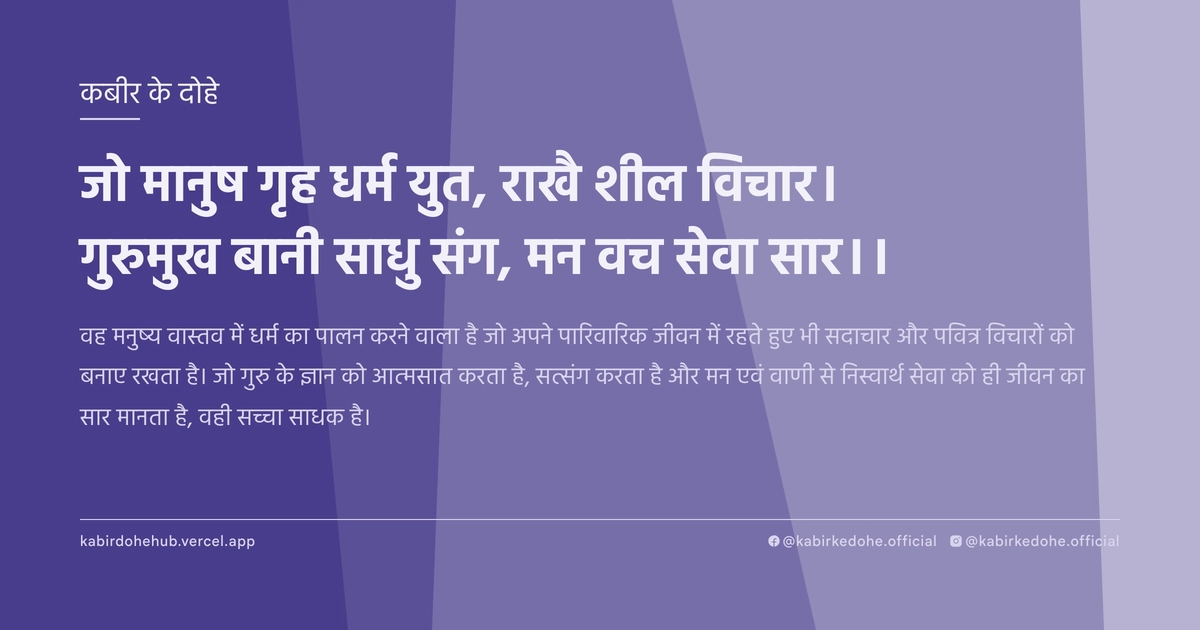
जो मानुष गृह धर्म युत, राखै शील विचार।
गुरुमुख बानी साधु संग, मन वच सेवा सार।।
Jo manush grih dharm yut, rakhai sheel vichaar. Gurmukh baani sadhu sang, man vach seva saar.
इस पृष्ठ पर इस कबीर दोहे का अर्थ (meaning), हिंदी व्याख्या और अंग्रेज़ी अनुवाद, दार्शनिक विश्लेषण और व्यावहारिक जीवन सीख दी गई है। यह दोहा सहज योग (Sahaja Yoga) विषय से जुड़ा है — Kabir doha meaning and explanation in Hindi and English.
अर्थ (Meaning):
वह मनुष्य वास्तव में धर्म का पालन करने वाला है जो अपने पारिवारिक जीवन में रहते हुए भी सदाचार और पवित्र विचारों को बनाए रखता है। जो गुरु के ज्ञान को आत्मसात करता है, सत्संग करता है और मन एवं वाणी से निस्वार्थ सेवा को ही जीवन का सार मानता है, वही सच्चा साधक है।
The person who truly adheres to righteousness is one who maintains moral conduct and pure thoughts while fulfilling their worldly and domestic duties. True spiritual essence is found in those who follow the Guru's wisdom, keep company with the virtuous, and embody selfless service in both thought and speech.
व्याख्या (Interpretation):
यह दोहा गृहस्थ जीवन और आध्यात्मिक उत्थान के बीच के संतुलन को परिभाषित करता है। 'गृह धर्म' का अर्थ केवल पारिवारिक कर्तव्यों से नहीं, बल्कि संसार में रहते हुए अनासक्त रहने से है। 'शील विचार' का तात्पर्य उस आंतरिक स्थिरता से है जहाँ व्यक्ति बाहरी शोर के बीच भी अपनी आत्मा की शांति नहीं खोता। यहाँ 'गुरुमुख' होना केवल किसी व्यक्ति का अनुसरण करना नहीं, बल्कि उस सार्वभौमिक सत्य (Nirgun) को स्वीकार करना है जो अहंकार को मिटाता है। यह निरंजन भक्ति का मार्ग है जहाँ सेवा (Seva) को कर्मकांडों से ऊपर रखा गया है। यह इस विरोधाभास को सुलझाता है कि मोक्ष केवल जंगलों में नहीं, बल्कि समाज के बीच रहकर अहंकार के विसर्जन से प्राप्त होता है।
This couplet defines the equilibrium between domestic existence and spiritual ascension. 'Grih Dharm' does not merely imply familial obligations but refers to the state of being 'in the world but not of it.' 'Sheel Vichaar' denotes an internal stability where one maintains psychic purity amidst external chaos. Being 'Gurumukh' is not simply following a human teacher, but aligning oneself with the Universal Truth (Nirgun) that dissolves the ego. It emphasizes the path of Nirgun Bhakti, where selfless service (Seva) is prioritized over rigid ritualism. It resolves the paradox that liberation is not reserved for the forest-dwelling ascetic but is attainable for the householder who annihilates the 'I' through service.
दार्शनिक विश्लेषण (Philosophical Analysis):
कबीर का यह दृष्टिकोण मध्यकालीन भारत के उस समय का है जब धर्म और आध्यात्मिकता को अक्सर गृहस्थ जीवन के विपरीत देखा जाता था। कबीर ने इस द्वैत को चुनौती दी और यह स्थापित किया कि वास्तविक धर्म मंदिर या मस्जिद में नहीं, बल्कि आचरण में है। यह विचार अद्वैत वेदांत के 'कर्म योग' के करीब है, जहाँ निष्काम कर्म ही ईश्वर की प्राप्ति का मार्ग है।
यहाँ 'शील' का अर्थ केवल नैतिकता नहीं, बल्कि वह मानसिक अनुशासन है जो माया के प्रभाव को कम करता है। कबीर का तर्क है कि यदि आप घर छोड़कर भी क्रोध और मोह से ग्रस्त हैं, तो वह त्याग व्यर्थ है। इसके विपरीत, यदि आप घर में रहकर भी सबको समान देखते हैं, तो आप वास्तव में मुक्त हैं।
सूफी मत के 'इश्क-ए-हकीकी' (ईश्वरीय प्रेम) की तरह, यहाँ सेवा को सर्वोच्च माना गया है। जब सेवा मन और वाणी (मन वच) दोनों से होती है, तो वह केवल एक कार्य नहीं रह जाता, बल्कि एक ध्यान बन जाता है। यह अहंकार के विसर्जन की प्रक्रिया है, क्योंकि सेवा में 'मैं' का अस्तित्व समाप्त हो जाता है।
कबीर जातिगत और श्रेणीबद्ध धार्मिकता का खंडन करते हैं। उनके लिए 'साधु' वह नहीं है जिसने गेरुआ वस्त्र पहना हो, बल्कि वह है जिसका आचरण शुद्ध है। यह सामाजिक समानता का एक शक्तिशाली संदेश है, जो व्यक्ति को बाहरी पहचानों से मुक्त कर उसकी आंतरिक मानवता से जोड़ता है।
अंततः, यह दोहा यह समझाता है कि आध्यात्मिक यात्रा का लक्ष्य संसार से पलायन नहीं, बल्कि संसार के भीतर ही सत्य की खोज है। जब वाणी में मधुरता और मन में सेवा का भाव होता है, तो व्यक्ति स्वयं एक जीवित मंदिर बन जाता है, जिससे किसी बाहरी अनुष्ठान की आवश्यकता नहीं रहती।
Kabir's perspective emerges from a medieval Indian era where spirituality was often viewed as antithetical to domestic life. Kabir challenged this duality, asserting that true religion resides not in temples or mosques, but in one's conduct. This aligns closely with the 'Karma Yoga' of Advaita Vedanta, where selfless action is the primary vehicle for realizing the Divine.
'Sheel' here refers not just to morality, but to a mental discipline that mitigates the influence of Maya (illusion). Kabir argues that renunciation is futile if one remains imprisoned by anger and attachment even in a forest. Conversely, one who remains in the household yet perceives the unity of all existence is truly liberated.
Mirroring the Sufi concept of 'Ishq-e-Haqiqi' (Divine Love), service is elevated to the highest spiritual practice. When service is performed with both mind and speech (Man Vach), it ceases to be a mere chore and becomes a form of meditation. This is the process of ego-annihilation, as the 'I' dissolves into the act of giving.
Kabir vehemently rejects caste-based and hierarchical religiosity. For him, a 'Sadhu' is not defined by saffron robes, but by the purity of their character. This is a potent message of social egalitarianism, stripping away external identities to reveal the universal human essence.
Ultimately, the couplet teaches that the spiritual journey is not an escape from the world, but a quest for Truth within it. When speech is sweetened by truth and the mind is anchored in service, the individual becomes a living temple, rendering external rituals obsolete.
मूल संदेश (Core Message):
- बाहरी आडंबरों का त्याग कर आंतरिक शुद्धि को प्राथमिकता दें।
- सच्चा धर्म कर्तव्यों के पालन और करुणा के समन्वय में है।
- वाणी की मधुरता ही आत्मा की वास्तविक सुंदरता है।
- सेवा केवल कार्य नहीं, बल्कि अहंकार को मिटाने का साधन है।
- परमात्मा को खोजने के लिए घर छोड़ना नहीं, हृदय बदलना आवश्यक है।
- Prioritize internal purity over external religious displays.
- True righteousness lies in the harmony of duty and compassion.
- The sweetness of speech is the true beauty of the soul.
- Service is not just an act, but a tool to dissolve the ego.
- To find the Divine, one need not leave home, but transform the heart.
व्यावहारिक उदाहरण (Practical Example):
वाराणसी के एक पुराने मोहल्ले में माधव नाम का एक बुनकर रहता था। वह दिन भर करघे पर मेहनत करता और शाम को अपने परिवार के साथ समय बिताता। माधव के पास बहुत धन नहीं था, लेकिन उसके घर में एक अजीब सी शांति थी। मोहल्ले के लोग उसे एक साधारण बुनकर मानते थे, लेकिन माधव का जीवन 'शील' का उदाहरण था।
एक बार उनके मोहल्ले में एक बहुत बड़ा विद्वान आया, जिसने सबको बताया कि मोक्ष पाने के लिए घर छोड़ना और कठिन तपस्या करना अनिवार्य है। लोग माधव के पास गए और उसका मज़ाक उड़ाया कि वह कैसे एक गृहस्थ होकर आध्यात्मिक हो सकता है। माधव ने बस मुस्कुराकर अपनी करघे की लय जारी रखी।
माधव की दिनचर्या सरल थी। वह सुबह उठकर सबसे पहले अपने वृद्ध पड़ोसियों की मदद करता, बिना किसी अपेक्षा के। जब भी कोई विवाद होता, वह अपनी मधुर वाणी से सबको शांत कर देता। वह कभी नहीं कहता था कि वह 'सेवा' कर रहा है; उसके लिए यह स्वाभाविक था।
एक दिन शहर में भीषण बाढ़ आई। लोग अपनी जान और संपत्ति बचाने के लिए भाग रहे थे। माधव ने अपना घर और करघा छोड़कर उन लोगों की मदद करना शुरू किया जो तैरना नहीं जानते थे। उसने अपने घर के दरवाजे उन अजनबियों के लिए खोल दिए जिन्हें कोई शरण नहीं दे रहा था।
उस विद्वान ने देखा कि माधव के चेहरे पर न तो डर था और न ही अहंकार। वह व्यक्ति जो शास्त्रों की बात कर रहा था, वह खुद अपनी संपत्ति बचाने में लगा था, जबकि माधव, जिसे वह 'अज्ञानी गृहस्थ' समझ रहा था, दूसरों के दुखों को अपना मानकर उनकी सेवा कर रहा था।
विद्वान ने माधव से पूछा, "तुम यह सब कैसे कर पा रहे हो? क्या तुम्हें अपने नुकसान का डर नहीं?"
माधव ने विनम्रता से उत्तर दिया, "महाराज, मैंने कभी यह नहीं सोचा कि यह मेरा घर है या वह मेरा शत्रु। जब मैं करघे पर धागे बुनता हूँ, तो मैं देखता हूँ कि हर धागा एक ही सूत का हिस्सा है। वैसे ही, हम सब एक ही परमात्मा के अंश हैं। सेवा ही मेरा धर्म है, और मेरा घर ही मेरा आश्रम है।"
विद्वान को समझ आया कि असली वैराग्य घर छोड़ने में नहीं, बल्कि मोह छोड़ने में है। माधव ने बिना किसी बाहरी दिखावे के, गृहस्थी के कर्तव्यों को निभाते हुए भी उस परम सत्य को पा लिया था जिसे विद्वान किताबों में ढूँढ रहा था।
उस दिन के बाद, मोहल्ले के लोगों ने समझा कि धर्म केवल पूजा-पाठ नहीं, बल्कि दूसरों के प्रति करुणा और वाणी की मधुरता है। माधव का जीवन एक जीता-जागता प्रमाण बन गया कि एक साधारण बुनकर भी अपनी आत्मा के उच्चतम शिखर को छू सकता है।
In an ancient neighborhood of Varanasi lived a weaver named Madhav. He spent his days at the loom and his evenings with his family. Madhav possessed little wealth, yet his home was filled with an inexplicable peace. The neighbors saw him as a simple weaver, but Madhav's life was a testament to 'Sheel' (moral fortitude).
Once, a renowned scholar visited the neighborhood, proclaiming that renouncing the world and performing rigorous penance were the only paths to liberation. People mocked Madhav, questioning how a householder could ever be spiritual. Madhav merely smiled and continued the rhythmic beat of his loom.
Madhav's routine was simple. Every morning, he helped his elderly neighbors without expecting anything in return. Whenever disputes arose, he calmed the parties with his gentle and truthful speech. He never claimed to be performing 'service'; for him, it was as natural as breathing.
One day, a devastating flood hit the city. People scrambled to save their lives and possessions. Madhav abandoned his loom and his own safety to rescue those who could not swim. He opened his doors to strangers whom others had turned away.
The scholar observed that Madhav's face showed neither fear nor ego. The man who spoke of scriptures was preoccupied with saving his own belongings, while Madhav, the 'ignorant householder,' was absorbing the sorrows of others as his own.
The scholar asked, "How are you doing this? Do you not fear your own loss?"
Madhav replied humbly, "Sir, I never thought of this house as mine or that person as a stranger. When I weave on my loom, I see that every thread is part of the same yarn. Similarly, we are all fragments of the same Divine. Service is my only religion, and my home is my ashram."
The scholar realized that true detachment (Vairagya) is not about leaving home, but about leaving behind attachment. Without any external display, Madhav had attained the supreme truth that the scholar had been searching for in books.
From that day on, the community understood that religion is not merely rituals, but compassion for others and sweetness of speech. Madhav's life became living proof that a simple weaver could touch the highest peak of spiritual consciousness.
अभ्यास मार्गदर्शन (Practice Guidance):
- दैनिक चिंतन: प्रतिदिन 15 मिनट मौन बैठें और विचार करें कि क्या आपकी वाणी ने आज किसी को शांति दी या तनाव।
- निस्वार्थ सेवा: सप्ताह में एक बार ऐसा कार्य करें जिसके बदले आपको कोई प्रशंसा या लाभ न मिले, और इसे गुप्त रखें।
- वाणी का अनुशासन: जब भी क्रोध आए, प्रतिक्रिया देने से पहले तीन गहरी सांसें लें और शब्दों के प्रभाव पर विचार करें।
- डायग्नोस्टिक चेकलिस्ट: क्या मैं दूसरों की मदद करते समय श्रेष्ठता महसूस करता हूँ? क्या मेरा व्यवहार घर के बाहर और भीतर अलग है? यदि हाँ, तो अहंकार अभी सक्रिय है।
- Daily Contemplation: Spend 15 minutes in silence daily, reflecting on whether your speech brought peace or tension to others today.
- Anonymous Service: Once a week, perform an act of kindness that brings no praise or profit, and keep it strictly secret.
- Speech Discipline: When anger arises, take three deep breaths before responding, consciously evaluating the impact of your words.
- Diagnostic Checklist: Do I feel a sense of superiority while helping others? Is my behavior different inside my home versus outside? If yes, the ego is still active.
चिंतन प्रश्न (Reflection Questions):
- क्या मेरी 'धार्मिकता' केवल दूसरों को दिखाने के लिए है, या यह मेरे एकांत में भी उतनी ही प्रभावी है?
- मैं अपने परिवार के साथ जिस तरह का व्यवहार करता हूँ, क्या मैं वही व्यवहार अजनबियों के साथ भी कर सकता हूँ?
- क्या मेरी सेवा वास्तव में निस्वार्थ है, या मैं अनजाने में प्रशंसा की अपेक्षा कर रहा हूँ?
- मेरी वाणी में जो कड़वाहट है, वह किस डर या असुरक्षा से पैदा होती है?
- यदि मेरा सामाजिक पद और पहचान छीन ली जाए, तो क्या मेरा 'शील' अभी भी बचेगा?
- Is my 'righteousness' merely a performance for others, or is it equally present in my solitude?
- Can I extend the same kindness to strangers that I reserve for my own family, or vice versa?
- Is my service truly selfless, or am I unconsciously craving validation and praise?
- What hidden fear or insecurity fuels the bitterness in my speech?
- If my social status and identity were stripped away, would my moral integrity (Sheel) still remain?