
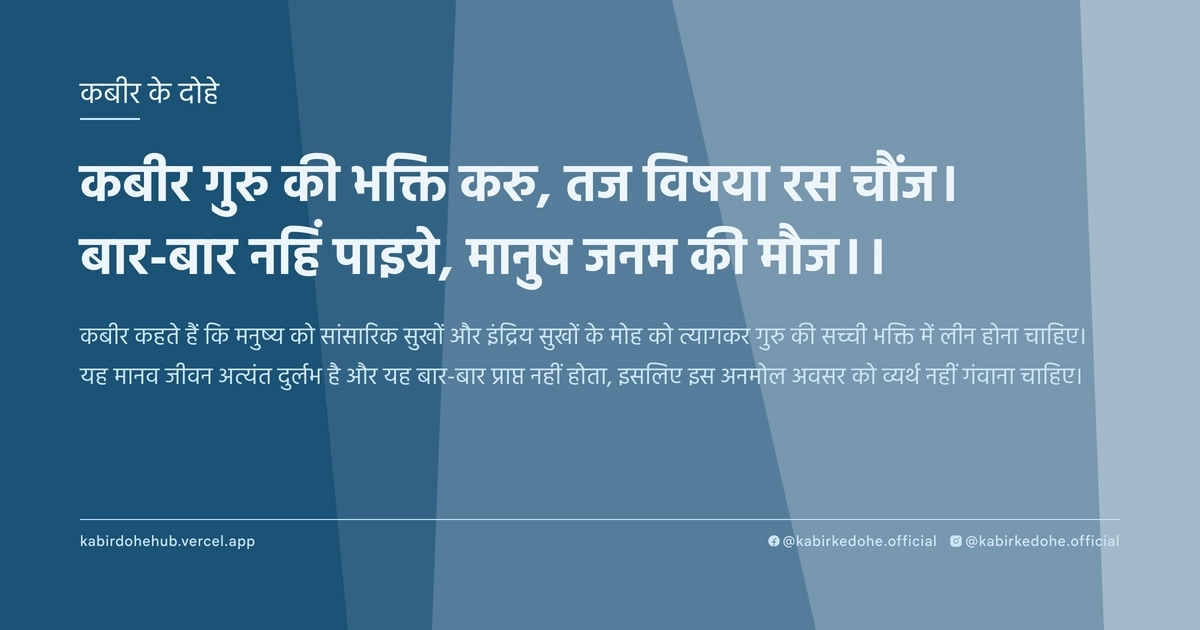
कबीर गुरु की भक्ति करु, तज विषया रस चौंज।
बार-बार नहिं पाइये, मानुष जनम की मौज।।
Kabir guru ki bhakti karu, taj vishya ras chounj. Baar-baar nahin paiye, manush janam ki mauj.
इस पृष्ठ पर इस कबीर दोहे का अर्थ (meaning), हिंदी व्याख्या और अंग्रेज़ी अनुवाद, दार्शनिक विश्लेषण और व्यावहारिक जीवन सीख दी गई है। यह दोहा वैराग्य (Detachment) विषय से जुड़ा है — Kabir doha meaning and explanation in Hindi and English.
अर्थ (Meaning):
कबीर कहते हैं कि मनुष्य को सांसारिक सुखों और इंद्रिय सुखों के मोह को त्यागकर गुरु की सच्ची भक्ति में लीन होना चाहिए। यह मानव जीवन अत्यंत दुर्लभ है और यह बार-बार प्राप्त नहीं होता, इसलिए इस अनमोल अवसर को व्यर्थ नहीं गंवाना चाहिए।
Kabir exhorts the seeker to renounce the fleeting allure of sensory pleasures and worldly cravings, directing that energy instead toward the devotion of the Guru. He emphasizes that the gift of human birth is a rare occurrence, not to be squandered in pursuit of transient desires.
व्याख्या (Interpretation):
इस दोहे का शाब्दिक अर्थ है कि गुरु के मार्गदर्शन में भक्ति करें और विषयों के स्वाद को छोड़ें। आध्यात्मिक स्तर पर, 'विषय रस' वह माया है जो आत्मा को ब्रह्म से अलग करती है। गुरु यहाँ केवल एक व्यक्ति नहीं, बल्कि वह चैतन्य शक्ति है जो अज्ञान के पर्दे को हटाती है। यह दोहा निर्गुण भक्ति की उस अवस्था को दर्शाता है जहाँ साधक बाहरी आडंबरों को छोड़कर आंतरिक सत्य की खोज करता है। यह अद्वैत वेदांत के उस सिद्धांत से जुड़ा है जहाँ जीव और शिव की एकता को पहचानना ही जीवन का परम लक्ष्य है। मानव जन्म को 'मौज' या अवसर कहा गया है क्योंकि केवल इसी शरीर में विवेक और आत्म-साक्षात्कार की क्षमता है।
Literally, the verse urges devotion to the Guru and the abandonment of sensory cravings. Metaphorically, 'Vishaya Ras' represents the veil of Maya that separates the Atman from Brahman. The Guru is not merely a physical instructor but the awakened consciousness that dissolves the ego. This aligns with Nirgun Bhakti, where the formless Divine is sought within rather than through external rituals. It echoes Advaita Vedanta's non-duality, suggesting that the human condition is a paradoxical bridge between bondage and liberation. The 'joy' of human birth is the unique capacity for discernment (Viveka), making this life a singular, precious opportunity for spiritual transcendence.
दार्शनिक विश्लेषण (Philosophical Analysis):
कबीर का यह संदेश उस समय के सामाजिक परिवेश में एक क्रांतिकारी आह्वान था, जहाँ धर्म केवल कर्मकांडों और बाहरी दिखावे तक सीमित था। उन्होंने स्पष्ट किया कि मोक्ष किसी विशेष जाति या मंदिर-मस्जिद जाने से नहीं, बल्कि आंतरिक रूपांतरण से मिलता है। यह दृष्टिकोण सूफी मत के 'फना' (अहंकार का विनाश) और वेदांत के 'अहं ब्रह्मास्मि' के करीब है।
विषय रस का त्याग करने का अर्थ संसार का त्याग नहीं, बल्कि आसक्ति का त्याग है। जब तक मनुष्य इंद्रियों के सुख में उलझा रहता है, वह अपनी वास्तविक प्रकृति को भूल जाता है। कबीर यहाँ मनोवैज्ञानिक स्तर पर समझाते हैं कि इच्छाएं एक अंतहीन चक्र हैं, जो कभी तृप्त नहीं होतीं।
गुरु की भक्ति का अर्थ है—विवेक का जागरण। कबीर के लिए गुरु वह दर्पण है जिसमें शिष्य अपनी कमियों और अपनी दिव्यता दोनों को देख सकता है। यह संबंध औपचारिक नहीं, बल्कि आत्मिक है।
इस दोहे में 'मानुष जनम' की दुर्लभता पर जोर दिया गया है, जो बौद्ध धर्म के पुनर्जन्म और हिंदू दर्शन के कर्म सिद्धांत से मेल खाता है। यह चेतावनी है कि समय सीमित है और आध्यात्मिक आलस्य सबसे बड़ा शत्रु है।
अंततः, यह दर्शन हमें सिखाता है कि मुक्ति बाहरी दुनिया को जीतने में नहीं, बल्कि अपने भीतर के शोर को शांत करने में है। यह अहंकार के विसर्जन और सार्वभौमिक चेतना में विलीन होने की प्रक्रिया है।
Kabir's message was a revolutionary call in an era dominated by rigid ritualism and caste hierarchies. He asserted that liberation is not achieved through external ceremonies or religious affiliations, but through a profound internal transformation. This perspective converges with the Sufi concept of 'Fana' (annihilation of the self) and the Vedantic realization of 'Aham Brahmasmi' (I am Brahman).
Renouncing 'Vishaya Ras' does not imply a physical withdrawal from the world, but a psychological detachment from craving. As long as the human mind is enslaved by sensory gratification, it remains blind to its inherent divinity. Kabir analyzes the psychological loop of desire, which creates a perpetual state of lack and longing.
The devotion to the Guru represents the awakening of discernment (Viveka). For Kabir, the Guru is a spiritual mirror reflecting both the seeker's flaws and their latent divinity. This relationship transcends formal instruction, becoming a catalyst for ontological shift.
The emphasis on the rarity of human birth aligns with the Buddhist and Hindu doctrines of Samsara and Karma. It serves as an urgent reminder that the window for spiritual awakening is narrow, and spiritual procrastination is the greatest obstacle to liberation.
Ultimately, this philosophy teaches that salvation is not found in conquering the external world, but in silencing the internal noise. It is the process of dissolving the ego to merge with the universal consciousness, moving from the fragmented 'I' to the infinite 'All'.
मूल संदेश (Core Message):
- इंद्रिय सुख क्षणभंगुर हैं, जबकि आत्मिक शांति शाश्वत है।
- गुरु का मार्गदर्शन अज्ञान के अंधकार को मिटाने वाला प्रकाश है।
- मानव जीवन एक दुर्लभ अवसर है, इसे केवल भौतिकता में न गंवाएं।
- आसक्ति का त्याग ही वास्तविक स्वतंत्रता का एकमात्र मार्ग है।
- भीतर की खोज ही बाहरी दुनिया के शोर का एकमात्र समाधान है।
- Sensory pleasures are ephemeral; spiritual peace is eternal.
- The Guru's guidance is the light that dissolves the darkness of ignorance.
- Human birth is a rare portal; do not waste it on mere materialism.
- Renunciation of attachment is the only path to true liberation.
- The internal quest is the only solution to the external noise.
व्यावहारिक उदाहरण (Practical Example):
एक समय की बात है, बनारस के घाटों पर माधव नाम का एक वृद्ध बुनकर रहता था। वह अपने काम में निपुण था, लेकिन उसका मन हमेशा इस चिंता में रहता था कि वह और अधिक धन कैसे कमाए ताकि वह शहर के सबसे बड़े घर में रह सके। वह दिन-रात केवल भौतिक सुखों और प्रतिष्ठा की दौड़ में लगा रहता था।
माधव का जीवन केवल 'विषय रस' यानी भौतिक इच्छाओं का एक अंतहीन सिलसिला बन गया था। वह जितना कमाता, उसकी इच्छाएं उतनी ही बढ़ती जातीं। वह अपने परिवार और स्वास्थ्य की अनदेखी कर केवल संग्रह में लगा रहा।
एक दिन उसकी मुलाकात एक फकीर से हुई, जिसने माधव को एक साधारण सा सूत का धागा दिखाया और पूछा, 'इस धागे का अंत कहाँ है?' माधव ने कहा, 'यह तो छोटा है, इसका अंत यहीं है।' फकीर मुस्कुराया और बोला, 'जैसे इस धागे का अंत है, वैसे ही तुम्हारी इन इच्छाओं का भी अंत है, लेकिन तुम अंतहीन दौड़ में इसे भूल गए हो।'
फकीर ने उसे समझाया कि यह मानव जीवन एक दुर्लभ अवसर है, जिसे वह केवल ईंट और गारे के मकानों को बड़ा करने में व्यर्थ कर रहा है। उसने माधव को 'गुरु' के रूप में आत्म-चिंतन का मार्ग दिखाया।
माधव को अचानक यह अहसास हुआ कि वह जिस सुख की तलाश कर रहा था, वह बाहर नहीं बल्कि उसके भीतर की शांति में था। उसने महसूस किया कि वह अब तक केवल एक भ्रम (माया) का पीछा कर रहा था।
उसने अपनी जीवनशैली बदली। उसने धन कमाना नहीं छोड़ा, लेकिन अब वह धन का उपयोग दूसरों की मदद के लिए करने लगा। उसकी आसक्ति समाप्त हो गई और वह वर्तमान क्षण में जीना सीख गया।
उसने पाया कि जब उसने 'विषय रस' की लालसा छोड़ी, तो उसे वह मानसिक शांति मिली जो करोड़ों रुपयों से भी नहीं खरीदी जा सकती थी। उसका काम अब केवल जीविका नहीं, बल्कि एक साधना बन गया।
माधव अब बनारस के उस घाट पर केवल एक बुनकर नहीं था, बल्कि एक ऐसा व्यक्ति था जिसने जीवन के वास्तविक अर्थ को पहचान लिया था। उसने समझ लिया कि मानव जन्म का असली 'मौज' आत्म-साक्षात्कार में है, न कि भौतिक संचय में।
Once, in the ghats of Varanasi, lived an elderly weaver named Madhav. He was a master of his craft, yet his mind was perpetually consumed by the anxiety of accumulating more wealth to afford the grandest house in the city. His life became a relentless pursuit of prestige and material luxury.
Madhav's existence had become an endless cycle of 'Vishaya Ras'—the craving for sensory and material gratification. The more he earned, the more his desires expanded, leading him to neglect his health and his family in favor of accumulation.
One day, he encountered a wandering Sufi mystic who showed him a simple piece of cotton thread and asked, 'Where does this thread end?' Madhav replied, 'It is short; its end is right here.' The mystic smiled and said, 'Just as this thread has an end, so do your desires, yet you have forgotten this in your endless race.'
The mystic explained that human life is a rare opportunity, which Madhav was squandering by merely trying to enlarge the walls of his house. He guided Madhav toward the 'Guru'—the internal teacher of self-reflection.
Suddenly, Madhav realized that the happiness he sought was not in the external world but in the stillness within. He recognized that he had been chasing a mirage, a manifestation of Maya.
He transformed his lifestyle. He did not stop working, but he ceased to be possessed by his possessions. He began using his wealth to serve others, shifting his focus from acquisition to contribution.
He discovered that by letting go of the craving for 'Vishaya Ras,' he attained a mental peace that no amount of gold could purchase. His weaving ceased to be a mere chore and became a meditative practice.
Madhav was no longer just a weaver on the ghats; he became a man who had decoded the true meaning of existence. He understood that the real 'joy' of human birth lies in self-realization, not in material hoarding.
अभ्यास मार्गदर्शन (Practice Guidance):
- प्रतिदिन 20 मिनट मौन ध्यान करें, जहाँ आप अपने भीतर उठने वाली इच्छाओं को केवल एक साक्षी (Observer) की तरह देखें, उनमें उलझें नहीं।
- एक 'इच्छा डायरी' बनाएँ। लिखें कि कौन सी भौतिक इच्छा आपको मानसिक तनाव दे रही है और विश्लेषण करें कि क्या वह वास्तव में आवश्यक है या केवल अहंकार की संतुष्टि है।
- सप्ताह में एक दिन 'सादा जीवन' का अभ्यास करें—न्यूनतम भोजन, न्यूनतम वस्त्र और शून्य विलासिता, ताकि आप विषय रस के प्रति अपनी निर्भरता को पहचान सकें।
- डायग्नोस्टिक चेकलिस्ट: क्या मैं किसी वस्तु के बिना बेचैन महसूस करता हूँ? क्या मेरी खुशी बाहरी परिस्थितियों पर निर्भर है? क्या मैं वर्तमान क्षण के बजाय भविष्य की लालसा में जी रहा हूँ?
- Practice 20 minutes of silent meditation daily, observing the arising desires as a witness (Sakshi) without engaging with or judging them.
- Maintain a 'Desire Journal.' Document the material cravings causing mental distress and analyze whether they serve a genuine need or merely feed the ego.
- Observe one day a week of 'Radical Simplicity'—minimal food, basic clothing, and zero luxury—to consciously recognize and break your dependency on sensory gratification.
- Diagnostic Checklist: Do I feel restless without a specific object? Is my happiness contingent on external circumstances? Am I living in the longing for the future rather than the presence of now?
चिंतन प्रश्न (Reflection Questions):
- यदि आज मेरी सारी भौतिक उपलब्धियां छीन ली जाएं, तो मेरे व्यक्तित्व का क्या बचेगा?
- मैं अपनी पहचान किन वस्तुओं या पदवियों से जोड़ता हूँ, और वे मुझे वास्तव में कितना सुकून देती हैं?
- क्या मेरी 'भक्ति' वास्तव में समर्पण है, या यह केवल एक और मानसिक इच्छा है कि मैं 'विशेष' दिखूँ?
- मेरे जीवन का वह कौन सा 'विषय रस' है जिसे मैं छोड़ने से सबसे ज्यादा डरता हूँ?
- क्या मैं अपने जीवन के दुर्लभ अवसर का उपयोग कर रहा हूँ, या मैं केवल समय काट रहा हूँ?
- If all my material achievements were stripped away today, what would remain of my identity?
- Which objects or titles do I anchor my ego to, and do they truly provide lasting peace?
- Is my 'devotion' a genuine surrender, or is it another desire to be perceived as 'spiritually special'?
- What is the specific 'sensory pleasure' in my life that I am most terrified of letting go?
- Am I actively utilizing the rarity of this human birth, or am I merely passing the time?