
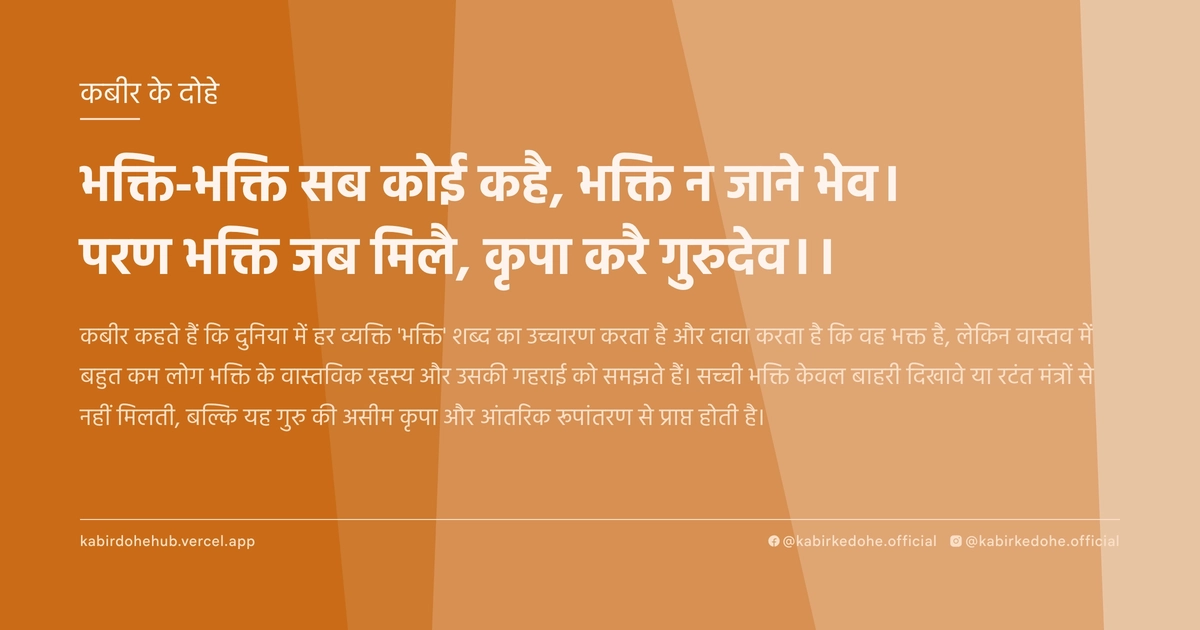
भक्ति-भक्ति सब कोई कहै, भक्ति न जाने भेव।
परण भक्ति जब मिलै, कृपा करै गुरुदेव।।
Bhakti-bhakti sab koi kahai, bhakti na jaane bhev. Paran bhakti jab milai, kripa karai gurudev.
इस पृष्ठ पर इस कबीर दोहे का अर्थ (meaning), हिंदी व्याख्या और अंग्रेज़ी अनुवाद, दार्शनिक विश्लेषण और व्यावहारिक जीवन सीख दी गई है। यह दोहा गुरु महत्व (The Guru's Importance) विषय से जुड़ा है — Kabir doha meaning and explanation in Hindi and English.
अर्थ (Meaning):
कबीर कहते हैं कि दुनिया में हर व्यक्ति 'भक्ति' शब्द का उच्चारण करता है और दावा करता है कि वह भक्त है, लेकिन वास्तव में बहुत कम लोग भक्ति के वास्तविक रहस्य और उसकी गहराई को समझते हैं। सच्ची भक्ति केवल बाहरी दिखावे या रटंत मंत्रों से नहीं मिलती, बल्कि यह गुरु की असीम कृपा और आंतरिक रूपांतरण से प्राप्त होती है।
Kabir observes that while everyone speaks of 'Bhakti' (devotion) and claims to be a devotee, very few comprehend its true essence or the hidden secrets of its practice. Genuine devotion is not achieved through superficial rituals or the mere repetition of words, but is realized only through the profound grace of a true spiritual guide and a deep internal awakening.
व्याख्या (Interpretation):
इस दोहे में कबीर 'भक्ति' के शब्द और 'अनुभव' के बीच के अंतर को स्पष्ट करते हैं। यहाँ 'भेव' का अर्थ है वह गुप्त रहस्य जो केवल अनुभव से जाना जा सकता है। शाब्दिक अर्थ में, लोग भक्ति को एक धार्मिक क्रिया मानते हैं, लेकिन आध्यात्मिक स्तर पर यह अहंकार का विसर्जन है। यह निर्गुण भक्ति की ओर संकेत करता है जहाँ ईश्वर किसी मूर्ति में नहीं, बल्कि स्वयं के भीतर स्थित है। जब साधक माया के पर्दे को हटाता है, तब उसे बोध होता है कि भक्त और भगवान अलग नहीं हैं। यह अद्वैत वेदांत की उस स्थिति को दर्शाता है जहाँ द्वैत समाप्त हो जाता है। अंततः, गुरु वह माध्यम है जो इस भ्रम को तोड़कर आत्मा का परमात्मा से मिलन कराता है।
In this couplet, Kabir distinguishes between the 'word' of devotion and the 'experience' of it. The term 'Bhev' refers to the esoteric secret that can only be accessed through direct realization. Literally, people perceive Bhakti as a religious activity, but metaphorically, it is the total dissolution of the ego. This points toward Nirgun Bhakti, where the Divine is not found in idols but within the self. As the seeker peels away the layers of Maya (illusion), they realize the non-duality of the devotee and the Divine. This mirrors the Advaita Vedanta state where all separation vanishes. Ultimately, the Guru acts as the catalyst who shatters the illusion of duality, facilitating the union of Atman and Brahman.
दार्शनिक विश्लेषण (Philosophical Analysis):
कबीर का यह दोहा उस सामाजिक और धार्मिक पाखंड पर प्रहार है जहाँ धर्म केवल एक पहचान बन गया था। उनके समय में, भक्ति अक्सर कर्मकांडों, तीर्थयात्राओं और बाहरी दिखावे तक सीमित थी। कबीर ने इस 'संस्थागत धर्म' को नकारते हुए 'सहज' मार्ग की वकालत की। उनके अनुसार, यदि भक्ति में अहंकार (मैं भक्त हूँ) मौजूद है, तो वह भक्ति नहीं बल्कि एक और मानसिक बंधन है।
दार्शनिक रूप से, यह विचार सूफीवाद के 'फना' (अहंकार का विनाश) और अद्वैत वेदांत के 'अहं ब्रह्मास्मि' से मेल खाता है। सूफी संतों की तरह, कबीर मानते हैं कि बिना एक मार्गदर्शक (पीर या गुरु) के, साधक माया के जाल में उलझा रहता है। गुरु यहाँ केवल एक व्यक्ति नहीं, बल्कि वह चेतना है जो शिष्य को उसके वास्तविक स्वरूप से परिचित कराती है।
यहाँ 'कृपा' का अर्थ कोई दैवीय चमत्कार नहीं, बल्कि वह क्षण है जब गुरु शिष्य के भीतर के अज्ञान को नष्ट कर देता है। यह मनोवैज्ञानिक रूपांतरण की प्रक्रिया है जहाँ 'कर्ता' समाप्त हो जाता है और केवल 'साक्षी' बचता है। कबीर स्पष्ट करते हैं कि भक्ति कोई ऐसी वस्तु नहीं है जिसे बाजार से खरीदा जा सके या किताबों से सीखा जा सके।
यह विश्लेषण हमें बताता है कि सच्ची भक्ति वास्तव में 'अ-भक्ति' है—अर्थात उस भावना का त्याग करना कि हम कुछ प्राप्त कर रहे हैं। जब पाने की इच्छा समाप्त होती है, तभी वास्तविक मिलन होता है। यह विरोधाभास ही कबीर के दर्शन की जान है: जिसे तुम खोज रहे हो, वह खोजने वाले में ही छिपा है।
अंततः, यह दोहा जाति, धर्म और संप्रदाय की सीमाओं को तोड़ता है। यह संदेश देता है कि ईश्वर तक पहुँचने का रास्ता मंदिर या मस्जिद से नहीं, बल्कि हृदय की शुद्धता और अहंकार के शून्य होने से होकर गुजरता है।
Kabir’s couplet is a sharp critique of the social and religious hypocrisy of his era, where faith had become a mere identity marker. During his time, devotion was often reduced to ritualism, pilgrimages, and outward displays of piety. Kabir rejected this 'institutionalized religion,' advocating instead for the 'Sahaja' (natural/spontaneous) path. He argues that if the ego ('I am a devotee') persists, then such devotion is not liberation but another mental shackle.
Philosophically, this aligns with the Sufi concept of 'Fana' (annihilation of the self) and the Advaita Vedanta realization of 'Aham Brahmasmi' (I am Brahman). Like the Sufi masters, Kabir believes that without a guide (Pir or Guru), the seeker remains entangled in the web of Maya. The Guru here is not merely a person, but the awakened consciousness that introduces the disciple to their own true nature.
'Grace' (Kripa) in this context is not a supernatural miracle, but the precise moment when the Guru dissolves the disciple's ignorance. This is a process of psychological transformation where the 'doer' vanishes, leaving only the 'witness.' Kabir clarifies that Bhakti is not a commodity to be acquired or a subject to be learned from scriptures.
This analysis reveals that true devotion is actually 'un-devotion'—the cessation of the desire to attain something. Only when the longing for acquisition ends does the actual union occur. This paradox is central to Kabir's philosophy: that which you seek is hidden within the seeker.
Ultimately, this teaching transcends the boundaries of caste, creed, and sect. It asserts that the path to the Divine does not lead through temples or mosques, but through the purity of the heart and the total voiding of the ego.
मूल संदेश (Core Message):
- शब्दों की भक्ति केवल शोर है, अनुभव की भक्ति ही सत्य है।
- अहंकार का जीवित रहना सच्ची भक्ति का सबसे बड़ा अवरोध है।
- गुरु की कृपा वह कुंजी है जो बाहरी कर्मकांड के ताले खोलती है।
- ईश्वर को खोजने की कोशिश छोड़ो, स्वयं के होने के रहस्य को जानो।
- प्रेम जब निस्वार्थ होता है, तभी वह वास्तविक भक्ति बनता है।
- भक्ति कोई उपलब्धि नहीं, बल्कि स्वयं को पूरी तरह खो देने की प्रक्रिया है।
- Devotion in words is mere noise; devotion in experience is the only truth.
- The survival of the ego is the greatest obstacle to genuine devotion.
- The Guru's grace is the key that unlocks the shackles of external ritualism.
- Stop trying to 'find' God; instead, realize the mystery of your own being.
- Love becomes true devotion only when it is entirely selfless.
- Bhakti is not an achievement, but the process of completely losing oneself.
व्यावहारिक उदाहरण (Practical Example):
वाराणसी के घाटों पर रहने वाले एक वृद्ध विधवा, जानकी, का जीवन केवल माला जपने और मंदिर जाने में बीत रहा था। वह शहर की सबसे 'बड़ी भक्त' मानी जाती थी, क्योंकि वह दिन में दस बार आरती में शामिल होती थी। लेकिन उसके मन में अपने पड़ोसियों के प्रति घृणा और श्रेष्ठता का भाव था। वह मानती थी कि उसकी भक्ति उसे दूसरों से ऊपर उठाती है।
एक दिन, घाट की सीढ़ियों पर एक फकीर बैठा था, जो बिना किसी माला या मंत्र के बस शांत था। जानकी ने गर्व से उससे पूछा, 'तुम यहाँ बैठे हो, पर क्या तुम्हें पता है कि सच्ची भक्ति क्या है? मैं वर्षों से तपस्या कर रही हूँ।' फकीर ने मुस्कुराकर बस इतना कहा, 'माँ, तुम माला फेर रही हो, पर क्या तुमने कभी उस माला के धागे को देखा है जिसने मोतियों को जोड़ रखा है? तुम्हारी भक्ति मोतियों की चमक है, पर प्रेम वह धागा है जो अदृश्य है।'
यह बात जानकी के हृदय पर बिजली की तरह गिरी। उसे अहसास हुआ कि उसकी पूरी भक्ति केवल एक 'प्रदर्शन' थी। वह खुद को भक्त मानकर अपने अहंकार को और बड़ा कर रही थी। उसने महसूस किया कि वह ईश्वर को नहीं, बल्कि अपनी 'भक्त होने की छवि' को पूज रही थी।
अगले कुछ महीनों तक, जानकी ने मंदिर जाना कम कर दिया। उसने अपनी ऊर्जा उन लोगों की सेवा में लगाई जिन्हें वह अब तक तुच्छ समझती थी। उसने देखा कि जब वह एक बीमार पड़ोसी के पैर दबाती थी, तो उसे जो शांति मिलती थी, वह हज़ारों मंत्रों से अधिक थी।
उसका व्यवहार बदल गया। अब वह अपनी श्रेष्ठता का दावा नहीं करती थी। वह चुपचाप काम करती और दूसरों के दुख में दुखी होती। उसके चेहरे पर एक ऐसी चमक आई जो पहले कभी नहीं थी।
एक दिन वही फकीर दोबारा मिला। उसने देखा कि जानकी अब माला नहीं जप रही थी, लेकिन उसकी आँखों में एक गहरा ठहराव था। फकीर ने कहा, 'अब तुम भक्ति को जान गई हो, क्योंकि अब तुम 'भक्त' नहीं रही।'
जानकी समझ गई कि जब तक 'मैं' मौजूद था, तब तक वह केवल अभिनय था। जब 'मैं' मिटा, तब केवल प्रेम बचा। यही वह 'भेव' या रहस्य था जिसे कबीर ने बताया था।
उसका जीवन अब एक निरंतर प्रार्थना बन गया था, जहाँ हर कार्य भक्ति था और हर इंसान ईश्वर का रूप।
Janaki, an elderly widow living on the ghats of Varanasi, spent her entire life chanting beads and visiting temples. She was regarded as the city's 'greatest devotee' because she attended the Aarti ten times a day. However, within her heart lay a deep seed of hatred and a sense of superiority toward her neighbors. She believed her devotion placed her above others.
One day, she encountered a wandering fakir sitting silently on the stone steps of the ghat, without any beads or mantras. With pride, Janaki asked him, 'You sit here idle, but do you even know what true devotion is? I have spent years in rigorous penance.' The fakir smiled and replied, 'Mother, you are turning the beads, but have you ever looked at the thread that holds the beads together? Your devotion is the shine of the beads, but love is the invisible thread.'
These words struck Janaki like a bolt of lightning. She realized that her entire spiritual practice had been a 'performance.' By identifying as a devotee, she had only inflated her ego. She saw that she wasn't worshipping God, but rather the 'image of herself as a devotee.'
Over the next few months, Janaki reduced her temple visits. She redirected her energy toward serving the very people she had previously looked down upon. She discovered that the peace she felt while nursing a sick neighbor was far greater than the merit of a thousand mantras.
Her behavior shifted fundamentally. She stopped claiming spiritual superiority. She worked in silence and felt the pain of others as her own. A radiance appeared on her face that had never been there during her ritualistic phase.
One day, the fakir returned. He noticed that Janaki was no longer chanting beads, but her eyes held a profound stillness. The fakir said, 'Now you know Bhakti, for you are no longer a "devotee."'
Janaki understood that as long as the 'I' existed, it was merely an act. When the 'I' vanished, only love remained. This was the 'Bhev' or the secret that Kabir spoke of.
Her life became a continuous prayer, where every action was devotion and every human being was a reflection of the Divine.
अभ्यास मार्गदर्शन (Practice Guidance):
- दैनिक आत्म-निरीक्षण: दिन के अंत में यह पूछें, 'आज मैंने कितनी बार अपनी धार्मिक या नैतिक श्रेष्ठता का प्रदर्शन किया?'
- मौन साधना: प्रतिदिन 20 मिनट पूर्ण मौन में बैठें। शब्दों और मंत्रों को छोड़कर केवल अपनी श्वास और अस्तित्व के होने के अहसास पर ध्यान दें।
- अहंकार का विसर्जन: किसी ऐसे व्यक्ति की निस्वार्थ सेवा करें जिससे आपका वैचारिक मतभेद हो, बिना यह सोचे कि आप 'पुण्य' कमा रहे हैं।
- डायरी लेखन: उन क्षणों को लिखें जब आपको लगा कि आपकी आस्था आपको दूसरों से अलग या श्रेष्ठ बना रही है।
- डायग्नोस्टिक चेकलिस्ट: यदि आप दूसरों की आध्यात्मिक कमी पर टिप्पणी कर रहे हैं, तो समझ लें कि आप 'भक्ति' के भ्रम में हैं, वास्तविकता में नहीं।
- Daily Self-Inquiry: At the end of the day, ask yourself, 'How many times today did I perform or project my religious or moral superiority?'
- Silence Practice: Sit in total silence for 20 minutes daily. Move beyond words and mantras; focus solely on the breath and the raw sensation of existing.
- Ego Dissolution: Perform selfless service for someone with whom you have a deep ideological conflict, without the thought that you are earning 'spiritual merit.'
- Journaling: Record moments when you felt your faith made you separate from or superior to others.
- Diagnostic Checklist: If you find yourself critiquing the spiritual shortcomings of others, recognize that you are trapped in the illusion of devotion, not the reality.
चिंतन प्रश्न (Reflection Questions):
- क्या मेरी आध्यात्मिक पहचान मेरे अहंकार को संतुष्ट करने का एक नया तरीका बन गई है?
- यदि मुझसे मेरे सभी धार्मिक प्रतीक (माला, तिलक, वस्त्र) छीन लिए जाएं, तो क्या मेरी भक्ति शेष रहेगी?
- मैं ईश्वर से प्रेम करता हूँ, या मैं उस 'छवि' से प्रेम करता हूँ जो मैं ईश्वर के सामने खुद की देखता हूँ?
- मेरे जीवन में 'गुरु' का अर्थ केवल एक व्यक्ति है, या वह आंतरिक प्रकाश जो मुझे मेरी गलतियाँ दिखाता है?
- क्या मैं वास्तव में सत्य की खोज में हूँ, या मैं केवल अपनी मान्यताओं की पुष्टि चाहता हूँ?
- मेरे भीतर का कौन सा हिस्सा अभी भी यह मानता है कि मैं दूसरों से अधिक 'पवित्र' हूँ?
- Has my spiritual identity become just another way to satisfy my ego?
- If all my religious symbols (beads, marks, attire) were stripped away, would my devotion still remain?
- Do I love the Divine, or do I love the 'image' of myself that I present before the Divine?
- In my life, is the 'Guru' merely a person, or the inner light that reveals my own flaws?
- Am I truly seeking the Truth, or am I merely seeking confirmation of my own beliefs?
- Which part of me still clings to the belief that I am more 'pure' than others?