
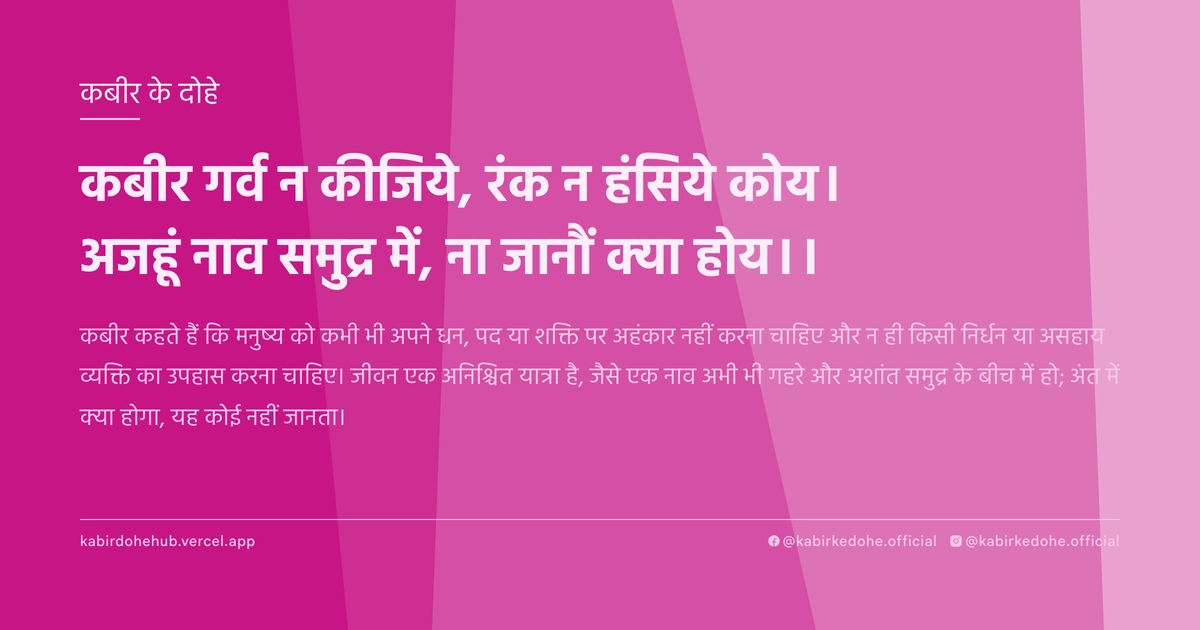
कबीर गर्व न कीजिये, रंक न हंसिये कोय।
अजहूं नाव समुद्र में, ना जानौं क्या होय।।
Kabir garv na kariye, rank na hansiye koy. Ajhun naav samudra mein, na jaanoun kya hoye.
इस पृष्ठ पर इस कबीर दोहे का अर्थ (meaning), हिंदी व्याख्या और अंग्रेज़ी अनुवाद, दार्शनिक विश्लेषण और व्यावहारिक जीवन सीख दी गई है। यह दोहा विनम्रता (Humility) विषय से जुड़ा है — Kabir doha meaning and explanation in Hindi and English.
अर्थ (Meaning):
कबीर कहते हैं कि मनुष्य को कभी भी अपने धन, पद या शक्ति पर अहंकार नहीं करना चाहिए और न ही किसी निर्धन या असहाय व्यक्ति का उपहास करना चाहिए। जीवन एक अनिश्चित यात्रा है, जैसे एक नाव अभी भी गहरे और अशांत समुद्र के बीच में हो; अंत में क्या होगा, यह कोई नहीं जानता।
Kabir advises against harboring pride in one's status or wealth and warns against mocking the poor or destitute. He likens human existence to a boat still adrift in the vast, unpredictable ocean of samsara; since the final destination and the journey's end remain unknown, arrogance is futile.
व्याख्या (Interpretation):
इस दोहे का शाब्दिक अर्थ है कि वर्तमान स्थिति स्थायी नहीं है। रूपक के तौर पर, 'समुद्र' इस भौतिक संसार (माया) का प्रतीक है और 'नाव' मानव जीवन और शरीर का। कबीर यहाँ द्वैत को चुनौती देते हैं—अमीर और गरीब का भेद केवल एक सामाजिक भ्रम है। जब आत्मा (Atman) शरीर रूपी नाव में सवार है, तो वह अभी भी जन्म और मृत्यु के चक्र में फंसी है। Nirgun Bhakti के अनुसार, ईश्वर किसी विशेष वर्ग का नहीं है, और अहंकार (Ahamkara) ही वह सबसे बड़ी बाधा है जो मनुष्य को ब्रह्म के साथ एकाकार होने से रोकती है। यह विरोधाभास है कि जिसे हम अपनी 'उपलब्धि' समझते हैं, वही वास्तव में हमारी आध्यात्मिक प्रगति में सबसे बड़ा अवरोध बन जाता है।
Literally, the verse warns that current circumstances are transient. Metaphorically, the 'ocean' represents Maya (the illusory material world) and the 'boat' symbolizes the human life and physical vessel. Kabir challenges the duality of social hierarchy, asserting that the distinction between the rich and the poor is a mere social construct. While the Atman resides within the boat of the body, it remains subject to the turbulent tides of birth and death. In the context of Nirgun Bhakti, the Divine is formless and beyond caste or class; thus, the ego (Ahamkara) is the primary veil obscuring the realization of non-duality (Advaita). The central paradox is that the very achievements we pride ourselves on are the anchors that prevent our spiritual liberation.
दार्शनिक विश्लेषण (Philosophical Analysis):
कबीर का यह संदेश उस युग की सामाजिक कठोरता के विरुद्ध एक प्रहार था जहाँ जाति और आर्थिक स्थिति व्यक्ति की योग्यता तय करती थी। वे ritualism (कर्मकांड) का विरोध करते थे क्योंकि बाहरी दिखावा आंतरिक शुद्धि का विकल्प नहीं हो सकता। यहाँ कबीर का दर्शन Advaita Vedanta से मिलता है, जहाँ यह माना जाता है कि केवल 'अहं' का विलोपन ही सत्य का साक्षात्कार करा सकता है।
Sufism के 'Fana' (अहंकार का विनाश) के सिद्धांत की तरह, कबीर भी यह समझाते हैं कि जब तक व्यक्ति खुद को दूसरों से श्रेष्ठ मानता है, वह ईश्वर के करीब नहीं पहुँच सकता। अहंकार एक पर्दा है जो आत्मा को उसकी वास्तविक प्रकृति से अलग करता है।
यह दोहा मनोवैज्ञानिक स्तर पर 'अस्थिरता' (Impermanence) की याद दिलाता है। जिसे हम 'स्थिर' समझते हैं—जैसे धन या सत्ता—वह वास्तव में रेत पर बनी इमारत है। कबीर हमें सिखाते हैं कि करुणा ही एकमात्र स्थायी गुण है।
अक्सर लोग इस दोहे को केवल एक नैतिक उपदेश मान लेते हैं, लेकिन यह वास्तव में एक आध्यात्मिक चेतावनी है। यह चेतावनी है कि संसार की लहरें कभी भी पलट सकती हैं, और जो आज शिखर पर है, वह कल शून्य में हो सकता है।
अंततः, यह विश्लेषण हमें इस निष्कर्ष पर ले जाता है कि विनम्रता कोई कमजोरी नहीं, बल्कि सर्वोच्च ज्ञान है। जब हम यह जान लेते हैं कि हम सब उसी एक निराकार तत्व के अंश हैं, तो श्रेष्ठता का भाव स्वतः समाप्त हो जाता है और केवल प्रेम शेष रहता है।
Kabir’s message served as a visceral critique of the rigid social hierarchies of his era, where caste and economic status dictated human worth. He vehemently rejected ritualism, arguing that external displays of piety are meaningless without internal purification. His philosophy aligns with Advaita Vedanta, asserting that the dissolution of the 'I' (the ego) is the only path to realizing the Absolute Truth.
Parallel to the Sufi concept of 'Fana' (the annihilation of the self), Kabir suggests that as long as an individual perceives themselves as superior to another, they remain alienated from the Divine. The ego acts as a veil, distorting the perception of the Atman and preventing its union with Brahman.
Psychologically, the verse emphasizes the law of impermanence. What we perceive as stability—wealth, power, or social standing—is merely a transient ripple in the ocean of existence. Kabir posits that compassion is the only enduring virtue in a world defined by flux.
Common literalist interpretations often reduce this to a simple moral lesson on kindness. However, it is a profound spiritual warning: the tides of Samsara are unpredictable, and the height of one's current pedestal does not guarantee safety from the storm.
Ultimately, this analysis reveals that humility is not a lack of confidence, but the pinnacle of spiritual intelligence. By recognizing that all beings are manifestations of the same formless essence, the illusion of superiority vanishes, leaving behind only universal love.
मूल संदेश (Core Message):
- अहंकार एक भ्रम है जो आत्मा को सत्य से दूर करता है।
- संसार की हर स्थिति अस्थायी है; न सुख स्थायी है, न दुख।
- विनम्रता ही वह एकमात्र सेतु है जो मनुष्य को ईश्वर से जोड़ता है।
- किसी की वर्तमान स्थिति को उसकी योग्यता या मूल्य न मानें।
- जीवन की अनिश्चितता को स्वीकार करना ही मानसिक शांति का मार्ग है।
- सच्ची आध्यात्मिक प्रगति दूसरों के प्रति करुणा में निहित है।
- Ego is a delusion that alienates the soul from the Absolute Truth.
- Every worldly state is transient; neither pleasure nor pain is permanent.
- Humility is the only bridge that connects the human to the Divine.
- Never equate a person's current circumstance with their intrinsic value.
- Accepting the uncertainty of life is the definitive path to inner peace.
- True spiritual evolution resides in the practice of universal compassion.
व्यावहारिक उदाहरण (Practical Example):
वाराणसी के घाटों पर रहने वाले एक वृद्ध विधवा, जानकी, की कहानी है। जानकी के पास केवल एक छोटी सी झोपड़ी थी और वह दूसरों के घरों में सफाई करके अपना गुजारा करती थी। उसी मोहल्ले में एक संपन्न व्यापारी, दीनानाथ रहता था, जिसे अपनी धन-संपदा और समाज में अपने प्रभाव पर बहुत गर्व था। दीनानाथ अक्सर जानकी को देखते हुए उपहास करता और उसे 'भाग्यहीन' कहता था।
एक समय ऐसा आया जब शहर में भीषण बाढ़ आई। गंगा का जलस्तर इतना बढ़ गया कि दीनानाथ का आलीशान मकान और उसका गोदाम सब कुछ पानी में डूब गया। उसकी सारी संपत्ति, जिस पर उसे गर्व था, पल भर में नष्ट हो गई। वह सड़क पर आ गया और उसके पास सिर छुपाने की जगह नहीं बची।
दूसरी ओर, जानकी की झोपड़ी ऊँचे स्थान पर थी। उसने बिना किसी संकोच के दीनानाथ को अपने घर में शरण दी। उसने उसे भोजन कराया और उसकी देखभाल की। दीनानाथ, जो कभी जानकी का मजाक उड़ाता था, अब उसकी दया पर निर्भर था।
शुरुआत में दीनानाथ को बहुत शर्मिंदगी महसूस हुई, लेकिन जानकी ने उसे एक बार भी यह एहसास नहीं कराया कि वह अब गरीब हो चुका है। उसने बस इतना कहा, 'भैया, हम सब इस जीवन रूपी नाव में सवार हैं, कभी लहरें हमें ऊपर उठाती हैं तो कभी नीचे गिराती हैं।'
यह शब्द दीनानाथ के हृदय में तीर की तरह लगे। उसे अचानक कबीर का वह दोहा याद आया जो उसने बचपन में सुना था। उसे अहसास हुआ कि उसका अहंकार कितना खोखला था और जिस स्त्री को वह तुच्छ समझता था, वही वास्तव में महान थी।
दीनानाथ का व्यवहार पूरी तरह बदल गया। उसने महसूस किया कि असली संपत्ति सोना-चांदी नहीं, बल्कि वह करुणा है जो दूसरों के दुख में काम आए।
बाढ़ उतरने के बाद, दीनानाथ ने अपना शेष जीवन केवल धन कमाने में नहीं, बल्कि गरीबों की सेवा में लगाया। उसने जानकी के साथ मिलकर एक छोटा सा सामुदायिक केंद्र खोला जहाँ किसी भी जाति या वर्ग के व्यक्ति को मुफ्त भोजन और आश्रय मिलता था।
उसने सीखा कि जीवन की अनिश्चितता ही हमें विनम्र बनाती है। अब वह किसी को छोटा नहीं समझता था, क्योंकि वह जान चुका था कि समुद्र की लहरें किसी को भी कभी भी किनारे लगा सकती हैं।
उसका अहंकार पूरी तरह मिट चुका था और उसकी जगह एक शांत, प्रेमपूर्ण व्यक्तित्व ने ले ली थी। वह अब वास्तव में स्वतंत्र था।
यह परिवर्तन केवल बाहरी नहीं था, बल्कि उसकी आत्मा का रूपांतरण था, जिसने उसे वास्तव में 'मनुष्य' बनाया।
In the ghats of Varanasi lived an elderly widow named Janki. She possessed nothing but a small hut and survived by cleaning the homes of others. In the same neighborhood lived Deenanath, a wealthy merchant who took immense pride in his riches and social influence. Deenanath often mocked Janki, calling her 'destitute' and 'unfortunate' with a sneer.
Time turned, and a catastrophic flood hit the city. The waters of the Ganges rose so violently that Deenanath's opulent mansion and his warehouses were completely submerged. The wealth he had spent a lifetime accumulating vanished in an instant, leaving him homeless and broken.
Conversely, Janki's humble hut was situated on higher ground. Without a moment's hesitation or a hint of judgment, she offered Deenanath shelter in her tiny home. She fed him and tended to his needs with genuine tenderness.
Deenanath was initially consumed by shame, but Janki never reminded him of his fallen state. She simply whispered, 'Brother, we are all passengers in this boat of life; sometimes the waves lift us high, and sometimes they pull us down.'
These words pierced Deenanath's heart. He suddenly recalled a Doha by Kabir he had heard in childhood. He realized the hollowness of his pride and the profound nobility of the woman he had once deemed insignificant.
Deenanath's entire demeanor shifted. He understood that true wealth is not measured in gold, but in the compassion one extends to others in their darkest hour.
After the floodwaters receded, Deenanath no longer sought wealth for the sake of status. Instead, he dedicated his remaining resources to the service of the poor. Together with Janki, he established a small community center providing free food and shelter to all, regardless of caste or class.
He learned that the unpredictability of life is the greatest teacher of humility. He stopped judging others, knowing that the ocean of existence can cast anyone ashore at any moment.
His ego had been completely eroded, replaced by a serene and loving presence. For the first time in his life, he felt truly free.
This transformation was not merely behavioral but an alchemy of the soul, turning his arrogance into an enduring spiritual grace.
He lived the rest of his days as a servant of humanity, embodying the essence of Kabir's wisdom.
अभ्यास मार्गदर्शन (Practice Guidance):
- दैनिक चिंतन: प्रतिदिन 10 मिनट मौन बैठें और विचार करें कि आपकी कौन सी उपलब्धियाँ वास्तव में स्थायी हैं और कौन सी केवल 'माया' का हिस्सा हैं।
- आत्म-पूछताछ जर्नल: एक डायरी लिखें जिसमें उन क्षणों को दर्ज करें जब आपने किसी को छोटा महसूस कराया या जब आपने अपनी श्रेष्ठता का प्रदर्शन किया। विश्लेषण करें कि उस समय आपके भीतर कौन सा डर या असुरक्षा थी।
- व्यवहार परिवर्तन: सप्ताह में एक बार किसी ऐसे व्यक्ति की निस्वार्थ मदद करें जिससे आप सामाजिक या आर्थिक रूप से बहुत भिन्न हैं, और यह अनुभव करें कि सेवा में ही वास्तविक समानता है।
- निदान चेकलिस्ट: यदि आप किसी की सफलता से ईर्ष्या करते हैं या किसी की विफलता पर गुप्त संतोष महसूस करते हैं, तो समझ लें कि आपका अहंकार अभी भी सक्रिय है और आप 'समुद्र' की लहरों के भ्रम में हैं।
- Daily Contemplation: Spend 10 minutes in silence daily, reflecting on which of your achievements are truly permanent and which are merely constructs of 'Maya'.
- Self-Inquiry Journal: Maintain a journal recording moments when you made someone feel inferior or displayed superiority. Analyze the underlying fear or insecurity that triggered that behavior.
- Behavioral Shift: Once a week, perform a selfless act of service for someone vastly different from you in social or economic status, experiencing the inherent equality in the act of giving.
- Diagnostic Checklist: If you feel envy toward another's success or a secret satisfaction in someone's failure, recognize that your ego is still dominant and you are still deceived by the waves of the material ocean.
चिंतन प्रश्न (Reflection Questions):
- यदि आज आपकी सारी सामाजिक पहचान और संपत्ति छीन ली जाए, तो आपके व्यक्तित्व में क्या शेष बचेगा?
- आप अपनी श्रेष्ठता सिद्ध करने के लिए किन सूक्ष्म तरीकों से दूसरों को नीचा दिखाते हैं?
- क्या आपका 'विनम्र' होने का दिखावा भी आपके अहंकार का एक परिष्कृत रूप है?
- आप उन लोगों के प्रति कैसा व्यवहार करते हैं जिनसे आपको जीवन में कुछ भी मिलने की उम्मीद नहीं है?
- क्या आप वास्तव में यह स्वीकार कर सकते हैं कि आप और एक 'रंक' (भिखारी) आध्यात्मिक रूप से समान हैं?
- आपकी डिजिटल पहचान (सोशल मीडिया) आपके वास्तविक आंतरिक शून्य को कितना छिपाती है?
- If all your social identifiers and assets were stripped away today, what would remain of your identity?
- In what subtle ways do you diminish others to validate your own sense of superiority?
- Is your outward display of 'humility' actually a more sophisticated form of ego?
- How do you treat those from whom you expect absolutely nothing in return?
- Can you truly accept that you and a 'rank' (destitute person) are spiritually identical?
- To what extent does your digital persona mask the internal void of your existence?